1×6 Coverage Calculator and Lumber Calculator Hub
12 free lumber and wood-quantity calculators in one place — including the actual-width board coverage math this page is known for, plus board feet, cubic volume, decking, framing studs, cut lists, firewood cords, wood-burner sizing, cabinet doors, fencing, and buying-waste buffers.
Quick Answer
Every lumber-quantity question — how many boards, how much volume, how many studs, how much firewood — comes down to one idea: multiply the real (actual) dimensions of the material, not the marketing (nominal) name, then add a waste buffer of 10–20% before you buy.
Jump to a Calculator
This hub replaced 18 separate single-purpose calculator pages that covered overlapping ground. Every calculator below still uses the exact formulas woodworkers and DIYers were already relying on — just organized in one place so you can cross-check a project (say, board feet and waste buffer and cut list) without leaving the page.
Why Nominal and Actual Lumber Sizes Trip People Up
Almost every miscalculation on this page traces back to the same mistake: using the nominal (named) size of a board instead of its actual (milled) size. A “1×6” is really 3/4 in x 5.5 in. A “2×4” is really 1.5 in x 3.5 in. That gap is exactly why a coverage calculator using 6 in instead of 5.5 in undercounts boards, why a framing calculator needs the true 3.5 in stud width for blocking, and why a board-foot calculator still bills 4/4 lumber at a full 1 in even after it’s been surfaced to 13/16 in. Every calculator below uses actual dimensions by default, and several show you what the wrong (nominal) answer would have been so you can see the size of the error.
Board & Siding Coverage Calculator (Actual Width)
Find how many boards cover an area using the visible face width of the board, not its nominal name. A plain 1×6 covers 5.5 in, while 1×6 tongue-and-groove and shiplap cover about 5-1/8 in once the tongue or lap is hidden. Add a gap and a waste factor for a realistic buy list.
Enter your area and click calculate.
How Much Does a 1×6 Cover? Square Feet per Board by Length
A 1×6 is 3/4 in thick and 5-1/2 in wide as sold, so a plain surfaced board covers 5.5 / 12 = 0.458 sq ft for every linear foot, or about 2.18 linear feet of board per square foot. Tongue-and-groove and shiplap cover less, because the tongue or the lap sits under the neighboring board and only the face shows.
| Board length | Plain 1×6 (5.5 in): sq ft per board | Boards per 100 sq ft | 1×6 T&G or shiplap (5-1/8 in face): sq ft per board | Boards per 100 sq ft |
|---|---|---|---|---|
| 6 ft | 2.75 | 37 | 2.56 | 40 |
| 8 ft | 3.67 | 28 | 3.42 | 30 |
| 10 ft | 4.58 | 22 | 4.27 | 24 |
| 12 ft | 5.50 | 19 | 5.12 | 20 |
| 14 ft | 6.42 | 16 | 5.98 | 17 |
| 16 ft | 7.33 | 14 | 6.83 | 15 |
Board counts are rounded up and shown before waste. Add 10% for trim cuts and defects, which is the allowance Buffalo Lumber suggests for paneling jobs, and more for diagonal or herringbone layouts that create extra offcuts.
The Face Width Is What You Cover, and Mills Differ
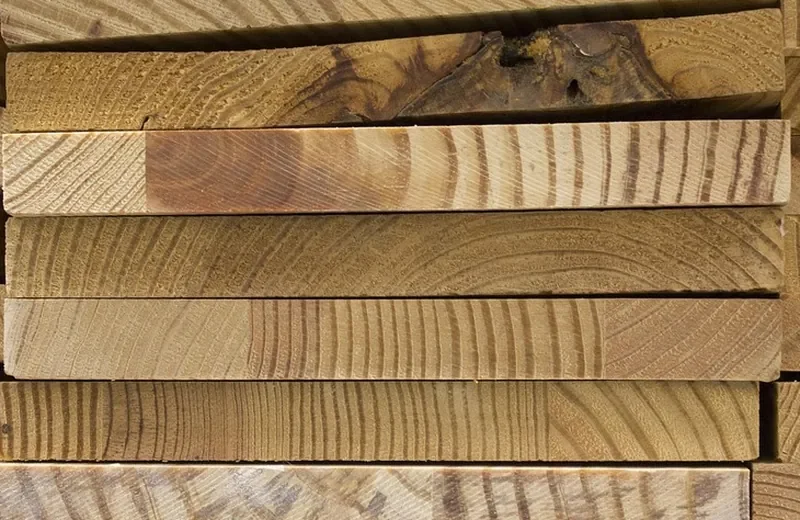
The Western Wood Products Association pattern for a nominal 6 in tongue-and-groove or shiplap board lists a 5-3/8 in dressed width and a 5-1/8 in exposed face, which works out to 2.34 linear feet of board per square foot. Some suppliers quote a 5 in face for the same board (about 2.4 linear feet per square foot), and mills are free to cut their own profile. That small gap adds up: for 1,000 sq ft with 16 ft boards, a 5-1/8 in face needs 147 boards and a 5 in face needs 150, or 161 versus 165 with 10% waste. Measure the face of a sample board from your supplier, then enter it in the custom face width box above.
Worked Examples
- 170 sq ft with 1x6x16 tongue-and-groove: each board covers 6.83 sq ft, so 170 / 6.83 = 24.9, which rounds up to 25 boards, or 28 boards with 10% waste.
- 3,500 sq ft with 1x6x16 tongue-and-groove: 513 boards before waste and 564 with 10% waste.
- 100 sq ft with plain 1x6x12: 19 boards before waste. Using the nominal 6 in instead of 5.5 in gives 17, so you would arrive about two boards short.
For the actual size of every other nominal board, see the nominal lumber size chart. Overlapping lap siding follows different rules, so use our wood siding calculator for that. Pattern reference: Buffalo Lumber paneling coverage guide.
Board Footage & Lumber Cost Calculator
The core lumber math: a board foot is a volume equal to a board 1 in thick, 12 in wide, and 12 in long. This covers plain board-foot totals, per-piece cost, “how much wood do I need,” and 4/4-notation lumber (always billed at 1 in nominal thickness even when surfaced thinner).
Enter your values and click calculate.
Wood & Lumber Volume Calculator
Two modes in one calculator: measure the volume of a single board or piece of stock (inches or millimetres), or measure bulk fill material like mulch, gravel, or a concrete footing pad by area x depth.
Enter your dimensions, then click calculate.
Deck Board & Joist Calculator
Estimate decking boards and joists for a rectangular deck, accounting for board width, the gap between boards, and board length as sold.
Enter your values and click calculate.
Wood Panel / Sheet Coverage Calculator
For sheet goods (paneling, plywood, drywall-style sheets) rather than individual boards — divide the total area by your sheet size.
Enter your values and click calculate.
2×4 Framing Stud Calculator
Estimate the number of wall studs needed for a framing run, including extra studs for door and window openings.
Enter your wall length and click calculate.
Cut List Calculator (Kerf-Aware)
Find how many pieces a stock board yields once you account for the saw blade’s kerf, which is consumed on every cut after the first.
Enter your stock length, cut length, and quantity, then calculate.
Wood Fence Cost Calculator
Estimate posts, rails, pickets, and total cost for a wood fence based on standard 8 ft post spacing.
Enter your fence length and click calculate.
Cabinet Door Sizing Calculator
Calculate cabinet door dimensions and hinge count from the opening size and your overlay style.
Enter your opening size and click calculate.
Wood Burner / Stove Size Calculator
Two conventions, one calculator: the US method sizes a stove in BTUs from square footage, while the UK/EU method sizes it in kilowatts from room volume in cubic metres. Both estimate the same thing.
Enter your values and click calculate.
Cords of Wood (Firewood) Calculator
Measure a stack of firewood and convert it to full cords, face cords, and price per cord.
Enter your values and click calculate.
Wood Waste & Buying-Buffer Calculator
Work backward from the net usable board feet your project needs to how much you should actually buy, after cutting/kerf waste and defect/grade waste.
Enter your values and click calculate.
Common Mistakes to Avoid Across These Calculators
- Using nominal lumber size (the name, like “1×6” or “2×4”) instead of actual milled size (5.5 in and 3.5 in respectively) — this alone causes most of the “why did I run short” problems on this page.
- Using square feet where the material is actually priced or measured in board feet, or vice versa.
- Forgetting quantity when scaling a single-piece calculation up to a full project.
- Skipping a waste buffer entirely — cutting waste, saw kerf, defects, and grain-matching all consume more material than the bare geometric minimum.
- Ignoring saw kerf on a cut list with many repeated cuts, which overstates how many pieces one board actually yields.
- Mixing unit systems (feet vs. inches, or imperial vs. metric) inside the same calculation without converting first.
When These Estimates May Be Wrong
Every calculator on this page is a planning tool, not an engineered spec. Real wood varies by species, moisture content, grain direction, and defects; retailers round to different stock sizes; and installation method changes actual coverage and waste. For safety-sensitive work — structural framing, decks, stairs, fasteners, load-bearing walls, or anything governed by local code — treat every result here as an educational estimate and verify with a qualified professional, code-approved span tables, or official design data before you build.
Lumber & Wood Calculator FAQs
What is the actual width of a 1×6 board?
5.5 inches, not the full 6 inches implied by its nominal name, standard for S4S dimensional lumber after drying and planing.
How many square feet does a 1x6x16 cover?
A plain 1x6x16 covers about 7.33 sq ft (5.5 in face x 16 ft). A 1x6x16 tongue-and-groove or shiplap board covers about 6.83 sq ft with a 5-1/8 in face, because the tongue or lap is hidden.
How much does a 1×6 tongue and groove board cover?
Most 1×6 tongue-and-groove and shiplap boards are 5-3/8 in wide with a 5-1/8 in exposed face, so each linear foot covers about 0.43 sq ft. Some mills quote a 5 in face, so measure a sample before you order.
How many 1×6 boards do I need per square foot?
A plain 1×6 needs about 2.18 linear feet of board per square foot, and tongue-and-groove or shiplap needs about 2.34. For 100 sq ft with 8 ft boards that is 28 plain boards or 30 tongue-and-groove boards before waste.
Why do coverage calculators sometimes give the wrong number of boards?
Many use the nominal 6 in width instead of the actual 5.5 in width, which understates the boards needed.
Is board foot the same as square foot?
No. A board foot measures volume; a square foot measures surface area.
What does 4/4 mean in lumber?
4/4 means the board is 1 inch thick in the rough-sawn state, using woodworking’s quarter-inch thickness notation. Board-foot pricing always uses this nominal 1 in thickness, even after the board is surfaced down to about 13/16 in.
How many board feet are in a cubic foot?
Exactly 12 board feet equal one cubic foot of wood.
How many cubic feet are in a cubic yard?
There are exactly 27 cubic feet in 1 cubic yard (3 ft x 3 ft x 3 ft = 27 cubic feet).
How much decking do I need for a 12×12 deck?
For a 12 ft x 12 ft deck using 5.5 in wide boards with a 3/16 in gap and 12 ft boards at 10% waste, expect roughly 28-29 boards — run the calculator above with your exact board length for a precise count.
What’s the standard gap between deck boards?
About 1/8 in for dry or kiln-dried pressure-treated lumber, and closer to 3/16 in for green (wet) pressure-treated lumber that will shrink as it dries.
How many 4×8 sheets do I need for a 12×12 room’s walls?
Four 12 ft walls at 8 ft tall is 384 sq ft of wall (before subtracting openings); at 32 sq ft per sheet with 10% waste, that’s about 13-14 sheets — adjust down if you subtract door/window area.
What is the actual size of a 2×4?
A 2×4’s actual finished dimensions are 1.5 inches by 3.5 inches, not the full 2 in by 4 in nominal size.
How many extra studs does a door or window need?
Roughly 3 extra studs per opening: a king stud and jack/trimmer stud on each side to support the header, plus cripple studs above or below.
How much material does a saw blade kerf remove?
A standard full-kerf table saw blade removes about 1/8 inch (0.125 in) per cut; thin-kerf blades remove about 3/32 inch (0.094 in). Every cut after the first consumes this extra material, so ignoring kerf overstates how many pieces a board yields.
How much does an 8 ft wood fence cost per linear foot?
Nationally, wood fences average $44-$67 per linear foot installed, though pressure-treated pine can run as low as $25/ft and premium redwood can exceed $60/ft.
How many posts do I need for a wood fence?
Divide your fence length by 8 (standard post spacing), round up to get the number of sections, then add 1 post.
How do you calculate cabinet door size?
Add the overlay to each side of the opening: door width = opening width + (2 x overlay), door height = opening height + (2 x overlay). For an inset door, subtract a small reveal from each side instead. For a pair, subtract the center gap and split the width.
How many hinges does a cabinet door need?
Use two hinges up to about 40 inches tall, three up to 60 inches, four up to 80 inches, and five beyond that. Heavier doors and thick solid wood may need one more than the minimum.
What size wood burner do I need for my room?
In the US, multiply square footage by 20-25 BTU per sq ft (adjusted for insulation). In the UK/EU, multiply room length x width x height in metres for volume, then divide by an insulation factor (about 14 for average) to get kilowatts.
How do you convert kW to BTU for a stove?
Multiply kilowatts by 3,412 to get BTU per hour. A 5 kW stove is about 17,000 BTU/hr and an 8 kW stove is about 27,300 BTU/hr. BTU is common in the US, kW in the UK and Europe.
What is a cord of wood?
A full cord is 128 cubic feet of stacked firewood, typically an 8 ft x 4 ft x 4 ft stack.
Is a face cord a full cord?
No. A face cord is usually one row with variable log depth, so its actual volume depends on how long the logs are cut.
How much wood waste should I plan for?
A common starting point is 10-20% for cutting/kerf loss plus 5-10% for defects, for a combined 15-30% depending on lumber grade and part sizes.
Why did 18 separate calculator pages become one page?
The original pages covered overlapping lumber-quantity questions with thin, near-duplicate content and formulas. Consolidating them onto one verified hub removes that duplication, keeps every calculator’s formula in a single place to maintain, and lets you cross-check related numbers (like board feet, waste buffer, and cut list) for the same project without leaving the page.
Sources and Methodology
This hub replaces 18 separate single-purpose Woodworking Advisor calculator pages that covered overlapping lumber-quantity ground (board feet, coverage, volume, framing, decking, firewood, wood-burner sizing, cabinet doors, fencing, cut lists, and waste buffers). Rather than maintain 18 thin pages with duplicate formulas and duplicate FAQ content, every verified calculator was consolidated onto one page with unique widget IDs, so each tool still works exactly as it did on its original page.
- Wood properties, moisture movement, shrinkage, density, and engineering concepts are based on standard wood science references such as the USDA Forest Products Laboratory Wood Handbook.
- Firewood cord calculations use the standard full-cord volume of 128 cubic feet.
- Tongue-and-groove and shiplap coverage uses the Western Wood Products Association pattern for a nominal 6 in board (5-3/8 in dressed, 5-1/8 in exposed face, 2.34 linear feet per square foot). Buffalo Lumber quotes a 5 in face as a rule of thumb, and mills vary, so the calculator accepts a custom face width.
- Board foot math uses the standard lumber-industry formula: thickness (in) x width (in) x length (ft) / 12, billed at nominal thickness even for surfaced stock.
- Framing, decking, and fencing calculators use standard residential on-center spacing (16 in studs, 16 in joists, 8 ft fence post spacing) as planning defaults — always verify against your local building code.
- Wood-burner sizing uses the common US convention of 20-25 BTU per square foot and the UK/EU convention of room volume (m3) divided by an insulation factor, per stove manufacturer guidance.
Sponsored / affiliate links. As an Amazon Associate I earn from qualifying purchases. I may earn additional commission from eligible campaigns.