Screw-In LED Garage Lights: Wattage & Vibration Guide (2026)
Screw-in LED garage lights use a standard E26/E27 base, but how much wattage a fixture can safely run depends on where it is mounted — a garage door opener’s built-in socket is typically capped at 13 to 15 watts of real LED draw, while a plain ceiling socket can run a 60- to 200-watt deformable panel light with no issue. Mixing up the two causes most of the flickering and burned-out drivers people report. This guide covers wattage limits by fixture, vibration problems, and installation.
Affiliate disclosure: this post contains Amazon affiliate links. As an Amazon Associate we earn from qualifying purchases.
How Many Watts Can a Screw-In LED Garage Light Fixture Handle?
The safe wattage for a screw-in LED garage light depends entirely on which socket it screws into, not just the bulb’s own rating. A garage door opener’s built-in bulb socket is the most restrictive: most openers accept up to 100W-equivalent incandescent bulbs, but limit actual LED draw to 13–15 watts because of heat and radio-frequency interference near the opener’s circuit board. A standard ceiling-mounted keyless or porcelain socket has no such limit and can run a 60- to 200-watt multi-panel LED fixture without issue, since it is wired independently of the opener.
| Fixture Type | Safe LED Wattage | What It’s For |
|---|---|---|
| Garage door opener bulb socket | 13–15W (real draw) | Built-in light on the opener unit itself |
| Standard ceiling keyless/porcelain socket | Up to 60–100W | Dedicated garage ceiling fixture |
| Multi-panel “deformable” screw-in light | 60–200W actual draw, 8,000–20,000 lumens | High-output shop or workspace lighting |
If you are lighting a dedicated work area — a bench, a two-car garage used as a shop — use the ceiling socket, not the opener’s bulb. A high-output panel light screwed into an opener’s socket will overload it and can trip thermal protection or damage the opener’s bulb circuit.
Best Deformable Garage Light Pick
 |
Adiding LED Garage Ceiling Light, 2-Pack (20,000LM, 6+1 Deformable Panels) A 2-pack of screw-in E26/E27 panel lights built for a standard ceiling socket, not a garage door opener’s bulb socket.
|
How Deformable “UFO” Panel Lights Work
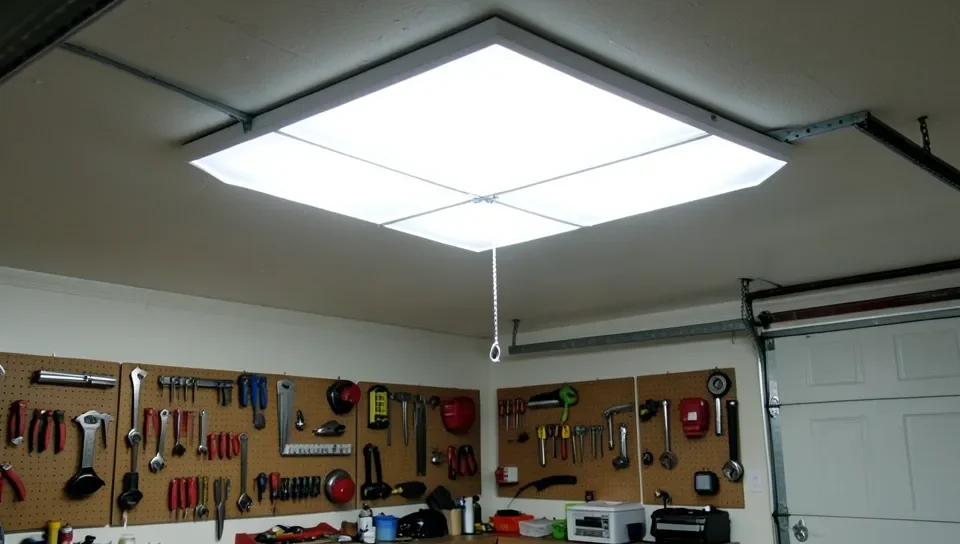
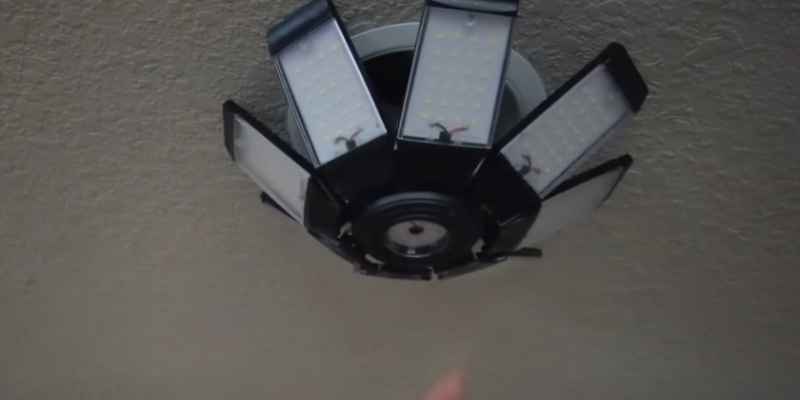
A deformable LED garage light is a single E26/E27 screw-in fixture with 4 to 6 hinged panels folded flat for shipping. Once screwed in, each panel swings out and can be angled independently, typically 0 to 90 degrees, so the light spreads across the whole ceiling instead of casting one narrow cone straight down like a standard bulb. Combined output on current models ranges from about 8,000 lumens (a single small garage) up to 20,000+ lumens across a 2-pack for a full two-car bay — enough to light a dedicated workshop tool area evenly instead of leaving dark corners around a bench.
Why Screw-In LED Lights Flicker or Interfere With Garage Door Openers
Two separate problems get lumped together as “LED lights messing with my garage door opener,” and they have different fixes. The first is vibration: every time the opener runs, the motion can momentarily break contact between a loose bulb and its socket in the opener’s own light housing, which reads as flickering. The second is radio-frequency interference — some LED drivers emit RF noise on the same band the opener’s remote uses, which can cause the door to respond late or not at all.
Manufacturers that build bulbs specifically for opener sockets address both: they list an FCC-compliant, interference-minimizing design and a vibration-resistant base. Genie, for example, sells an opener-specific LED bulb rated for the vibration of daily opener use and built to minimize RF interference — a distinction a generic high-wattage panel light sold for ceiling use does not make, because it is not designed to sit inside a moving opener housing at all.
“A bulb rated only by lumens and wattage does not tell you whether it will survive the vibration inside a garage door opener housing — that requires a separate vibration and RFI rating from the manufacturer, which is why opener-specific bulbs exist as their own category.”
How to Install a Screw-In LED Garage Light
- Cut power at the breaker or switch: turn off the circuit feeding the fixture, not just the wall switch, before touching the socket.
- Remove the old bulb or cover: unscrew any existing bulb and take off a globe or cage if the fixture has one.
- Check the socket type and rating: confirm it is a standard E26 (US) or E27 (international) base and note whether it is an opener socket (13–15W LED limit) or a plain ceiling socket (60–200W capable).
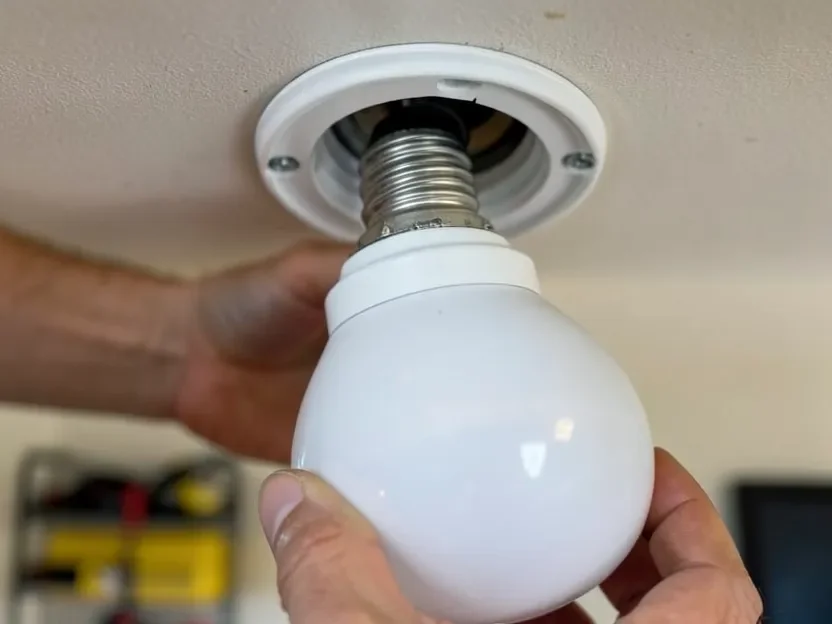
- Screw in the new fixture: thread it in clockwise until snug — do not overtighten, which can crack the plastic housing.
- Deploy and aim the panels: fold out each panel and angle it toward the work area, then restore power and test.
How Many Lumens and What Color Temperature for Your Garage?
A single-car garage used mainly for parking is comfortable at 3,000–5,000 lumens total. A two-car garage set up as a workshop benefits from 8,000–12,000 lumens or more, especially over a workbench. For color temperature, 4000K–5000K (labeled “daylight” or “cool white”) reads as neutral, task-friendly light; anything above 6500K starts to look blue-tinted rather than brighter.
What Does It Actually Cost to Run One?
A 100-watt deformable panel light run 2 hours a day draws 0.2 kWh daily. At the U.S. average residential rate of roughly $0.16 per kWh, that is about 3 cents a day, or under $12 a year — even for a fixture bright enough to replace several old incandescent shop lights. A single 15-watt opener bulb run the same 2 hours a day costs closer to $1.75 a year. The real savings over incandescent bulbs come from the wattage drop for the same brightness: a 60-watt-equivalent incandescent garage bulb actually draws 60 real watts, while an LED equivalent draws 8–10 watts for the same light output.
Rated lifespan matters just as much as wattage for total cost. Most screw-in LED garage fixtures are rated for 25,000 to 60,000 hours, compared to roughly 1,000 hours for a standard incandescent bulb. At 2 hours a day, a 50,000-hour LED panel light lasts around 68 years of use before the diodes degrade below usable output — in practice, other parts of the fixture (the driver, the hinges) usually wear out first.
Common Mistakes When Upgrading Garage Lighting
- Screwing a high-wattage panel light into the opener’s bulb socket instead of a plain ceiling socket — the single most common mistake, and the one most likely to trip the opener’s protection or shorten the bulb’s life.
- Buying a bulb with no vibration or FCC rating for an opener socket, then blaming the opener when the light flickers or the remote gets flaky.
- Assuming higher lumens always means better light — overly bright, uneven panels can create harsh shadows under a car or workbench; aiming the panels matters as much as total output.
- Ignoring the circuit’s total amperage when adding multiple fixtures — even low-wattage LEDs add up if a garage runs off a shared 15-amp circuit with an opener, a freezer, or a shop vacuum or dust collector.
Frequently Asked Questions
Can you put any LED bulb in a garage door opener?
No. Most openers cap the LED socket at 13 to 15 watts of real draw even though they accept a 100W-equivalent bulb, and the bulb should carry an FCC interference rating and a vibration-resistant base. A high-wattage deformable panel light belongs in a plain ceiling socket, not the opener’s own bulb socket.
Do LED garage lights cause interference with garage door openers?
Some do, but only certain bulbs. Non-FCC-compliant LED drivers can emit radio-frequency noise that interferes with the opener’s remote signal. Bulbs marketed specifically for garage door openers are FCC listed to minimize this; a generic ceiling panel light was never tested against that requirement.
How many lumens do I need to light a two-car garage?
Plan for roughly 8,000 to 12,000 lumens for a two-car garage used as a workspace, or 3,000 to 5,000 lumens if it is mainly for parking. Splitting that total across two ceiling fixtures usually lights the space more evenly than one very bright unit in the center.
Can a screw-in LED shop light overload a garage door opener’s circuit?
The opener’s own bulb socket is limited to about 13 to 15 watts, so a high-output panel light will exceed it long before overloading the branch circuit itself. The bigger circuit-level risk is running several high-wattage fixtures plus other equipment off one shared 15-amp garage circuit.
Conclusion
Screw-in LED garage lights are an easy upgrade precisely because they need no rewiring — but that simplicity only works if the wattage matches the socket. Keep opener-socket bulbs under 15 real watts and FCC-rated, and save the bright deformable panel lights for a standard ceiling socket where they belong. Get that match right and a screw-in fixture will outlast the incandescent bulb it replaced by years.
Sponsored / affiliate links. As an Amazon Associate I earn from qualifying purchases. I may earn additional commission from eligible campaigns.