Can You Use a Scroll Saw Blade in a Jigsaw? (Real Answer)
Standard scroll saw blades — pin-end or plain-end — won’t fit a jigsaw chuck, because the shank types are entirely different. Forcing one in risks damaging the chuck or snapping the blade mid-cut. The good news: T-shank “scrolling” jigsaw blades replicate scroll-saw behavior in a portable tool, and a 20 TPI narrow blade under 0.1 in. wide can cut curves as tight as 1/4 in. This guide covers which blade types are incompatible and why, which T-shank blades actually work, and the five-step technique for clean scroll cuts.
Quick Answer
Standard scroll saw blades (pin-end or plain-end) are NOT compatible with jigsaws — the shank types don’t match. For scroll-style cuts on a jigsaw, use T-shank scrolling jigsaw blades with 20 TPI and a blade body under 0.1 in. wide. These fit 90%+ of modern jigsaws and handle curves down to a 1/4-in. radius in wood up to 3/4 in. thick.
Why Standard Scroll Saw Blades Won’t Fit a Jigsaw
Best Scrolling Jigsaw Blade Pick
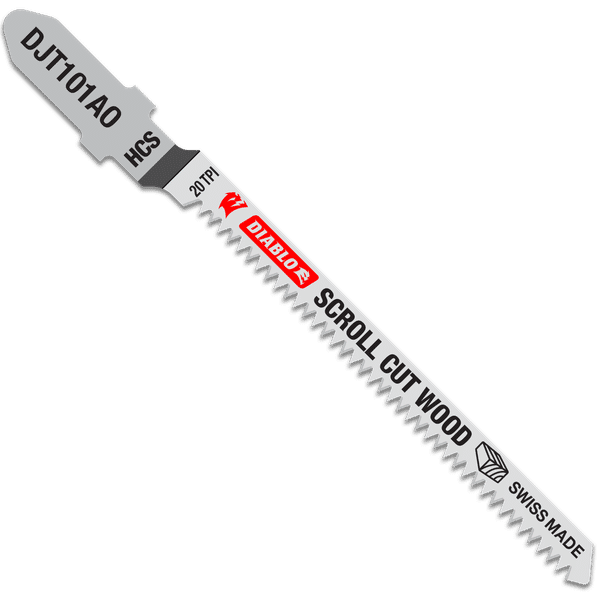
Bosch T101AO 20 TPI Scroll Cut T-Shank Jig Saw Blades
20 TPI pointed-tooth T-shank blades that cut clean curved and scroll cuts in wood without splintering. Narrow body enables tight-radius curves; 5-pack covers a full project without blade swaps.
- Best for: Scroll-style curved cuts in hardwood and softwood up to 3/4 in. thick
- Why we picked it: 20 TPI pointed-tooth geometry produces the cleanest edge on tight curves; widely available and consistently stocked
- Main drawback: High-carbon steel (not bi-metal) dulls faster in hardwood than premium alternatives
Compare more scrolling jigsaw blade options
 Option 1 LENOX Scroll Cutting T-Shank Jig Saw Blade
|
 Option 2 Diablo Bi-Metal T-Shank Jig Saw Blades for Scroll Cuts
|
 Option 3 GINEPAN T101AO T-Shank 20-Piece Jigsaw Blades Set
|
As an Amazon Associate we earn from qualifying purchases.
A scroll saw blade is a thin, double-tensioned blade held at both ends by the saw’s clamp system — either a pin at each end (pin-end) or bare metal gripped by upper and lower clamps (plain-end). Jigsaws use a completely different attachment: a T-shank or U-shank that slots into the tool’s chuck from one end only. The blade runs in one direction only, driven from the bottom, with no top support. None of the scroll saw attachment styles are interchangeable with a jigsaw chuck without an adapter, and no off-the-shelf adapter exists for standard pin-end blades.
Pin-End Scroll Saw Blades
Pin-end blades have a horizontal cross-pin at each end, designed to slot into matching holes in a scroll saw’s upper and lower blade holders. A jigsaw chuck has no such hole. Even if you forced the blade in, the cross-pin would prevent the chuck from closing, and the blade would immediately fly out under load. Pin-end blades are 5 in. long, far shorter than the 3.25–4 in. working stroke of a jigsaw blade — another incompatibility on top of the attachment mismatch.
Plain-End Scroll Saw Blades
Plain-end blades have no cross-pin but still cannot fit a jigsaw chuck. They are roughly 0.050 in. (1.3 mm) thick and 0.10–0.14 in. (2.5–3.5 mm) wide — far narrower than the jigsaw chuck’s receiver slot, which is sized for the 0.026–0.031 in. shank thickness of a T-shank blade. The blade would rattle loose immediately. Specialty adapter kits exist for some scroll saw models to accept plain-end blades from a different brand, but no jigsaw-to-scroll-saw adapter is available at retail for either blade type.
The Right Tool: T-Shank Scrolling Jigsaw Blades
The correct product for scroll-style cuts on a jigsaw is a T-shank jigsaw blade designed specifically for scroll cutting. These blades have a narrow body — under 0.1 in. (about 2.5 mm) wide — and a 20 TPI tooth profile that produces clean curved cuts without tearing wood fibers. They are sold by every major blade manufacturer (Bosch, LENOX, Diablo) and labeled as “scroll,” “scroll cut,” or “narrow scrolling” blades. At 20 TPI in a jigsaw, a scrolling blade can replicate most of what a scroll saw does in wood up to 3/4 in. thick — it just cannot match a scroll saw’s ability to cut 0.010-in.-thick stock or hold a 1/16-in. radius.
What to Look for in a Scrolling Jigsaw Blade
Three specs determine whether a T-shank jigsaw blade can actually handle tight curves: blade body width, TPI, and material. Narrower bodies flex around curves; higher TPI gives cleaner edges; bi-metal construction lasts longer than high-carbon steel. The table below summarizes the trade-offs by material and curve radius.
| Material | Recommended TPI | Blade Width | Min. Curve Radius |
|---|---|---|---|
| Soft wood (pine, cedar) | 10–20 TPI | Under 0.14 in. | 1/2 in. |
| Hard wood (oak, maple) | 20 TPI | Under 0.10 in. | 1/4 in. |
| MDF / plywood | 20 TPI | Under 0.12 in. | 3/8 in. |
| Plastic / acrylic | 20–32 TPI | Under 0.10 in. | 1/4 in. |
How to Cut Tight Curves with a Jigsaw
Getting scroll-saw-quality curves from a jigsaw takes more technique than a scroll saw requires, because the jigsaw’s orbital action and one-end drive create more vibration and blade deflection. These five steps minimize both:
- Choose a 20 TPI T-shank scrolling blade: Install a narrow scrolling blade (under 0.1 in. wide, 20 TPI) in the jigsaw chuck. A wide or coarse blade cannot follow tight curves without binding.
- Mark the cut line and drill an entry hole for interior cuts: Use a pencil and template for the cut line. For any interior cutout, drill a 1/4-in. entry hole inside the waste area before inserting the jigsaw blade — threading the blade through the hole lets you start on an interior contour.
- Set the orbital setting to 0 (straight reciprocating action): Most jigsaws have an orbital dial. Set it to 0 or the lowest setting — this eliminates the forward blade sweep that causes tear-out on curves and gives you the most control over direction.
- Make relief cuts along tight curves before the final pass: On curves tighter than 1/2 in., cut short straight relief cuts from the waste edge to the cut line every 1/4 in. The waste falls away in small pieces as the jigsaw reaches each relief cut, so the blade never has to pivot sharply enough to snap.
- Guide the jigsaw slowly along the line without pushing forward: Let the blade’s own cutting action advance the tool — pushing forward causes the blade to flex sideways and leave a beveled edge. Hold the base plate flat against the workpiece and steer, do not push.

Scroll Saw vs. Jigsaw for Intricate Work: Which Is Right?
A jigsaw with a scrolling blade covers most casual curved-cut needs, but a dedicated scroll saw is better for fine detail work. The table below covers the real practical differences so you can decide which tool your project actually needs.
| Feature | Jigsaw + Scrolling Blade | Scroll Saw |
|---|---|---|
| Minimum curve radius | ~1/4 in. (6 mm) | ~1/16 in. (1.5 mm) |
| Material thickness | Up to ~3/4 in. soft wood | Up to 2 in. soft wood |
| Portability | Fully portable | Stationary (benchtop) |
| Interior cutouts | Yes (drill entry hole) | Yes (tool-free blade threading) |
| Edge finish | Good (may need light sanding) | Excellent (almost no sanding) |
| Cost | $20–$80 jigsaw + $8–$20 blades | $100–$500+ for the saw |
| Best for | One-off curved cuts, site work | Repeated intarsia, puzzle, and pattern cuts |
If you already own a jigsaw and need occasional scroll-style cuts in 1/2-in. plywood or thinner soft wood, a scrolling T-shank blade is the right and cheapest solution. If you regularly cut intricate patterns in thin stock — inlay strips, wooden puzzle pieces, or decorative fretwork under 1/4 in. thick — a dedicated scroll saw will give better results every time.
Blade Maintenance and Safety Tips
- Replace blades before they are dull, not after: A dull scrolling blade wanders off the cut line before it feels noticeably harder to push. If you start fighting the jigsaw to stay on the line, the blade is already overdue for replacement. A 5-pack of Bosch T101AO blades costs under $9 — the cut quality is not worth preserving on an old blade.
- Keep the blade body dry and free of pitch: Resin build-up on the blade body increases friction and causes the blade to heat up, which causes it to drift sideways in the cut. Wipe the blade with acetone or mineral spirits after each session in resinous wood (pine, fir, cedar).
- Never use a scrolling blade for straight rip cuts: The narrow body that enables tight curves has no resistance to lateral load. A long straight cut will bow the blade sideways and produce a bevel on the cut edge.
- Secure the workpiece with clamps before cutting: Jigsaw vibration will move an unsecured piece off your line. Two clamps — one on each side of the cut path — prevent the workpiece from shifting and keep fingers away from the blade path.
- Wear eye protection and hearing protection: Jigsaw operation produces fine wood dust and sustained 90–100 dB noise at the operator’s ear. Safety glasses and foam earplugs are minimum PPE for any jigsaw session longer than a few minutes.
Frequently Asked Questions
Can you use a scroll saw blade on a jigsaw?
No — standard scroll saw blades (pin-end or plain-end) cannot fit a jigsaw chuck. The shank attachment systems are completely different. Pin-end blades use a cross-pin that a jigsaw chuck cannot accept, and plain-end blades are far too narrow to be gripped securely by a T-shank chuck. The correct substitute is a T-shank jigsaw blade marketed as a “scroll” or “narrow scrolling” blade, available at 20 TPI from manufacturers including Bosch (T101AO), LENOX, and Diablo.
What TPI should I use for scroll cuts with a jigsaw?
20 TPI is the standard recommendation for scroll cuts in wood. At 20 TPI, a narrow-body T-shank blade cuts smoothly through hardwood and softwood without tearing, and leaves an edge that needs minimal sanding. If you are cutting thin acrylic or plastic (1/8 in. or less), step up to 32 TPI to prevent chipping. For faster but rougher curves in soft wood over 1/2 in. thick, a 12 TPI scrolling blade will work but leaves a rougher edge.
What is the difference between a scroll saw blade and a jigsaw blade?
The fundamental difference is the attachment system and operating principle. Scroll saw blades are held at both ends (top and bottom clamps or pins) and reciprocate in a straight up-and-down line with no orbital action — this allows them to be extremely thin (0.050 in.) for the tightest curves. Jigsaw blades are only attached at one end (the bottom chuck), which means they must be stiffer (typically 0.026–0.031 in. shank thickness) to resist deflection. Jigsaws also use orbital action that tilts the blade forward on the upstroke, giving faster cuts but less precision than a true scroll saw.
Can a jigsaw replace a scroll saw for intricate woodworking?
A jigsaw with a scrolling T-shank blade can replace a scroll saw for curves down to about 1/4-in. radius in wood up to 3/4 in. thick. For tighter curves (1/16 in. radius), thinner stock (under 1/8 in.), or repeated pattern cuts that require a stable table to hold the workpiece, a scroll saw is the better tool. If you do intricate woodworking regularly — intarsia, wooden puzzles, decorative fretwork — a dedicated scroll saw will save time and produce cleaner results than a jigsaw at a comparable project volume within a few months.
How narrow does a jigsaw blade need to be for tight curves?
For the tightest curves a jigsaw can manage (approximately 1/4-in. radius), the blade body needs to be under 0.1 in. (2.5 mm) wide. Bosch T101AO and LENOX scroll cutting blades meet this spec. A standard 0.25-in.-wide jigsaw blade cannot follow a 1/4-in. radius — the blade body is physically too wide to pivot that sharply without the kerf pinching the blade. If you need to cut curves tighter than 1/4 in., use relief cuts (see the technique section above) or switch to a dedicated scroll saw.
Conclusion: Standard scroll saw blades — pin-end or plain-end — are physically incompatible with a jigsaw chuck. The correct approach is a T-shank scrolling jigsaw blade (20 TPI, under 0.1 in. wide), which gives clean curved cuts down to 1/4-in. radius in wood up to 3/4 in. thick. Pair the right blade with zero orbital action, relief cuts on tight bends, and a slow steady guide hand, and a jigsaw handles most scroll-saw-style work without the dedicated machine. For high-volume intricate cutting below 1/8-in. stock thickness, a scroll saw remains the correct tool.
Sponsored / affiliate links. As an Amazon Associate I earn from qualifying purchases. I may earn additional commission from eligible campaigns.