.325 vs 3/8 Chainsaw Chain: 3/8 LP Is Not Standard 3/8
.325 and 3/8 are different chain pitches (0.325 in vs 0.375 in), so they cannot share a sprocket. The trap is 3/8 LP: despite the name, it has the same 0.375 in pitch as full-size 3/8, not a size in between. This guide covers the three-rivet test, gauge and drive-link numbers, which saws each class suits, and what to check before you swap a chain.
What Chainsaw Chain Pitch Means: .325 vs 3/8 in Inches
| Best Chain Size Gauge Pick | |
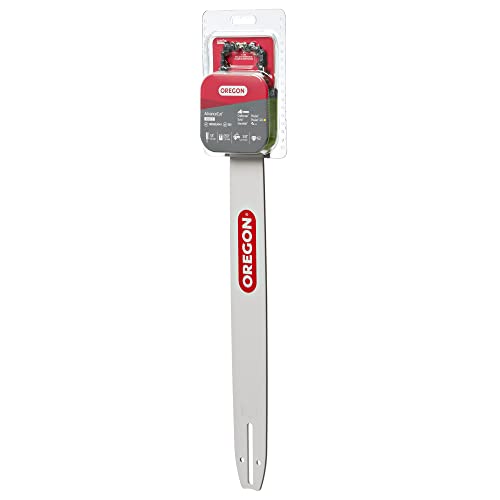
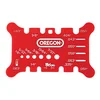 | Oregon OEM 556418 Chainsaw Bar & Chain Measuring Tool ($4.64) A pocket-sized plastic gauge with notches for pitch, drive-link gauge, bar groove width and file size. It turns the pitch and gauge checks in this guide into a quick match-the-notch test.
|
As an Amazon Associate we earn from qualifying purchases. Price checked on Amazon at the time of writing and may change.
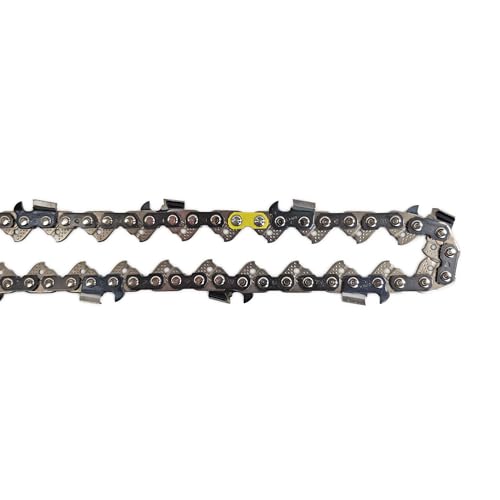
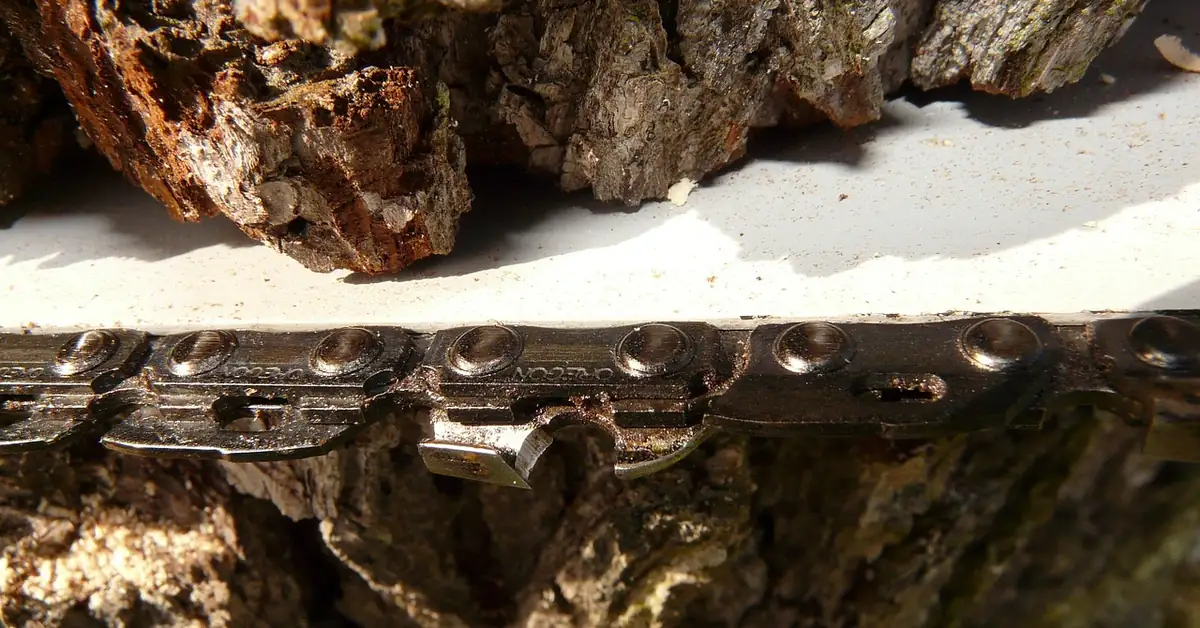
Pitch is the size of the chain. Oregon defines it as the distance between any three consecutive rivets divided by two, and Husqvarna uses the same definition. That gives a test you can do with a ruler: measure from the first rivet to the third, then halve it. A .325 chain spans 0.65 in (about 21/32 in), and a 3/8 chain spans 0.75 in (3/4 in).
| Pitch class | Pitch (inches) | Three-rivet span (2 x pitch) | Other names you will see |
|---|---|---|---|
| 1/4″ | 0.250 | 0.50 in | Smallest pitch Oregon lists |
| .325″ | 0.325 | 0.65 in (about 21/32 in) | .325 mini (Husqvarna), .325 low profile (Oregon) |
| 3/8″ low profile (LP) | 0.375 | 0.75 in (3/4 in) | 3/8 mini (Husqvarna), PICCO 3/8 (STIHL) |
| 3/8″ full size | 0.375 | 0.75 in (3/4 in) | Oregon calls 3/8 the most popular pitch |
| .404″ | 0.404 | 0.81 in (about 13/16 in) | Largest handheld chain, per Oregon |
The spans are computed from the pitch values, and the pitch classes come from Oregon’s and Husqvarna’s own pitch lists. The detail the table exposes is in rows three and four: low-profile and full-size 3/8 have the same pitch, so a ruler cannot separate them.
Oregon: pitch is measured across three rivets, then halved, and the drive sprocket must match the chain pitch (plus the bar nose sprocket, if the bar has one). Source: Oregon, Finding the Right Saw Chain
That sprocket rule is why .325 and 3/8 chain are never a drop-in swap. Moving between them means a different drive sprocket and, on many bars, a different nose sprocket or a whole new bar, not just a new loop of chain.
3/8 LP Is Not a Middle Size Between .325 and 3/8
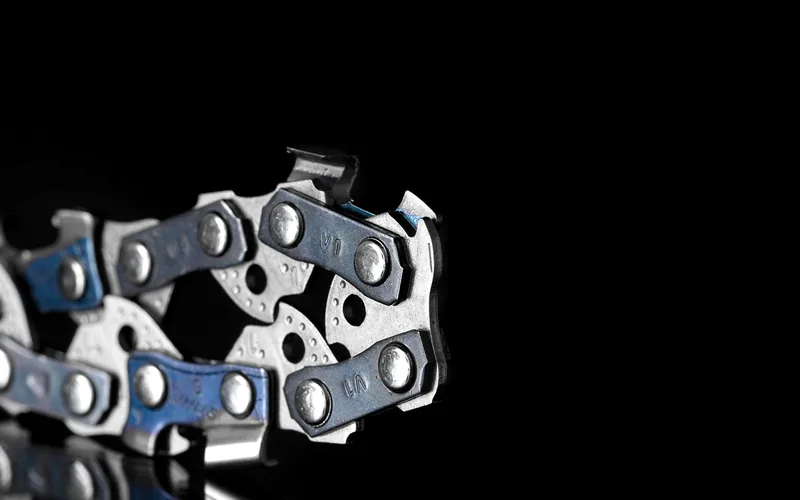
Most confusion on this topic comes from the name. Low profile sounds like a smaller pitch, and the common questions people search (“is 3/8 LP the same as .325”, “which is smaller, 3/8 or .325”) assume it sits near .325. It does not. Low profile refers to the lighter build and smaller cutters, while the pitch stays at 0.375 in.
Every maker has its own label for this class. Oregon calls it 3/8″ Low Profile, STIHL sells it as PICCO 3/8″, and Husqvarna lists it as 3/8″ mini. Husqvarna’s support page names six pitch variants in total: 1/4″, .325″ mini, 3/8″ mini, .325″, 3/8″ and .404″. Oregon’s filing chart also lists a .325 Low Profile chain (80TXL), so low profile exists in the .325 family too. The word alone does not tell you the pitch.
So how do you separate the families when the ruler gives the same answer? Use the part number. Oregon’s filing chart groups its chain by series, and the series maps cleanly to pitch class:
| Oregon chain series (from Oregon’s filing chart) | Pitch class | Round file size in the chart |
|---|---|---|
| 25AP | 1/4″ | 5/32″ |
| 80TXL | .325″ low profile | 5/32″ |
| 90PX, 90SG | 3/8″ low profile | 4.5 mm |
| 91P, 91PX, 91PXL, 91VXL | 3/8″ low profile | 5/32″ |
| 95VPX, 95TXL, 20/21/22BPX | .325″ | 3/16″ |
| 72, 73, 75 series | 3/8″ full size | 7/32″ |
| 27X, 27R, 58, 59, 68 series | .404″ | 7/32″ |
The file sizes show the practical cost of mixing these up: the same saw can need a 5/32 in, 3/16 in or 7/32 in file depending on which class you really have. Our chainsaw file size guide compares Oregon, STIHL and Husqvarna sizes in full, and the STIHL file size chart covers STIHL’s own numbers.
Gauge and Drive Links: The Other Two Numbers
Pitch is only one of three numbers that must match. Gauge is the thickness of the drive link where it sits in the bar groove, and both Oregon and Husqvarna list four sizes: .043 in (1.1 mm), .050 in (1.3 mm), .058 in (1.5 mm) and .063 in (1.6 mm). The gauge must match the guide bar. Oregon adds a warning that gauge is hard to measure on a worn chain, so read the number stamped on the drive link rather than measuring it.
The third number is the drive-link count, which sets the chain length. Husqvarna says the count is normally not printed on the bar, so count the links on your old chain. Do not assume the bar length gives it away. The catalog examples below show how much the count shifts with pitch, and even two Oregon 14 in chains with the same class and gauge can differ:
| Bar length | Chain (Oregon catalog) | Gauge | Drive links |
|---|---|---|---|
| 12 in | 3/8″ LP | .050″ | 45 |
| 14 in | 3/8″ LP (Amazon listing B00004RA8B) | .050″ | 53 |
| 14 in | 3/8″ LP (Oregon 91PX product page) | .050″ | 52 |
| 16 in | 3/8″ LP | .043″ | 56 |
| 18 in | 3/8″ full size | .050″ | 66 |
| 18 in | .325″ (bar and chain combo) | .063″ | 74 |
| 20 in | .325″ | .063″ | 81 |
Counts come from Oregon listings checked through the Amazon Creators API on 2026-10-07 and from Oregon’s 91PX product page, and they are examples, not a lookup table for your saw. The 52 versus 53 pair is the reason to count your own links. The smaller pitch also needs more links for a similar bar length, which is why the .325 loop on an 18 in bar has more links than the 3/8 loop. For a deeper look at why the count matters, see why drive-link count must match your bar and how to tell a 70 from a 72 link chain.
Which Chain Class Fits Which Saw
Manufacturers tie chain classes to saw size, and the numbers they publish are narrower than most blog charts. Oregon states that its 91PX low-profile chain is designed for saws up to 42 cc and that it met the ANSI B175.1-2012 kickback requirement. STIHL describes its PICCO Micro 3 (3/8″P, .050 in) as a low-kickback chain for small to mid-sized saws between 1.5 kW (2.0 bhp) and 1.9 kW (2.5 bhp). Husqvarna says its 3/8″ mini H38 chain (.043 in gauge) is for electric and small gasoline saws.
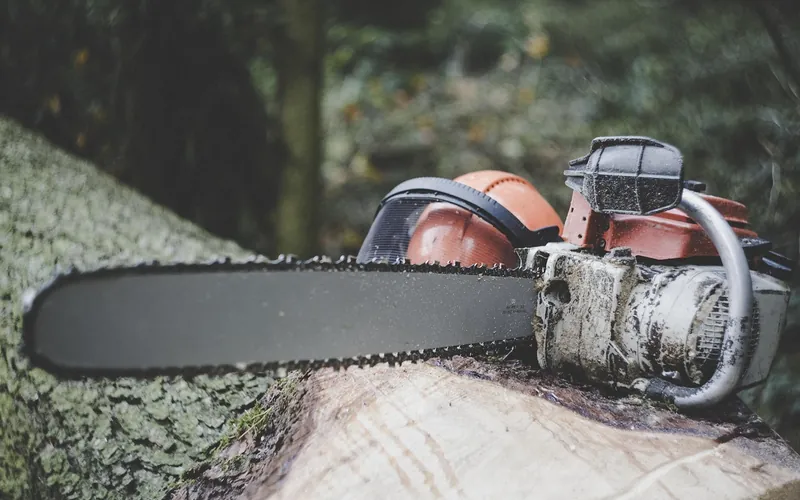
For mid-size and larger saws, the common rule of thumb in retailer guides is .325 for roughly 40 to 60 cc and full-size 3/8 above that. Treat that as a starting point, not a standard, because it is not a manufacturer specification. Your saw manual and the stamp on the bar are what decide.
Husqvarna also makes a point most upgrade-minded buyers miss: putting a more aggressive chain on a standard saw will never give better performance, because the saw’s power sets the limit. If you run a small cordless saw, our handheld cordless chainsaw picks roundup covers the 6, 8 and 10 inch sizes.
Can You Swap One Chain Class for Another?
Short answer for .325 and 3/8: no, not without changing hardware. The drive sprocket must match the chain pitch, so a .325 chain will not seat on a 3/8 sprocket, and the reverse is also true. A chain that does not seat can climb the sprocket or come off the bar while cutting, which is a safety hazard, not just a performance problem.
The 3/8 LP versus full-size 3/8 question is the one people actually ask (“can I run 3/8 LP on a normal 3/8 bar”), and it is the one without a safe universal answer. They share a pitch, and the common .050 in gauge appears in both, so on paper the sprocket pitch and bar groove can line up. But the manufacturer ratings are class-specific. Oregon, for example, designs its 91PX for saws up to 42 cc. Putting low-profile chain on a larger saw puts it outside the use its maker designed it for, and putting full-size chain on a small saw does the same in reverse. Use the chain class your saw manual lists for that saw, bar and sprocket, and ask a dealer if the manual is missing.
How to Identify Your Chain Class in Five Steps
Treat the saw as live until proven otherwise: remove the battery or pull the spark plug boot, and wear cut-resistant gloves before you handle the chain.
- Read the stamp. Oregon says the pitch and gauge numbers are stamped on the drive link, and Husqvarna says fit details are often printed on the bar side plate.
- Do the three-rivet test. Measure from the first rivet to the third and halve it. About 0.325 in is .325 pitch, and about 0.375 in is a 3/8 class chain.
- Check gauge from the stamp, not a caliper. Wear can make a measured gauge read low on an old chain.
- Count the drive links. Count them on the old chain, since the number is normally not printed on the bar.
- If you landed in the 3/8 class, find the part number. The series (for example 91PX versus 72) separates low profile from full size, as the Oregon table above shows. If the stamp is worn off, take the old chain and bar to a dealer.
When you order, use the numbers on the old chain, not just the bar length. Oregon advises ordering from the number stamped on the drive link of your old chain. Our guide to measuring chainsaw bar length covers the bar side, and when a chain is worn enough to replace helps you decide whether to buy at all.
Frequently Asked Questions
Is 3/8 pitch the same as .325 pitch?
No. A .325 chain has a 0.325 in pitch and a 3/8 chain has a 0.375 in pitch, so .325 is the smaller of the two. They need different drive sprockets, so one cannot replace the other on the same saw without changing hardware.
What does 3/8 LP mean on a chainsaw chain?
LP means low profile. It is a 3/8 chain with a 0.375 in pitch, the same as full-size 3/8, but with a lighter build and smaller cutters meant for small saws. Husqvarna sells it as 3/8 mini and STIHL as PICCO 3/8.
Which is smaller, 3/8 LP or .325?
The .325 chain is smaller by pitch (0.325 in versus 0.375 in). Low profile describes cutter size, not pitch, so a 3/8 LP chain has wider tooth spacing than a .325 chain even though its cutters are smaller than full-size 3/8.
Can I run 3/8 LP chain on a normal 3/8 bar?
They share a pitch, and .050 in gauge appears in both, so they can look compatible. The safe answer is to run the class your saw manual specifies for that bar and sprocket, because makers design and rate chain for specific saw sizes. Ask a dealer if unsure.
How do I measure the difference between .325 and 3/8 chain?
Measure from the first rivet to the third rivet and halve the distance. About 0.65 in across three rivets is .325 pitch, and about 0.75 in is 3/8. The pitch is also stamped on the drive link, and a gauge tool with pitch notches works too.
Pitch, gauge and drive-link count all have to match your saw before a chain is safe to run, and 3/8 LP is its own class rather than a step between .325 and 3/8. Confirm the class from the stamp or part number, count your links, and buy to those numbers.
Sponsored / affiliate links. As an Amazon Associate I earn from qualifying purchases. I may earn additional commission from eligible campaigns.