Best Cement Board Saw Blade: PCD vs. Carbide (Top 4 Picks)
Cutting fiber cement board dulls a standard wood blade within minutes — the silica and Portland cement in the substrate are nearly as abrasive as concrete. A PCD (polycrystalline diamond) blade with 4 to 6 teeth is the correct tool: it outlasts carbide by up to 75x and generates up to 50% less respirable dust. This guide covers how to pick the right blade for your saw size, the difference between PCD and carbide tip types, our top picks, and the cutting techniques that protect the board and extend blade life.
Quick Answer
Use a PCD (polycrystalline diamond) circular saw blade rated for fiber cement — 4 teeth for most 7-1/4-inch saws, 6 teeth for 10-inch miter saws. Never use a standard wood blade: it dulls within a single sheet. The Diablo HardieBlade is the most widely trusted option, lasting up to 75x longer than carbide blades.
What Type of Saw Blade Cuts Cement Board?
Best Cement Board Blade Pick
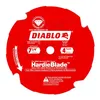
Diablo HardieBlade 7-1/4in 4T PCD Saw Blade
James Hardie-endorsed PCD triple chip design. Produces up to 50% less respirable dust than carbide and lasts up to 75x longer — the industry benchmark for fiber cement cutting.
- Best for: Full siding installations, production cutting, any job where blade longevity matters
- Why we picked it: The only blade explicitly endorsed by James Hardie Building Products; PCD tips verified at 75x carbide lifespan
- Main drawback: Most expensive upfront — roughly $45 vs $15-25 for carbide; cost-per-cut favors it across any full project
Compare more cement board blade options
 Option 1 WEN BL0704 7-1/4in 4-Tooth PCD Saw Blade
|
 Option 2 TWIN-TOWN 7-1/4in 6-Tooth PCD Fiber Cement Blade
|
 Option 3 TOMAX PCDM61204 6-1/2in 4-Tooth PCD Fiber Cement Blade
|
As an Amazon Associate we earn from qualifying purchases.
Cement board is a composite panel made from Portland cement, sand, and reinforcing fibers — the same silica-rich compound that rapidly wears down metal cutting edges. Three blade types are used on this material, and the differences matter considerably:
- PCD (Polycrystalline Diamond) blades — the professional standard. Synthetic diamond particles are fused onto carbide substrates under high pressure, creating a tip that shrugs off silica abrasion. Lasts 60-75x longer than standard carbide. Required for production siding work on HardiePlank, Cemplank, or any fiber cement siding product.
- Carbide-tipped blades rated for fiber cement — a step up from wood blades but far below PCD. Tolerate 30-50 cuts before dulling on 5/16-inch panels; acceptable for occasional small trim jobs but expensive per cut compared to PCD across a full project.
- Standard wood blades — never use on cement board. The 40-60-tooth geometry designed for clean wood cuts is wrong for abrasive cementitious materials; teeth round off within 1-2 sheets and the blade can deflect or overheat under continued load.
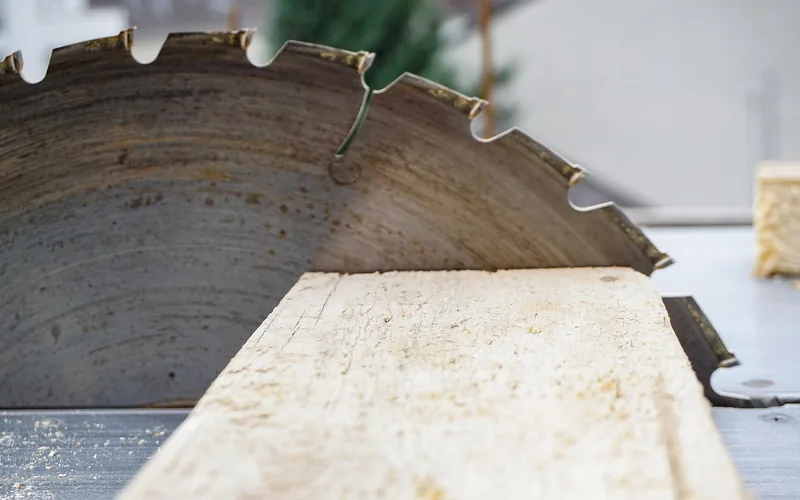
PCD vs. Carbide: Which Blade Should You Use for Cement Board?
Choosing between PCD and carbide blades comes down to job volume and cost per cut — not sticker price. A $45 PCD blade that cuts an entire house of HardiePlank siding is far cheaper per cut than replacing a $15 carbide blade every 40 sheets. For a single-sheet tile backer job, either type works. For any production siding installation, PCD is the only practical choice.
| Blade Type | Tooth Count | Lifespan on Fiber Cement | Dust Level | Best Use |
|---|---|---|---|---|
| PCD (Polycrystalline Diamond) | 4-6 teeth | 60-75x longer than carbide | Up to 50% less | Production siding, full installs |
| Carbide (fiber cement rated) | 6-8 teeth | Baseline — 30-50 sheets | Standard | Small occasional jobs |
| Standard wood carbide | 24-60 teeth | Ruins in 1-2 sheets | High — damage risk | Do NOT use on cement board |
The tooth count difference is critical and is often overlooked: fiber cement needs large gullets between teeth to clear abrasive dust. A 4-tooth PCD blade has gullets roughly 10 times larger than a 40-tooth wood blade — that is what prevents heat buildup and premature tip wear. According to Diablo, their PCD HardieBlade produces up to 50% less respirable dust than standard carbide, directly because the wide gullets evacuate silica particles before they clog the kerf. For related comparisons, see our best saw blade for plywood guide and best circular saw blade for concrete.
Best Cement Board Saw Blades: Our Top Picks
All four blades below use PCD tips — the only tip type we recommend for regular fiber cement cutting. Prices verified via linked Amazon listings.
Key Features of a High-Quality Cement Board Saw Blade
Understanding blade specifications helps you evaluate options beyond brand recognition. Three specs matter most when buying a fiber cement blade:
Tip Material: PCD vs. Carbide
PCD (Polycrystalline Diamond) is manufactured by sintering synthetic diamond particles onto a carbide substrate at extreme heat and pressure, producing a tip harder than any natural mineral commonly found in construction panels. Standard tungsten carbide, while effective on wood, softens and rounds quickly against silica — the primary abrasive in fiber cement board. If a blade listing does not explicitly say “PCD” or “polycrystalline diamond,” assume it is carbide-tipped. “Diamond-tipped” in marketing copy sometimes refers to carbide with a thin diamond coating, not true PCD — read the product specifications carefully before buying.
Tooth Count: Why 4-6 Teeth Is Correct
Counterintuitively, fewer teeth produce better results on cement board. A 4-tooth blade running at 7000 RPM still makes over 460 cuts per second — more than enough for clean edges through 5/16-inch panels. More importantly, the large spaces between teeth (called gullets) act as dust channels, evacuating silica particles before they accumulate in the kerf and overheat the tips. A 40-tooth wood blade has essentially no gullet capacity for this volume of abrasive dust, which is why it fails within a single sheet of fiber cement.
Kerf Width and Expansion Slots
A thin kerf (1.8-2.2mm) removes less material per pass, generates less heat, and lets cordless saws run longer per charge — valuable on production siding jobs. Look for laser-cut expansion slots in the blade body: these allow the steel plate to flex slightly as it heats during continuous cutting, preventing warping and the lateral wobble that causes ragged edges on fiber cement panel faces.
How to Choose the Right Blade Size for Your Saw
The blade diameter must match your saw’s specification exactly. Using the wrong diameter risks contact with the blade guard and can cause kickback. Common sizes and their applications:
- 4-1/2-inch blades — fit compact circular saws and adapted angle grinders; useful for trim cuts and tight spots near walls, not production siding runs.
- 6-1/2-inch blades — fit cordless circular saws common in crew kits; the TOMAX PCDM61204 is designed for this class.
- 7-1/4-inch blades — the industry-standard size; fits the widest range of corded and cordless circular saws; the Diablo HardieBlade and WEN BL0704 are both 7-1/4-inch.
- 10-inch and 12-inch blades — for miter saws and table saws used to batch-cut siding pieces; use a 6- to 8-tooth PCD blade in these larger diameters.
Arbor size: Most 7-1/4-inch circular saws use a 5/8-inch arbor. Verify the blade listing specifies 5/8-inch before ordering — a mismatched arbor is a safety hazard and the blade will not seat correctly. For tile backer applications, see our guide on how to finish cement board after cutting to size.
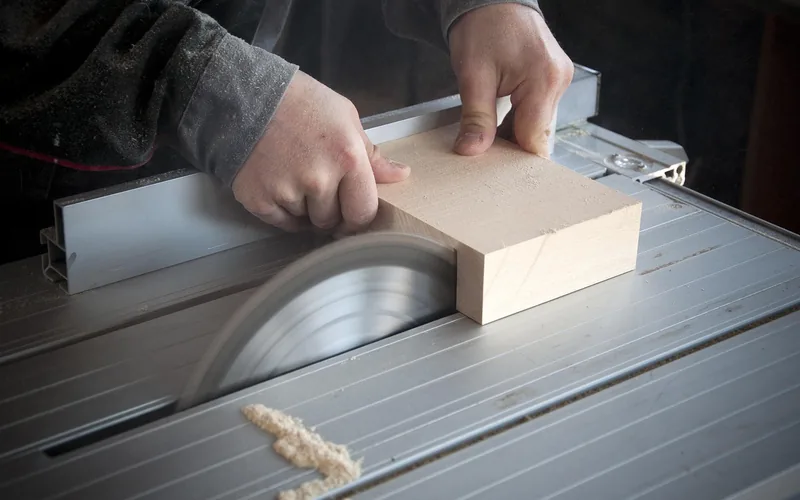
How to Cut Cement Board Without Cracking or Chipping
Even a correctly specified PCD blade produces ragged edges with poor technique. Follow these steps to protect the board face and extend blade life:
- Run the blade right-side-up: Cut from the face (finish side) down, so the blade’s upward exit stroke is on the back face. This keeps any minor spalling on the non-visible side.
- Score the cut line first: Use a utility knife and straight edge to score 1/8-inch deep on the face before powering the saw. Scoring defines a clean boundary the blade follows, preventing chipping at the panel edge.
- Clamp long boards on both sides: Unsupported cement board flexes as the blade exits, cracking the panel at the cut line. Clamp both sides on sawhorses to hold the board flat throughout the cut.
- Let the blade reach full RPM before contact: Starting the cut before the blade reaches full speed causes it to drag rather than shear, producing rough edges and accelerating PCD wear.
- Use a steady, even feed rate: Move the saw at a consistent pace without forcing it. If you smell burning cement dust, slow down or let the blade cool for 60 seconds before continuing.
- Wear a NIOSH N95 respirator: Fiber cement contains crystalline silica — the dust is a serious respiratory hazard with repeated exposure. Cut outdoors or in ventilated spaces and use your saw’s dust port with a vacuum when available.
“According to Diablo, the HardieBlade’s PCD triple chip design lasts up to 75x longer than standard carbide blades — in practical terms, one blade covers an entire house of fiber cement siding where a standard carbide blade requires replacement after roughly every 40-50 sheets.”
Frequently Asked Questions About Cement Board Saw Blades
What is a cement board saw blade used for?
A cement board saw blade is designed to cut fiber cement panels — a composite material made from Portland cement, sand, and cellulose fibers used for siding, tile backer, and exterior cladding. Standard wood blades fail immediately on this material because the silica content wears down standard carbide teeth within one or two cuts. PCD-tipped cement board blades use synthetic diamond tips that resist abrasion and last through entire construction projects.
Can I use a regular saw blade to cut cement board?
No. A regular wood saw blade will dull in under 60 seconds of cutting cement board. The silica particles in fiber cement act as an abrasive against standard carbide, rounding off teeth so quickly that the blade stops cutting cleanly and begins tearing the panel. In addition to ruining the blade, the resulting excessive heat can crack the cement board and increase kickback risk. Always use a PCD-tipped blade rated specifically for fiber cement.
How many teeth does a cement board saw blade need?
A cement board saw blade needs only 4 to 6 teeth for a 7-1/4-inch circular saw — far fewer than the 40-60 teeth on a typical wood blade. The low tooth count creates large gullets (the spaces between teeth) that evacuate abrasive cement dust from the kerf before it accumulates and overheats the PCD tips. More teeth means smaller gullets and faster tip failure on abrasive materials. For 10-inch and 12-inch miter saws, 6 to 8 teeth is the correct range.
What is the difference between PCD and diamond blades for cement board?
PCD (polycrystalline diamond) blades and segmented diamond blades are both effective, but for different applications. PCD blades use synthetic diamond particles bonded to carbide teeth and are designed for saw-type cutting (circular saw, miter saw) on fiber cement boards. Segmented diamond blades use a continuous abrasive rim designed for angle grinder wet-cutting or tile saws used on poured concrete and stone. For cutting cement board panels with a circular saw, always choose a PCD blade — not a segmented diamond blade, which is too aggressive and can crack fiber cement panels.
What safety precautions should I take when using a cement board saw blade?
Wear a NIOSH N95 respirator (not a basic dust mask) — crystalline silica from fiber cement dust is a serious respiratory hazard with repeated exposure. Add safety glasses and hearing protection. Cut outdoors or in a well-ventilated area when possible, or use a vacuum attachment on your saw’s dust port. Always let the blade reach full RPM before contacting the board, keep hands clear of the blade’s exit path, and never remove the blade guard.
Conclusion
Choosing the right cement board saw blade comes down to two decisions: PCD tips (not standard carbide) and 4-6 teeth for your saw size. The Diablo HardieBlade is the benchmark for most residential applications, with verified 75x carbide lifespan and 50% dust reduction. The WEN BL0704 and TWIN-TOWN 6T PCD offer genuine PCD tips at lower upfront cost. Match blade diameter and arbor size to your specific saw, follow the scoring-and-clamping technique above, and a single quality PCD blade should carry you through an entire exterior installation without replacement.
Sponsored / affiliate links. As an Amazon Associate I earn from qualifying purchases. I may earn additional commission from eligible campaigns.