Flooring & Decking Cost Calculator: Square Footage, Boxes, Boards & Stain
Flooring & Decking Cost Calculator
One tool for every flooring and decking estimate: square footage, total cost, boxes of flooring, deck boards, and stain or sealant — each with a proper waste buffer built in.
Quick Answer
Square footage is length x width. Cost is square footage x price per unit, plus a waste buffer (5-20% depending on layout). Flooring and decking are sold by the box or board, so round up. Stain and sealant needs depend on coats, coverage rate, and wood porosity.
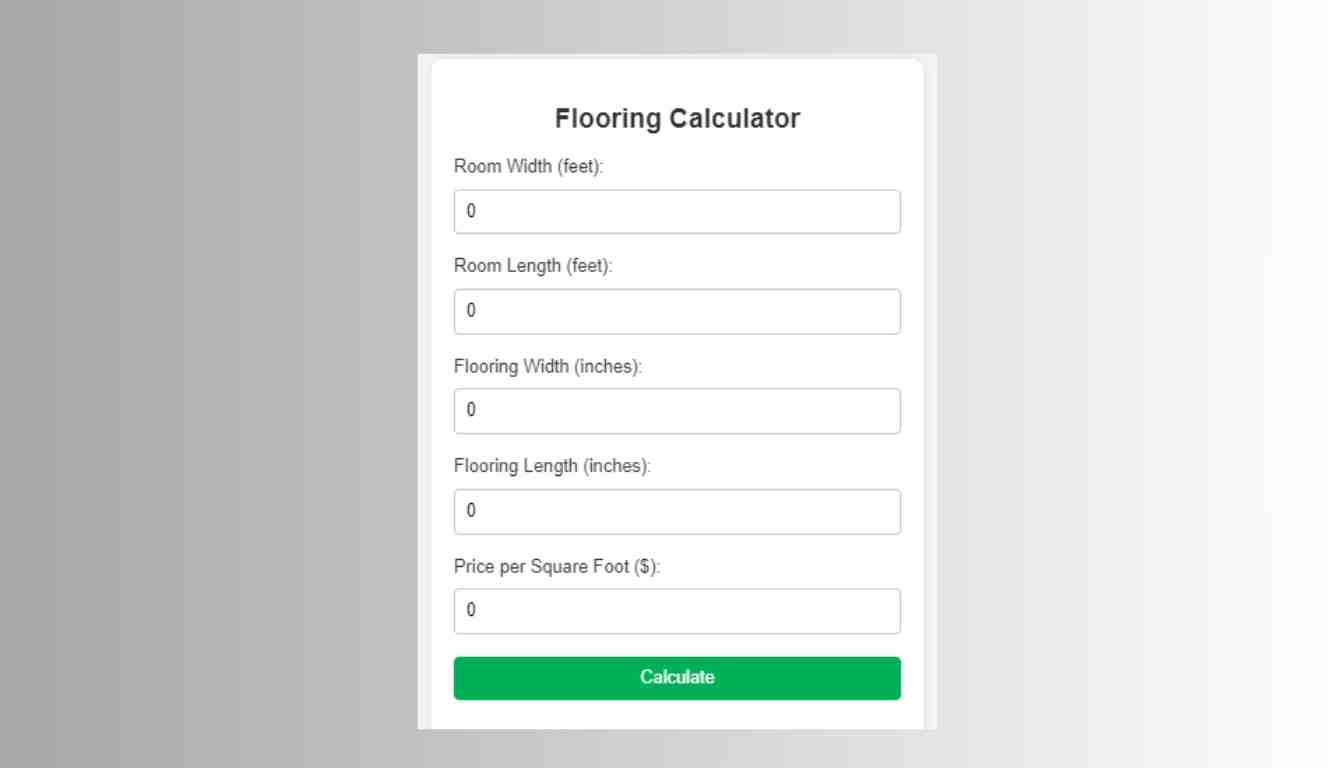
Flooring & Decking Calculator
Pick the calculator that matches your project. Every tab includes a waste buffer so your estimate matches what you’ll actually need to buy.
Enter your values and click calculate.
Enter your values and click calculate.
Reverse: Find Price Per Unit From a Total Quote
Use this to compare a contractor quote against a per-unit price.
Enter your values and click calculate.
Enter your values and click calculate.
Enter your values and click calculate.
How to Use These Calculators
Measure length and width in feet (or meters) for each room, deck, or section you’re covering. Break irregular rooms into rectangles and add the areas together.
Check the box coverage (flooring), board dimensions (decking), or coverage rate per gallon (stain/sealant) printed on the product, or divide a bundle price by its coverage area.
10% is typical for straight layouts; use 15-20% for diagonal layouts, irregular rooms, or rough/porous wood that soaks up more finish.
Flooring and decking are sold by the box or board, so round up. Use the buffered total to compare against contractor quotes, which usually already include waste.
Reference Table: Waste Buffers & Coverage Rates
| Material / project type | Typical waste buffer | Typical coverage |
|---|---|---|
| Simple square/rectangular room or deck | 5-10% | – |
| Room with alcoves or angles | 10-15% | – |
| Diagonal pattern layout | 15-20% | – |
| Herringbone or complex pattern | 20%+ | – |
| Laminate/hardwood flooring carton | 10% standard | 20-24 sq ft per box |
| Composite decking boards (e.g. TimberTech) | 10% standard | 1/8-1/4 in gap, 12/16/20 ft lengths |
| Deck stain/sealant, smooth wood | 10% | 250-400 sq ft/gallon |
| Deck stain/sealant, rough or weathered wood | 15-20% | 150-250 sq ft/gallon |
Common Mistakes to Avoid
- Forgetting to add a waste buffer, then running short mid-project.
- Using a per-box or per-board price without dividing by its actual coverage area.
- Not rounding up to full boxes or boards — flooring and decking are sold in fixed units.
- Mixing up price per square foot with price per linear foot for plank-style materials.
- Ignoring wood porosity when estimating stain or sealant — rough and weathered wood can need 20-35% more finish.
- Ordering flooring or deck boards from multiple batches, risking visible dye-lot or shade differences.
- Assuming a deck board calculator also covers framing — joist spacing and structural requirements follow separate code and span tables.
When the Estimate May Be Wrong
These calculators assume simple rectangular areas and standard material coverage. For rooms or decks with alcoves, closets, curves, or irregular shapes, break the space into rectangles and sum the results, or increase the waste buffer to compensate. Always confirm your specific product’s coverage rate on the label, since it varies by brand.
FAQs
How do I calculate cost per square foot?
Multiply the area (length x width) by the material’s price per square foot — or use the Cost by Area tab above to do it instantly, including a waste buffer.
How much waste buffer should I add for flooring or decking?
5-10% for a simple rectangular room or deck, 10-15% for rooms with alcoves or angles, 15-20% for diagonal patterns, and 20%+ for herringbone or complex layouts. Deck boards and stain both use the same ranges.
How many square feet are in a box of laminate or hardwood flooring?
Most flooring cartons cover 20-24 sq ft, though this varies by brand and plank size — always confirm the coverage printed on your specific box before buying, and round purchases up to full boxes. See our guide on how many square feet are in a box of hardwood flooring for a full breakdown by plank width and type.
What is a good cost per square foot for a home renovation?
It varies widely by project scope, but mid-range whole-home renovations in the U.S. commonly run $100-$200 per square foot in 2026, while high-end remodels can exceed $300 per square foot.
How do you convert square meters to square feet?
Multiply the square meter figure by 10.7639 to get the equivalent in square feet. This is the precise conversion based on 1 meter equaling 3.28084 feet, and it’s built into the Square Footage tab above.
How many deck boards do I need for a 12×16 deck?
For a 192 sq ft deck using standard 5.5 in wide, 12 ft boards with a 1/8 in gap, you need about 33 boards before waste, or roughly 36-37 with a 10% buffer. Enter your own dimensions in the Decking Boards tab for an exact count.
What is the standard gap between deck boards?
Most manufacturers, including composite brands like TimberTech, specify a 1/8 in to 1/4 in gap between boards for drainage and thermal expansion — 3/16 in is a common default with hidden-fastener systems.
Does this calculator account for joist spacing or framing?
No. These tools estimate material quantity and area coverage only. Joist spacing (typically 16 in on-center) and structural framing are separate requirements that should follow your local building code and the decking manufacturer’s span tables.
Does wood porosity or age affect how much stain or sealant I need?
Yes. Porous or rough-sawn softwoods and weathered outdoor wood absorb more finish than smooth, dense, or already-sealed surfaces — the Deck Stain tab includes a condition multiplier to account for this.
Should I buy all my flooring or decking material in one order?
Yes where possible. Ordering flooring in one batch helps match dye lots across rooms (color can shift slightly between production runs), and ordering deck boards together reduces the chance of visible shade or profile differences.
Sources and Methodology
These tools use standard area math (length x width, or circumference for curved sections), manufacturer-published coverage rates, and construction-industry waste-buffer ranges based on typical flooring, decking, and finishing practice. Figures are planning estimates — always verify final quantities against your specific product’s label and your own measurements.
Sponsored / affiliate links. As an Amazon Associate I earn from qualifying purchases. I may earn additional commission from eligible campaigns.