Screw and Nail Organizer: 5 Types Compared (+ Best Picks)
A screw and nail organizer generally falls into one of five types — drawer cabinets, portable cases, wall-mounted bins, magnetic trays, or rotating carousels — and picking the wrong one means mismatched screws end up back in a coffee can within weeks. A 44-drawer cabinet with 2-inch compartments, for example, can’t hold 3-inch deck screws. This guide compares all five types by drawer count, portability, and price, then names our top pick in each category.
What Are the Main Types of Screw and Nail Organizers?
Best Screw and Nail Organizer Pick
Akro-Mils 44-Drawer Plastic Storage Cabinet (10144)
A 44-drawer stackable cabinet built in the U.S.A. from high-impact plastic, with molded-in dividers and keyhole slots for wall mounting.
- Best for: A large, growing screw and nail collection that needs a fixed spot in the garage
- Why we picked it: 44 drawers cover most size ranges without buying a second cabinet, and it stacks if you outgrow it
- Main drawback: Not portable — it’s built to stay wall-mounted or shelved, not carried to a job site
Compare more screw and nail organizer options
 Option 1 IRIS USA 44-Drawer Small Parts Organizer
|
 Option 2 DEWALT TSTAK V Organizer (DWST17805)
|
 Option 3 KJE 30-Piece Wall Mounted Storage Bins
|
As an Amazon Associate we earn from qualifying purchases.
Most screw and nail organizers on the market fall into five categories, and each one solves a different storage problem. Knowing which type matches your workspace — a fixed garage cabinet versus a case you carry to job sites — narrows the decision fast.
Modular Drawer Cabinets
Stackable plastic cabinets with 24 to 64 small pull-out drawers, like the Akro-Mils and IRIS USA lines. Best for a fixed spot in a garage or workshop where you sort a large, growing hardware collection by size.
Portable Divided Cases
Single-box cases with a hinged, often clear lid and removable dividers, such as the DEWALT TSTAK small-parts organizer. Best for contractors who need to haul a curated set of fasteners between job sites.
Wall-Mounted Pegboard Bins
Small open-top bins that clip onto a pegboard or rail system, like the KJE 30-piece set. Best for keeping a workbench surface clear while hardware stays visible and within arm’s reach.
Magnetic Parts Trays
Flat magnetic dishes that hold loose screws mid-project so they don’t roll off a ladder or workbench. Best as a companion to one of the other four types, not a full storage solution — a magnetic tray holds what you’re using right now, not your whole inventory.
Rotating Parts Carousels
A tower of small bins that spins on a base, common in electrical and hardware supply shops. Best for a shared workshop where multiple people need to reach the same hardware from different sides of a bench.
| Organizer Type | Compartment Count | Portability | Typical Price Range | Best For |
|---|---|---|---|---|
| Drawer Cabinet | 24–64 drawers | Low (fixed) | $20–$45 | Large, growing hardware collection |
| Portable Case | 2–9 compartments | High | $15–$35 | Job-site contractors |
| Wall-Mounted Bins | 20–36 bins | Low (fixed) | $20–$40 | Clearing bench surface space |
| Magnetic Tray | 1 open tray | High | $8–$15 | Mid-project, temporary holding |
| Rotating Carousel | 16–40 bins | Low (fixed) | $30–$60 | Shared, multi-user workshops |
Compartment counts and prices reflect the specific products compared later in this guide, current as of this writing; check current listings before buying.
📊 DEWALT rates its TSTAK V small-parts organizer (DWST17805) at a 22 lb load capacity — enough for a loaded compartment of mixed screws and small hardware without stressing the latch. Source: DEWALT official product page, DWST17805 spec sheet (dewalt.com).
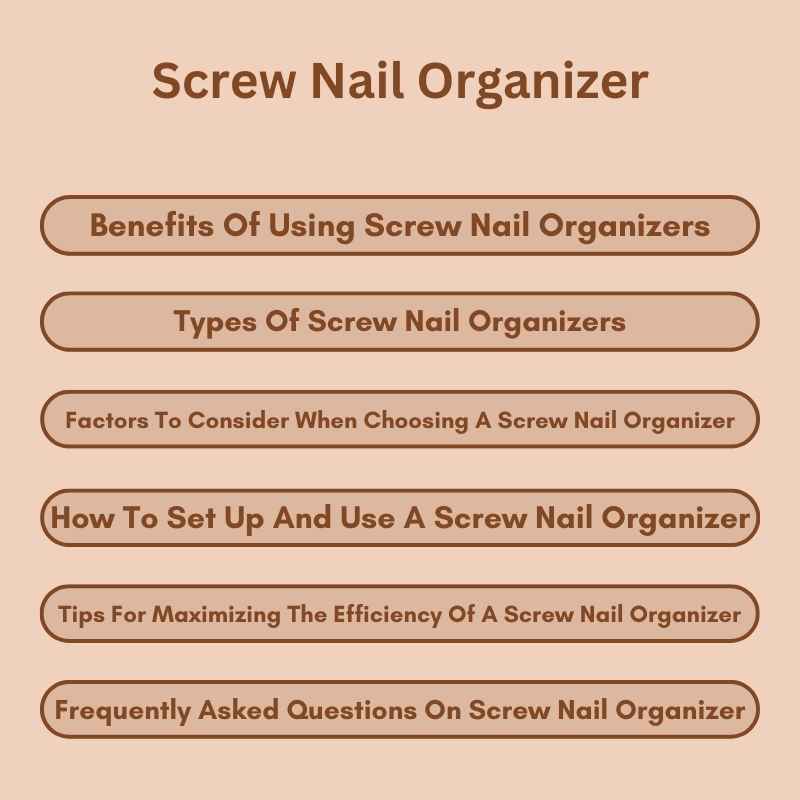
Benefits Of Using Screw Nail Organizers
Organizing your screws and nails changes how a project actually goes, not just how the shelf looks. Here are the two biggest, measurable benefits.
Saves Time And Effort
- Find the right size fast: No rummaging through a mixed bin to identify a screw by eye.
- Finish projects faster: Less time searching means more time actually building.
Reduces Clutter And Risk
- Neat storage: A dedicated organizer keeps a workbench clear.
- Fewer accidents: Loose nails and screws on a floor or bench are a real puncture and slip hazard.
Factors To Consider When Choosing A Screw And Nail Organizer
When selecting a screw and nail organizer, size and capacity matter more than style. Match the organizer to your actual hardware collection, not the other way around.
Size and Capacity
Count roughly how many distinct screw and nail sizes you keep on hand before buying. A larger drawer cabinet suits professionals or frequent DIYers; a small portable case is enough for occasional use.
Material and Durability
Polypropylene plastic resists cracking at the hinges better than thin, brittle plastics, which is where most cheap organizers actually fail first. Impact-resistant polycarbonate lids hold up better if you drop the case on a concrete floor.
“I stopped trusting handwritten labels years ago — a drawer marked ‘#8 x 1’ is often actually holding #10s by the third refill. Now I check a sample screw against a size gauge before relabeling, instead of going by memory.”
How To Set Up And Use A Screw And Nail Organizer
Keeping screws and nails organized is a five-step process whether you’re setting up a new drawer cabinet or a portable case.
Organizing Screws And Nails
- Sort by size and type: Group your screws and nails by size, type, or project purpose before loading any container.
- Choose your organizer type: Pick a drawer cabinet, portable case, or wall-mounted bin system that matches your workspace and how often you move it.
- Label every compartment: Mark each section with the exact size or type so you’re not guessing mid-project.
- Load and arrange: Transfer fasteners into their labeled sections, keeping bulk or heavier fasteners in reinforced compartments.
- Use clear lids for a stock check: Clear or semi-transparent lids let you see what’s running low without opening every drawer.
Maintaining Order
- Declutter regularly — remove unused or mismatched hardware to free up compartments.
- Return screws and nails to their labeled section immediately after use instead of leaving them on the bench.
- Keep the workspace clear — loose hardware on the floor is a real safety hazard.
- Pro tip: A small shop vacuum or brush dedicated to sweeping up stray screws and nails keeps the area around the organizer clear.
Following this five-step process keeps your hardware storage setup system usable long-term instead of turning back into a mixed bin within a few months.
Tips For Maximizing The Efficiency Of A Screw And Nail Organizer
Labeling Systems
A wet-erase marker works better than a permanent label maker here — your hardware mix will change as you restock, and a wet-erase label wipes clean and updates in seconds. Identify your most-used sizes first, then label those compartments before tackling the rest.
Regular Maintenance
Clean out dust and debris from compartments with a small brush or compressed air every few months so drawers keep sliding freely. Check that dividers are still seated correctly — a shifted divider is the most common cause of two fastener sizes mixing together.
Review your labeling periodically as your hardware collection changes. A system that matches what you actually keep on hand, checked every few months, stays useful far longer than one set up once and never revisited.
Frequently Asked Questions
Can a screw and nail organizer hold different sizes of nails?
Yes. Most organizers use adjustable compartments or removable dividers, so you can resize a section to fit anything from small brads to long deck nails as your collection changes.
Should I choose a drawer cabinet or a portable case?
Choose a drawer cabinet if your hardware stays in one garage or workshop. Choose a portable case if you regularly carry fasteners to different job sites or projects.
How do I stop screws and nails from mixing between compartments?
Pick an organizer where the lid presses flush against the dividers when closed. If the lid doesn’t seal against every divider wall, small items shift into neighboring compartments whenever the case is moved or tipped.
How do I prevent rust inside a metal hardware organizer?
Keep the organizer in a dry area away from a damp basement or garage floor. A silica gel packet in a couple of compartments absorbs stray moisture and protects uncoated steel fasteners and metal cabinet drawers alike.
How does a screw and nail organizer benefit DIY enthusiasts?
It removes the search time from every project. Instead of digging through a mixed jar or drawer, you go straight to the labeled compartment holding the exact size you need.
Is a screw and nail organizer portable?
Portable cases are, typically with a carry handle and secure latch built for job-site use. Drawer cabinets and wall-mounted bin systems are designed to stay fixed in one location instead.
Conclusion
The right screw and nail organizer comes down to matching the type — drawer cabinet, portable case, wall-mounted bins, magnetic tray, or rotating carousel — to how and where you actually work. Once you’ve sorted your hardware into a system that fits, check out our guide to organizing drill bits next, since many of the same drawer cabinets covered here double as drill bit storage too.
Sponsored / affiliate links. As an Amazon Associate I earn from qualifying purchases. I may earn additional commission from eligible campaigns.
 Hardware Organizer Box 34 Compartments Small Parts Organizer with Removable Dividers Durable Plastic Double Side Tools Box Screw Organizer For Nuts, Bolts, Screws, Nails, Small Hardware (Yellow)
 Hardware Organizer Box with 34 Compartments & Removable Dividers - Durable Plastic Double Side Tools Box for Nuts, Bolts, Screws, Nails & Small Hardware (Blue)