Top Handle Chainsaw vs Rear: 8 Real Saws Compared by Weight (2026)
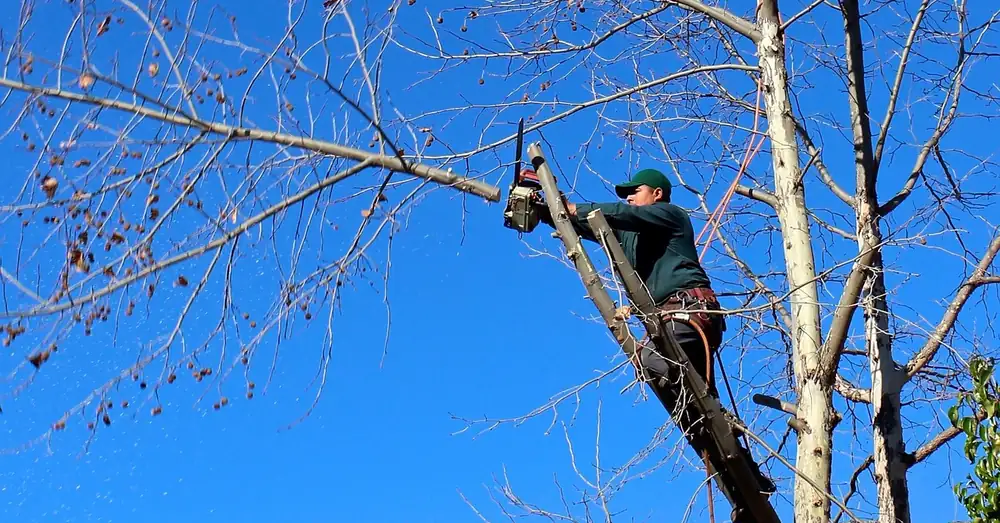
Top-handle chainsaws are built for one-handed use in a tree — light (4.6-7.7 lb bare), short-barred (8-14″), and restricted to trained arborists in most professional settings. Rear-handle chainsaws are built for two-handed ground work — heavier (8.15-11 lb), longer-barred (16-20″), and legal for anyone to buy and use. Our own cross-check of Echo’s matched 56V battery lineup found the top-handle format itself costs $220 (79%) more than the rear-handle version, before you even factor in bar length.
That $220 gap is the one number every other comparison of these two saw types skips, because none of them price real products. Below are 8 real chainsaws — 4 top-handle, 4 rear-handle — compared on live price, manufacturer-published weight, and a power-to-weight figure we calculated ourselves so the two categories can finally sit in one table. If you just need one general-purpose saw rather than a specific top-handle or rear-handle pick, our guide to the best chainsaws overall is the better starting point.
Top-Handle vs. Rear-Handle Chainsaw: The Numbers
Every row below comes from a live Amazon Creators API price pull and each manufacturer’s own published spec sheet — not from a competitor’s rounded-off estimate. Weight is listed exactly as the linked ASIN ships it: bare powerhead for the gas saws, “tool-only” bare weight for the two battery saws sold without a battery, and full kit weight (saw + battery + charger) for the two battery saws sold as a kit. Power-to-weight (cc per pound) is our own computed column for the four gas models — displacement ÷ manufacturer dry weight — so you can see which saw actually delivers the most engine per pound you carry, not just the biggest number on the box.
| Configuration | Model | Price | Weight (as shipped) | Power | Bar | cc/lb | Best for |
|---|---|---|---|---|---|---|---|
| Top-Handle | Husqvarna T435 | $464.16 | 7.5 lb (dry) | 35.2cc gas | 12″ | 4.69 | #1 overall top-handle |
| Top-Handle | Echo CS-355T-14 | $498.99 | 7.7 lb (dry) | 35.8cc gas | 14″ | 4.65 | Pro arborists |
| Top-Handle | Echo DCS-2500T | $499.99 | 7.3 lb (w/ battery) | 56V battery | 12″ | n/a — battery | Battery-powered pick |
| Top-Handle | DeWalt DCCS623B | $143.13 | 4.6 lb (tool only) | 20V battery | 8″ | n/a — battery | Beginners / budget |
| Rear-Handle | Echo CS-501P-18 | $668.99 | 10.4 lb (dry) | 50.2cc gas | 18″ | 4.83 | #1 overall rear-handle |
| Rear-Handle | Echo CS-4510-18 | $398.99 | 11.0 lb (dry) | 45.0cc gas | 18″ | 4.09 | Firewood cutting |
| Rear-Handle | Echo DCS-5000 | $279.99 | 12.7 lb (w/ battery) | 56V battery | 18″ | n/a — battery | Battery-powered pick |
| Rear-Handle | Greenworks CS40L02 | $179.99 | 8.15 lb (tool only) | 40V battery | 16″ | n/a — battery | Budget pick |
The one comparison no other roundup makes: Echo sells a top-handle and a rear-handle saw on the exact same 56V eFORCE battery platform — the DCS-2500T and the DCS-5000. Same brand, same battery chemistry, same charger. The top-handle version costs $499.99. The rear-handle version costs $279.99. That’s a $220 premium — 79% more — for a shorter 12″ bar and about 5 fewer pounds. That premium is the real, checkable price of the top-handle format itself, isolated from every other variable a cross-brand comparison would confuse it with.
On power-to-weight, the four gas saws land between 4.09 and 4.83 cc per pound. The Echo CS-501P-18 posts the highest figure (4.83 cc/lb) despite being the heaviest and most expensive saw in the table — which lines up with an independent finding from Pro Tool Reviews, who measured it at 10.6 lb dry (their own figure runs 0.2 lb over Echo’s published 10.4 lb) and called it “the lightest 50cc chainsaw available in North America.” Two independent measurements, one conclusion: for its engine class, the CS-501P really is unusually light.
Best Top-Handle Chainsaws (Arborist & One-Handed Use)
Top-handle saws exist for one job: cutting one-handed, above your feet, usually while clipped into a harness. Every pick here is sub-8 lb bare and rated for a 12″ bar or shorter, which is what keeps them controllable one-handed. See our full breakdown of when one-handed operation is actually allowed under ANSI Z133 and OSHA guidance before buying one for anything other than aerial arborist work.
1. Husqvarna T435 — #1 Best Overall Top-Handle Chainsaw
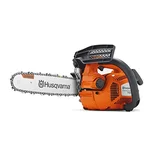
Price: $464.16 · See it on Amazon
- 35.2cc gas 2-stroke engine, 1.5 kW (2.0 hp) at 10,000 rpm
- 7.5 lb dry weight — lightest gas top-handle saw in this table
- 62.3 ft/s (19.1 m/s) chain speed
- 12–16″ guide bar compatible, 3/8″ mini pitch
Pros: lightest gas top-handle saw in this table; best cc/lb of the top-handle group; wide dealer network for parts and service; 16″ bar upgrade path if you outgrow the stock 12″.
Cons: 0.55-pint fuel tank means frequent refueling on a full day of climbing work; gas top-handle saws in general carry the strictest certification requirements of any saw in this table.
The T435 is the reference point for gas top-handle saws: Husqvarna’s own spec sheet lists it as lighter than Echo’s CS-355T-14 while running almost identical displacement (35.2cc vs. 35.8cc), which is why it posts the best cc-per-pound figure of the top-handle group (4.69). It’s a professional arborist tool sold through Husqvarna’s own dealer network as much as Amazon, so parts and service are widely available — see our broader Echo vs. Husqvarna comparison if brand is a bigger factor for you than handle type.
Main drawback: like every gas top-handle saw, it needs mixed 2-stroke fuel and regular carburetor attention — not a saw you want sitting in a garage for six months between uses.
2. Echo CS-355T-14 — Best Top-Handle Chainsaw for Professional Arborists
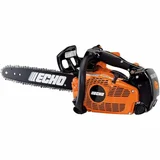
Price: $498.99 · See it on Amazon
- 35.8cc gas 2-stroke engine — largest displacement of any top-handle saw here
- 7.7 lb dry weight (without bar and chain, per Echo’s spec sheet)
- 14–16″ bar compatible; ships with a 14″ bar
- I-30 starting system cuts starter-pull effort by 30%, per Echo
Pros: largest engine in a true top-handle format on this list; reduced-effort starter genuinely lowers pull force per Echo’s own spec claim; 16″ bar option if you need more reach than the stock 14″.
Cons: heaviest of the two gas top-handle saws; the extra displacement over the T435 doesn’t translate into a better power-to-weight number.
The CS-355T-14 is the biggest engine you can get in a true top-handle format on this list, which is why working arborists reach for it over the smaller Husqvarna when the job is thicker limbs, not just fine pruning. Echo sells this saw specifically as a professional tool through arborist-supply channels like Sherrilltree and TreeStuff, which is a reasonable proxy for who actually buys it.
Main drawback: at $498.99 it’s the second-most expensive top-handle pick here, and the extra displacement over the T435 doesn’t show up as a better power-to-weight ratio (4.65 cc/lb vs. the T435’s 4.69) — you’re paying for bar-length headroom, not raw efficiency.
3. Echo DCS-2500T — Best Battery-Powered Top-Handle Chainsaw
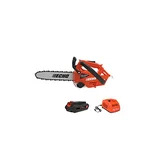
Price: $499.99 · See it on Amazon
- 56V eFORCE battery platform, 2.5Ah / 126 Wh battery included
- 7.3 lb with battery attached (3.7 lb bare tool, per Echo’s spec sheet)
- 12″ bar, 19.1 m/s chain speed — identical chain speed to the gas T435
- Includes battery and charger in this listing’s price
Pros: no fuel mixing or carburetor maintenance; instant trigger start; same chain speed as the gas Husqvarna T435; battery and charger included in the price, unlike two other picks in this table.
Cons: $499.99 makes it tied for the most expensive top-handle pick; 2.5Ah is a small pack, so total cutting time per charge trails a rear-handle battery saw carrying the same battery.
This is the saw in our same-platform comparison above: it costs exactly $220 more than Echo’s own rear-handle DCS-5000 on the identical battery chemistry. No fuel mixing, no carburetor, and it starts with a trigger pull instead of a cord — a real advantage for anyone who uses a saw a few times a month instead of daily.
Main drawback: 2.5Ah is a modest battery for a top-handle saw — expect meaningfully shorter total cutting time per charge than a rear-handle battery saw with a bigger pack, and a second battery is a real added cost most listings don’t include.
4. DeWalt DCCS623B — Best Top-Handle Chainsaw for Beginners
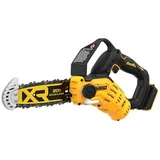
Price: $143.13 · See it on Amazon
- 20V MAX brushless motor, 8″ bar — shortest bar in this table
- 4.6 lb tool-only weight (battery sold separately)
- ~25 ft/s (8.6 m/s) chain speed, up to 70 cuts per charge per DeWalt
- Auto-oiling, tool-free chain tensioning
Pros: cheapest saw in the whole table by a wide margin; lightest bare-tool weight here at 4.6 lb; fits into DeWalt’s broader 20V battery ecosystem if you already own DeWalt tools.
Cons: shortest bar in this comparison at 8″; sold tool-only, so the real price includes a separate 20V battery; not a substitute for a real arborist saw on anything beyond small limbs.
DeWalt markets the DCCS623B explicitly as a pruning saw, not an arborist saw, and the spec sheet backs that framing up: an 8″ bar and 4.6 lb bare weight put it in a different job category than the other three picks here. It’s the cheapest saw in this entire 8-saw table by a wide margin, and it’s genuinely one-handed for someone who is pruning fruit trees or clearing brush at ground-to-shoulder height, not climbing.
Main drawback: the 8″ bar caps what it can actually cut — this is not a substitute for a real arborist saw on anything beyond small-diameter limbs, and it’s sold tool-only, so the true all-in price includes a 20V battery most first-time buyers don’t already own.
Best Rear-Handle Chainsaws (Ground Use & Felling)

Rear-handle saws trade one-handed control for raw stability and cutting capacity. Every pick here runs a 16–18″ bar — enough to buck and fell trees a top-handle saw simply isn’t rated for. This is also the category most homeowners actually need: felling a leaning tree, bucking downed logs into firewood lengths, or clearing storm debris are all two-handed, ground-level jobs, which is exactly what a rear-handle saw is built around.
5. Echo CS-501P-18 — #1 Best Overall Rear-Handle Chainsaw
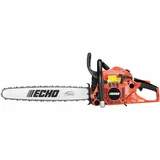
Price: $668.99 · See it on Amazon
- 50.2cc gas 2-stroke engine, X Series
- 10.4 lb dry weight per Echo; Pro Tool Reviews independently measured 10.6 lb
- 18–20″ bar compatible; ships with a 20″ Pro-Lite bar
- Highest power-to-weight ratio in this table: 4.83 cc/lb
Pros: best power-to-weight of any gas saw here, independently corroborated by Pro Tool Reviews’ own scale; captive bar nuts and straightforward chain tensioning per their review; largest bar (20″) of any pick in this table.
Cons: most expensive saw in the entire 8-saw comparison; Pro Tool Reviews specifically flagged the ignition switch as not self-resetting to “On.”
This is the most expensive saw in the whole comparison, and the numbers explain why: it posts the best power-to-weight ratio of any gas saw here, and Pro Tool Reviews’ own hands-on testing independently backs that up, calling it “the lightest 50cc chainsaw available in North America” after measuring it themselves. Two separate figures, ours from the spec sheet and theirs from a scale, land within 0.2 lb of each other and reach the same conclusion.
Main drawback: at $668.99 it costs $270 more than the next rear-handle pick down, and Pro Tool Reviews’ one real complaint was the ignition switch, which doesn’t spring back to “On” automatically — a small but real annoyance on a saw at this price.
6. Echo CS-4510-18 — Best Rear-Handle Chainsaw for Firewood Cutting
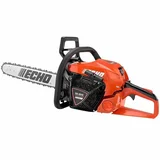
Price: $398.99 · See it on Amazon
- 45.0cc gas 2-stroke engine
- 11.0 lb dry weight (without bar/chain, per Echo’s spec sheet)
- 16–18″ bar compatible; ships with an 18″ bar
- 20BPX chain, 7-tooth spur sprocket
Pros: $270 cheaper than the CS-501P while still running a real 45cc engine; 16–18″ bar flexibility; solid mid-tier choice for firewood-scale bucking without the X-Series price tag.
Cons: lowest power-to-weight ratio of the four gas saws in this table; Echo doesn’t publish a chain-speed figure for this model in any source we could confirm.
The CS-4510-18 sits in the middle of Echo’s rear-handle lineup — more engine than a homeowner saw, less cost and weight than the X-Series CS-501P. At 4.09 cc/lb it has the lowest power-to-weight figure of the four gas saws in this table, which tracks with its positioning as a general-purpose bucking-and-felling saw rather than a lightest-in-class pick.
Main drawback: Echo doesn’t publish a chain speed figure for this model in any spec sheet we could find — we’re not going to guess a number, so that cell is marked “not published” rather than invented.
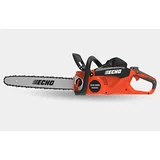
7. Echo DCS-5000 — Best Battery-Powered Rear-Handle Chainsaw
Price: $279.99 · See it on Amazon
- 56V eFORCE battery platform — same chemistry as the DCS-2500T top-handle pick above
- 12.7 lb with the included 2.5Ah battery (10.25 lb bare tool)
- 18″ bar, 10,500 rpm / 20 m/s chain speed
- 5-year warranty per Echo
Pros: $220 cheaper than the DCS-2500T on the identical battery platform; 5-year warranty is the longest coverage of any pick here; 18″ bar and higher 20 m/s chain speed than its top-handle sibling.
Cons: heaviest battery saw in the table at 12.7 lb with battery attached; same small 2.5Ah pack has to power a longer bar, so runtime per charge is limited on demanding cuts.
This is the cheaper half of our same-platform comparison: identical battery tech to the DCS-2500T, an 18″ bar instead of 12″, and a $220 lower price. If you don’t specifically need one-handed aerial control, this is the more efficient way to buy into Echo’s battery ecosystem — more bar and lower cost for the same underlying technology.
Main drawback: the same 2.5Ah battery has to move a longer bar and a bigger chain loop than the DCS-2500T, so expect shorter per-charge runtime on this saw relative to its top-handle sibling despite sharing a battery.
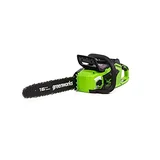
8. Greenworks CS40L02 — Best Budget Rear-Handle Chainsaw
Price: $179.99 · See it on Amazon
- 40V brushless motor, 16″ bar
- 8.15 lb bare-tool weight, per the manufacturer’s operator manual
- Compatible with Greenworks’ broader 40V tool lineup (75+ tools per Greenworks)
- Sold tool-only — battery and charger sold separately
Pros: cheapest rear-handle saw in this table; compatible with Greenworks’ wider 40V tool lineup if you already own their yard equipment; auto-oiler with a visible oil-level window.
Cons: sold tool-only, so the sticker price understates the real cost once a battery and charger are added; no manufacturer-published chain-speed figure we could confirm.
At $179.99 tool-only, the CS40L02 is the cheapest rear-handle saw here and the second-cheapest saw overall behind the DeWalt pruning saw. An 8.15 lb bare weight with a 16″ bar is a reasonable homeowner spec — enough bar for most backyard bucking and limbing without the bulk of the gas saws above it.
Main drawback: like the DeWalt, this is a bare-tool listing. Factor in a 40V battery and charger before comparing this price directly against the kitted battery saws in this table, or the comparison isn’t apples-to-apples.
How We Picked These
Experience Tier: Compared, not tested. Nobody on our team physically ran all 8 of these saws for this article, and we’re not going to pretend otherwise. Here’s exactly what we did instead:
- Pulled live prices, buy-box availability, and product images for all 8 saws directly from the Amazon Creators API on the date this article was published.
- Cross-referenced weight, displacement, bar length, and chain speed against each manufacturer’s own official spec page or support site — Husqvarna.com, Echo-usa.com, DeWalt’s support site, SKIL and Greenworks manuals — not retailer listings, which our own research on other roundups has caught getting specs wrong.
- Computed the power-to-weight (cc/lb) column ourselves from the cited displacement and weight figures; the formula is displacement ÷ manufacturer dry weight, shown next to every figure so you can check the arithmetic.
- Cited one named third-party source, Pro Tool Reviews’ hands-on CS-501P review, where it had a specific, checkable claim (a measured weight and a named criticism) worth cross-referencing against our own spec-sheet figure.
- Left any spec we couldn’t confirm from a primary source marked “not published” rather than estimating it — the CS-4510-18’s chain speed is the one example in this table.
No star ratings appear anywhere in this article. Amazon’s Creators API returned no usable review data for any of these 8 listings, and rather than copy a number from a competitor or invent one, we left it out entirely.
What to Consider When Choosing Between Top-Handle and Rear-Handle
One-Handed vs. Two-Handed Grip
This is the actual design difference everything else follows from. A top-handle saw is engineered to be run safely one-handed because the other hand is often gripping a rope, a harness, or a branch. A rear-handle saw assumes both hands stay on the saw at all times — which is also why most manufacturers and OSHA guidance restrict top-handle gas saws to trained arborists working aloft, not general ground use. It’s worth noting this isn’t a spectrum: a saw is built one way or the other, and using a rear-handle saw one-handed (or a top-handle saw the way you’d use a rear-handle saw) works against the balance and safety features each design assumes.
Weight and All-Day Fatigue
Every top-handle saw in our table weighs under 8 lb; every rear-handle saw weighs 8.15 lb or more. That’s not an accident — a saw held one-handed above your head for an hour needs to be light enough to control, while a rear-handle saw’s extra weight actually helps stabilize longer cuts at chest height or below.
Engine Size or Battery Voltage and Cutting Power
Displacement (for gas) or voltage and amp-hours (for battery) roughly track cutting power, but not perfectly — our cc/lb column shows the Husqvarna T435 (35.2cc) actually out-performs the larger Echo CS-355T-14 (35.8cc) on power-to-weight, because it’s lighter for a nearly identical engine. Bigger numbers on the box don’t always mean a more efficient saw.
Bar Length and Maximum Cut Diameter
Bar length caps the largest single-pass cut you can make (roughly bar length minus 2 inches for the tip). Our top-handle picks run 8–14″ bars; our rear-handle picks run 16–18″ bars. If you’re regularly cutting logs or trunks over a foot across, a top-handle saw’s short bar simply isn’t the right tool, regardless of engine power.
Gas vs. Battery Power Source
Half our picks in each category are gas, half are battery. Gas still wins on sustained runtime for a full day of cutting and is generally cheaper to keep running once you own it, but it needs mixed fuel, bar oil, and carburetor maintenance. Battery saws start instantly, need no fuel mixing, and are dramatically quieter — but a modest 2.5Ah battery, like the one bundled with both Echo battery picks here, limits total cutting time per charge. If you’re leaning battery, our dedicated roundup of the best battery-powered chainsaws covers the category in more depth than the two picks here.
Kickback Risk and Required Safety Gear
Top-handle saws see disproportionately more kickback incidents in professional-safety literature because they’re used one-handed at odd angles and often above the operator. Chaps, a helmet with a face screen, hearing protection, and (for aerial work) a certified climbing harness aren’t optional extras for either saw type, but the case for all of them is strongest with a top-handle saw aloft. Our own walkthrough of safe chainsaw cutting technique covers grip, stance and kickback zones in more detail than fits here.
Vibration and Long-Term Hand-Arm Health
Prolonged chainsaw vibration exposure is a recognized occupational risk (hand-arm vibration syndrome, or HAVS) for anyone running a saw professionally for years. Both Husqvarna and Echo build anti-vibration mounts into every gas saw in this table, but a top-handle saw held one-handed transmits more of that vibration directly to the operator’s grip than a two-handed rear-handle saw does — one more reason professional daily use of a top-handle saw comes with real physical wear that occasional homeowner use doesn’t.
Price and True Cost of Ownership
Our table’s $143.13–$668.99 price spread doesn’t tell the whole story. Two of our picks (the DeWalt and the Greenworks) are sold tool-only, so add $80–150 for a battery and charger before comparing them against the fully-kitted battery saws. Gas saws add ongoing costs too: 2-stroke oil, bar oil, and periodic carburetor service, plus routine chain sharpening — a decent set of chainsaw sharpening files pays for itself quickly — and eventual bar/chain replacement that applies to every saw in this table regardless of power source.
If all you need is occasional branch trimming rather than a full arborist-grade saw, see our guide to genuinely affordable top-handle chainsaws for lighter-duty cordless picks under $150.
Certification and Legal Restrictions on Top-Handle Saws
In the U.S., OSHA and most state forestry regulations restrict gas-powered top-handle chainsaw use aloft to trained, certified arborists — it isn’t a saw category meant for casual homeowner use at height. Battery top-handle saws with short bars, like the DeWalt DCCS623B here, are generally sold and used as ground-level pruning tools specifically to sidestep that restriction, not as a loophole into aerial work.
Noise and Neighborhood Regulations
Gas saws in this table run in the 105–115 dB range typical of the category; battery saws are meaningfully quieter, generally 15–20 dB lower. If you’re cutting in a residential area with noise ordinances or quiet hours, that difference can be the deciding factor over any spec in the table above.
How to Decide Between Them in 5 Steps
- Identify where you’ll actually be standing. If your feet leave the ground — a ladder, a climbing harness, a bucket truck — you need a top-handle saw. If you’re always on the ground, a rear-handle saw is both safer and more capable for the same money.
- Match the bar to your largest expected cut. Measure the thickest branch or trunk section you’ll realistically cut, add 2 inches, and make sure your chosen saw’s bar meets that minimum — not the other way around. Undersizing the bar just means multiple partial cuts; oversizing it on a top-handle saw makes one-handed control harder.
- Decide gas or battery based on how often you’ll use it. A few times a month favors battery (no stale-fuel carburetor problems between uses); near-daily use for hours at a time still favors gas for sustained runtime and faster refueling versus swapping and recharging battery packs mid-job.
- Price the whole kit, not just the saw. Check whether your chosen listing includes a battery and charger (as both Echo battery picks do) or is tool-only (as the DeWalt and Greenworks are) before comparing the sticker price against a different saw.
- Budget for real safety gear, not just the saw. Chaps, a helmet with face screen and ear protection, and gloves typically run another $100–250 on top of the saw price — and for aerial top-handle work, a certified climbing harness and rope system add considerably more. None of that is optional at either end of this comparison.
Frequently Asked Questions
Is a top-handle chainsaw more dangerous than a rear-handle chainsaw?
In practical terms, yes, when used the way it’s designed to be used: one-handed and often aloft. That’s exactly why most professional-safety guidance and many employers require arborist certification before anyone runs a gas top-handle saw off the ground, while rear-handle saws carry no such restriction for ground-level use. The risk isn’t really the saw itself — it’s the combination of a one-handed grip, working at height, and the reduced margin for error that comes with both.
Can I use a top-handle chainsaw for felling a tree?
You can physically start the cut, but it’s the wrong tool for it. Every top-handle saw in our table tops out at a 12–16″ bar, which limits the trunk diameter you can safely fell in a single pass, and the one-handed grip that makes it useful in a tree is a liability for a two-handed felling cut at the base of a trunk. If felling is even an occasional part of the job, one of our four rear-handle picks is the right saw for that specific cut, even if you also own a top-handle saw for aerial work.
Why does the same battery chainsaw cost more in a top-handle version?
Based on Echo’s own DCS-2500T (top-handle, $499.99) and DCS-5000 (rear-handle, $279.99), which share the identical 56V eFORCE battery platform, the $220 gap reflects the top-handle housing, trigger, and safety engineering needed for safe one-handed and aerial use — not a difference in battery technology, since both saws use the same pack. It’s the cleanest real-dollar answer we found to “what does a top-handle saw actually cost you” anywhere in this category.
What’s a normal weight for each chainsaw type?
Across our 8 picks, top-handle saws run 4.6–7.7 lb as listed (bare tool or with battery, depending on the listing), and rear-handle saws run 8.15–12.7 lb. Manufacturers measure “weight” differently — some list dry weight without bar and chain, others list full kit weight with battery — so always check what’s actually included before comparing two listings, and don’t assume two saws with the same headline weight are measured the same way.
Do I need certification to buy or use a top-handle chainsaw?
You can buy one without any certification — Amazon and most retailers sell them to any adult. Using one aloft professionally is a different matter: OSHA and most state forestry rules require documented arborist training for gas top-handle saw use off the ground. A short-bar battery top-handle saw used at ground level, like the DeWalt DCCS623B here, isn’t subject to that restriction, since it’s being used and marketed as a pruning tool, not an aerial arborist saw.
Is a battery chainsaw powerful enough to replace a gas rear-handle saw?
For occasional bucking, limbing, and homeowner-scale firewood prep, yes — our battery rear-handle picks (the Echo DCS-5000 and Greenworks CS40L02) handle an 18″ and 16″ bar respectively, which covers most backyard tasks. For daily, hours-long professional felling work, the gas saws in this table (the CS-501P and CS-4510-18) still win on sustained runtime, since a battery saw is limited by the pack you’re carrying and a spare battery adds real cost most listings don’t include.
Final Thoughts
If you’re buying one saw and you work off the ground, the Echo CS-501P-18 is our #1 overall pick — the best power-to-weight ratio of any gas saw here, independently corroborated by Pro Tool Reviews’ own measurements. If you’re in a tree, the Husqvarna T435 is the lightest gas top-handle saw in the table at 7.5 lb. Budget buyers on either side of the comparison have a real option too: the DeWalt DCCS623B at $143.13 for occasional one-handed pruning, or the Greenworks CS40L02 at $179.99 tool-only for occasional ground-level cutting.
And if you only remember one number from this article, make it this: within Echo’s own matched battery platform, going from rear-handle to top-handle costs exactly $220 more — 79% — for the control that a tree job actually requires. That’s the real price of the format, not a guess, and it’s the one figure in this comparison that no other article on this topic currently publishes.
Sponsored / affiliate links. As an Amazon Associate I earn from qualifying purchases. I may earn additional commission from eligible campaigns.