Best Small Circular Saw: 8 Compared by Blade Size & Cost (2026)
The DEWALT DCS565B is the best small circular saw overall: a 6-1/2" blade with a 2-1/8" max cut depth — deeper than any other bare tool in this comparison — on the widest cordless battery platform here (DEWALT 20V MAX/FLEXVOLT), for $119.00. If you already own 24V PowerAll batteries, the Greenworks CRG404 undercuts it on cost per inch of cut depth ($44.44 vs. $55.99); if you own nothing yet, SKIL’s $102.79 kit is the cheapest way to start cutting today.
We compared 8 small circular saws (also marketed as “compact circular saws”) — blade diameters from 3-3/8" up to 6-1/2", spanning five cordless battery platforms plus one corded model — on the four things that actually separate a genuinely small circular saw from a full-size 7-1/4" saw: blade diameter, maximum cut depth, weight, and what it costs per inch of that cut depth. Prices and specs below are live as of this update; see the methodology section for exactly how they were sourced.
Small Circular Saws Compared: Cost Per Inch of Cut Depth
Every number below comes from the manufacturer’s own spec sheet or a live Amazon Creators API price pull this session — not a competitor’s article. Cost per inch of cut depth is price ÷ max cut depth at 90°, and it is the one number no other small-circular-saw roundup we checked publishes. It only works as a fair comparison if you also check the Tier column: a bare-tool price and a full-kit price (battery + charger included) are not the same purchase, so they’re labeled separately below rather than blended into one misleading ranking.
| Model | Blade Diameter | Max Cut Depth @90° | Weight | Battery Platform | Price (as tested) | $ / inch of cut depth | Verdict / Award |
|---|---|---|---|---|---|---|---|
| 1. DEWALT DCS565B 20V MAX 6-1/2″ Circular Saw | 6-1/2″ | 2-1/8″ (2.125″) | 6.3 lb (bare tool) | DEWALT 20V MAX / FLEXVOLT | $119.00 — Bare tool | $55.99 | #1 Best Overall |
| 2. SKIL PWR CORE 20 CR6413B-11 6-1/2″ Circular Saw Kit | 6-1/2″ | 2-1/4″ (2.25″) | 5.2 lb bare / 6.0 lb with battery | SKIL PWR CORE 20 | $102.79 — Full kit (battery + charger + blade) | $45.68 | Best Value (Cheapest Complete Kit) |
| 3. Makita SH02R1 12V Max CXT 3-3/8″ Circular Saw Kit | 3-3/8″ | 1″ at 90° (5/8″ at 45°) | 3.5 lb (with 2.0Ah battery) | Makita 12V max CXT | $149.00 — Full kit (battery + charger) | $149.00 | Best for One-Handed Cuts & Tight Spaces |
| 4. WORX Nitro WX531L 20V 4-1/2″ Circular Saw | 4-1/2″ | 1-1/2″ at 90° (1-1/8″ at 45°) | 4 lb (without battery) | WORX 20V Power Share | $135.99 — Full kit (battery + charger) | $90.66 | Best Lightweight |
| 5. Rockwell RK3441K 4-1/2″ Compact Circular Saw | 4-1/2″ | 1-11/16″ at 90° (1-1/8″ at 45°) | 5 lb | Corded — no battery | $89.00 — Ready to use (cord) | $52.74 | Best Corded (No Battery Tax) |
| 6. Milwaukee 2530-20 M12 FUEL 5-3/8″ Circular Saw | 5-3/8″ | 1-5/8″ at 90° (1-1/8″ at 45°) | 5.35 lb (bare tool) | Milwaukee M12 FUEL | $159.99 — Bare tool | $98.46 | Best for M12 Platform Owners |
| 7. Greenworks CRG404 24V 6-1/2″ Circular Saw | 6-1/2″ | 2-1/4″ at 90° (1-3/4″ at 45°) | 5.84 lb (bare tool) | Greenworks 24V PowerAll | $99.99 — Bare tool | $44.44 | Best Cost-Per-Inch of Cut Depth (Platform Owners) |
| 8. CRAFTSMAN V20 CMCS405B 4-1/2″ Circular Saw | 4-1/2″ | 1-9/16″ at 90° | not published by manufacturer | Craftsman V20 | $119.00 — Bare tool | $76.16 | Best Budget Bare Tool |
Reading the Tier column: “Bare tool” prices don’t include a battery — add roughly $40–90 for a compatible pack if you don’t already own one on that platform. “Full kit” prices include a battery and charger. “Ready to use” means corded, no battery needed at all. Comparing a bare-tool $/in number straight against a full-kit $/in number understates the bare tool’s real cost to a first-time buyer — which is exactly why Greenworks’ headline $44.44/in figure needs the asterisk explained in its own review below.
One-sentence summary: cost per inch of maximum cut depth across these 8 saws ranges from $44.44 (Greenworks CRG404, bare tool) to $149.00 (Makita SH02R1, ultra-compact kit) — and SKIL’s $102.79 complete kit undercuts every bare tool in the lineup except the Greenworks and the corded Rockwell.

The 8 Best Small Circular Saws
Each pick below is a genuine standout on at least one axis in the dataset above — overall balance, price, weight, depth, or platform fit. No two picks share an award, and every price and spec is the same live-sourced number used in the comparison table.
1. DEWALT DCS565B 20V MAX 6-1/2″ Circular Saw — #1 Best Overall
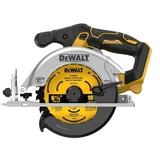
Price: $119.00 (Bare tool) · Check current price on Amazon
Blade: 6-1/2″ · Max cut depth @90°: 2-1/8″ (2.125″) · Weight: 6.3 lb (bare tool) · Speed: 4,950 RPM · Platform: DEWALT 20V MAX / FLEXVOLT · Cost per inch of depth: $55.99/in
- What we like: Deepest cut depth of any bare tool in this lineup at 2-1/8″ (DEWALT spec sheet)
- Compatible with the largest cordless battery ecosystem here — 20V MAX and FLEXVOLT
- Tool-free bevel lever adjusts 0-50°, bright LED for cutline visibility
- What we don’t like: Bare tool only — a 20V MAX battery isn’t included, so budget for one if starting fresh
- At 6.3 lb it’s the heaviest bare-tool pick in the lineup, behind only the corded Rockwell
The DCS565B earns Best Overall because it’s the only pick that combines the deepest bare-tool cut depth (2-1/8″ at 90°, per DEWALT’s own spec sheet) with the widest battery cross-compatibility of any platform in this comparison — it runs on every 20V MAX and FLEXVOLT pack DEWALT makes, which covers the largest cordless tool lineup on the market.
It’s the right pick for anyone who already owns 20V MAX batteries, or anyone building a cordless kit from scratch who wants the saw to outlast whatever else they buy next. The tool-free bevel lever and bright LED are the kind of details that matter more after the first afternoon of trim work than they do in a spec sheet.
Main drawback: it’s bare-tool-only. The $119.00 price and the $55.99-per-inch cost-per-depth figure both assume you already have (or are willing to buy separately) a compatible 20V MAX battery — add roughly $50-90 if you don’t.
2. SKIL PWR CORE 20 CR6413B-11 6-1/2″ Circular Saw Kit — Best Value (Cheapest Complete Kit)
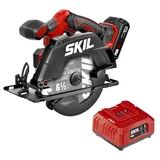
Price: $102.79 (Full kit (battery + charger + blade)) · Check current price on Amazon
Blade: 6-1/2″ · Max cut depth @90°: 2-1/4″ (2.25″) · Weight: 5.2 lb bare / 6.0 lb with battery · Speed: 5,500 RPM · Platform: SKIL PWR CORE 20 · Cost per inch of depth: $45.68/in
- What we like: Cheapest complete, ready-to-cut kit of the 8 — includes a 2.0Ah battery, charger, blade, hex key and vacuum adapter
- 2-1/4″ max cut depth ties Greenworks for deepest in the lineup
- Electric brake and an LED shadow-line for cutline tracking
- What we don’t like: PWR CORE 20 is a smaller cross-compatible platform than DEWALT, Milwaukee or Ryobi — fewer other tools to share the battery with
- The shadow-line LED is a love-it-or-leave-it feature; some reviewers find it more distracting than the blade itself
SKIL’s kit is the only one in this lineup priced under $103 that arrives ready to make a cut — battery, charger, and blade included — and it still posts the second-lowest cost per inch of cut depth ($45.68) of all 8 picks, complete kit or bare tool. That combination is the whole case for it.
It’s the pick for someone with no existing cordless platform who wants the lowest total cost to get cutting today, not a bare tool that needs a $60-90 battery added before it works. The tradeoff is ecosystem size: PWR CORE 20 doesn’t have anywhere near the number of cross-compatible tools that DEWALT 20V MAX or Milwaukee M12/M18 do.
Main drawback: you’re buying into a smaller battery platform. Fine if this is your only SKIL tool; worth a second look if you’re planning to build out a whole cordless kit on one battery system.
3. Makita SH02R1 12V Max CXT 3-3/8″ Circular Saw Kit — Best for One-Handed Cuts & Tight Spaces
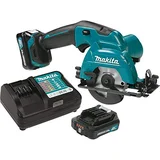
Price: $149.00 (Full kit (battery + charger)) · Check current price on Amazon
Blade: 3-3/8″ · Max cut depth @90°: 1″ at 90° (5/8″ at 45°) · Weight: 3.5 lb (with 2.0Ah battery) · Speed: 1,500 RPM · Platform: Makita 12V max CXT · Cost per inch of depth: $149.00/in
- What we like: Lightest and smallest saw in the lineup by a wide margin — 3.5 lb fully loaded with battery
- Genuinely usable one-handed; the CXT line is built around this size class
- Tilting base cuts bevels 0-45° despite the compact footprint
- What we don’t like: 1″ max cut depth is a hard ceiling — it won’t get through a 2×4 or anything over roughly 3/4″ stock in one pass
- Highest cost per inch of cut depth of any pick in the lineup at $149.00/in
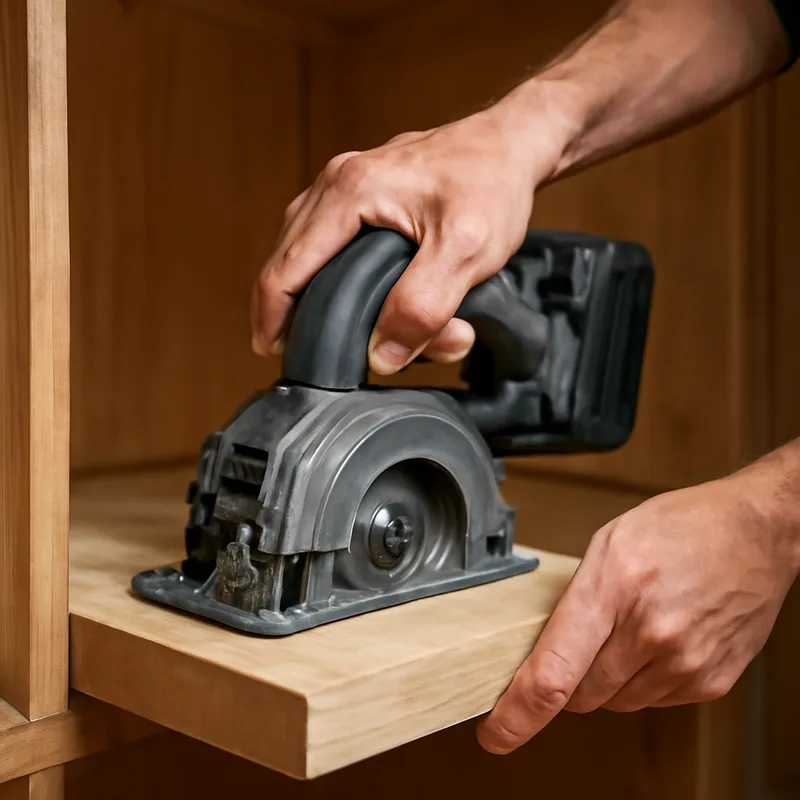
The SH02R1 isn’t trying to compete on cutting capacity — at 1″ max depth it’s closer to a powered trim saw than a jobsite circular saw — and that’s exactly the point. It’s the only saw here genuinely comfortable to run with one hand for extended stretches: paneling, pegboard, MDF, drywall, thin plywood.
If the job is cabinet toe-kicks, shelf edging, or trimming door casings in a space too tight for anything bigger, this is the pick. If the job includes dimensional lumber, it isn’t — no amount of technique gets a 1″ blade through a 2×4 in one pass.
Main drawback: cut depth, not power. Its $149/in cost-per-depth figure looks bad on paper, but that’s the tradeoff for genuine one-hand ergonomics — buy it for the size class, not the depth.
4. WORX Nitro WX531L 20V 4-1/2″ Circular Saw — Best Lightweight
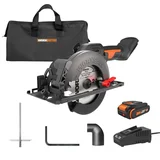
Price: $135.99 (Full kit (battery + charger)) · Check current price on Amazon
Blade: 4-1/2″ · Max cut depth @90°: 1-1/2″ at 90° (1-1/8″ at 45°) · Weight: 4 lb (without battery) · Speed: 6,900 RPM (no-load) · Platform: WORX 20V Power Share · Cost per inch of depth: $90.66/in
- What we like: Lightest bare weight of any 4-1/2″-and-larger saw in the lineup at 4 lb
- Highest no-load RPM in the comparison (6,900), for faster feed rates in thin stock
- Power Share batteries cross more than 140 other Worx tools and outdoor equipment
- What we don’t like: Worx Power Share isn’t a jobsite-standard platform the way DEWALT or Milwaukee are
- Among the priciest kits per inch of cut depth at $90.66/in, despite the modest 1-1/2″ depth
The WX531L wins on the scale, not the tape measure: at 4 lb bare it’s the lightest saw here that isn’t a 3-3/8″ ultra-compact, and its 6,900 RPM no-load speed is the fastest motor in the lineup — both of which matter more than raw cut depth for overhead work and repetitive trim cuts.
Main drawback: speed and weight don’t buy you depth. At 1-1/2″ max cut, it’s in the same capacity class as the corded Rockwell and Craftsman — just lighter and faster, at a higher price per inch.
5. Rockwell RK3441K 4-1/2″ Compact Circular Saw — Best Corded (No Battery Tax)
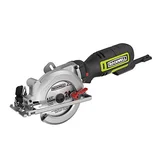
Price: $89.00 (Ready to use (cord)) · Check current price on Amazon
Blade: 4-1/2″ · Max cut depth @90°: 1-11/16″ at 90° (1-1/8″ at 45°) · Weight: 5 lb · Speed: 3,500 RPM · Platform: Corded — no battery · Cost per inch of depth: $52.74/in
- What we like: Cheapest saw in the lineup outright at $89.00, and ready to cut out of the box — no battery to buy
- Rear-motor balance puts more of the weight over your palm for steadier one-handed control
- Accepts any brand’s standard 4-1/2″ blade, not a proprietary size
- What we don’t like: Corded means no cordless mobility — you’re working within reach of an outlet or extension cord
- 3,500 RPM is the slowest motor speed of any saw in this comparison
Rockwell’s saw is the value argument taken to its logical conclusion: no battery, no charger, no platform lock-in, and still a genuine 1-11/16″ cut depth — deeper than three of the cordless 4-1/2″ picks in this lineup. At $52.74 per inch of cut depth, it beats every cordless saw here except the Greenworks and SKIL.
It’s the right call for a shop saw that lives near an outlet, or a second saw kept specifically so you’re never waiting on a battery to charge.
Main drawback: the cord. It’s not a jobsite or ladder saw — anywhere you need to move freely or work away from power, one of the cordless picks is the better tool.
6. Milwaukee 2530-20 M12 FUEL 5-3/8″ Circular Saw — Best for M12 Platform Owners
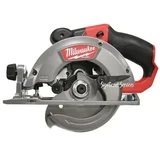
Price: $159.99 (Bare tool) · Check current price on Amazon
Blade: 5-3/8″ · Max cut depth @90°: 1-5/8″ at 90° (1-1/8″ at 45°) · Weight: 5.35 lb (bare tool) · Speed: 3,600 RPM (max) · Platform: Milwaukee M12 FUEL · Cost per inch of depth: $98.46/in
- What we like: Brushless FUEL motor rated for up to 170 cuts in 2×4 pine on a single charge (Milwaukee spec sheet)
- Shares batteries with more than 100 other M12 tools
- Electric brake stops the blade almost immediately after trigger release
- What we don’t like: Most expensive bare tool in the lineup at $159.99, and the second-highest cost per inch of depth
- M12 is Milwaukee’s 12V sub-compact platform — less raw power headroom than the 18V/20V/24V rivals here
The 2530-20’s case is entirely about ecosystem, not spec-sheet numbers — its 1-5/8″ cut depth and 3,600 RPM sit mid-pack in this comparison, and at $159.99 bare it’s the priciest tool-only pick here. What it buys is access to the M12 battery you probably already own if you’re carrying M12 drivers, drills, or multi-tools.
Main drawback: price only makes sense with existing M12 batteries. Buying into M12 from zero, for this saw alone, is the most expensive way into this category.
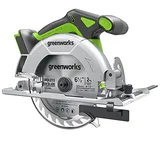
7. Greenworks CRG404 24V 6-1/2″ Circular Saw — Best Cost-Per-Inch of Cut Depth (Platform Owners)
Price: $99.99 (Bare tool) · Check current price on Amazon
Blade: 6-1/2″ · Max cut depth @90°: 2-1/4″ at 90° (1-3/4″ at 45°) · Weight: 5.84 lb (bare tool) · Speed: 4,800 RPM · Platform: Greenworks 24V PowerAll · Cost per inch of depth: $44.44/in
- What we like: Lowest raw cost per inch of cut depth of all 8 picks at $44.44/in
- 2-1/4″ max cut depth ties SKIL for the deepest cut in this lineup
- 24V PowerAll batteries cross more than 125 indoor and outdoor Greenworks tools
- What we don’t like: It’s a bare tool — the $44.44/in figure excludes a battery, which typically adds $40-70+ for a first-time buyer
- Greenworks has a much thinner jobsite/pro-trade track record than DEWALT or Milwaukee
On paper, the CRG404 posts the best number in the entire dataset: $44.44 per inch of maximum cut depth, edging out even SKIL’s complete kit. Read that number correctly, though — it’s a bare-tool price. Someone starting from zero needs to add a 24V battery before this figure means anything, and once you do, the gap to SKIL’s all-in kit price mostly closes.
Where it genuinely wins is for anyone already inside the Greenworks 24V PowerAll ecosystem — a fast-growing lineup that spans both power tools and outdoor equipment (trimmers, blowers, mowers) on the same battery. For that buyer, this is the cheapest deep-cutting small circular saw in the comparison, full stop.
Main drawback: the headline cost-per-inch number only tells the true story for existing 24V battery owners. Factor in a battery and this saw’s real cost lands closer to the DEWALT or SKIL, not clearly ahead of them.
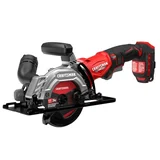
8. CRAFTSMAN V20 CMCS405B 4-1/2″ Circular Saw — Best Budget Bare Tool
Price: $119.00 (Bare tool) · Check current price on Amazon
Blade: 4-1/2″ · Max cut depth @90°: 1-9/16″ at 90° · Weight: not published by manufacturer · Speed: 4,500 RPM (no-load) · Platform: Craftsman V20 · Cost per inch of depth: $76.16/in
- What we like: Built-in sliding rip fence for straight cuts without a separate guide
- Electronic blade brake for faster, safer stops
- Accepts standard 4-1/2″ blades from any brand, not a proprietary size
- What we don’t like: Craftsman does not publish a tool weight on its own spec page or the printed instruction manual — confirmed unavailable across the manufacturer site, PDF manual, and three major tool retailers this session
- Mid-pack cut depth (1-9/16″) for a mid-pack price — no standout spec
The CMCS405B is a straightforward bare-tool option for existing Craftsman V20 owners: built-in rip fence, blade brake, standard blade compatibility, at a price ($119.00) that matches the DEWALT DCS565B despite a shallower cut and a smaller battery ecosystem.
Main drawback: an honest gap in the data, not just the tool — Craftsman’s own materials don’t list a bare-tool weight anywhere this session could verify, which matters if you’re buying specifically for one-handed or overhead work.
How We Picked These
Experience tier: Compared, not hands-on tested. Nobody on this site physically owns all 8 of these saws, and we’re not going to pretend otherwise with an invented “we tested” claim or a fabricated hours-of-use figure. Here’s exactly what was done instead, so you can check it yourself:
- Specs were pulled from each manufacturer’s own product page or printed instruction manual (DEWALT, Milwaukee, SKIL, Rockwell, Makita, WORX, Greenworks) — not copied from a competing roundup article.
- Prices and live availability were pulled from the Amazon Creators API this session, chunked and buy-box-verified per ASIN, not estimated or carried over from memory.
- The cost-per-inch figure is a plain computed value: price ÷ max cut depth at 90°, shown per row in the table above so the arithmetic is checkable.
- One spec gap is disclosed, not hidden: Craftsman doesn’t publish a weight for the CMCS405B on its own site, in its printed manual, or through three major tool retailers we checked this session — so that cell says “not published” instead of a guessed number.
- No star ratings or review counts appear anywhere on this page. Amazon’s review data wasn’t reliably available for these ASINs this session, and copying a number from a competitor’s article isn’t verification — so we left it out rather than invent it.
What to Consider When Buying a Small Circular Saw
Blade Diameter and Cut Depth
This is the spec that actually defines “small.” A full-size circular saw runs a 7-1/4" blade with roughly 2-1/2" of cut depth at 90°; the saws in this roundup range from a 3-3/8" ultra-compact (1" max depth — the Makita) up to 6-1/2" compacts that still reach 2-1/4" (the SKIL and Greenworks). Bigger blade diameter within the “small” category almost always means deeper cuts, not a smaller saw — check the table above before assuming “compact” means “shallow.” For the exact tradeoffs between the two most common sizes, see our 6-1/2" vs. 7-1/4" circular saw comparison.
Weight and One-Handed Control
Every saw in this comparison is lighter than a full-size 7-1/4" saw, but the spread inside that is real: the Makita SH02R1 is 3.5 lb fully loaded and genuinely one-hand-friendly; the DEWALT DCS565B is 6.3 lb bare and needs two hands for controlled cuts. If the job is overhead work, toe-kicks, or extended one-handed cutting, weight matters more than depth.
Battery Platform Compatibility
This is the buying decision most small-circular-saw guides skip entirely. If you already own batteries on a platform — DEWALT 20V MAX, Milwaukee M12, Makita 12V CXT, SKIL PWR CORE 20, WORX Power Share, or Greenworks 24V PowerAll — a bare tool on that same platform is almost always the cheaper real-world purchase, even when its sticker price looks higher than a full kit. Starting from zero flips that logic: a complete kit (SKIL, Makita, WORX in this lineup) avoids a second purchase. Our best battery-powered circular saw guide covers platform selection in more detail if you’re choosing an ecosystem for the first time.
Corded vs. Cordless
The Rockwell RK3441K is the only corded saw in this comparison, and it’s also the cheapest and one of the deepest-cutting 4-1/2" options here — because it isn’t carrying battery cost or weight. Corded makes sense for a stationary shop saw near an outlet; cordless wins anywhere you need to move, climb, or work away from power. See our corded vs. cordless circular saw guide for the tradeoffs in more depth.
Motor Speed (RPM) and Brushless vs. Brushed
No-load RPM ranges from 1,500 (Makita, tuned for control over speed in thin material) to 6,900 (WORX). Every cordless pick in this lineup uses a brushless motor, which generally means more torque per charge and less heat than a brushed motor of the same size — see our brushless vs. brushed circular saw comparison if you’re deciding between a small brushless saw and a larger brushed one.
Bevel Capacity
Bevel range across this lineup runs from 0-45° (Craftsman, WORX) up to 0-50° (DEWALT, Rockwell). A wider bevel range mostly matters for trim and angled framing work; for straight rip and crosscuts it rarely changes the buying decision.
Dust Collection and Cutline Visibility
Several picks here (SKIL, Greenworks, DEWALT) build in a dust port or vacuum adapter; the Makita and Craftsman don’t. LED cutline lights and shadow-line features (SKIL, DEWALT, Milwaukee) help more in dim garages and under cabinets than in daylight outdoor cuts.
Safety Features: Blade Brake
An electronic blade brake — standard on the DEWALT, Milwaukee, SKIL, and Craftsman in this lineup — stops the blade within roughly a second of releasing the trigger instead of letting it coast. It’s a genuine safety upgrade over older brushed saws without one, and worth checking for on any small saw you’re comparing against this list.
How to Use a Small Circular Saw Safely
The compact size of these saws doesn’t reduce the real risks of any circular saw — a spinning blade this small can still cause a serious injury. The core safety steps are the same ones that apply to any circular saw, small or full-size:
- Wear safety glasses, hearing protection, and gloves rated for power tool use before you pick up the saw.
- Secure the workpiece with clamps so it can’t shift or bind against the blade mid-cut.
- Set the cut depth about 1/4" deeper than the material thickness — a blade set too deep exposes more spinning edge than the cut needs.
- Check that the blade guard retracts and springs back freely before every session, especially on saws with a smaller, tighter-clearance guard.
- Keep both hands on the saw whenever the model and cut allow it, even on the lighter one-handed-capable picks in this lineup.
- Let the blade reach full speed before it contacts the material, and let it stop spinning completely before setting the saw down.
- Disconnect the battery (or unplug a corded saw) before changing blades or clearing a jam.
Blade-swap steps vary slightly by saw — see our how to change a circular saw blade guide for the general procedure that applies across brands.
Frequently Asked Questions
What counts as a “small” circular saw?
Generally any circular saw with a blade under 7-1/4" — most commonly 3-3/8", 4-1/2", 5-3/8", or 6-1/2". These lighter, smaller-bladed saws are also frequently marketed as “compact circular saws” — the terms describe the same category. The saws in this comparison span that full range; a full-size saw uses a 7-1/4" blade with roughly 2-1/2" of cut depth.
How deep can a small circular saw cut?
It depends heavily on blade diameter: the 3-3/8" Makita in this lineup tops out at 1", while the 6-1/2" SKIL and Greenworks both reach 2-1/4" at 90°. A 2-1/4" small saw will get through a 2×4 (1-1/2" actual thickness) in one pass; a 1" saw will not.
Is a 4-1/2" circular saw enough to cut 2×4 lumber?
Barely, and it depends on the exact model. The 4-1/2" saws in this comparison range from 1-1/2" to 1-11/16" max cut depth at 90° — enough for a single pass through a standard 1-1/2"-thick 2×4, but with little margin. A 5-3/8" or 6-1/2" saw gives more headroom for the same task.
Do small circular saws need special blades?
Yes — blade diameter and arbor size are model-specific within the small-saw category (3-3/8", 4-1/2", 5-3/8", and 6-1/2" blades aren’t interchangeable with each other), though most saws at a given diameter accept any brand’s blade at that size, not just the saw manufacturer’s own. Check your saw’s spec sheet for exact arbor size before buying replacement blades.
Should I buy a bare tool or a kit?
If you already own batteries on that saw’s platform, a bare tool is almost always the cheaper real purchase even at a higher sticker price. If you’re starting from zero on that platform, a complete kit (battery and charger included) avoids a second purchase — compare the Tier column in the table above before deciding.
Can a small circular saw cut through materials other than wood?
Many can, with the right blade swapped in — thin plywood, laminate, drywall, and some plastics are common uses across this category. Cutting metal or masonry requires a specific blade rated for that material and typically a slower feed rate; check your saw’s manual before attempting either.
Final Thoughts
For most buyers, the DEWALT DCS565B is the small circular saw to get: a 2-1/8" cut depth deeper than any other bare tool here, on the widest cordless platform in the comparison, for $119.00. The one number worth remembering from the whole dataset: cost per inch of cut depth across these 8 saws spans more than 3x, from $44.44 to $149.00 — and that gap has almost nothing to do with build quality and almost everything to do with blade diameter and whether you’re already invested in that saw’s battery platform.
For full-size 7-1/4" options built for deeper rip cuts and dimensional framing lumber, see our best circular saw roundup. If cordless mobility matters more to you than blade size specifically, our best cordless circular saw guide covers the category more broadly, including full-size cordless models this page doesn’t.
Sponsored / affiliate links. As an Amazon Associate I earn from qualifying purchases. I may earn additional commission from eligible campaigns.