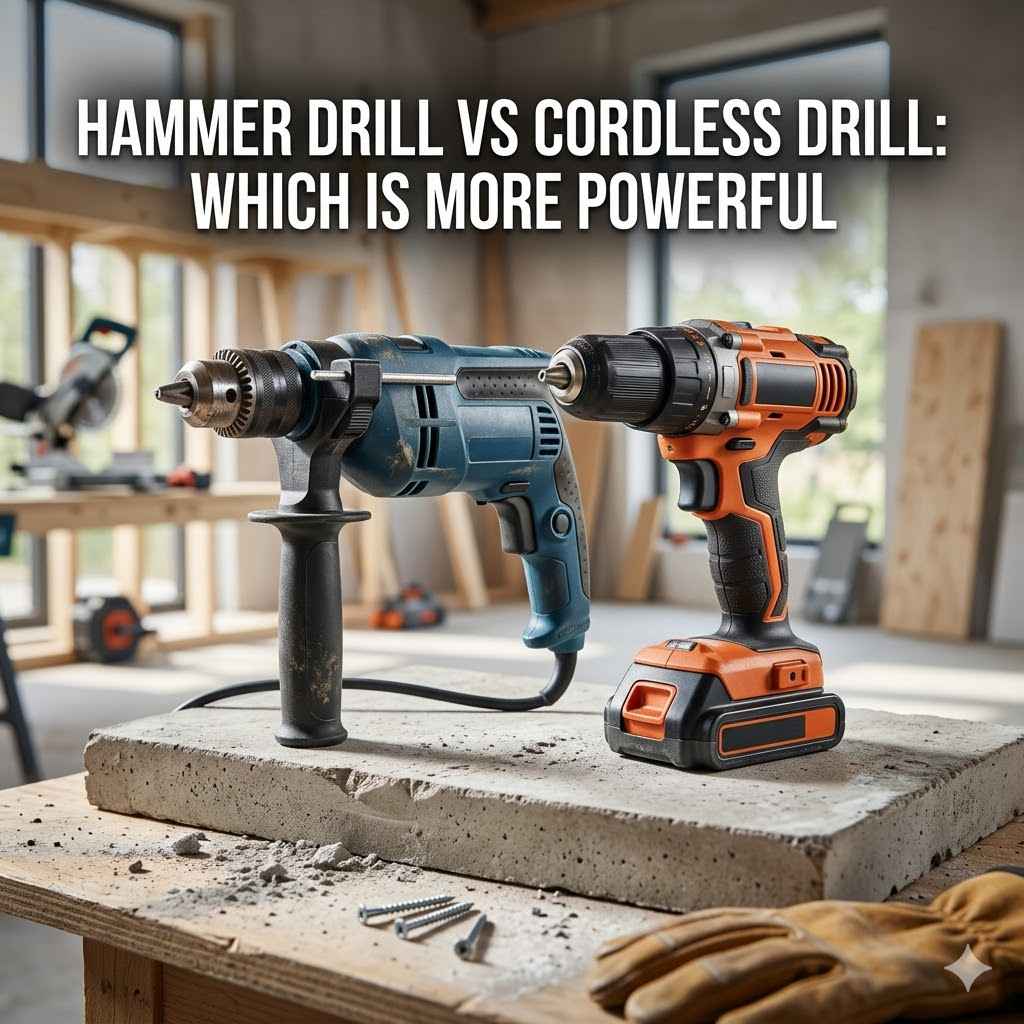
Hammer Drill vs Cordless Drill: Which Is More Powerful
Figuring out the right tool for your job can feel tricky. Especially when you’re starting out with DIY projects. You might wonder, is a hammer drill stronger than a regular cordless drill?
It’s a common question because they look similar but do different things. Don’t worry, we’ll break down the Hammer Drill vs Cordless Drill: Which Is More Powerful? question in a simple way. We’ll guide you step-by-step so you can pick the best drill for what you need to do.
Let’s get your projects moving the right way!
Understanding Hammer Drills
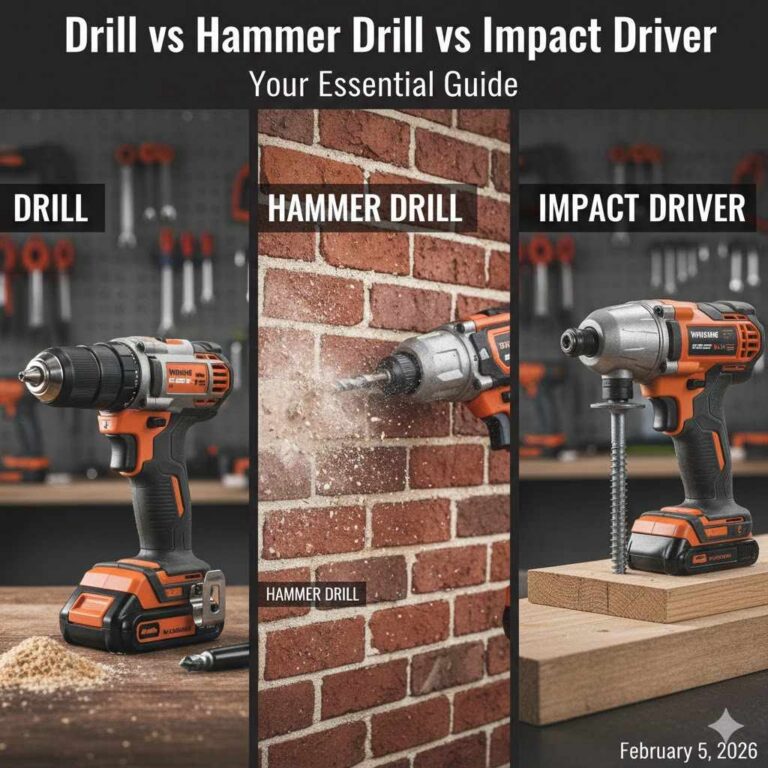
A hammer drill is a powerful tool designed for tough jobs. It has a special mechanism that adds a hammering action to its rotation. This makes it great for drilling into hard materials like concrete, brick, and stone. Think of it like a drill and a jackhammer combined, but on a much smaller, controlled scale. This dual action allows it to break apart the material as it drills, making the process faster and more effective.
How a Hammer Drill Works
The “hammering” action comes from two sets of gears that spin against each other. One set rotates the drill bit, and the other moves up and down rapidly. When these gears engage, they create a pulsating force. This force drives the drill bit forward with extra power. The speed and intensity of the hammer action can often be adjusted. This allows you to control how much force you’re applying.
The gears inside a hammer drill create thousands of percussive blows per minute. This is what helps it cut through dense materials. The depth of the hammer action is usually small, but the frequency is high.
This combination is key to its effectiveness.
When to Use a Hammer Drill
You’ll want to reach for a hammer drill when you need to drill into very hard surfaces. This includes things like:
- Mounting shelves on a brick wall.
- Installing anchors in concrete for heavy furniture.
- Creating holes in stone for landscaping projects.
- Working with cinder blocks or masonry.
Using a regular drill on these materials would be slow and might even damage the drill bit. The hammer action prevents the bit from getting stuck and makes the drilling smoother. It’s like having a tiny, powered chisel working alongside your drill bit.
Hammer Drill Features to Consider
When looking at hammer drills, several features matter. Power is important, often measured in Amps for corded models or Volts for cordless ones. More power generally means more drilling capability. Variable speed settings are also key. This lets you start slow and increase speed as needed, giving you more control. A comfortable grip and a sturdy construction are also beneficial for longer jobs. Some hammer drills also offer different modes, like rotation-only or hammer-only.
The chuck size is another factor. Most hammer drills have a 1/2-inch chuck, which is standard for larger bits. Adjustable depth stops are also useful for drilling holes to a specific depth.
This prevents you from drilling too deep, which is important for installing anchors.
Exploring Cordless Drills
A cordless drill, also known as a battery-powered drill, is a versatile tool. It’s a staple in most toolboxes. Its primary function is to drive screws and drill holes. Unlike a hammer drill, it doesn’t have the hammering mechanism. This makes it ideal for lighter-duty tasks and everyday use. They offer freedom from power cords, allowing you to work anywhere.
How a Cordless Drill Works
A cordless drill uses a rechargeable battery to power an electric motor. This motor turns a chuck, which holds a drill bit or screwdriver bit. The motor’s speed and torque can usually be adjusted. This allows for precise control when driving screws or drilling through different materials.
The battery voltage is a key indicator of a cordless drill’s power. Higher voltages usually mean more power and better performance, especially for tougher tasks. Battery capacity, measured in Amp-hours (Ah), tells you how long the battery will last on a single charge.
When to Use a Cordless Drill
Cordless drills are perfect for a wide range of common household tasks. These include:
- Assembling furniture.
- Hanging pictures and shelves on drywall.
- Woodworking projects.
- Light repairs around the house.
- Driving screws into soft materials.
They are easy to handle and control. Their portability makes them incredibly convenient for quick jobs or when working in areas without power outlets. You can easily switch between drilling and driving functions.
Cordless Drill Features to Consider
When choosing a cordless drill, look at the battery voltage. Common options are 12V, 18V, and 20V Max (which is often the same as 18V). Higher voltage generally means more power. Also, consider the battery type. Lithium-ion batteries are lighter, hold a charge longer, and are more powerful than older NiCad batteries.
Torque settings are crucial for driving screws. A clutch with multiple torque settings prevents you from over-tightening screws, which can strip the screw head or damage the material. Variable speed triggers allow for precise control.
A brushless motor, while often more expensive, offers longer tool life and better efficiency.
Hammer Drill vs Cordless Drill Which Is More Powerful
When comparing Hammer Drill vs Cordless Drill: Which Is More Powerful?, the answer depends on the task. A hammer drill is generally more powerful in terms of its ability to break through hard materials due to its percussive action. A high-end cordless drill can be very powerful for drilling and driving tasks, but it lacks the hammering feature.
Power Differences Explained
The power difference isn’t just about raw motor strength. It’s about the type of power delivered. A standard cordless drill delivers rotational force. This is great for boring holes in wood or metal, or for driving screws.
A hammer drill adds a hammering force to the rotation. This means it’s not only spinning but also pounding. This pounding action is what makes it superior for materials like concrete or brick.
It pulverizes the material in front of the drill bit.
Impact of Materials
The material you’re working with is the biggest factor in choosing between the two.
- Concrete and Masonry: Hammer drills excel here. The hammering action is essential to penetrate these hard substances. A regular cordless drill would struggle immensely, if it could do it at all.
- Wood and Drywall: Standard cordless drills are perfect for these softer materials. The hammering action of a hammer drill would be unnecessary and could even damage the surface.
- Metal: Both can drill into metal, but a powerful cordless drill might be preferred for precision and control, especially with thinner metals.
For instance, if you need to hang a heavy mirror on a concrete wall, a hammer drill is your only real option. If you’re building a wooden birdhouse, a cordless drill is the tool you’ll use.
Torque vs. Percussion
It’s important to distinguish torque from percussion. Torque is the twisting force. A drill with high torque can apply a lot of twisting power, useful for driving large screws or drilling large holes. Many cordless drills offer excellent torque.
Percussion is the hammering action. This is the unique capability of a hammer drill. It adds a forceful, repetitive impact.
This impact is what makes drilling concrete possible.
Common Scenarios
Let’s look at a couple of common scenarios to illustrate the difference:
- Scenario 1: You need to install a large, heavy cabinet to a wall made of solid brick. You’ll need to drill deep holes for anchor bolts.
- Scenario 2: You are assembling a flat-pack bookshelf made of particle board. You need to drive many screws to put it together.
For Scenario 1, the Hammer Drill vs Cordless Drill: Which Is More Powerful? question is clearly answered by the hammer drill. Its percussive force is necessary for brick. For Scenario 2, a standard cordless drill is the ideal tool.
Its variable speed and torque control are perfect for driving screws into wood without stripping them.
Comparing Key Performance Metrics
When we talk about performance, different metrics highlight the strengths of each drill type. Understanding these can help you decide which is right for your needs.
Rotations Per Minute (RPM)
Both hammer drills and cordless drills have RPM ratings. This indicates how fast the drill bit can spin. Higher RPMs are generally better for drilling smaller holes and working with softer materials, allowing for faster progress.
A typical cordless drill might offer RPMs ranging from 0-400 for low speed and 0-1500 or higher for high speed. Hammer drills often have similar RPM ranges when in their standard drilling mode. However, their effectiveness comes from the added percussive action, not just speed.
Impacts Per Minute (IPM) or Beats Per Minute (BPM)
This metric is specific to hammer drills and rotary hammers. It measures how many times the hammer mechanism strikes per minute. A higher IPM/BPM means more forceful impacts.
For example, a hammer drill might have an IPM rating of 0-30,000. This means the hammer action is striking the material up to 30,000 times every minute. This high frequency of impact is what breaks apart hard materials efficiently.
Cordless drills do not have this rating as they lack the hammer function.
Torque Strength
Torque is the rotational force. It’s measured in inch-pounds (in-lbs) or Newton-meters (Nm). Higher torque allows a drill to turn a large drill bit, drive long screws, or work through dense materials when using rotational power.
High-performance cordless drills can offer torque ratings of 500 in-lbs or more. This is plenty for most home improvement tasks. Hammer drills also have torque ratings, but their real advantage lies in their ability to overcome resistance with percussion, not just torque alone.
| Feature | Hammer Drill | Cordless Drill |
|---|---|---|
| Primary Function | Drilling into hard materials (concrete, brick) | Driving screws and drilling holes (wood, drywall, metal) |
| Power Type | Rotational + Percussive (hammering) | Rotational only |
| Best For | Masonry, concrete, stone | Wood, metal, general assembly |
| Common Ratings | Amps/Volts, RPM, IPM/BPM | Volts, Ah, RPM, Torque (in-lbs/Nm) |
This table provides a quick comparison. The IPM/BPM rating is a clear indicator of the hammer drill’s specialized power. The torque rating is more relevant for the driving power of a cordless drill.
Are Hammer Drills Just More Powerful Cordless Drills
It’s a common misconception that a hammer drill is simply a more powerful version of a cordless drill. While both use motors and batteries (or cords), their fundamental operation differs significantly, especially regarding their power delivery. The core difference is the addition of the percussive mechanism.
The Role of the Hammering Action
The hammering action in a hammer drill is not about delivering more raw rotational force, but about adding a new dimension of force: impact. This impact is what allows it to overcome the resistance of dense materials like concrete. Imagine trying to push a nail into wood with just your hand versus using a hammer. The hammer adds the percussive force that makes the job feasible.
Without the hammering action, a hammer drill would function like a standard drill. The added mechanism is engaged when needed, typically by a switch or button. When not engaged, it performs like a regular drill.
Power for Specific Tasks
When we ask Hammer Drill vs Cordless Drill: Which Is More Powerful?, we need to consider the task at hand. For drilling into concrete, the hammer drill is undeniably more powerful because it can actually do the job. A regular cordless drill, no matter how powerful its motor, cannot achieve this without the percussive force.
However, for driving screws into wood, a high-torque cordless drill might be considered more “powerful” in that specific application. It can provide the precise control and rotational force needed without damaging the material, something a hammer drill might do too aggressively in its hammer mode.
Interchangeable Features
Many cordless drills are now being designed with hammer drill capabilities. These are often called “cordless hammer drills” or “combi drills.” They offer the best of both worlds, allowing you to switch between standard drilling, driving, and hammer drilling modes.
This means that the distinction is becoming blurred. A high-quality cordless hammer drill can be both the powerful rotational tool and the effective percussive tool. However, there are also standalone hammer drills that might offer more specialized features for heavy-duty masonry work.
Choosing the Right Drill for You
Deciding between a hammer drill and a cordless drill comes down to what you plan to do with it. If your projects mainly involve wood, metal, or general assembly, a good cordless drill will likely suffice. If you anticipate working with concrete, brick, or stone, a hammer drill is essential.
Consider Your Projects
Think realistically about the types of tasks you’ll be tackling.
- Occasional DIYer: If you only do light tasks like hanging pictures or assembling furniture, a basic cordless drill is probably all you need.
- Homeowner with Renovation Plans: If you plan on doing more involved work, like building decks, installing cabinets on masonry, or doing minor repairs, a hammer drill or a cordless hammer drill would be a wise investment.
- Professional Contractor: Professionals often have both types of tools, choosing the right one for each specific job to ensure efficiency and quality.
If you’re unsure, a cordless hammer drill offers the most versatility. You get the convenience of cordless operation and the added capability for tough materials.
Budget and Features
Both hammer drills and cordless drills come in a wide range of prices and feature sets. Basic cordless drills can be quite affordable. Hammer drills, especially higher-powered models, may cost more.
Features like battery capacity, motor type (brushed vs. brushless), variable speed, and clutch settings can significantly impact performance and price. For the question of Hammer Drill vs Cordless Drill: Which Is More Powerful?, consider that a more expensive model of either type will generally offer more power and better features.
Cordless Hammer Drills as the Hybrid Solution
For many DIYers, a cordless hammer drill is the ultimate solution. It combines the portability and convenience of a cordless drill with the power of a hammer drill. You can use it for everyday tasks like driving screws, and then switch to hammer mode when you need to drill into concrete.
This hybrid approach saves you from needing two separate tools and provides flexibility. When looking at cordless hammer drills, pay attention to the IPM/BPM rating as well as the torque and RPMs. This will give you a good indication of its overall capability.
Frequently Asked Questions
Question: What is the main difference between a hammer drill and a regular drill
Answer: A hammer drill has a percussive or hammering action that helps it drill into hard materials like concrete and brick, while a regular drill only rotates.
Question: Can I use a hammer drill to drive screws
Answer: Yes, most hammer drills have a mode that turns off the hammering action, allowing them to function as a regular drill for driving screws.
Question: Which drill is better for drilling into wood
Answer: A regular cordless drill is usually better for drilling into wood because it offers more control and avoids damaging the wood with unnecessary hammering.
Question: Are cordless hammer drills as powerful as corded hammer drills
Answer: High-end cordless hammer drills can be very powerful, often matching or exceeding the power of corded models for most common tasks.
Question: How do I know if I need a hammer drill
Answer: You need a hammer drill if you frequently need to drill into concrete, brick, stone, or other very hard masonry materials.
Conclusion
When comparing a Hammer Drill vs Cordless Drill: Which Is More Powerful?, remember power isn’t one-size-fits-all. A hammer drill excels in masonry with its percussive force. A cordless drill offers versatile rotational power for wood and general use. For maximum flexibility, a cordless hammer drill combines both capabilities for diverse projects. Choose based on your material needs.