How Many Square Feet Does 5 Gallons of Paint Cover?
Five gallons of paint covers 1,750–2,000 square feet on smooth, primed drywall — but bare wood like cedar fencing or raw siding absorbs almost twice as much, cutting real coverage closer to 900–1,200 square feet. Buying by the drywall rule alone is the #1 reason DIYers run short mid-project. This guide covers coverage rates by surface, a worked square-footage example, and how much extra to budget for unprimed wood.
Insert your Affiliate Disclosure reusable block here
Paint Coverage by Surface Type
Best 5-Gallon Bucket Grid Pick
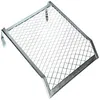
Wooster Acme Deluxe 5-Gallon Bucket Grid
A metal roller grid that hangs inside a standard 5-gallon pail so you can roll straight from the bucket instead of refilling a tray every few minutes.
- Best for: anyone rolling straight from a full 5-gallon pail instead of a tray
- Why we picked it: Wooster is a long-trusted painting-tool brand, and the angled ribs wring the roller evenly so you don’t overload the wall or waste paint
- Main drawback: the metal edge can scratch a plastic bucket’s interior over repeated use
Compare more bucket grid options
 Option 1 Rocky Mountain Goods Heavy Duty Metal Bucket Grid
|
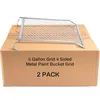 Option 2 Landhoow 2-Pack Metal Paint Roller Grid
|
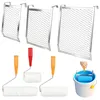 Option 3 3-Pack Paint Roller Grid with Roller Covers
|
As an Amazon Associate we earn from qualifying purchases.
The surface you’re painting matters more than the paint can label. Smooth, already-primed drywall is the best-case scenario manufacturers use for their headline coverage numbers — anything rougher or more porous pulls that number down fast. Our full paints guide breaks down priming and prep for every surface type; the table below shows what changes surface-to-surface.
| Surface | Sq Ft per Gallon (1 coat) | Coats Typically Needed |
|---|---|---|
| Smooth, primed drywall | 350–400 | 1–2 |
| Unprimed drywall | 275–325 | 2 |
| Stucco (textured) | 200–250 | 2 |
| Brick / masonry | 150–225 | 2–3 |
| Bare, unprimed wood | 150–200 | 2–3 |
📊 One gallon of quality latex paint covers 350–400 square feet on a smooth, already-primed surface with one coat. — Source: Sherwin-Williams and Behr official paint calculators, 2026.
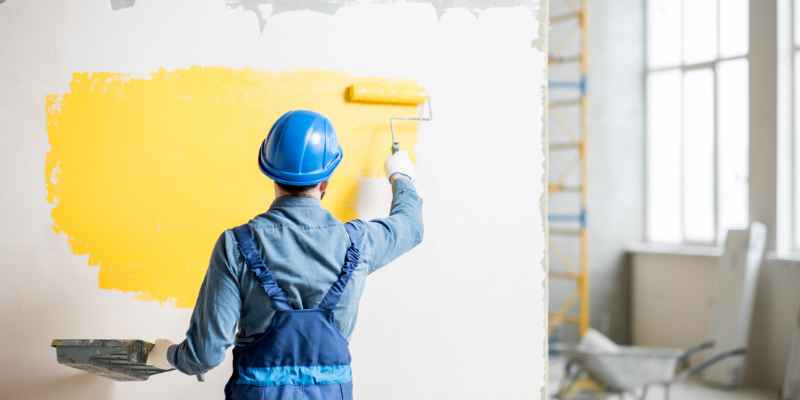
Paint Coverage on Bare and Primed Wood (Fences, Siding, Trim)
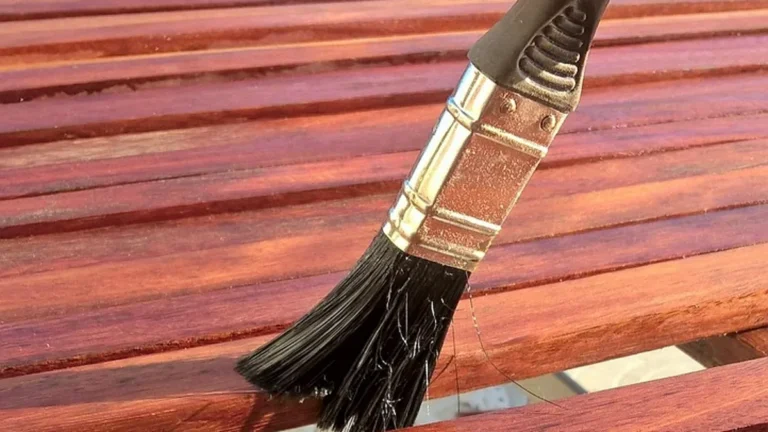
Wood behaves differently than drywall, and most generic paint-coverage guides skip it entirely. Bare, unprimed wood — a new cedar fence panel, raw pine siding, or freshly cut trim — is far more porous than primed drywall, so the first coat soaks in instead of sitting on top. Our wood fence paint guide covers prep and primer choice in more depth; the numbers below are what to expect on a standard 5-gallon pail.
| Wood Surface Condition | Sq Ft per Gallon | Notes |
|---|---|---|
| Bare softwood (cedar, pine) – 1st coat | 150–200 | No primer; most porous |
| Bare hardwood (oak, mahogany) – 1st coat | 200–250 | Denser grain absorbs less |
| Primed wood trim / siding | 300–350 | Primer seals the grain first |
| Previously painted wood (recoat) | 350–400 | Similar to primed drywall |
Softwoods like cedar and pine soak up noticeably more paint than hardwoods such as oak or mahogany because their grain is more open. A coat of exterior primer or sealer before painting closes off that porosity, which is why primed wood coverage jumps back up near drywall numbers — skipping that step is the single biggest reason a 5-gallon pail runs out early on a fence or siding job.
“When I’ve painted cedar fence panels straight off the sawhorses with no primer, a 5-gallon pail that should’ve covered 1,800 square feet of drywall was tapped out well under 1,000 square feet — the raw wood just drinks the first coat. A cheap coat of exterior primer or sealer first is what actually saves you a second trip to the store.”
Thickness of Paint Application
How thick you spread each coat changes coverage as much as the surface does. A thin, even coat stretches a gallon further; a heavy coat cuts the square footage you’ll get and often leaves drips or lap marks. If you’re planning multiple coats — which most projects need — a light sanding between coats keeps each layer thin and level instead of building up texture.
Does Paint Finish (Flat vs. Gloss) Affect Coverage?
Yes. Flat and matte finishes have more pigment and less binder, so they usually cover in fewer coats than satin, semi-gloss, or gloss finishes of the same brand. Glossier sheens need a thinner, more even application to avoid streaking, which means more careful (and often slower) rolling to get the same square footage out of a gallon.
Paint Type and Brand
Solids content — the amount of actual paint left behind once the liquid carrier evaporates — varies by brand and product line, and it’s the real driver behind why one brand’s gallon covers more than another’s. Premium lines are formulated with a higher solids content for better hide and coverage; economy lines need more coats to reach the same result. Our guide to choosing paint for wood covers which formulations hold up best on furniture, trim, and siding specifically. Always check the spread rate printed on the specific can you’re buying — it’s measured for that exact product, not a general estimate.
How to Calculate How Much Paint You Need (Worked Example)
Here’s the full process, walked through on a real 12×10 room with 8-foot ceilings and one door and one window:
- Measure each wall: add the length of all four walls together (12+10+12+10 = 44 linear feet), then multiply by the 8-foot ceiling height for 352 total square feet of wall.
- Subtract doors and windows: a standard door is about 20 sq ft and a window about 15 sq ft, so subtract 35 sq ft, leaving 317 sq ft to actually paint.
- Divide by the coverage rate: 317 ÷ 350 sq ft per gallon ≈ 0.9 gallons for one coat.
- Multiply by the number of coats: two coats × 0.9 gallons ≈ 1.8 gallons — round up to 2 gallons.
- Add 10% for touch-ups and cutting-in waste: 2 gallons plus a safety margin means most painters buy a full 2-gallon or one 5-gallon pail if painting several rooms.
- Adjust for bare wood or trim: if any surface is bare wood, use the 150–200 sq ft per gallon rate from the table above instead of 350, which roughly doubles the gallons needed for that section.
Common Paint-Buying Mistakes That Leave You Short
- Measuring floor space instead of wall space — a 10×12 room isn’t 120 sq ft of paintable surface; it’s roughly 280–350 sq ft once you add up all four walls.
- Skipping primer on bare wood or drywall patches, then being surprised the first coat seems to “disappear” into the surface.
- Forgetting to subtract doors and windows from the total, which overstates how much paint is actually needed by 10–15%.
- Not buying an extra 10% for touch-ups, cutting-in waste, and future repairs from the same batch.
- Assuming a dramatic color change (dark to light, or bare wood to any color) needs the same number of coats as a same-shade repaint.
Frequently Asked Questions
How many coats of paint do I need?
Most walls need two coats for solid, even color. One premium coat can work if you’re painting over a very similar shade. Budget three coats when covering a dark color with a light one, painting bare wood, or covering a heavily textured surface — each of those lets the old surface or grain show through after just one pass.
Does dark paint cover less area than light paint?
Yes. Deep, saturated colors need more pigment to reach full opacity, so they often require an extra coat or a tinted gray primer first. Going from a dark wall to a light color is the hardest transition and usually needs the most coats of all.
How many gallons of paint do I need for 2,000 square feet?
About 5 to 6 gallons for one coat on a smooth, primed surface, using the standard 350–400 square feet per gallon rate. Plan on roughly 10 to 12 gallons total if you’re applying two coats, and add more if any of the surface is bare wood or unprimed drywall.
Does spraying paint use more paint than rolling or brushing?
Yes, typically. Rolling and brushing put paint directly where you aim it, covering around 300–350 square feet per gallon. Spraying loses paint to overspray and drift, dropping real-world coverage to roughly 150–250 square feet per gallon even though it applies faster.
Five gallons of paint stretches to 1,750–2,000 square feet only under best-case conditions — smooth, primed, same-color repaints. The moment bare wood, dark colors, or textured surfaces enter the picture, real coverage can drop by half. Measure your actual wall square footage, match it to the right surface row above, and add the 10% buffer before you buy — it’s cheaper than a second trip to the store mid-project.
Sponsored / affiliate links. As an Amazon Associate I earn from qualifying purchases. I may earn additional commission from eligible campaigns.