Difference Between Hard Maple and Soft Maple: A Proven Guide
Hard maple is significantly denser, heavier, and more durable than soft maple, making it ideal for high-wear items like flooring and cutting boards. Soft maple is lighter, easier to work with, and more affordable, suiting it for decorative projects, small furniture, and painted pieces. The main difference lies in their durability and cost.
Hello, fellow woodworker! If you’ve ever stood in a lumberyard staring at two stacks of maple, wondering what makes one “hard” and the other “soft,” you’re not alone. It’s a question every beginner asks. The names sound simple, but they can be tricky. Picking the wrong one can affect your project’s durability and even your budget.
Don’t worry! I’m here to clear up the confusion. Think of me as your guide in the workshop. We’ll walk through the simple differences between these two wonderful woods. By the end of this article, you’ll know exactly how to tell them apart and which one is perfect for your next project. Let’s get started.
What is Hard Maple?
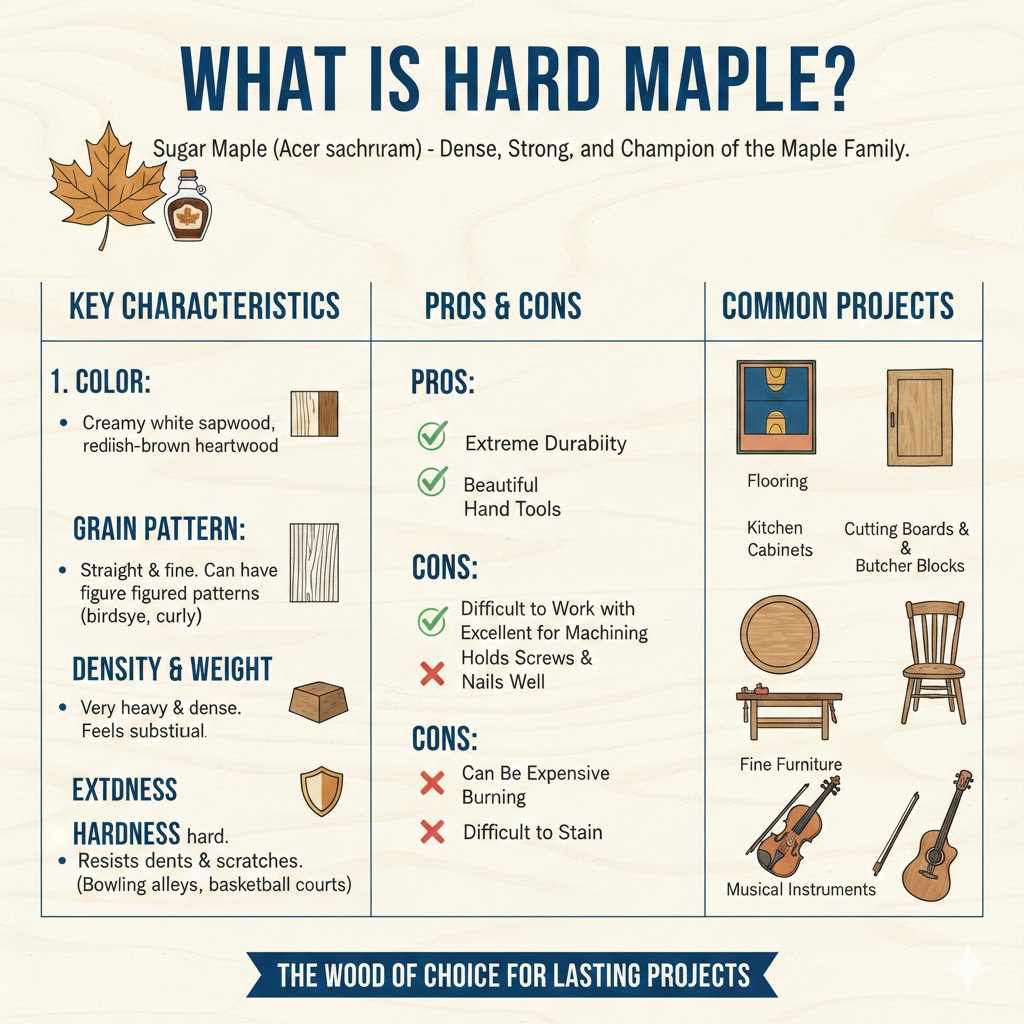
When people in woodworking talk about “hard maple,” they are almost always talking about one specific species: Sugar Maple (Acer saccharum). This is the same tree that gives us delicious maple syrup! It grows slowly in the colder climates of North America, which makes its wood incredibly dense and strong. It’s truly the champion of the maple family when it comes to toughness.
Because of its strength and beautiful, light color, hard maple has been a favorite for generations of craftspeople. It’s known for its ability to stand up to heavy use without showing much wear and tear.
Key Characteristics of Hard Maple
Hard maple has a few tell-tale signs that make it stand out. Once you know what to look for, it becomes much easier to identify.
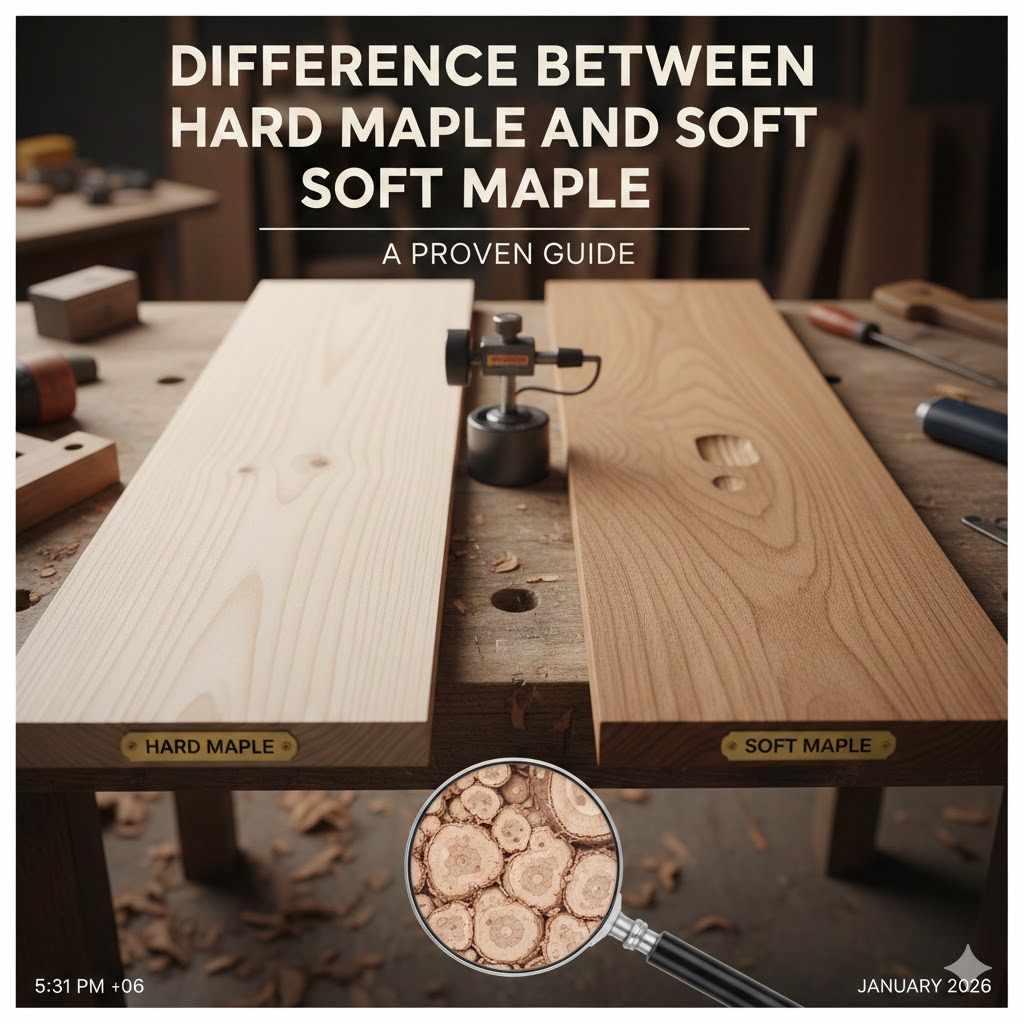
- Color: The sapwood (the outer part of the tree) is a creamy, off-white color. It can sometimes have a faint reddish tint. The heartwood (the center) is a darker, reddish-brown. Most woodworkers prefer to use the sapwood for its clean look.
- Grain Pattern: The grain is usually straight and fine, with a very smooth, uniform texture. This is what gives hard maple its clean, modern appearance. However, you can sometimes find beautiful figured patterns like birdseye, curly, or quilted maple, which are highly prized.
- Density and Weight: This is the big one. Hard maple is very heavy and dense. If you pick up a board of hard maple and a same-sized board of soft maple, you will immediately feel the difference. It feels solid and substantial in your hands.
- Hardness: As its name suggests, hard maple is extremely hard and resistant to dents and scratches. We’ll talk more about the official hardness scale later, but for now, just know that it’s tough enough for bowling alleys and basketball courts.
Pros and Cons of Using Hard Maple
Like any wood, hard maple has its strengths and weaknesses. It’s important to know them before you start your project.
Pros:
- Extreme Durability: It can withstand a lot of abuse, making it perfect for items that get used every day.
- Beautiful Appearance: Its light, creamy color and smooth grain give projects a bright, clean, and elegant look.
- Excellent for Machining: Hard maple cuts cleanly, routes beautifully, and holds sharp details very well. It produces crisp edges.
- Holds Screws and Nails Well: Because it’s so dense, it provides a strong grip for fasteners.
Cons:
- Difficult to Work with Hand Tools: Its density can make it challenging to saw, chisel, or carve by hand. It will dull your blades faster than softer woods.
- Can Be Expensive: High-quality hard maple generally costs more than soft maple.
- Prone to Burning: When using a router or saw blade that is dull or moving too slowly, the wood can burn easily due to friction.
- Difficult to Stain: Its dense, tight grain doesn’t absorb stain evenly, which can lead to a blotchy finish. Using a pre-stain conditioner is almost always necessary for a good result.
Common Projects for Hard Maple
You’ll find hard maple used in places where strength and durability are a must.
- Flooring: Especially for gyms and basketball courts.
- Kitchen Cabinets: It can handle the daily bumps and bangs of a busy kitchen.
- Cutting Boards & Butcher Blocks: Its closed-grain structure is durable and easy to clean.
- Workbenches: The top of a good workbench is often made from hard maple.
- Fine Furniture: Used for high-end tables, chairs, and dressers that are meant to last a lifetime.
- Musical Instruments: Such as violins, cellos, and the necks of guitars.
What is Soft Maple?
Now, let’s talk about the other side of the family. The term “soft maple” doesn’t refer to just one type of tree. It’s a general name for several different species of maple. The most common ones you’ll find at the lumberyard are Red Maple (Acer rubrum) and Silver Maple (Acer saccharinum).
It’s important to remember that “soft maple” is still a hardwood! It’s only called soft in comparison to its much tougher cousin, hard maple. Soft maple is still harder and more durable than woods like pine or poplar. It’s a great, versatile wood that is often more budget-friendly.
Key Characteristics of Soft Maple
Soft maple shares the family look, but with a few key differences.
- Color: The sapwood is a grayish-white, and it often has darker gray or reddish-brown streaks running through it. The color isn’t as uniform or clean as hard maple. The heartwood is typically a darker reddish-brown.
- Grain Pattern: The grain is generally straight, but the texture can be a bit coarser than hard maple. The growth rings are often wider and less defined.
- Density and Weight: Soft maple is noticeably lighter than hard maple. It feels less dense when you hold it, which is one of the easiest ways to tell the two apart.
- Hardness: It is significantly softer than hard maple. You can sometimes even leave a small dent in it by pressing a fingernail firmly into the wood.
Pros and Cons of Using Soft Maple
Soft maple is a fantastic choice for many projects, but it’s good to know where it shines and where it falls short.
Pros:
- Easier to Work With: It’s much kinder on your tools and easier to cut, sand, and shape by hand.
- More Affordable: Soft maple is usually less expensive than hard maple, making it a great choice for projects on a budget.
- Good for Painting: It takes paint exceptionally well, providing a smooth and even surface.
- Often Has Figured Grain: While less common, soft maple can also have beautiful curly or quilted patterns, sometimes called “tiger maple.”
Cons:
- Dents Easily: It is not very resistant to scratches and dents, so it’s not ideal for high-wear surfaces like tabletops or floors.
- Less Strong: It doesn’t have the same structural strength as hard maple.
- Inconsistent Color: The color can be blotchy with gray or brown streaks, which can be undesirable for a clear, natural finish.
- Absorbs Stain Unevenly: Just like hard maple (and perhaps even more so), soft maple is notorious for getting blotchy when stained. A pre-stain conditioner is a must.
Common Projects for Soft Maple
Think of soft maple for projects where looks are important but extreme durability is not.
- Painted Furniture: Bookshelves, dressers, and nightstands that will be painted.
- Decorative Items: Picture frames, small boxes, and wood turnings.
- Cabinet Doors and Drawer Fronts: Especially if they are going to be painted.
- Interior Millwork: Such as trim, molding, and door casings.
- Hobby and Craft Projects: It’s an easy-to-use wood for small, fun creations.
Hard Maple vs. Soft Maple: A Side-by-Side Comparison
Sometimes, the easiest way to see the difference is to put everything side-by-side. Here’s a quick-glance table to help you compare the two types of maple.
| Feature | Hard Maple (Sugar Maple) | Soft Maple (Red/Silver Maple) |
|---|---|---|
| Hardness & Durability | Extremely hard and durable. Resists dents and scratches very well. | Moderately hard but dents much more easily than hard maple. |
| Weight | Very heavy and dense. | Noticeably lighter and less dense. |
| Color | Creamy, uniform white sapwood. Clean and consistent appearance. | Grayish-white sapwood, often with darker streaks. Less uniform. |
| Grain | Fine, tight grain with a smooth texture. Growth rings are close together. | Slightly wider grain. Growth rings are farther apart. |
| Workability | More difficult to work. Dulls tools faster. Prone to burning. | Easier to cut, shape, and sand with both hand and power tools. |
| Cost | Generally more expensive. | Typically more affordable. |
| Best For | Flooring, cutting boards, workbenches, fine furniture, kitchen cabinets. | Painted projects, decorative items, trim, small furniture, hobby crafts. |
How to Tell Hard Maple and Soft Maple Apart: Proven Methods for Your Workshop
Okay, so you’re at the lumberyard, and the boards aren’t labeled. How do you figure out what you’re looking at? Don’t worry, there are a few simple tests you can use right there in the aisle.
- The Weight Test: This is the most reliable and easiest test. If you can, find two boards of the same size. Pick one up, then the other. The hard maple board will feel significantly heavier and more solid. This is due to its higher density. After a little practice, you’ll be able to tell just by feel.
- The Fingernail Test: Try to press your fingernail firmly into an edge or corner of the board. With soft maple, you can often leave a small indentation. With hard maple, it’s very difficult, if not impossible, to leave a mark with just your fingernail.
- Look at the End Grain: Inspect the end of the board. Hard maple grew slowly, so its growth rings (the lines marking each year of growth) will be very close together. Soft maple grew faster, so its growth rings will be wider and farther apart. The lines on hard maple look tighter and more compressed.
- Examine the Color and Streaks: Look at the face of the board. Hard maple usually has a clean, creamy, uniform color. Soft maple often has gray or reddish-brown mineral streaks running through the wood, giving it a less consistent appearance.
- The Iron Sulfate Test (for the Dedicated Woodworker): If you’re really serious about identifying your wood at home, you can use a chemical test. A solution of ferrous sulfate (also known as iron sulfate) can help. You can buy it at a garden store. When you apply a drop to the wood, it will react differently with each species. On hard maple, it will likely turn a pale blue-green. On soft maple, it will usually turn a dark blue-black. Always test on a scrap piece first! For more scientific approaches to wood identification, you can check resources from institutions like Penn State Extension.
The Janka Hardness Scale: Putting Numbers to “Hard” and “Soft”
We’ve been talking about hardness, but how is it actually measured? Woodworkers use something called the Janka Hardness Test. It measures how much force it takes to press a small steel ball halfway into a piece of wood. The higher the number, the harder the wood.
This test provides a great, unbiased way to see the real difference between these woods. It confirms that “soft maple” is no weakling, but “hard maple” is in a league of its own. To learn more about this standard test, the USDA Forest Products Laboratory is a great source of detailed information.
Here’s how our maples stack up, with a few other common woods for comparison:
| Wood Species | Janka Hardness Rating (lbf) |
|---|---|
| Sugar Maple (Hard Maple) | 1,450 |
| Red Oak | 1,290 |
| Red Maple (Soft Maple) | 950 |
| Cherry | 950 |
| Silver Maple (Soft Maple) | 700 |
| Yellow Poplar | 540 |
| Eastern White Pine | 380 |
As you can see, hard maple is one of the toughest domestic hardwoods available. Red maple (a soft maple) is still respectable, on par with cherry. But there’s a huge gap between them. This number directly relates to how well the wood will resist dents and dings in your finished project.
Which Maple Should You Choose for Your Project?
The best way to choose is to think about the final purpose of your project. Let’s make it simple.
Choose HARD MAPLE if:
- Your project needs to be extremely durable. This includes anything that will be walked on, cut on, or bumped into frequently. Think floors, tabletops, and cutting boards.
- You want a clean, bright, natural wood look. Its uniform color is perfect for a modern and elegant finish.
- You have sharp power tools. Good, sharp blades will make working with hard maple a much more enjoyable experience.
- Your budget has a little more room. The extra cost is an investment in longevity.
Choose SOFT MAPLE if:
- You are painting your project. There’s no sense in paying a premium for beautiful grain if you’re going to cover it with paint. Soft maple provides a fantastic, smooth surface for painting.
- Your project is more decorative than functional. For things like picture frames, small boxes, or wall art, the extra durability of hard maple is unnecessary.
- You are on a tighter budget. Soft maple offers the look of maple for less money.
- You are new to woodworking or use hand tools. It’s much more forgiving and easier on your tools and your arms.
A Final Word of Encouragement
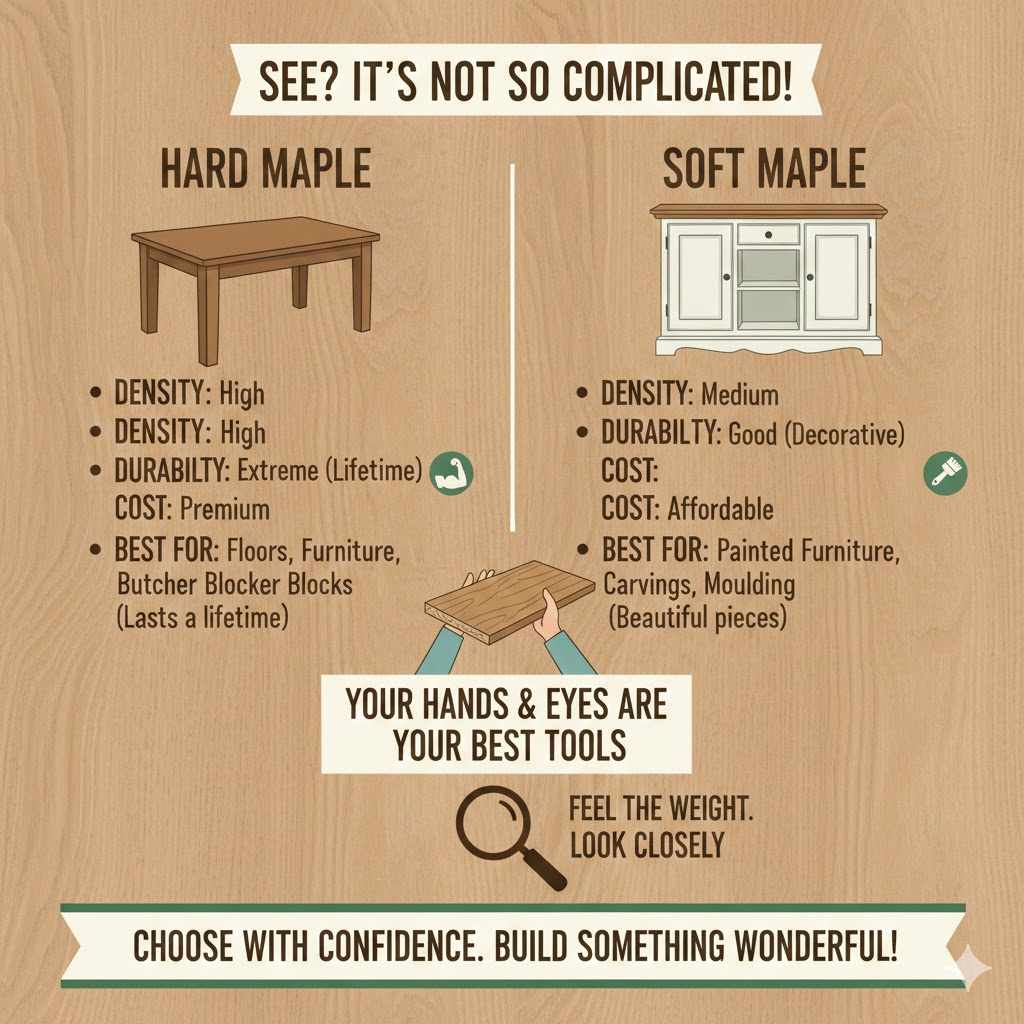
See? It’s not so complicated after all. The difference between hard maple and soft maple really comes down to density, durability, and cost. Hard maple is the tough, premium choice for projects that need to last a lifetime. Soft maple is the friendly, affordable option for beautiful painted pieces and decorative work.
Don’t be afraid to pick up the wood, feel its weight, and look closely at the grain. Your hands and eyes are some of your best tools in the lumber aisle. The more you work with different woods, the easier it will become to tell them apart. Now you have the knowledge to choose with confidence. Go ahead and build something wonderful!
Frequently Asked Questions (FAQ)
Is soft maple still considered a hardwood?
Yes, absolutely! All maple trees are deciduous (they lose their leaves in the fall), which classifies them botanically as hardwoods. The terms “hardwood” and “softwood” refer to the type of tree, not the actual density of the wood. Soft maple is only “soft” when compared to the much denser hard maple.
Can I use soft maple for a cutting board?
It’s not recommended. Cutting boards take a lot of abuse from knives. Soft maple is much more likely to get scarred and dented than hard maple. For food safety and durability, hard maple is the superior choice because its tight grain and hardness resist bacteria and wear.
Is hard maple always more expensive than soft maple?
Generally, yes. Hard maple is in higher demand for applications like flooring and cabinetry, and it grows more slowly. This makes it more expensive. Soft maple is more widely available and is almost always the more budget-friendly option.
Which maple is better for painting?
Soft maple is the winner here. It’s less expensive and takes paint extremely well, providing a very smooth, stable surface. Since painting covers the wood’s natural grain and color, there is no need to pay the premium price for hard maple.
How can I be sure I’m buying hard maple for my project?
The best way is to ask your lumber supplier directly. Reputable dealers will know exactly what they are selling. You can also use the tips from this guide: check the weight, the end grain (look for tight growth rings), and the uniform creamy color.
Will soft maple hold screws as well as hard maple?
Hard maple will hold screws more securely due to its higher density. While soft maple holds screws reasonably well for most furniture and cabinet applications, if you’re building something that will be under a lot of stress (like a workbench vise), hard maple provides superior strength and holding power.
Why does my maple look blotchy after staining?
Both hard and soft maple are known for being difficult to stain. Their dense, tight grain structure prevents stain from absorbing evenly. To avoid a blotchy finish, it’s very important to use a pre-stain wood conditioner before you apply your stain. This helps the wood absorb the stain more uniformly.