Hackzall vs Sawzall: Real Specs and Which to Buy (2026)
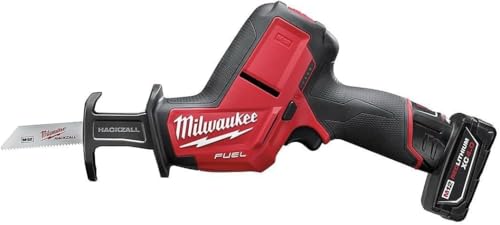
The Hackzall is Milwaukee’s compact one-handed reciprocating saw, and the Sawzall is its full-size, two-handed one. The real gap is stroke length: 1/2 to 7/8 in on the Hackzall models against 1-1/4 in on the M18 FUEL Sawzall.
That gap decides which one you should buy. Both top out at 3,000 strokes per minute on the models compared here, so the Hackzall is limited by how far the blade travels, not by how fast it moves. Below are the specs from Milwaukee’s own listings, what they mean for wood, pipe and demolition, and a straight recommendation.
Hackzall vs Sawzall: The Short Answer
BEST COMPACT RECIP SAW PICK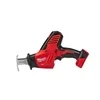 |
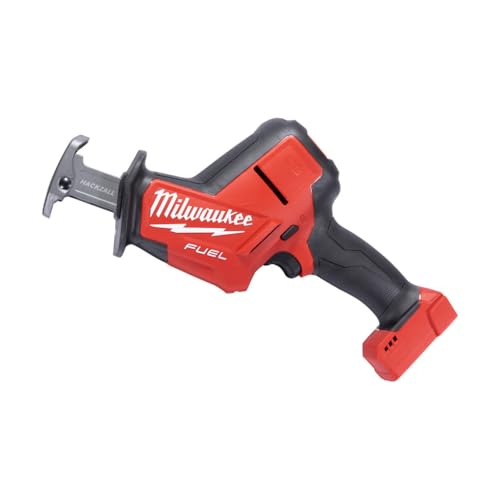
Milwaukee M18 Hackzall (2625-20), Tool Only
|
Buy the Hackzall if your cuts are occasional and awkward: overhead, inside a wall cavity, under a sink, or up a ladder. Buy the Sawzall if you will spend hours cutting through nail-embedded framing, thick timber or demolition debris. Most homeowners and woodworkers are in the first group.
One naming point first. Sawzall and Hackzall are both Milwaukee brand names, so this comparison is a choice inside one product family, not two competing brands. If you want to see how other makers stack up, our cordless reciprocating saw comparison ranks seven models by strokes per minute and price.
Hackzall vs Sawzall Specs Side by Side
These figures come from Milwaukee’s product pages and retailer listings for the bare tools (no battery). The fourth column multiplies stroke by maximum strokes per minute, a simple way to compare how much stroke each saw can deliver every minute.
| Model | Stroke length | Max strokes/min | Stroke inches per min | Tool weight | Length |
|---|---|---|---|---|---|
| M12 Hackzall (2420-20) | 1/2 in | 3,000 | 1,500 | 2.6 lb | 11 in |
| M18 Hackzall (2625-20) | 3/4 in | 3,000 | 2,250 | 4.1 lb | 13 in |
| M18 FUEL Sawzall (2821-20) | 1-1/4 in | 3,000 | 3,750 | about 6.8 lb | about 17 in |
What the table shows: the M18 FUEL Sawzall delivers 2.5 times the stroke inches per minute of the M12 Hackzall and about 1.7 times the M18 Hackzall, at the same top speed. It also weighs roughly 2.6 times as much as the M12 Hackzall. That extra weight is the cost of the longer stroke and bigger motor, and it is why the Sawzall is a two-handed tool.
Milwaukee also sells brushless M18 FUEL Hackzall models with a 7/8 in stroke, such as the 2719-20, which closes some of the gap. Milwaukee describes that longer stroke as removing more material per stroke for faster cuts. Even so, it stays well short of the Sawzall’s 1-1/4 in. For a price-by-model breakdown, see our Milwaukee reciprocating saw price guide.
Why Stroke Length Matters More Than “Power”
A common belief is that a Hackzall is just a weaker Sawzall. The numbers say something more specific. On the models above, top speed is identical, so the difference is how far each stroke travels. A longer stroke pulls more of the blade’s teeth through the cut on every pass, which is why full-size saws chew through thick lumber and stud walls faster.
A short stroke has one real advantage: the saw body can be small and light. That is the trade Milwaukee made with the Hackzall, and it is a good one when the alternative is holding a 7 lb saw at arm’s length above your head.
Which Saw Fits Which Job
| Job | Better pick | Why |
|---|---|---|
| Pruning tree branches | Hackzall | Light enough to hold overhead with one hand |
| Cutting PVC or copper pipe in a tight spot | Hackzall | Compact body fits between joists and under sinks |
| Drywall and trim cutouts | Hackzall | Short blades and light weight give control |
| Cutting nails out of framing lumber | Sawzall | Longer stroke and heavier body hold up to sustained cuts |
| Demolishing walls or decking | Sawzall | Removes more material per stroke, all day |
| Cutting thick timber or posts | Sawzall | Longer stroke clears the cut faster |

If you mostly cut wood, note that neither saw makes a clean furniture cut. A reciprocating saw is a rough-cut tool for trimming, demolition and pruning, and for finished cuts you are better served by a circular saw, jigsaw or handsaw. Our comparison of the circular saw and Sawzall explains where each one belongs, and reciprocating vs oscillating saws covers the other tool people confuse with these.
One-Handed Does Not Mean Careless
The Hackzall is built so you can hold it in one hand, which tempts people to hold the workpiece with the other. Do not. Clamp small pieces, or support them so the free hand stays well away from the blade path. Rest the saw’s shoe against the material before pulling the trigger so the blade does not bounce, and let the blade reach speed before it touches the cut. These habits apply to any reciprocating saw, and the one-handed design makes them easier to skip.
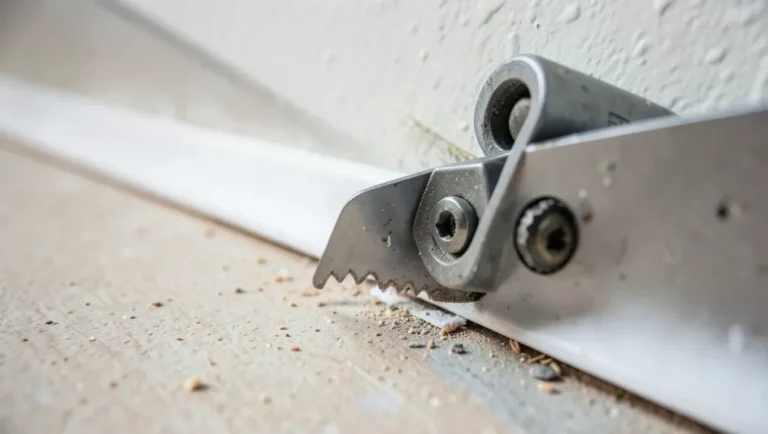
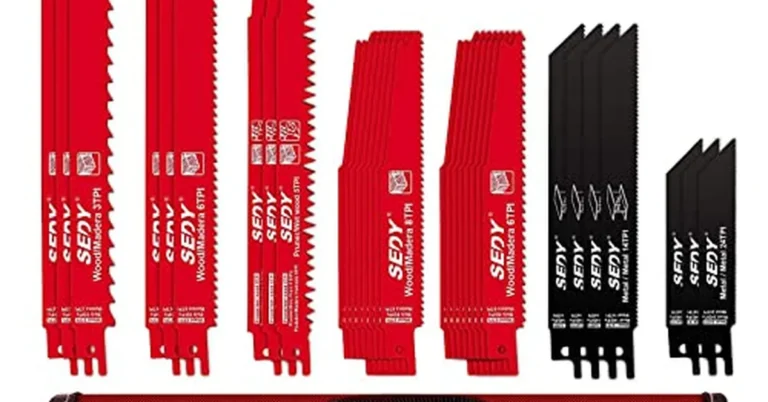
You do not need a separate blade set for each saw. Milwaukee lists the M12 Hackzall as accepting both Hackzall and Sawzall style blades, and the M18 Hackzall uses a QUIK-LOK clamp for tool-free changes that is listed for both blade types. If you want the details on shanks and compatibility across brands, read Are Sawzall blades universal. A short stroke works best with a blade only slightly longer than the material is thick, so use short blades on the Hackzall and keep the long ones for the Sawzall.
Battery Platform and Price
Price follows size. On Amazon listings checked on 30 September 2026, the bare M18 Hackzall (2625-20) was about $107, while a bare M18 FUEL Sawzall was around $184, and prices move often. The battery you already own matters as much as the saw: M12 and M18 are separate systems, so an M12 Hackzall will not use your M18 batteries. Our M12 vs M18 comparison and the guide on using M18 batteries on M12 tools cover the trade-offs. If you are weighing another brand’s compact saw, see the DeWalt 12V reciprocating saw review.
Three Myths About Hackzall and Sawzall
Myth 1: The Hackzall is slower because it has less power. On paper, the M12 Hackzall, M18 Hackzall and M18 FUEL Sawzall all list the same 3,000 strokes per minute ceiling. What differs is stroke length, which is why the Sawzall still cuts faster in thick material.
Myth 2: A one-handed saw kicks back less. Milwaukee’s listings describe the Hackzall’s one-handed design as giving control and versatility in tight spaces, not as reducing kickback. Any reciprocating saw can grab and jump if the shoe is not seated against the work, so the technique above matters just as much on the small saw.
Myth 3: A Sawzall cuts concrete. The saw is a mechanism; the blade decides the material. Standard wood and metal blades do not cut concrete, and masonry work needs a specialty carbide or grit blade, which wears fast. If demolition means concrete, plan for a different tool or blade, not just a bigger saw.
Whichever saw you choose, buy the bare tool if you already own batteries for that platform, and a kit only if you do not. A kit costs more up front, but a bare tool with no battery cannot cut anything.
Which Should You Buy?
- Buy a Hackzall if you cut occasionally, work overhead or in tight spaces, prune trees, or already own M12 or M18 batteries.
- Buy a Sawzall if you demolish, remodel or cut framing weekly and want the fastest cutting per stroke.
- Buy both only if you do demolition and also need a light saw for awkward spots, and share one battery platform between them.
For most readers, the M18 Hackzall bare tool is the sensible starting point: it is light, takes standard blades, and costs far less than a full-size FUEL Sawzall.
Frequently Asked Questions About Hackzall vs Sawzall
Can a Hackzall replace a Sawzall?
For light work, yes: pruning, PVC and copper pipe, drywall cutouts and trimming wood in tight spots. For sustained demolition, no. The M18 FUEL Sawzall has a 1-1/4 in stroke against the M18 Hackzall’s 3/4 in, so it removes more material per stroke and is built for all-day cutting through framing and nails.
Can you cut wood with a Hackzall?
Yes. Milwaukee lists wood, metal and PVC as materials for the M18 Hackzall, and the saw accepts standard Sawzall-style blades, so a coarse wood-cutting blade works. Expect slower progress than a full-size saw in thick lumber because of the shorter stroke.
Is Sawzall a brand or a type of saw?
Both are Milwaukee product names. Sawzall is Milwaukee’s name for its full-size reciprocating saw, and Hackzall is its compact one-handed line. Most people use Sawzall as a generic word for any reciprocating saw, and the correct generic term is reciprocating saw.
Do Hackzall and Sawzall use the same blades?
Yes for Milwaukee’s current models. Milwaukee lists the M12 Hackzall as accepting both Hackzall and Sawzall style blades, and the M18 Hackzall’s QUIK-LOK clamp is listed for both blade types. See our guide on whether Sawzall blades are universal for shank details.
Which is better for cutting tree branches?
The Hackzall is easier to hold overhead and to steer through a branch with one hand. Pair it with a pruning blade, since a coarse pruning blade clears green wood better than a fine metal blade.
Sponsored / affiliate links. As an Amazon Associate I earn from qualifying purchases. I may earn additional commission from eligible campaigns.