How to Cut a Circle on a Table Saw: Jig Plans & Safety Steps
A table saw cuts a clean circle when the workpiece pivots around a fixed center point instead of feeding straight through the blade — not by guiding it freehand along a marked line. Raising the blade more than 1/16″ per pass tears out the edge or catches the offcut and kicks it back. This guide covers building a pivot-point jig, the safe incremental-cutting sequence, and how to finish the edge smooth.
Marking and Measuring Your Circle
Accurate layout is what makes the rest of the process work — a pivot point that’s off by 1/16″ throws the entire circle out of round. Measure the diameter with a tape measure, then find the center point before you touch the saw.
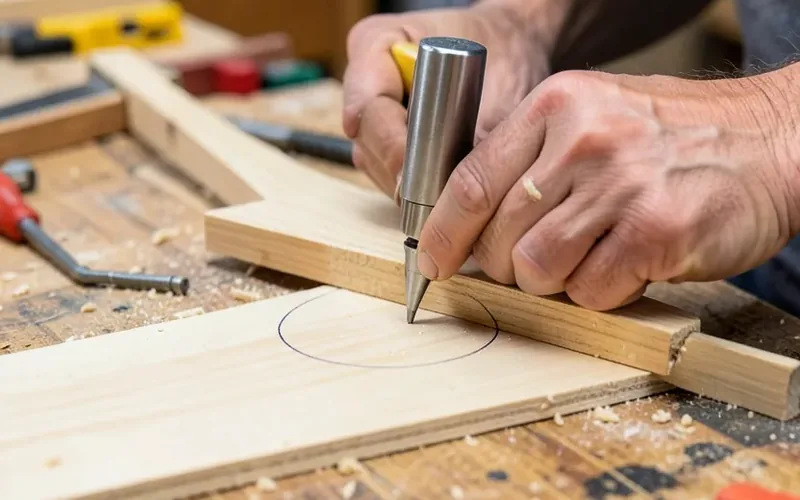
A pair of trammel points (sometimes called a beam compass) is the fastest way to scribe an accurate circle directly onto plywood or solid stock — set one point on the center mark and the other at the radius, then swing the arc in one motion instead of tracing a store-bought template.
Best Circle-Marking Tool Pick
 |
General Tools 523 Trammel Set, Stainless Steel A two-point beam compass that clamps to any straight board to scribe circles far larger than a standard compass can reach.
|
As an Amazon Associate we earn from qualifying purchases.
Safety Gear and Precautions
Circle cutting keeps the blade exposed and spinning near your hands for longer than a normal rip or crosscut, so the usual safety routine needs a few additions before you start.
- Safety glasses and hearing protection — the pivot cut runs longer and louder than a single straight pass
- A dust mask or shop vacuum at the blade — a full rotation throws far more sawdust than a straight cut
- A featherboard or push block to hold the pivot arm down, never your bare hand near the blade path
- The riving knife or splitter removed only if your jig design requires it, and reinstalled immediately after
Never reach over a spinning blade to retrieve an offcut, and keep the blade guard on for every pass where the jig design allows it — most pivot jigs only require removing the guard for the final few passes as the piece separates.
Two Ways to Cut a Circle on a Table Saw
There isn’t one correct method — which one to use depends mostly on the circle’s diameter and whether you want a jig you can reuse. If you don’t own a table saw at all, our roundup of the cut a circle covers bandsaw and jigsaw alternatives.
| Method | Best Circle Size | Setup Time | Best For |
|---|---|---|---|
| Pivot-point jig | 6″ – 36″ diameter | 15–20 min to build once, reusable after | Repeated circle cuts, round tabletops, clock faces |
| Corner-cutting (no jig) | Under 12″ diameter | None — start cutting immediately | A single one-off circle, small wheels or discs |
According to WOODWEB’s shop-tested circle-cutting reference, both methods share the same core rule: the blade should never be raised more than 1/16″ between passes on a pivoting cut — a bigger jump is what causes the workpiece to bind and kick back, since the blade is cutting into end grain and cross grain simultaneously as the piece rotates.
Building a Pivot-Point Circle-Cutting Jig
This shop-made jig reuses on every future circle cut and costs under $15 in scrap plywood and hardware — see our full table saw jig roundup for six other jigs worth building alongside it.
Materials and Tools Needed
| Materials | Tools |
|---|---|
| 3/4-inch plywood | Table saw |
| Wood screws | Drill |
| Wing nut and bolt | Tape measure |
| Marking pencil | Screwdriver |
| Wood glue | File or rasp |
Jig Assembly Steps
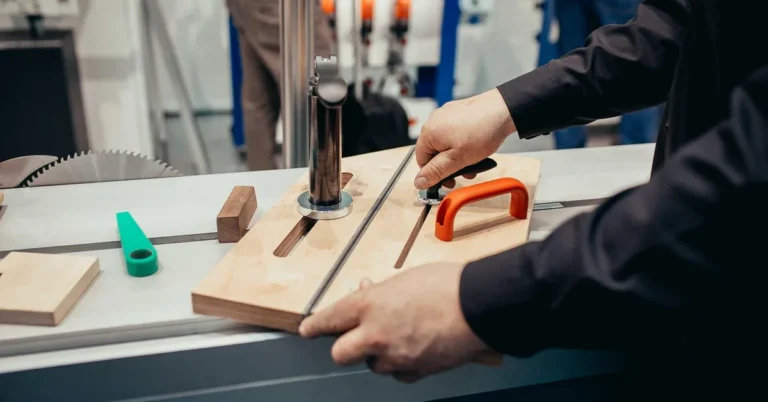
- Cut the base pieces: Cut the plywood into two pieces measuring 12″ x 12″ using the table saw.
- Join them at a right angle: Screw the two pieces together to form an L-shape, checking the corner is square before driving the screws.
- Add the pivot hardware: Drill a hole for the pivot bolt on one square and attach the wing nut to the other so the radius can slide and lock.
- Set the radius: Measure and mark the radius of your circle, then position and secure the pivot point at that exact mark.
- Lock the jig to the saw: Slide the jig along the table saw’s miter slot to the marked radius and tighten the wing nut to lock it in place.
- Reinforce the joints: Apply wood glue at the L-joint for long-term rigidity, then let it cure before the first cut.
- Smooth the edges: Once the glue has dried, use a file or rasp to knock down any rough edges so the workpiece pivots freely.
Making the Cut: Step-by-Step
Once the jig is built and the radius is locked in, the cut itself happens in short, controlled passes rather than one continuous rotation.
- Rough-cut the corners first: If your blank is square or rectangular, cut off each corner on the table saw before mounting it on the jig — removing the corners first means the blade meets less material on the first rotating passes, which is safer than starting from a full square blank.
- Mount the blank on the pivot: Center the workpiece on the pivot pin and lower the blade fully below the table.
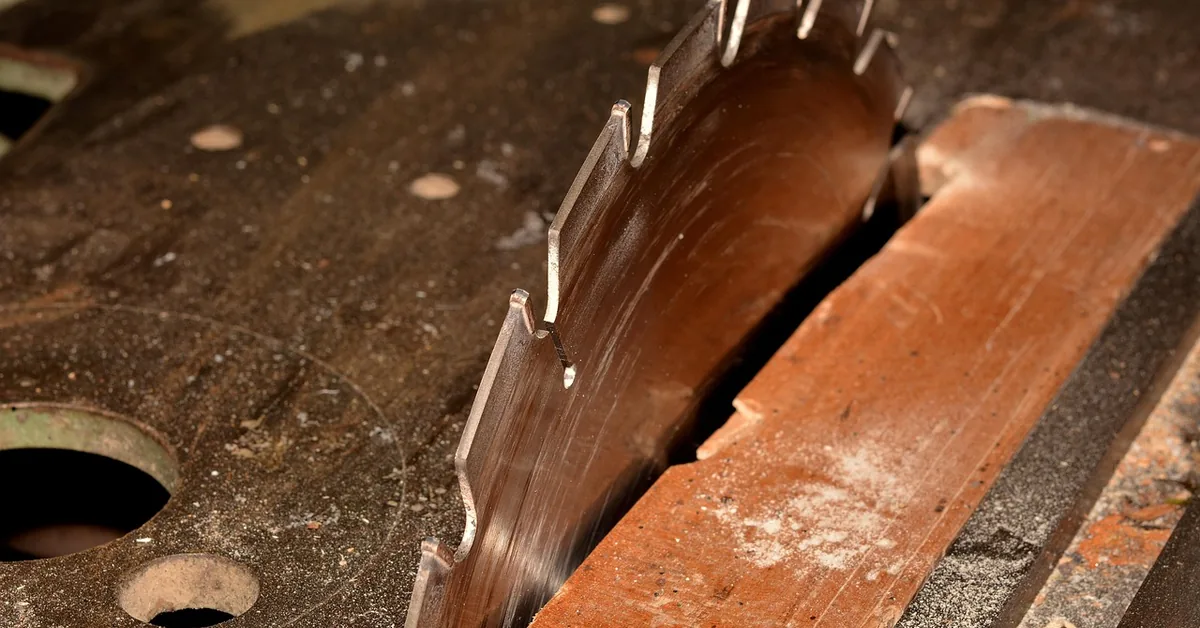
- Start the saw and raise in small increments: With the workpiece resting flat on the pivot, turn on the saw and raise the blade no more than 1/16″ before making a full rotation.
- Rotate the workpiece steadily: Keep even, slow pressure as you spin the blank around the pivot point, letting the blade do the cutting rather than forcing the rotation.
- Repeat the raise-and-rotate cycle: Continue raising the blade 1/16″ at a time and rotating a full turn after each raise until the blade cuts through completely.
- Kill the power before removing the piece: Switch off the saw and wait for the blade to stop completely before lifting the finished circle off the pivot.
Finishing the Edge
The incremental cut leaves a slightly stepped edge where each 1/16″ pass meets the next, so a finishing pass is standard, not optional.
Sand the edge with progressively finer grits, starting around 120-grit to knock down the steps and finishing at 220-grit for a smooth surface. A handheld router with a round-over bit cleans up any remaining unevenness in one pass and softens the edge at the same time, which is worth doing on any circle that will be handled often, like a clock face or a stool seat.
Common Mistakes and Troubleshooting
Most circle-cutting problems trace back to one of three causes: a loose pivot point, raising the blade too fast, or an inconsistent rotation speed.
- Tear-out on the underside: usually means the blade was raised more than 1/16″ per pass — slow down the increments.
- An out-of-round circle: almost always a loose or shifted pivot point — check that the pivot pin hasn’t worked loose in the jig before the next cut.
- Burn marks on the edge: the workpiece was rotated too slowly for the blade speed, or the blade is dull — see our guide on Table saw blade if this happens on every project, not just circles.
- Kickback or binding: the most common cause is skipping the corner-cutting step and starting from a full square blank — always knock the corners off first.
Frequently Asked Questions
How do you set up a table saw to cut a circle?
Build or clamp a pivot-point jig to the table saw so the workpiece can rotate around a fixed center. Mark the center of the circle on the blank, lower the blade below the table, set the workpiece on the pivot, then raise the blade in 1/16″ increments while rotating the piece a full turn after each raise.
What safety precautions should be taken while cutting a circle on a table saw?
Wear safety glasses and hearing protection, and run a dust mask or shop vacuum since a full rotation throws more sawdust than a straight cut. Keep hands on the jig’s pivot arm, never near the blade path, and never reach over a spinning blade to retrieve an offcut.
What type of blade is best for cutting circles on a table saw?
A sharp, fine-tooth carbide-tipped blade gives the cleanest circular cuts, since it’s cutting through end grain and cross grain in the same rotation. A dull blade is the most common cause of burn marks on a curved cut, so check the blade’s sharpness before starting.
Can you cut a circle on a table saw without a jig?
Yes, for circles under about 12″ in diameter. Cut off each corner of the square blank first, then keep cutting off the newly created corners in smaller passes until the shape rounds out. It’s slower and less precise than a pivot jig, but it works for a single one-off circle when building a jig isn’t worth the time.
How much should you raise the blade when cutting a circle on a table saw?
No more than 1/16″ per pass. Because the blade cuts into rotating end grain rather than a straight line, a bigger jump causes the workpiece to bind against the blade and kick back. Raise the blade, rotate the piece a full turn, then raise it again.
Conclusion
Cutting a circle on a table saw comes down to controlling two things: how the workpiece rotates around a fixed pivot, and how little material the blade removes on each pass. A shop-built pivot jig, the 1/16″ incremental raise, and a corners-first start on square blanks cover the vast majority of circle cuts you’ll need in a home shop — from a clock face to a round tabletop.
Sponsored / affiliate links. As an Amazon Associate I earn from qualifying purchases. I may earn additional commission from eligible campaigns.