How to Cut a 60-Degree Angle on a Miter Saw (Even at 45° Max)
A 60-degree angle cut means setting your miter saw’s scale to 30 degrees, not 60 — the saw measures from square, so the setting equals 90 minus your corner angle. Dial in 60 by habit and hexagon or triangle joints won’t close. A few saws, like the DeWalt DWS780 or Makita GSL02M1, do reach a true 60° stop. This guide covers the 30-degree method, a jig for saws capped at 45°, and how to check yours first.
What You’ll Need
Best Angle Verification Pick
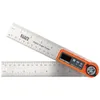
Klein Tools 935DAF Digital Angle Finder
A magnetic-base gauge built for miter saw protractor work, reading angles directly off the blade or table.
- Best for: Confirming a true 30° or 60° setting before you cut
- Why we picked it: Magnetic base holds steady on the saw table, so you’re not eyeballing the detent
- Main drawback: Pricier than a basic protractor gauge
Compare more angle gauge options
 Option 1 POWERTEC 71828 Angle Gauge
|
 Option 2 Klein Tools 935DAG Angle Gauge
|
 Option 3 GemRed 82305 Digital Angle Finder
|
As an Amazon Associate we earn from qualifying purchases.
- A 10″ or 12″ compound miter saw (corded or cordless)
- A digital angle finder or protractor to verify the setting before you cut
- A pencil and combination square for marking the cut line
- A clamp to hold the workpiece flush against the fence
- Safety glasses and hearing protection
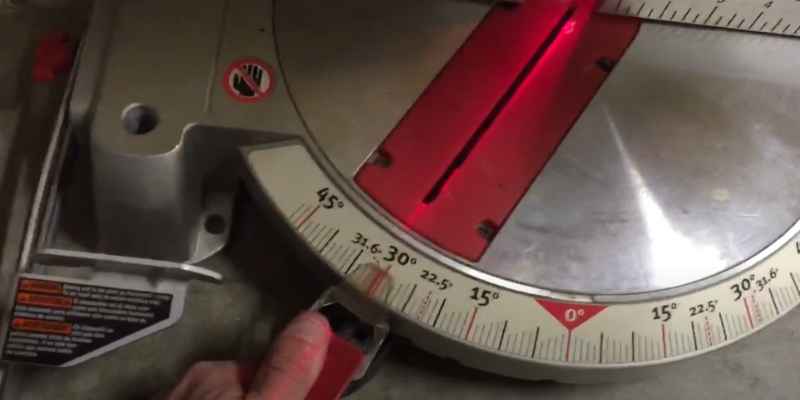
Saw Setting vs. Resulting Angle (Why 60° Confuses Everyone)
A miter saw’s angle scale reads the distance from square (0°), not the angle of the finished corner. That’s the source of almost every mix-up on this topic. When someone asks for a “60-degree cut,” they usually mean the corner two pieces form when joined — and that corner comes from a 30-degree saw setting, not a 60-degree one, because 90 minus 60 is 30.
This matters most on shapes built from repeating angles. The table below uses figures confirmed against our full miter saw angle chart: for a regular polygon, the saw setting equals 180 divided by the number of sides.
| Project Shape | Sides | Miter Saw Setting |
|---|---|---|
| Equilateral triangle | 3 | 60° |
| Square frame | 4 | 45° |
| Hexagon (6-sided planter, mirror frame) | 6 | 30° |
| Octagon | 8 | 22.5° |
So if a project calls for a true equilateral-triangle point — a wedge, a decorative bracket, a triangular shelf — the saw setting really is 60°. If it calls for the 60-degree interior corner of a hexagon, the saw setting is 30°. Read the project spec carefully before you touch the miter lock.
“The mix-up we see most often on hexagon shelving is a beginner dialing the saw to 60 degrees out of habit, cutting the full run, and then finding every joint gapped by the same amount. It’s a five-second fix once you know the setting is 30, not 60 — but it’s a frustrating way to find out.”
How to Cut a 60-Degree Corner Angle (30-Degree Method)
This is the method for the interior 60-degree corner used on hexagon frames, planters, and six-sided project pieces — the version of “60-degree cut” most searches actually mean.
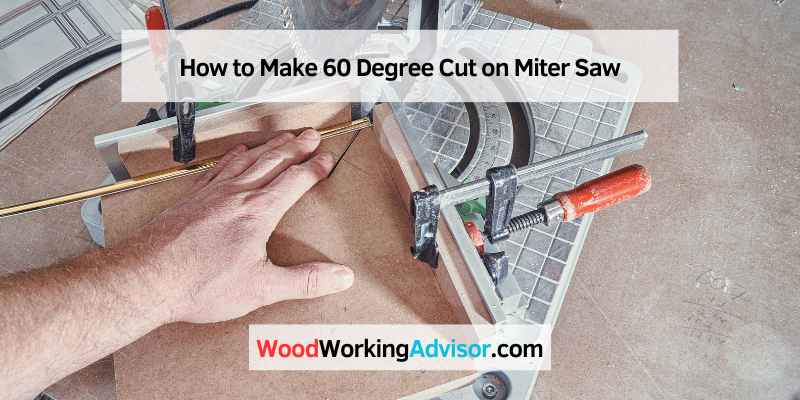
- Mark the cutting line: Square a reference line across the workpiece where the corner needs to fall, using a combination square.
- Set the miter angle to 30 degrees: Loosen the miter lock, rotate the table to the 30° detent (not 60°), and re-lock it.
- Verify the setting: Check the actual angle with a digital angle finder before cutting — factory detents drift over time.
- Position the workpiece: Hold it flush against the fence with the marked line aligned to the blade path.
- Clamp it down: Secure the workpiece so it can’t shift, keeping your hands clear of the blade’s travel path.
- Make the cut: Start the saw, let it reach full speed, then lower it slowly and steadily through the workpiece.
- Let the blade stop: Turn off the saw and wait for the blade to come to a complete stop before lifting it and removing the offcut.
Repeat the same 30-degree setting on every piece in the run — each piece gets a 30° cut on both ends, and the two mitered faces meet to form the hexagon’s 60-degree corner. For workholding tips on longer stock, see our guide on building a miter saw table with an extended fence.
Does Your Miter Saw Actually Reach 60° on the Scale?
Most compact miter saws stop at 45° or 50° per side, but larger sliding compound miter saws often go further. The DeWalt DWS780 miters 60° to the right and 50° to the left. The Makita GSL02M1 miters a full 0° to 60° in both directions. If you genuinely need the saw’s scale to read 60° — not the 30-degree corner-angle setup above — check your own saw’s spec sheet or owner’s manual first. It may already do it natively, with no jig required. Compare a few current DeWalt compound miter saw models or read our 10-inch vs. 12-inch miter saw comparison if you’re shopping for one with a wider miter range.
The Flip-Jig Method for Saws Capped at 45°
If your saw’s scale genuinely stops at 45° and you need it to actually cut at 60° on the scale (not the 30-degree corner method above), a simple jig closes the gap:
- Cut a scrap board — about 6″ long — at a 30-degree angle to use as a jig.
- Clamp the jig against the saw’s fence so its angled edge faces the blade.
- Set the saw itself to 30 degrees as well; the jig’s angle stacks with the saw’s angle.
- Butt your workpiece against the jig’s angled edge instead of the fence, then clamp and cut as usual.
- Check the result with a protractor — the two 30-degree angles combine to a true 60-degree cut.
The math works the same way with a 45-degree jig: subtract the jig’s angle from your target (60 − 45 = 15) and set the saw to that difference instead.
How to Cut a 60-Degree Angle Without a Miter Saw
A circular saw with an adjustable bevel base can make the same cut. Set the depth of cut so the blade protrudes only about 1/8″ past the material’s thickness, mark your cutting line with a combination square or T-bevel set to 60°, then guide the saw’s baseplate along a straightedge clamped to the workpiece. Go slowly — a circular saw doesn’t have a locked table angle, so the cut is only as accurate as your straightedge and your hand pressure.
What About a 65-Degree Angle?
A 65-degree cut needs a different approach than the 60-degree methods above — no standard miter saw rotates that far natively, even the wide-range models mentioned earlier. Our dedicated 65-degree angle miter saw guide walks through the jig setup and the exact math (65° minus 45° = 20° on the saw) for that specific angle.
Common Mistakes When Cutting 60-Degree Angles
- Setting the saw to 60° when you wanted a 60-degree corner. That setting cuts a 30-degree corner instead — the single most common error on this topic.
- Trusting the factory detent without checking it. Detent plates wear and shift; verify with a digital angle finder on any cut that has to close cleanly.
- Cutting the whole run before test-fitting one joint. Cut two pieces, dry-fit the corner, and only then commit to the rest of the pieces.
- Skipping safety basics. Full step-by-step safe operating practice — hand position, blade guard, kickback prevention — is covered in our guide to safely using a miter saw.
- Using a worn or wrong blade. A dull or low-tooth-count blade tears the cut edge on angled cuts more than on square crosscuts — see our 80 vs. 100-tooth blade comparison for trim and finish work.
Frequently Asked Questions
What angle do you set a miter saw to for a 60-degree cut?
For the interior 60-degree corner used on hexagons and six-sided projects, set the saw to 30 degrees — the setting equals 90 minus your target corner angle. For an actual 60-degree point, like an equilateral triangle’s tip, set the saw to 60 degrees directly.
Can a miter saw cut a true 60-degree angle on the scale?
Yes, on saws with a wide enough miter range. The DeWalt DWS780 miters 60° to the right, and the Makita GSL02M1 miters 60° in both directions. Many compact miter saws max out at 45° or 50° per side and need the flip-jig method instead.
How do you cut a 60-degree angle without a miter saw?
Use a circular saw with an adjustable bevel base, set to 60 degrees, guided along a clamped straightedge. Limit the blade depth to roughly 1/8″ past the material thickness and cut slowly, since there’s no locked table angle backing up the cut.
What’s the difference between a miter angle and a bevel angle?
The miter angle is the horizontal rotation of the saw table, which angles the cut across the face of the board. The bevel angle tilts the blade itself, angling the cut through the board’s thickness. A compound cut uses both at once — crown molding is the most common example.
How do you cut a 65-degree angle on a miter saw?
A 65-degree cut isn’t reachable natively on most saws, even the 60-degree models covered above. Our 65-degree angle miter saw guide covers the jig and the 65 minus 45 equals 20-degree saw setting needed for it.
Conclusion
Most of the confusion around a “60-degree cut” comes down to one question: do you want the saw’s scale to read 60°, or do you want the finished corner to measure 60°? For the corner — hexagons, six-sided projects — set the saw to 30 degrees. For an actual 60° point, check whether your saw reaches it natively before reaching for a jig. Either way, verify the setting with an angle finder and test-fit one joint before cutting a full run.
Sponsored / affiliate links. As an Amazon Associate I earn from qualifying purchases. I may earn additional commission from eligible campaigns.