How to Make a Wooden Sign Stand Up: 3 Builds, Cut Lists, Wind Limits
To make a wooden sign stand up, give it a base whose depth fits its height and your wind: an easel-back strut for sheltered spots, slotted 2×4 feet for most signs, or a hinged A-frame for outdoor use. Most guides stop at “attach a stand”. This one gives you cut lists for three builds and the wind speed each one tips over at, worked out from the sign size, with every assumption stated so you can check the numbers yourself.
Which Stand Fits Your Sign?
Best Easel-Back Hinge Pick
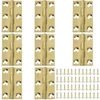 |
Piutouyar 8-Pack 1.5 in Solid Brass Butt Hinges: about $8 The hinge that joins the strut to the sign is the one part you cannot cut from wood. This pack includes enough hinges for several easel-back signs.
|
The example sign throughout is a 24 in wide by 18 in tall panel of 3/4 in pine, which weighs about 5.6 lb (24 x 18 x 0.75 in is 0.1875 cubic feet, times 30 lb per cubic foot). Use the same arithmetic for your own size. The table compares the three builds.
| Build | Best for | Calculated tipping gust | Folds flat? |
|---|---|---|---|
| Easel-back strut | Indoor tables, shelves, sheltered porches | 24 x 18 in sign: 14 mph from behind, 23 mph from the front | Yes |
| Slotted 2×4 feet, 12 in deep | Yard, shop front, event signs | 24 x 18 in sign: 20 mph | No, but the sign lifts out |
| A-frame (two hinged panels) | Sidewalk and outdoor display | Larger 24 x 36 in panels: 21 mph | Yes |
Those speeds come from the model in the next section. They are estimates for comparing designs, not engineering ratings, and a real gust can arrive from any angle.
Why Signs Tip: The Wind Math
A flat sign is different from the tall, top-heavy objects covered in our wooden cross stand guide, where the center of gravity sits high. On a flat panel the weight and the wind area both grow with the sign, so the tipping speed depends on just three things: panel thickness, base depth, and sign height.
The model: wind pushes on the face with a force of 0.00256 x V squared x 1.2 x area (V in mph, area in square feet, force in pounds). That pressure formula is the standard velocity-pressure relation and 1.2 is my assumed drag coefficient for a flat plate. The push acts at mid-height. The sign tips about the edge of its base when that push times half the height equals the sign weight times half the base depth. I assumed pine at 30 lb per cubic foot and ignored the weight of the base itself, so real feet add a little margin.
Worked out, the tipping gust in mph is the square root of (30 x thickness x depth) divided by (0.0369 x height), with thickness, depth and height in inches. Width drops out. Here is the base depth that holds a 3/4 in pine panel against a 20 mph and a 30 mph gust:
| Sign height | Base depth for 20 mph | Base depth for 30 mph |
|---|---|---|
| 12 in | 8 in | 18 in |
| 18 in | 12 in | 27 in |
| 24 in | 16 in | 35 in |
| 36 in | 24 in | 53 in |
| 48 in | 32 in | 71 in |
The rule of thumb is a base depth of about two thirds of the sign height for 20 mph. Doubling the panel thickness to 1-1/2 in halves the depth you need, which is why a thick plank sign stands more easily than a thin plywood one of the same size. Adding weight low in the base works too, and the ballast section below shows how much.
Build 1: Easel-Back Sign Stand
The easel-back is the right choice when the sign has to fold flat or travel, but it has the weakest outdoor numbers of the three because the base is just one narrow strut. For the 24 x 18 in sign, the cut list is:
- Sign panel: 24 x 18 x 3/4 in pine (edge-glued boards)
- Strut: one piece of 1×2 pine (3/4 x 1-1/2 in actual), 13-1/2 in long, with both ends cut at about 31 degrees so it sits flat on the floor and on the sign back
- One 1.5 in brass hinge with screws, and a short cord or small chain as a stop
Here is where the 13-1/2 in comes from. Mount the hinge 12 in up from the bottom of the sign back. With the sign leaning back 15 degrees, that hinge point sits about 3.1 in behind the bottom edge and 11.6 in off the ground. Put the strut foot 10 in behind the bottom edge and the strut runs 13.5 in at about 31 degrees from vertical. Scale these numbers if your sign is a different height.
- Screw the hinge to the top end of the strut, then to the sign back at the 12 in mark, with the strut centered side to side.
- Hold the sign at 15 degrees with the strut foot 10 in back, and measure the gap between the strut and the sign back where the cord will attach. Cut the cord to that length and screw it on with small screw eyes.
- Check that the strut cannot swing past the set angle. If it can, shorten the cord.
Now the numbers. At 15 degrees the center of gravity is only about 2.7 in behind the front bottom edge, so a gust from behind tips the sign at about 14 mph. A gust from the front is held by the strut and takes about 23 mph. Leaning the sign back to 25 degrees lifts the rear limit to about 18 mph. If a sign has to be outside, place it with its front to the prevailing wind, or bring it in when gusts are forecast.
Build 2: Slotted Feet
Slotted feet keep the sign removable and put the base depth exactly where the math says you need it. From the table, the 24 x 18 in sign needs about 12 in of base depth for 20 mph. The cut list:
- Sign panel: 24 x 18 x 3/4 in pine
- Two feet: 2×4 pine (1-1/2 x 3-1/2 in actual), each 12 in long, laid flat
- Exterior wood glue (Type II or Type III) and a 1/2 in chamfer on the foot ends
- Mark the center of each foot at 6 in. Cut a slot across the 3-1/2 in width, 3/4 in wide and 1 in deep.
- Test the fit on scrap, because blade kerfs vary and a slot cut at exactly 3/4 in is usually tight on a sanded panel.
- Place the feet 3 in in from each end of the panel bottom, check that the panel stands plumb, then glue it in or leave it dry-fit to lift the sign out for storage.
With a 12 in deep foot on both sides of the sign, the calculated tipping gust is about 20 mph. To raise it without lengthening the feet, glue a second layer of 2×4 under each one: the added weight sits right at the base, which is the best place for it.
Build 3: A-Frame Sandwich Board
An A-frame hinges two panels at the top and lets them spread at the bottom, so the footprint comes from the angle instead of from separate feet. It folds flat and carries easily. For two 24 x 36 in panels:
- Panels: two pieces of 24 x 36 x 1/2 in pine, about 7.5 lb each, 15 lb total
- Hinges: two 2 to 3 in butt hinges (not mini hinges), plus a chain or cord between the panels to stop the spread
- Rip the top edge of each panel at 15 degrees so the two meet flat when set at 15 degrees from vertical
At 15 degrees from vertical each panel leg spreads about 9.3 in, so the base is about 18.6 in wide. Fix the spreader chain 18 in below the hinge, where the panels are about 9.3 in apart, and cut it to that length. I modeled wind on the windward panel only, assuming the leeward panel sits in its wake, and ignored the upward push on the windward panel face. That makes the real limits a little lower than shown.
| Panel angle from vertical | Base width | Calculated tipping gust |
|---|---|---|
| 10 degrees | 12.5 in | 17 mph |
| 15 degrees | 18.6 in | 21 mph |
| 20 degrees | 24.6 in | 25 mph |
A steeper spread gives a wider base, but it also leaves the panels at a lower angle for reading. For a 36 in tall board, 15 degrees is a sensible compromise.
Add Weight to the Base
Ballast is the cheapest way to raise a tipping speed. The table shows the 24 x 18 in sign on an 8 in deep base with sand placed at the middle of the base, 4 in out from either edge:
| Added weight in base | Calculated tipping gust |
|---|---|
| 0 lb | 16 mph |
| 5 lb | 23 mph |
| 10 lb | 27 mph |
| 20 lb | 35 mph |
Put the weight low and inside the footprint, in a base box or a tray of sand, not strapped to the sign. And tip-over is only one failure mode: a sign that blows over can hurt someone, so choose a base for the gustiest weather you expect, not the average day.
Finish the Stand for Outdoor Use
Prime and paint every face and edge of the sign and the foot slots, because bare end grain absorbs moisture first. Use exterior paint and exterior-rated screws, and keep the bottom edge of the panel out of standing water. Brass hinges resist rust, but they are thin, so check the screws after the first season.
Frequently Asked Questions
How do you make a wooden sign stand up?
Pick a stand that gives the sign a base about two thirds as deep as the sign is tall if it will sit in wind: slotted 2×4 feet, a hinged easel-back strut for sheltered spots, or an A-frame with two hinged panels. A small indoor sign can use a base far smaller than that.
How deep should the base of a freestanding wooden sign be?
For 3/4 in pine with the weight of the base ignored, the math in this guide gives a depth of about 0.65 times the sign height to resist a 20 mph gust, and about 1.5 times the height for 30 mph. Adding weight low in the base shrinks those numbers.
Will an easel-back wooden sign stay up outside?
Only in calm or sheltered spots. In the 24 x 18 in example it tips at about a 14 mph gust from behind and about 23 mph from the front, assuming a flat-plate drag coefficient of 1.2. Bring it in or switch to an A-frame or weighted base when gusts are forecast.
How far back should a sign lean on an easel-back stand?
About 15 degrees from vertical is a common starting point. Leaning further back, to 25 degrees, raises the rear-wind tipping speed in the example from about 14 to about 18 mph, but the sign then reads at a steeper angle.
How much weight should I add to the base of a wooden sign?
In the 24 x 18 in example on an 8 in deep base, 10 lb of sand placed low in the base raises the calculated tipping gust from about 16 to about 27 mph. Put the weight in the base, not on the sign.
Conclusion
Pick the stand by the wind it will see: an easel-back for sheltered spots, 12 in deep slotted feet for the 24 x 18 in example in yard weather, and an A-frame for bigger signs. Then check the base depth against the table before you cut. If the numbers are short, add base depth or ballast rather than hoping the sign holds.
Sponsored / affiliate links. As an Amazon Associate I earn from qualifying purchases. I may earn additional commission from eligible campaigns.