Miter Saw Station Plans Free: 3 Compared + Height Math
A miter saw station only works when its wings sit exactly level with your saw’s own table, and that height depends on your saw, not on the plan. Free cabinet plans from Kreg Tool leave that measurement to you, and most skip dust collection. This guide gives the height math, a cut list for stock base cabinets, and a straight answer on which station plans really cost nothing.
Miter Saw Station Plans Free: Which Ones Cost Nothing
Best Station Fence Upgrade
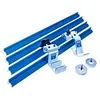 |
Kreg Precision Trak & Stops Kit, Miter Saw Track System (KMS8000) – $169.00 Kreg’s free Miter Saw Station and Storage plan, covered below, builds its fence around this track and stop system, so it is the one add-on the plan itself names.
|
As an Amazon Associate we earn from qualifying purchases.
Searches for free station plans turn up a mix of free walkthroughs and paid downloads, and the titles do not always say which is which. Three popular ones are compared below, using what each page itself states. If you want a plain 8-foot bench instead of a cabinet station, see our free miter saw workbench plans with an 8-ft cut list; for five table-style designs, see free miter saw table plans.
| Plan | Cost | What it builds | Materials per its page | Dust collection |
|---|---|---|---|---|
| Kreg Tool: Miter Saw Station and Storage | Free | Mobile cabinet station with drawers and doors, 48-inch fence pieces, 15-3/4-inch-deep cabinets | 3 sheets of 3/4-inch plywood, 1 sheet of 1/4-inch, 8 swivel casters, 14-inch drawer slides | None in the plan |
| Kreg Tool: Miter Saw Station with Drawers | Free | Two base cabinets with a middle box that holds the saw; rated Advanced | 3 sheets each of 3/4-inch, 1/2-inch and 1/4-inch plywood | Optional, not detailed |
| The Handyman’s Daughter: DIY Miter Saw Station | Paid plans (the post is a walkthrough) | 36-inch-deep station sized for a Bosch Glide saw | Ten 8-ft 2x4s and 1 sheet of 3/4-inch plywood | Dust funnel with hoses to a Y junction and a wall-mounted collector |
The useful pattern: none of these plans can hand you the one number that matters, the height of your saw’s table above its feet. Kreg’s drawer-station plan says outright that the saw’s table should end up level with the tops of the base cabinets, which means you set the middle box height from your own saw. That is the math in the next section.
Miter Saw Station Dimensions and Materials
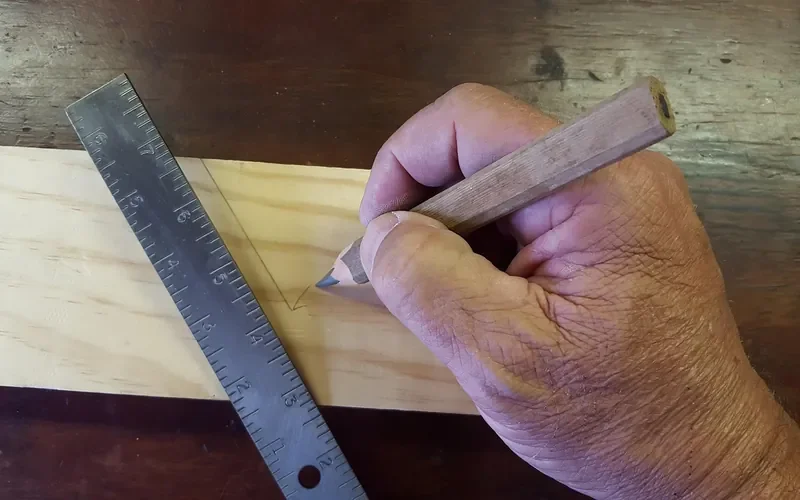
Start with one measurement: S, the distance from the surface your saw sits on to the top of the saw’s table. Measure it with the saw on a flat bench, with a square and tape. The platform that holds the saw must sit exactly S below the top of the wings, so the wings and the saw table form one flat surface.
Platform top = wing surface height minus S. The table below uses a stock 34-1/2-inch base cabinet and plywood tops, one layer or two. It is arithmetic only: your S will differ, so replace the S column with your own measurement.
| Your S (inches) | Platform top, one 3/4-inch top layer (wings at 35-1/4 in) | Platform top, two layers (wings at 36 in) | Cleat top edge for the one-layer build (platform minus 3/4 in) |
|---|---|---|---|
| 4 | 31-1/4 in | 32 in | 30-1/2 in |
| 5 | 30-1/4 in | 31 in | 29-1/2 in |
| 6 | 29-1/4 in | 30 in | 28-1/2 in |
| 7 | 28-1/4 in | 29 in | 27-1/2 in |
| 8 | 27-1/4 in | 28 in | 26-1/2 in |
Nominal 3/4-inch plywood often measures a hair thinner than 3/4 inch, so measure your actual sheet and subtract the real thickness, not the label. A 1/16-inch error here is the difference between a clean cut and a board that catches the edge of a wing.
How deep should a miter saw station be?
Deep enough for your saw at full rearward slide, plus clearance behind it. The plans above show how much that varies: Kreg’s station uses 15-3/4-inch-deep cabinets, a stock kitchen base cabinet is 24 inches deep, and The Handyman’s Daughter builds a 36-inch-deep surface around a Bosch Glide, a saw built to sit close to the wall. Measure your saw with the head fully extended and add an inch or two behind it. That answers the common question of whether a base-cabinet station needs 32 inches: only if your saw’s travel demands it.
Build a Station From Stock Base Cabinets
Kreg’s drawer plan puts the saw between two base cabinets, and you can do the same with store-bought cabinets instead of building the boxes. Stock base cabinets are usually 34-1/2 inches high and 24 inches deep, with widths in 3-inch steps. The cut list below is a worked example for two 24-inch-wide cabinets, a 28-inch saw bay and an S of 5 inches. Change the bay width and platform height to fit your saw.
| Part | Qty | Size | Notes |
|---|---|---|---|
| Wing tops, 3/4-inch plywood | 2 | 24 x 24 in | One per cabinet, top at 35-1/4 in with the cabinet at 34-1/2 in |
| Platform shelf, 3/4-inch plywood | 1 | 28 x 24 in | Top at 30-1/4 in when S = 5 in |
| Platform cleats, 1×3 (3/4 x 2-1/2 in actual) | 2 | 24 in long | Screwed to the inside cabinet faces, top edge at 29-1/2 in |
| Fence strips, 3/4-inch plywood | 2 | 3 x 24 in | One per wing, faces level with the saw’s own fence |
Total width is 24 + 28 + 24 = 76 inches, and every plywood part fits inside one 24-inch rip of a single 4×8 sheet (28 + 24 + 24 = 76 of 96 inches). Size the bay to your saw: it should clear the saw’s base with room for a clamp on each side.
- Measure S: put the saw on a flat bench and measure from the bench to the top of the saw’s table.
- Position the cabinets: set them on a level floor with the bay width you chose, and shim until both tops are level with each other.
- Fix the cleats: glue and screw each cleat so its top edge is at the platform height minus 3/4 inch.
- Drop in the platform: set the shelf on the cleats and check with a straightedge across the platform and both wings.
- Bolt the saw down: mount the saw through its base holes, then lay a straightedge from the saw’s table over each wing.
- Add the fence strips: shim them so their faces sit flush with the saw’s fence, then mount the stop system.
Fence, Stops and Wing Alignment
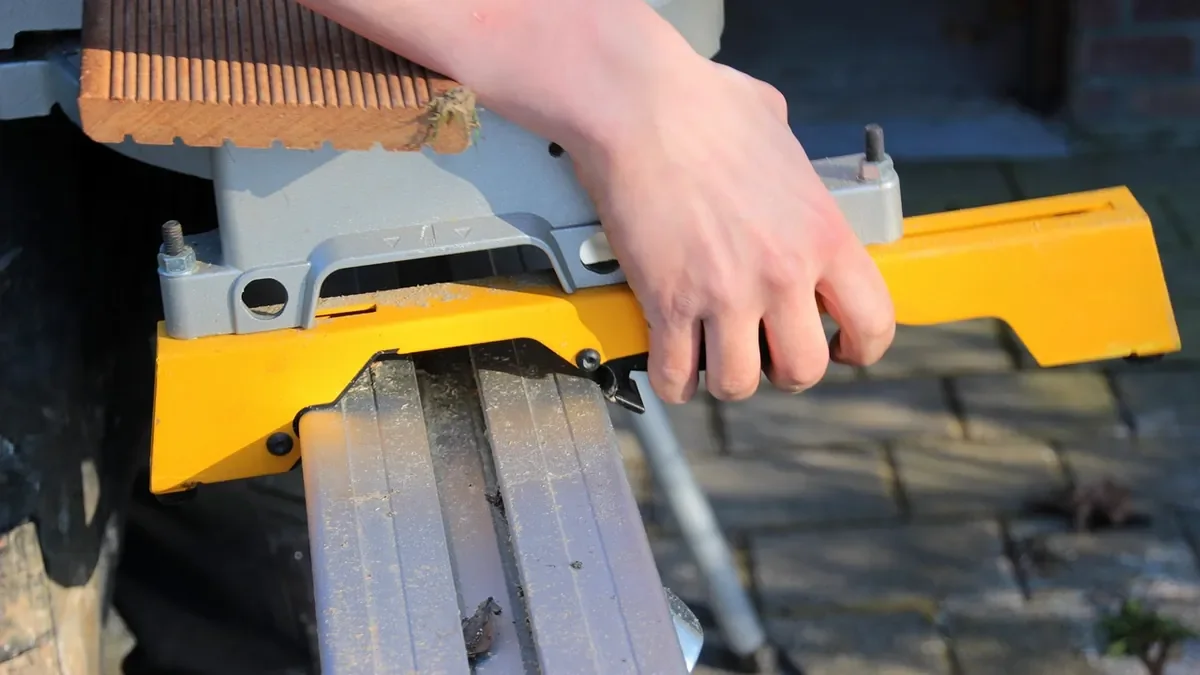
The fence is where a station earns its keep. Kreg’s station plan specifies 48-inch fence pieces and mounts a Precision Trak and Stop Kit along them, which turns repeat cuts into a matter of sliding a stop. A cheaper path is a shop-made fence with a clamped stop block. Either way, the rule is the same: the station fence and the saw’s fence must be one flat plane.
- Check flatness with a straightedge: lay it across the saw’s fence and both wing fences, and shim any gap.
- Keep the wings level front to back: a wing that tips toward you pushes boards away from the fence.
- Leave the blade path clear: do not let the wing tops or fence strips sit where the blade or its guard travels.
Dust Collection for a Miter Saw Station
Dust is the gap in most free plans. Kreg’s station plan includes no dust collection, and its drawer plan only suggests adding it. The Handyman’s Daughter takes the opposite approach, with a dust funnel behind the saw that feeds hoses to a Y junction and a wall-mounted collector. If you build a funnel or hood, plan the opening and hose path before you add the back panel, because adding it later means cutting into finished work. For collector sizing, see our guide to a dust collector for a home shop.
Mistakes That Make a Station Wobble or Cut Wrong
- Building to the plan’s saw: a plan drawn around another saw’s S puts your wings high or low. Use the S table above.
- Letting the wings sag: unsupported wing tops flex under a long board; support them with the cabinet top or a cleat along the front edge.
- Skipping a clamp: an unclamped board can shift into the blade. Clamp the workpiece, and unplug the saw before changing blades or adjusting anything.
- Forgetting the casters: casters raise the whole station, so include their height when you measure the wing surface, or your platform math ends up off.
If the station needs to move, a folding option such as a wheeled miter saw stand or extension arms from miter saw extension wings may fit your shop better than a fixed cabinet build. For a plain table without storage, our miter saw table build is the simpler route.
Miter Saw Station Plans Free: Frequently Asked Questions
Are there free miter saw station plans in PDF or printable form?
Kreg Tool publishes two free station plans on its website: a station with storage and a station with drawers. Both are web pages, so save a copy with your browser’s print-to-PDF option. Not every popular plan is free: The Handyman’s Daughter sells its station plans.
How high should a miter saw station be?
Whatever puts the wings level with your saw’s table. Measure S, the distance from the surface the saw sits on to the top of its table, then set the platform at wing height minus S. With a 34-1/2-inch base cabinet and a 3/4-inch top, the wings sit at 35-1/4 inches.
How deep should a miter saw station be?
Deep enough for your saw at full rearward slide plus an inch or two behind it. Published plans range from 15-3/4-inch-deep cabinets to a 36-inch-deep surface, so measure your own saw rather than copying a plan’s depth.
Can I build a miter saw station from kitchen base cabinets?
Yes. Kreg’s drawer station is built from two base cabinets with a middle box between them. Stock base cabinets are typically 34-1/2 inches high and 24 inches deep, so set a platform between them at the wing height minus S.
How much outfeed support does a miter saw station need?
A common shop rule is at least 24 inches of flat, level support on each side of the saw, and 36 to 48 inches per side when you cut trim or molding. Longer, lighter stock tips off a short support more easily.
Conclusion
Measure S before you cut a single panel, because that one number sets the platform height, the cleat position and the wing level. Choose Kreg’s free cabinet plans if you want drawers and doors, stock base cabinets if you want the fast route, and add the dust funnel while the back is still open.
Sponsored / affiliate links. As an Amazon Associate I earn from qualifying purchases. I may earn additional commission from eligible campaigns.