TopCast Finish: Grades, Application & Wash-Off Guide
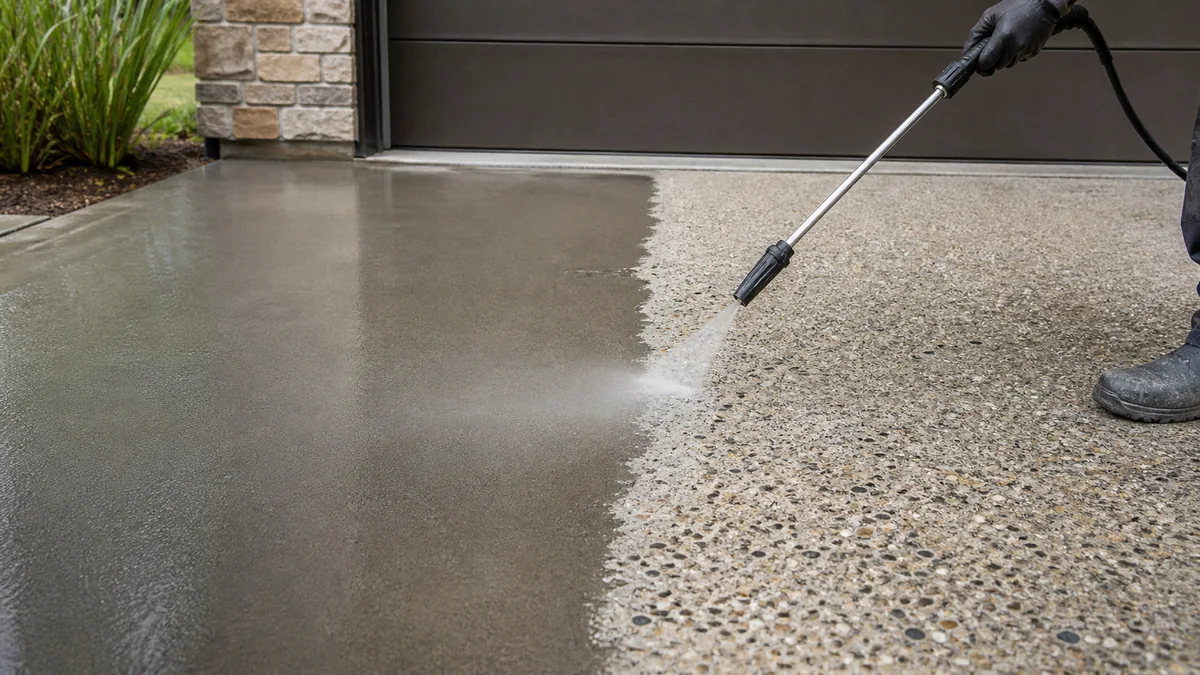
TopCast is not a metal coating or a final concrete sealer. It is a water-based top-surface retarder used on fresh concrete to create a controlled exposed-aggregate finish. The selected grade delays only the surface paste; after the slab gains enough strength, that paste is washed away to reveal aggregate.
The finish depends on the concrete mix, aggregate, grade number, application rate, weather, finishing method, and wash-off timing. Dayton Superior therefore recommends a mockup made with the actual mix and jobsite technique before the production pour.
TopCast Finish at a Glance
Apply TopCast uniformly after the initial bleed water has evaporated, using a compatible low-pressure sprayer and a complete hiding coat. The bulk concrete continues hardening while the surface matrix is delayed. Removal may occur roughly 4–16 hours later, but hot weather or fast-setting concrete can require same-day wash-off.
| Grade | Package color | Approximate effect or exposure |
|---|---|---|
| 03 | Violet | Acid-etch effect |
| 05 | Light blue | Sandblast effect |
| 15 | Yellow | Up to 1/4 in. (6.5 mm) |
| 25 | Beige | 1/8–1/4 in. (3–6.5 mm) |
| 50 or 75 | Canary green or blue | 1/8–3/8 in. (3–9.5 mm) |
| 100 | Gray | 3/8–1/2 in. (9.5–13 mm) |
| 125 or 150 | Pink or green | 3/8–5/8 in. (9.5–16 mm) |
| 200 | Salmon | 5/8–1 in. (16–25 mm) |
| 250 | Orange | 1–1 1/2 in. (25–38 mm) |
The manufacturer labels these as estimated results for standard mix conditions; they are not guaranteed depths. Use the current TopCast technical data sheet and a mockup to confirm the grade.
Application Sequence
- Choose aggregate, mix design, finishing method, and target exposure together. The retarder cannot expose aggregate that was pushed too deep during finishing.
- Place and finish the concrete without overworking the surface. Wait for the initial bleed water to evaporate.
- Mix the TopCast and strain it when filling the sprayer, following the current product instructions.
- Spray a uniform hiding coat. Thin, streaky coverage can create uneven exposure.
- Protect the area from traffic and monitor temperature, wind, shade, and concrete set.
- At the mockup-confirmed time, remove the delayed paste with water and a stiff broom or suitable pressure washing method.
- Rinse clean, inspect the exposure, allow the surface to dry, and apply only a compatible sealer when specified.
Weather, Temperature, and Timing Windows
Temperature and humidity move the wash-off window more than any other jobsite variable. In hot weather, on a slab poured in direct sun, or with an accelerated mix, hydration proceeds faster and the surface paste can firm up well before the general 4–16 hour range closes — some crews end up washing within just a few hours of placement, sometimes the same evening as the pour. In cool weather, in shade, or with a retarding admixture already in the mix, the opposite happens: the paste stays workable much longer, and washing on a schedule based on a “typical” job can pull aggregate loose because the surface hasn’t gained enough strength yet.
Wind and direct sun also dry and warm the surface independent of the concrete’s internal temperature, so two identical TopCast applications placed the same day — one in full sun, one in shade — can be ready for wash-off hours apart. Because of that spread, treat the manufacturer’s stated range as a starting estimate rather than an appointment: keep the test panel in the same sun/shade exposure as the production slab, and start checking it well before the earliest expected time rather than waiting for a single calculated hour.
Wash-Off Timing Matters More Than the Clock
The official range is broad because concrete does not set by the clock alone. Cement content, admixtures, slab temperature, wind, shade, finishing, and TopCast grade all affect removal. Washing too early can pull aggregate loose or create ruts; washing too late can make the paste difficult to remove and cause blotchy exposure.
A test panel placed beside the production slab gives the crew a realistic wash-off reference. The manufacturer’s TopCast user guide also explains grade selection, sprayer use, mix considerations, and troubleshooting.
Common TopCast Problems
| Problem | Likely cause | Prevention |
|---|---|---|
| Uneven or streaky exposure | Inconsistent spray coat or surface finishing | Use a mockup, maintain sprayer pressure, overlap passes |
| Aggregate pulls out | Washed too early or weak surface | Confirm set on the mockup; reduce wash aggression |
| Paste is hard to remove | Washed too late, hot weather, or light grade | Monitor conditions and begin sooner when required |
| Finish is deeper than expected | Grade/mix mismatch or aggressive washing | Choose grade with actual aggregate and mix |
Planning Mistakes That Cause Problems Later
The table above covers what goes wrong on the slab itself. Just as many TopCast jobs go sideways from decisions made before the sprayer ever comes out:
- Skipping the mockup panel. A test panel poured with the actual mix, aggregate, and crew technique is the only reliable way to know how a given grade and set of jobsite conditions will behave. Relying on the data sheet’s exposure range alone removes the one check that catches a mismatched grade before the production slab is committed.
- Ordering the wrong grade for the aggregate size. A grade chosen only from the desired look, without checking it against the actual aggregate gradation in the mix, can either under-expose (barely visible texture) or over-expose (aggregate popping loose because too much surrounding paste was removed).
- Not staffing for the wash-off window. Because timing can shift by hours based on weather, a crew that schedules wash-off as a fixed end-of-day task — rather than keeping someone free to start once the test panel says it’s ready — is set up to wash too late by default.
- Assuming one application rate fits every surface. A hiding coat that looks uniform on a flat slab can still run thin over broom-textured or sloped areas. Recheck coverage on any surface that isn’t flat and smooth before assuming the same technique applies everywhere.
- Sealing on a schedule instead of by condition. Applying a sealer because it’s “the next step” rather than because the washed and rinsed surface has actually dried can trap moisture under the sealer film, leading to haze, blushing, or poor adhesion.
Sealing and Maintenance
TopCast creates the texture; it does not make the concrete stain-proof. After wash-off and drying, choose a sealer compatible with the manufacturer’s system and the desired sheen, traction, and exposure. Avoid assuming a glossy sealer is appropriate for every walking surface, especially where wet slip resistance matters.
Bottom Line
A successful TopCast finish is planned as a system: mix, aggregate, grade, application, weather, removal timing, and sealer. The mockup is not optional guesswork—it is the quickest way to confirm that the selected grade and wash schedule will create the intended appearance.
Frequently Asked Questions
What is a TopCast finish?
A TopCast finish is exposed-aggregate concrete made with a water-based surface retarder. The retarder delays hardening of the top cement paste so it can be washed away and reveal the selected aggregate.
When should TopCast be washed off?
Dayton Superior says removal can be as early as about 4 hours and up to about 16 hours, depending on mix design, grade, finishing, temperature, humidity, and weather. A jobsite mockup is the safest timing guide.
Does a higher TopCast number expose more aggregate?
Generally, yes. The numbered grades correspond to progressively deeper etch ranges, but the final appearance also depends on aggregate size, mix design, finishing, application rate, and wash-off timing.
Is TopCast a concrete sealer?
No. The main TopCast product is a surface retarder used before wash-off. Protection or sheen requires a compatible sealer selected after the exposed surface is cleaned and dry.
Can TopCast be applied to old concrete?
It is intended for freshly placed concrete because it delays the surface cement paste. It does not recreate the same controlled exposure on an already cured slab.
More TopCast Questions
Can TopCast be used indoors?
TopCast itself is a surface retarder rather than a fume-heavy coating, but indoor exposed-aggregate work still needs the same ventilation, water management, and slip-resistance planning as any interior wet-wash process. The bigger practical issue indoors is usually the wash-off step: rinsing and brooming off the delayed paste produces a slurry that has to be contained and disposed of properly rather than allowed to run into a floor drain, and interior spaces often have less airflow to help the surface dry before sealing. Confirm ventilation, drainage, and disposal requirements for the specific building before scheduling an indoor pour.
How long before foot or vehicle traffic is allowed?
Wash-off only removes the delayed surface paste — it does not mean the slab has reached full structural strength. Light foot traffic is often possible once the surface is rinsed, drained, and no longer tacky, but the same general concrete curing timelines apply underneath: most walkways can take normal pedestrian use within a day or two, while vehicle traffic (driveways, parking areas) typically should wait until the concrete has cured for about a week at minimum, and longer in cool weather. Follow the mix design’s stated cure schedule rather than judging readiness by the exposed finish alone.
What happens if the wash-off window is missed?
Once the delayed paste hardens past the point a broom and water stream can remove it, options narrow quickly. Light pressure washing at a closer distance or higher pressure sometimes still works within a few hours of the missed window, but pushing pressure too high risks etching or pitting the surrounding aggregate and paste unevenly. Beyond that point, mechanical abrasion (light grinding or shot blasting) is typically the only way to expose the aggregate, and it will not match the texture a proper wash-off would have produced. This is the main reason to start checking the test panel early rather than waiting for the latest estimated hour.
Can TopCast be combined with integral color or seeded decorative aggregate?
Yes, in principle — TopCast reacts with the surface cement paste regardless of whether the mix has integral color, and it’s a common technique for exposing a decorative or seeded aggregate layer broadcast onto the surface during finishing. The wash-off step will affect both the exposed aggregate and any colored paste around it, so run the mockup with the actual colored/seeded mix, not a plain gray test batch, since color and seeded aggregate can change how the surface reads at a given exposure depth.
Sponsored / affiliate links. As an Amazon Associate I earn from qualifying purchases. I may earn additional commission from eligible campaigns.