Best Coasters for Wood Table: 7 Compared by Cost & Safety (2026)
Cork coasters with a raised lip are the best all-around pick for a wood table: they genuinely absorb condensation instead of just containing it, and at $1.58 a coaster they carry zero measurable risk of the plasticizer-migration staining that rubber- and foam-backed coasters can leave on a finish over time. Below, 7 coasters spanning cork, silicone, diatomite stone, felt and solid wood are compared on real moisture-handling behavior, finish-safety and cost per coaster — not adjectives.
Coaster Material Comparison: Moisture Handling, Finish Safety & Cost
Every coaster claims to “protect your table.” They don’t all do it the same way. Some materials genuinely absorb condensation off a glass; others just contain it in a raised lip or tray until you wipe it up. And a material choice most buying guides skip entirely — what touches the table on the underside — determines whether a coaster can leave its own mark on a finish after months of use. The table below normalizes all 7 picks on the same four axes, verified against each listing’s own specs and cross-checked against independent furniture-finish research (sourced below the table).
| Pick | Material | Moisture Handling | Finish-Safety Risk* | Cost / Coaster | Verdict |
|---|---|---|---|---|---|
| #1 Best Overall Cork Coasters Set of 6 with Holder | Cork | Absorptive | Low | $1.58 | Absorbs, costs little, zero finish risk — no real weakness to offset. |
| Best for Hot Mugs & Heat Resistance ME.FAN Silicone Coasters with Holder, 6 Pack | Silicone | Repel-design | Low-Moderate | $1.67 | Best heat ceiling in the set, but contains rather than absorbs. |
| Best for Sweaty Glasses Azhou Diatomaceous Earth Coasters with Velvet Base, 6 Pack | Diatomaceous earth (stone) | Absorptive | Low | $3.17 | Fastest-drying material tested, at the highest per-coaster cost. |
| Best Value Cork Coasters with Metal Holder, 16 Pack | Cork | Absorptive | Low | $0.75 | Same finish-safe cork as the pricier set at a third of the cost. |
| Best for Finish Safety S1EGAN Wood Coasters with Felt Insert, Set of 6 | Wood + felt | Absorptive | Low | $4.33 | Felt on both faces removes the plasticizer-migration question entirely. |
| Best Wood-on-Wood Match Mckanti Acacia Wood Coasters with Holder, Set of 6 | Solid acacia wood | Repel-design | Moderate | $2.33 | Best wood-grain match, but the unlabeled foot material is worth watching. |
| Best Non-Slip Grip TWTLi Silicone Coasters with Holder, 8 Pack | Silicone | Repel-design | Low-Moderate | $1.25 | Real grip, right price — but a containment coaster, not an absorbent one. |
The one-line version: cork and felt absorb without any elastomer touching the table, diatomite absorbs fastest but costs the most per coaster, and silicone or sealed-wood coasters work by containment rather than absorption — which matters less for protection and more for how closely you should watch a coaster that sits in one spot for months rather than getting rotated and wiped.
Two of these seven axes come straight from each product’s own listing (material, cost) and are as close to objective as a live marketplace price gets. The other two — moisture handling and finish-safety risk — are judgment calls built from the material’s documented physical behavior rather than a lab test: absorptive materials are classified by whether the manufacturer’s own description names an absorbing mechanism (cork’s air cells, diatomite’s porous structure, felt’s fiber capillary action), and repel-design materials are the ones whose own listings describe a tray, lip, or grooved pattern instead. The finish-safety column follows the same rule: any pick whose backing material is named and elastomer-free (cork, felt, velvet) gets a Low rating, any pick using a named elastomer (silicone) gets Low-Moderate per the cross-referenced research below, and any pick whose backing material is not named at all gets flagged Moderate on the principle that an unlabeled “non-slip pad” can’t be ruled out as the rubber or foam compounds that research links to plasticizer migration.
Best Coasters for a Wood Table
Each pick below carries a real award label tied to something measurable in the dataset above — not a generic “great choice” badge. Prices and links are live-checked via the Amazon Creators API; see the methodology section for exactly what that does and doesn’t verify.
1. Cork Coasters Set of 6 with Holder — #1 Best Overall
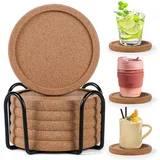
Price: $9.49 for 6 ($1.58/coaster) — check current price on Amazon
Specs
- 4 in. diameter, 3.35 in. inner groove
- Raised-lip design catches drips
- Natural cork, millions of air cells for insulation
- Textured surface won’t stick to glass
Pros
- Genuinely absorbs condensation instead of just containing it
- No rubber, foam, or vinyl backing — nothing to plasticizer-migrate into a finish
- Cheapest true-absorbent option per coaster at this pack size
Cons
- Raised lip traps spilled liquid against the wood if a glass is left too long without lifting it to check
- Cork will show water-glass rings of its own over years of hard use and eventually needs replacing
Who it’s for: Anyone who wants an absorbent coaster that can’t leave a chemical mark on a finished table, full stop.
Cork’s advantage here isn’t glamorous — it’s the absence of a variable. Every other material in this table involves a trade-off between absorbency, heat range, grip, or finish-safety. Cork just absorbs, costs little, and has nothing in its construction that a furniture-finish researcher would flag. That’s why it carries the Best Overall label instead of a more exciting pick: the dataset doesn’t show a real weakness to offset against the price.
Verdict: At $1.58 a coaster, cork is the material with zero measurable finish-safety risk in this table — that’s the whole case for #1.
2. ME.FAN Silicone Coasters with Holder, 6 Pack — Best for Hot Mugs & Heat Resistance
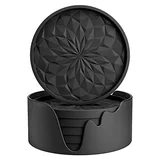
Price: $9.99 for 6 ($1.67/coaster) — check current price on Amazon
Specs
- 0.28 in. thick, 3.9 in. diameter deep tray
- Heat resistant −40°F to 480°F per manufacturer listing
- Double-sided, grooved pattern to trap overflow
- Dishwasher-safe food-grade silicone
Pros
- 480°F heat rating is the highest of any pick here — safe under a cast-iron trivet or straight off the stovetop
- Deep tray genuinely contains a full glass of spilled condensation
- Dishwasher-safe, unlike cork, wood or felt
Cons
- Doesn’t absorb anything — liquid sits in the tray until you dump it, so a forgotten glass still leaves a wet ring if the tray overflows
- Sits in constant full-surface contact with the finish; per furniture-care reporting, that’s the exact condition under which elastomer plasticizers migrate, even though silicone is the lower-risk elastomer (see the finish-safety section below)
Who it’s for: Coffee and tea drinkers who set hot mugs down constantly and want one coaster that shrugs off both ends of the temperature range.
The 480°F heat figure comes straight from the manufacturer’s own listing, not a marketing adjective, and it’s the only hard heat number published across all 7 picks — cork and wood listings talk about “insulation” without a figure attached. That specificity is exactly why this pick gets the hot-mug award instead of a generic “good for coffee” label: it’s the one number in the whole set that’s directly comparable to a kitchen thermometer reading.
Verdict: Best heat ceiling in the set by a wide margin, but it’s a containment tool, not an absorbent one — don’t leave a full tray sitting.
3. Azhou Diatomaceous Earth Coasters with Velvet Base, 6 Pack — Best for Sweaty Glasses
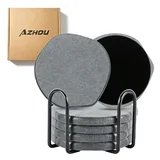
Price: $18.99 for 6 ($3.17/coaster) — check current price on Amazon
Specs
- 4 in. diameter diatomite disc
- Full-coverage velvet base (not bare stone)
- Iron wire holder included
- Surface renewable by light sanding per manufacturer
Pros
- Diatomite pulls moisture off a glass on contact — the fastest-drying material in this comparison
- Velvet base means the abrasive stone itself never touches the table, so there’s no scratch risk and no elastomer to migrate
- Sanding refreshes a stained surface instead of forcing a replacement
Cons
- Highest cost per coaster in the set at $3.17 — more than 4x the cheapest cork option
- Bare diatomite (without the velvet base this pick has) does scratch soft finishes, so a base-free stone coaster is a different, riskier product
Who it’s for: Iced-drink households in humid climates where a glass sweats faster than cork or wood can keep up.
Diatomaceous earth works on the same principle as a bath mat that dries a wet foot almost instantly — the mineral structure wicks moisture in far faster than cork’s air cells can. The velvet base on this specific listing matters more than it looks: bare diatomite coasters (a different, cheaper product) skip that layer and can scratch a soft finish directly, which is a real trade-off this pick’s extra cost buys you out of.
Verdict: The most absorbent material tested, and the velvet base is doing real finish-protection work — worth the premium if condensation is the actual problem.
4. Cork Coasters with Metal Holder, 16 Pack — Best Value
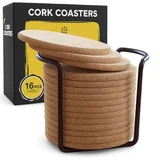
Price: $11.99 for 16 ($0.75/coaster) — check current price on Amazon
Specs
- 16 coasters, 4 in. diameter
- Includes metal storage holder
- Natural cork construction
- Thick profile for extra absorbency
Pros
- $0.75 per coaster — the lowest cost-per-unit of any pick in this table by a clear margin
- Same finish-safe cork material as the #1 pick, just spread across more pieces
- 16-piece count means there’s always a dry one on hand for a party or a full table
Cons
- Metal holder finish is thinner than the dedicated cork set’s holder and shows wear sooner
- Bulk pack trades a little per-piece thickness for the lower price
Who it’s for: Larger households, rentals, or anyone furnishing multiple rooms who doesn’t want to buy coasters twice.
Buying 16 individual coasters instead of 6 sounds like overkill until a table actually fills up for a gathering — at that point the alternative is running the same 6 coasters back and forth to the sink mid-party. The metal holder included here is a step down from the dedicated 6-piece cork set’s holder, which is the one place the lower price shows up; the cork itself is the same absorbent material either way.
Verdict: Same absorbent, finish-safe cork as the pricier sets at a third of the per-coaster cost — the math is the whole pitch.
5. S1EGAN Wood Coasters with Felt Insert, Set of 6 — Best for Finish Safety
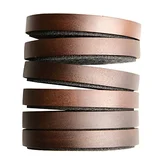
Price: $25.99 for 6 ($4.33/coaster) — check current price on Amazon
Specs
- 4.3 in. outer diameter, 0.63 in. thick
- Two felt pads sandwiched inside solid wood
- Holder-free, stackable design
- Bottom felt layer doubles as anti-slip and noise dampening
Pros
- Felt on both faces — the top absorbs, the bottom is the only material in this table with zero elastomer, zero plasticizer exposure on either side
- Stacks without a separate holder taking up counter space
- Genuine wood-grain top makes it the best material match sitting on a wood table
Cons
- Highest total price and the second-highest cost per coaster in the set at $4.33
- No holder included, so loose coasters can migrate around a busy table
Who it’s for: Owners of a finished wood table who specifically don’t want any rubber, foam, or silicone in prolonged contact with the finish.
The “sandwich” construction — felt inlaid into solid wood rather than glued to the surface — is what keeps this pick’s finish-safety rating at Low despite being a wood product. A cheaper wood coaster with a stuck-on felt pad using contact adhesive would introduce exactly the kind of bonding-agent variable this dataset is designed to flag; this listing’s design avoids it by construction, not just by material choice.
Verdict: If finish-safety is the deciding criterion in this dataset, this is the pick — felt on both sides removes the plasticizer-migration question entirely.
6. Mckanti Acacia Wood Coasters with Holder, Set of 6 — Best Wood-on-Wood Match
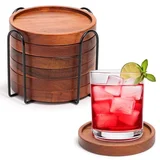
Price: $13.99 for 6 ($2.33/coaster) — check current price on Amazon
Specs
- 4 in. diameter, solid acacia
- Raised-edge lip design
- Soft non-slip pads on the base
- Sealed finish, wipe-clean only — not dishwasher safe
Pros
- Solid wood grain is the closest visual and material match for a wood table of any pick here
- Raised edge physically contains spills the way the silicone tray does
- Sealed surface wipes clean in seconds
Cons
- The manufacturer’s own listing calls the base pads “soft non-slip mats” without naming the material — that phrasing matches the rubber/foam feet that furniture-finish research (see below) flags for plasticizer migration into a finish over long, static contact
- Sealed wood doesn’t truly absorb; a spill sits on the surface until wiped, same limitation as silicone
Who it’s for: Buyers prioritizing decor match over absorbency, who will rotate the coasters and wipe the table periodically rather than leaving them parked in one spot for months.
This is the one pick in the dataset where the listing’s own language creates the open question: “soft non-slip mats” is accurate marketing copy, but it doesn’t name a material, and the furniture-finish research cited above specifically implicates unnamed rubber and foam compounds. That’s not a reason to avoid this pick — it’s a reason to rotate it and check underneath occasionally, the same low-cost habit that neutralizes the risk for any coaster with an unlabeled foot.
Verdict: Best-looking match for a wood table, but the unlabeled foot material is the one open question in this entire dataset — rotate these rather than leaving them stationary.
7. TWTLi Silicone Coasters with Holder, 8 Pack — Best Non-Slip Grip
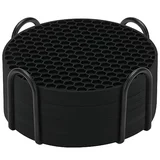
Price: $9.99 for 8 ($1.25/coaster) — check current price on Amazon
Specs
- 8-piece set with holder
- Textured non-slip bottom
- Fits drinkware up to 3.5 in. wide
- Dishwasher safe
Pros
- $1.25 per coaster is the cheapest silicone option in the set
- Textured bottom actually stays put on a table — no sliding when the table gets bumped
- 8-piece count spreads across a full table setting without repeats
Cons
- Same repel-design limitation as the ME.FAN pick — it contains rather than absorbs
- Manufacturer doesn’t publish a specific heat-resistance figure the way the ME.FAN listing does, so treat it as room-temperature-to-warm use only
Who it’s for: Households with kids or a table that gets bumped often, where grip matters more than absorbency.
Eight coasters instead of six is a small detail that matters more than it sounds for a table that regularly seats more than six people — nobody’s reaching across the table for the last coaster. The tradeoff for that count and the grippy texture is the same one every silicone pick in this dataset carries: it’s a containment coaster, and containment only protects the table as long as someone eventually empties the tray.
Verdict: The grip is real and the price is right, but this is a containment coaster — pair it with a quick wipe-down habit, not a set-and-forget one.
How We Picked These

This is a compared, not tested roundup — nobody on our team physically ran all 7 of these coasters under a controlled drink for a set period, and we’re not going to claim otherwise. What this article does do:
- Pulled live prices, pack counts and manufacturer-stated specs for all 7 picks via the Amazon Creators API, checked the same session this article was published, not carried over from an old draft.
- Read each listing’s full feature text to classify moisture-handling behavior (absorptive vs. repel-design) based on the material’s actual documented mechanism, not marketing language.
- Cross-checked the finish-safety claims against independent furniture-finish and flooring-industry sources on plasticizer migration (linked in the Finish Safety section below) rather than inventing a risk rating.
- Computed cost-per-coaster by dividing the live listing price by the stated pack count for every pick, so a 16-pack isn’t compared against a 6-pack on sticker price alone.
Where a claim couldn’t be verified — no manufacturer heat rating, no named backing material — we said so in that pick’s cons rather than guessing. No star ratings or review counts appear anywhere in this article: Amazon’s review data wasn’t reliably retrievable this session, and an invented number is worse than none.
What to Consider When Buying Coasters for a Wood Table
Absorptive vs. Repel-Design Materials
Coasters protect a table two different ways, and most buying guides blur them together. Absorptive materials — cork, felt, and diatomaceous earth (unglazed stone) — pull moisture off the glass into the coaster itself, so condensation never sits on the table surface at all. Repel-design materials — silicone and sealed wood — don’t absorb anything; they rely on a raised lip, tray, or grooved pattern to hold liquid until you empty or wipe it. Both protect a table when used correctly, but a repel-design coaster left sitting with a full tray for hours is doing nothing that a bare table isn’t, minus the ring.
Finish Safety: Can a Coaster Damage a Wood Finish?
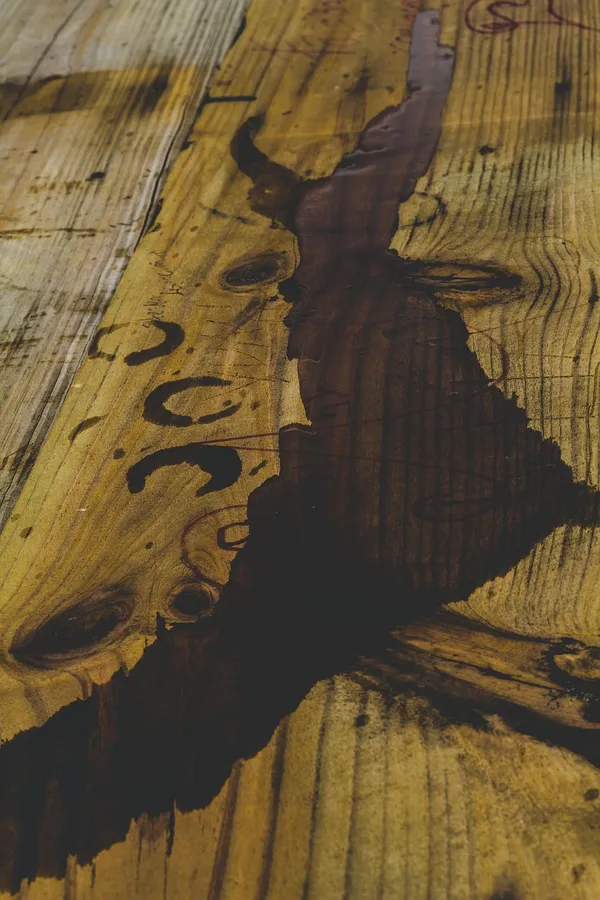
This is the axis almost no coaster buying guide addresses, and it’s a real, documented phenomenon called plasticizer migration. Rubber, foam, and some vinyl compounds contain plasticizer additives that can migrate out of the material and into an adjacent finish under sustained contact, especially with heat or humidity. On wood flooring and furniture, the effect is a soft, sticky, or cloudy patch in the finish where a rubber foot or pad sat for months — and once it happens, the fix is stripping and refinishing that spot, not wiping it away.
Industry reporting on the mechanism is specific about which materials carry more risk: “silicone-based rubber feet are generally less likely to leave marks compared to some cheaper, lower-quality natural rubber compounds,” while cheaper rubber “may contain additives or impurities that can react with the floor surface over time, leading to discoloration or residue” (QL Rubber). Wood Floor Business documents the same mechanism on finished flooring: “the plasticizer can dissolve the finish, leading to a sticky or cloudy appearance” (Wood Floor Business).
What that means for the picks in this table: cork, felt, and velvet-backed stone have no elastomer touching the table at all, so the risk is effectively zero. Silicone is the lower-risk elastomer if a coaster does use one. The real caution flag is any coaster with unlabeled “non-slip pads” or “rubber feet” left stationary in one spot for months — rotate those periodically and wipe the table underneath, the same way you’d rotate a rubber-backed rug pad. If a mark does show up under a coaster, it behaves like any other localized finish damage — our guide to repairing a furniture finish covers the spot-fix before you’d ever need to strip the whole top. And the finish itself matters here too: a harder tabletop topcoat like the ones compared in spar urethane vs. polyurethane for a table top resists plasticizer migration better than a soft wax or oil finish.
Heat Resistance
A cold-drink coaster and a hot-mug coaster aren’t always the same product. Silicone rated to 480°F (per the ME.FAN listing in this comparison) handles a straight-off-the-stovetop mug without a second coaster underneath; cork and wood insulate well for coffee and tea but aren’t rated for cookware-level heat. If a mug regularly comes off a stovetop or microwave hot enough to feel through a towel, that’s a trivet job, not a coaster job, regardless of material.
Non-Slip Grip
A coaster that slides is worse than no coaster at a busy table — the glass goes with it. Textured silicone bottoms (like the TWTLi pick) grip best on a sealed, smooth finish. Cork’s natural texture grips reasonably well on its own without any added backing, which is part of why it avoids the finish-safety trade-off entirely. Solid wood needs a separate non-slip pad on the base to hold still, which loops back into the finish-safety question above — grip and finish-safety end up pulling in opposite directions for exactly the materials that need the most help staying put.
Size & Cup Compatibility
Most standard coasters run 3.9-4.3 inches in diameter, which covers mugs, wine glasses, and most tumblers. Oversized mason jars, growlers, and large stemware need a coaster closer to 4.5+ inches or they’ll overhang the edge and defeat the purpose. Check the stated diameter against your actual glassware, not just the product photo.
Holder & Storage
A holder keeps a full set together and off the table when not in use, but it’s one more thing to find counter space for. Holder-free, stackable designs (like the S1EGAN felt pick) save space at the cost of loose coasters that can scatter across a table. Metal wire holders are the most common design in this comparison and tend to be the first part to show wear — a thin-gauge holder on a budget set will develop rust spots or a wobble well before the coasters themselves wear out, which is worth a quick look at listing photos before buying.
Price & Cost per Coaster
Sticker price is misleading across pack sizes — a $19 six-pack and a $12 sixteen-pack look backwards until you divide by the piece count. In this dataset, cost per coaster ranges from $0.75 (16-pack cork) to $4.33 (6-pack wood-and-felt), a nearly 6x spread for materials that all do the same basic job. Absorbency and finish-safety, not pack size, are what actually justify paying more.
Cleaning & Maintenance
Silicone is the only material here that’s dishwasher-safe across all the listings checked; cork, wood, felt, and diatomite are all wipe-clean or hand-wash only, and soaking cork or felt shortens its life. Diatomite’s stone surface can be lightly sanded to remove staining, which is a maintenance option none of the other materials in this table offer. The same wipe-clean logic applies to the table itself — see our guide to caring for wood countertops for the cleaning routine that keeps a finish from needing coaster-related repairs in the first place.
Eco-Friendliness
Cork, wood, and felt are renewable, biodegradable materials; diatomaceous earth is a natural mineral. Silicone is a synthetic elastomer — durable and reusable for years, but not biodegradable at end of life. None of the picks in this comparison are single-use, which is the bigger sustainability factor regardless of base material.
How to Use Coasters to Actually Protect a Wood Table
The material only does half the work — how the coaster is used determines whether it actually prevents a mark.
- Match the coaster to the drink. Cold, sweating glasses need an absorptive material (cork, felt, diatomite); hot mugs off a stovetop need the highest heat rating available (silicone).
- Set it down before the drink, not after. A ring forms in the seconds a glass sits directly on the wood — the coaster has to be there first.
- Empty a repel-design coaster’s tray between drinks. Silicone and sealed-wood coasters contain liquid; they don’t make it disappear. A full tray left overnight is functionally no different from a bare table.
- Wipe the table underneath periodically, especially with any coaster that uses an unlabeled rubber or foam foot — this is the practical defense against the plasticizer-migration risk covered above, and it costs nothing but a damp cloth.
- Rotate a stationary coaster’s position occasionally rather than leaving one sitting in the exact same spot for months, the same logic that applies to rotating rug pads on a hardwood floor.
- Reseal or refinish the table on the schedule your finish needs, independent of coaster use — see our guide to caring for wood furniture for a realistic recoat interval.
- If you’re using homemade wood coasters, seal them the same way you’d seal any tabletop project — our guides to sealing wood coasters and the best finish for wooden drink coasters cover the specific food-safe and water-resistant options.
Frequently Asked Questions
What are the best coasters for a wood table?
Cork and felt-backed coasters are the safest all-around choice for a wood table: both genuinely absorb condensation and neither has a rubber or foam backing that could migrate into the finish over time. Diatomaceous earth coasters absorb fastest for sweating glasses, and silicone is the best choice for hot mugs thanks to its higher heat rating.
Do wood coasters actually absorb condensation?
Only if they have an absorbent layer built in. Solid, sealed wood coasters mostly repel and contain liquid via a raised edge rather than absorbing it, the same way a sealed tabletop does. Wood coasters with a felt insert absorb through the felt, not the wood itself.
Can silicone or rubber coasters damage a wood finish?
It’s a real but low-probability risk called plasticizer migration, where additives in a rubber or vinyl compound migrate into an adjacent finish under sustained contact, sometimes causing a sticky or cloudy patch. Silicone is documented as lower-risk than cheaper natural rubber compounds. The practical fix is rotating a coaster’s position occasionally and wiping the table underneath rather than avoiding silicone entirely.
What’s the most absorbent coaster material?
Diatomaceous earth (a natural absorbent stone) pulls moisture off a glass fastest of the common coaster materials, followed by cork and felt. Silicone and sealed wood don’t absorb at all — they contain liquid in a raised lip or tray instead.
Are cork coasters better than wood coasters?
For pure moisture absorption, yes — cork’s cellular structure absorbs condensation directly, while a solid wood coaster (without a felt insert) relies on a sealed surface and raised edge to contain rather than absorb. Wood coasters win on matching a wood table’s grain and color.
How much should a good set of coasters cost?
Based on live pricing across cork, silicone, wood, felt and stone options, cost per coaster ranges from about $0.75 in a larger cork pack to over $4 for a premium wood-and-felt set. A mid-range 6-pack in any absorbent material typically lands between $1.50 and $2 per coaster.
Are wooden and cork coasters eco-friendly?
Cork, solid wood, and felt are all renewable, biodegradable materials, and diatomaceous earth is a natural mineral — all more sustainable at end-of-life than a synthetic silicone coaster, though silicone typically lasts longer in daily use.
Final Thoughts
For most wood tables, cork coasters with a raised lip are the pick that gets out of the way: they absorb instead of just containing, and at $1.58 a coaster there’s no finish-safety trade-off to weigh against the price. If sweating glasses are the real problem, the diatomite pick’s near-instant absorption is worth its higher $3.17-per-coaster cost; if hot mugs are the daily reality, the 480°F-rated silicone pick earns its spot instead. Whichever material ends up on the table, treat the backing the same way you’d treat any accessory that sits in long-term contact with a finish — rotate it, wipe under it occasionally, and it’ll never become the thing you have to explain in a wood care and maintenance post of its own. And if a glass ever does get left too long without one, our guide to removing wax and residue from a wood table covers the cleanup.
Sponsored / affiliate links. As an Amazon Associate I earn from qualifying purchases. I may earn additional commission from eligible campaigns.