How Long Does Gorilla Wood Glue Take to Dry? Clamp Time vs. Full Cure
Gorilla Wood Glue needs 20-30 minutes of clamp time before you can safely remove the clamps, and a full 24 hours to cure to its maximum bond strength. Those are two different milestones, not one — the joint will feel solid long before it’s actually at full strength, and putting real stress on it too early is the single most common way a glue-up fails.
Below is what Gorilla’s own spec sheet says for both the Original and Ultimate formulas, what actually happens to the glue during each stage, and the temperature/humidity conditions that can stretch those numbers out.
Gorilla Wood Glue Clamp Time and Full Cure Time
Gorilla Wood Glue (the Original PVA formula) requires 20-30 minutes of clamp time under normal shop conditions — roughly 65-75°F and moderate humidity — and reaches full cure at 24 hours. That’s the number printed directly on Gorilla’s own product listing and packaging: “requires only 20-30 minutes of clamp time and is fully cured in 24 hours.” Minimum application temperature is above 55°F; glue applied below that won’t set up correctly no matter how long you wait.
Don’t unclamp early because the seam looks dry. A joint that’s only been clamped for 10-15 minutes hasn’t finished its initial set, and moving or flexing it can break the bond before it ever gets a chance to cure.
Fastest Clamp Time Pick
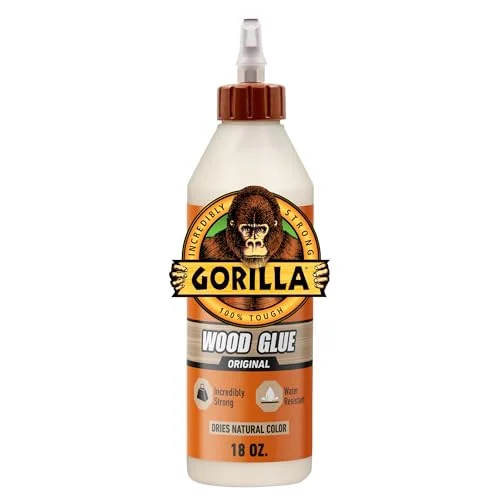 |
Gorilla Wood Glue, 18 oz Bottle – $5.99 The exact Original-formula PVA glue behind the 20-30 minute clamp time and 24-hour cure covered in this guide.
|
Dry to the Touch vs. Clamp Time vs. Full Cure: The Difference That Actually Matters
Most wood glue failures trace back to one mix-up: treating “dry” as one single moment instead of three separate stages. Each one means something different about what the joint can handle.
- Dry to the touch (5-10 minutes): The glue squeeze-out along the seam stops feeling wet or tacky. This tells you nothing about bond strength — it’s just the surface moisture evaporating. Don’t sand or finish over squeeze-out yet; scrape it off with a chisel once it’s rubbery, before it goes fully hard.
- Clamp time (20-30 minutes): The point where the internal bond has set up enough that the joint holds itself together without clamping pressure. You can remove the clamps here, but the joint still shouldn’t take load, be flexed, or go back into a machine for further cutting.
- Full cure (24 hours): The glue has reached its maximum bond strength — often described as stronger than the wood fibers around the joint itself. This is when the piece is ready for sanding across the joint, finishing, or actual use.
The gap between clamp time and full cure is the one most DIYers skip past. A drawer glued up at 9 a.m. can be unclamped by 9:30, but if you load it with tools and slam it shut that same afternoon, you’re stressing a joint that’s maybe 60-70% of the way to full strength.
Original vs. Ultimate: Dry and Cure Times Compared
Gorilla sells two PVA wood glue formulas, and their timelines aren’t identical — a detail the packaging doesn’t always make obvious.
| Spec | Gorilla Wood Glue (Original) | Gorilla Wood Glue Ultimate |
|---|---|---|
| Open/working time | Not extended — position pieces promptly | Up to 15 minutes of open assembly time |
| Clamp time | 20-30 minutes | 20-30 minutes |
| Full cure | 24 hours | 24 hours |
| Minimum application temp | Above 55°F | As low as 50°F |
| Water rating | Water-resistant (ANSI/HPVA Type II) | Fully waterproof (ANSI/HPVA Type I) |
Ultimate’s extra 15 minutes of open assembly time matters most on glue-ups with several pieces to align — a face-frame or a multi-board panel — where the Original’s shorter working window can leave you rushing a fit before the glue starts to skin over. Ultimate is also the one to reach for on anything headed outdoors, since it’s the only Gorilla wood glue formula rated fully waterproof rather than water-resistant.
What Actually Slows Gorilla Wood Glue Down
The 20-30 minute clamp time and 24-hour cure both assume a fairly ordinary shop environment. Three things push those numbers out further:
- Temperature: PVA glue cures through water evaporating out of the glue line, and that process slows sharply below 65°F. Anywhere near Gorilla’s 55°F (Original) or 50°F (Ultimate) minimum, expect clamp time and cure time to both run noticeably longer than the label numbers — and don’t glue at all below the minimum, since the bond won’t form properly regardless of how long it’s clamped.
- Humidity: High humidity slows the same evaporation, which is why a glue-up in a damp basement shop takes longer to set than the identical joint in a heated, dry room.
- Wood porosity and species: Open-grained, porous woods like oak or ash pull moisture out of the glue line faster and can shorten working time, sometimes to the point of skinning over before you’ve finished positioning the joint. Dense, closed-grain woods like maple or cherry hold that moisture longer, which extends both open time and cure.
Applying too thick a bead has the same effect as cold or humid conditions — more moisture has to work its way out before the glue line is fully cured, so a heavy, gap-filling application will always take longer than a thin, even coat on a tight-fitting joint.
Mistakes That Quietly Extend the Wait
Most “Gorilla Wood Glue won’t dry” complaints trace back to one of these, not a bad bottle of glue:
- Gluing over old finish, wax, or oil. PVA glue bonds to bare wood fibers, not to a film of polyurethane, wax, or oil sitting on top of them. If a joint still feels weak well past 24 hours, sand back to raw wood on both mating surfaces and reglue rather than assuming the glue is defective.
- Starving the joint. Wiping away almost all the glue before clamping leaves too thin a layer to form a proper bond, and the joint can feel dry and set almost immediately — a false positive for “done.” A thin, even, unbroken film of glue on both surfaces is what the clamp time is actually timing.
- Clamping too hard. Squeezing every trace of glue out of the joint with excessive clamp pressure can starve it the same way wiping does. Snug is enough — you want a thin, consistent bead of squeeze-out along the seam, not bare wood-to-wood contact.
- Reglued joints that were never fully clean. Old dried glue left in a joint from a prior repair doesn’t bond well to fresh Gorilla Wood Glue. Scrape or sand out as much of the old glue as possible before regluing.
None of these show up as an obvious problem at the 20-30 minute mark — they surface later, when a joint that should be at full strength after 24 hours still flexes or pops apart. If that happens, the fix is almost always to clean the joint back to bare wood and reglue, not to just wait longer.
Frequently Asked Questions About Gorilla Wood Glue Dry Time
How long does Gorilla Wood Glue take to harden enough to unclamp?
20-30 minutes under normal shop conditions (roughly 65-75°F). That’s Gorilla’s own published clamp time for both the Original and Ultimate formulas.
How long does Gorilla Wood Glue take to fully cure?
24 hours to reach maximum bond strength. The joint can be unclamped after 20-30 minutes, but don’t sand across the seam, apply finish, or put real stress on it until the full 24 hours has passed.
Is the dry time different between Gorilla Wood Glue Original and Ultimate?
Clamp time (20-30 minutes) and full cure (24 hours) are the same for both. The real difference is that Ultimate adds up to 15 minutes of open assembly time before it starts to set, and works in slightly colder conditions — down to 50°F versus the Original’s 55°F minimum.
Can Gorilla Wood Glue be too cold to dry properly?
Yes. Below 55°F (50°F for Ultimate), the water in the glue evaporates too slowly for the adhesive to cure correctly, and the joint can stay weak indefinitely even after 24 hours. In an unheated shop or garage in cold months, warm the wood and glue to room temperature before gluing up.
Conclusion
The numbers to remember are 20-30 minutes and 24 hours: clamp for the first, then leave the joint alone for the second before it does any real work. Everything else — temperature, humidity, wood species, how thick the bead is — just shifts those two numbers up or down. For a wider look at how Gorilla stacks up against other brands, see our Gorilla Wood Glue vs. Titebond comparison and our full wood glue cure time chart by type.
Sponsored / affiliate links. As an Amazon Associate I earn from qualifying purchases. I may earn additional commission from eligible campaigns.