How To Identify A Maple Tree For Tapping: Essential Steps
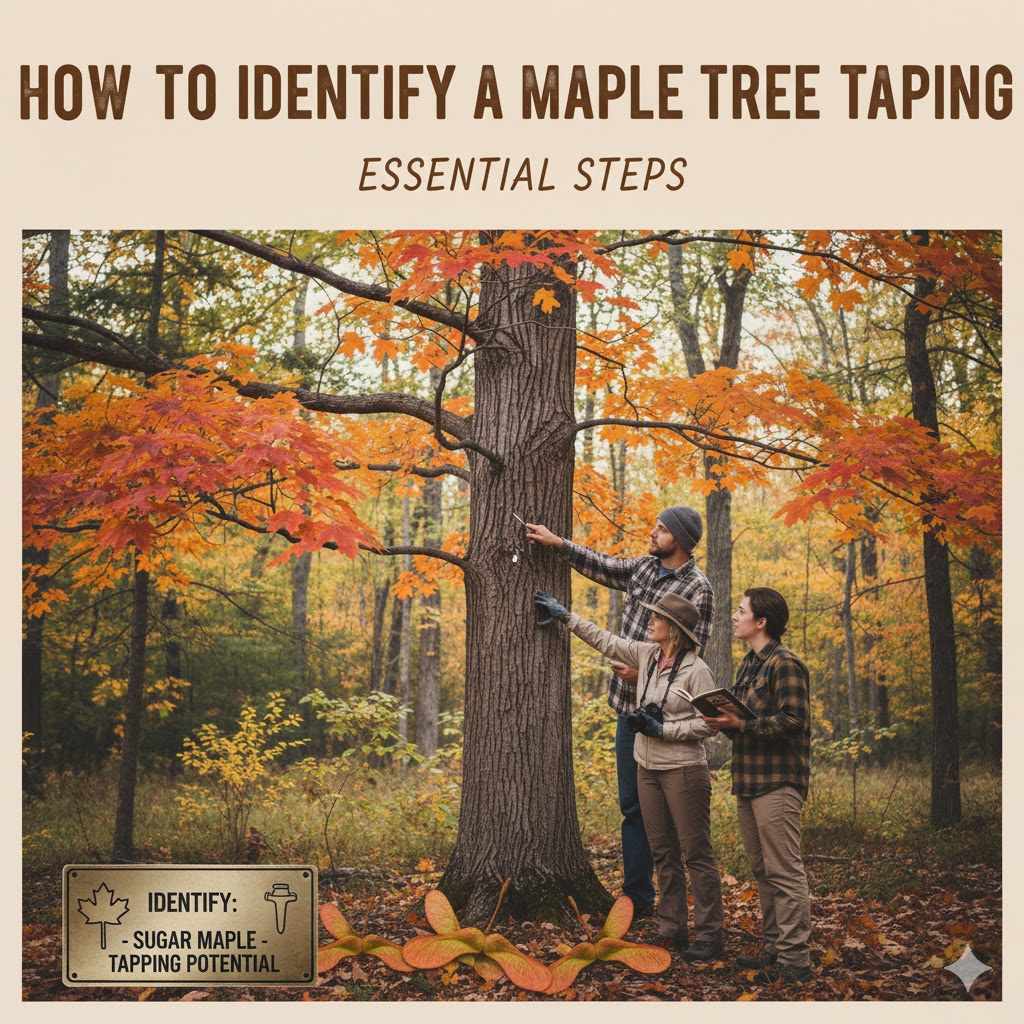
To identify a maple tree for tapping, look for its key features. Maples have opposite branching, where branches grow directly across from each other. Sugar maples, the best for sap, have gray, shaggy bark and sharp, pointy brown terminal buds. Red maples have smoother gray bark and reddish, rounded buds. Always choose a healthy, mature tree.
Hello there! I’m Md Meraj. Stepping into the woods with a bucket and a tap is one of the most rewarding feelings. It connects you to nature and gives you pure, delicious maple syrup. But before you can get that sweet reward, you need to find the right tree. For beginners, telling one tree from another can feel a bit overwhelming. Don’t worry, though. It’s simpler than you think.
Many folks feel stuck when they look at a forest full of similar-looking trees. It’s a common hurdle, but it’s one you can easily overcome. With a few simple tricks, you’ll be able to spot a sugar-rich maple like a pro. In this guide, I’ll walk you through the essential steps to identify the perfect maple tree for tapping. We’ll look at bark, branches, and buds so you can feel confident and ready to go.
Why Identifying the Right Maple Matters
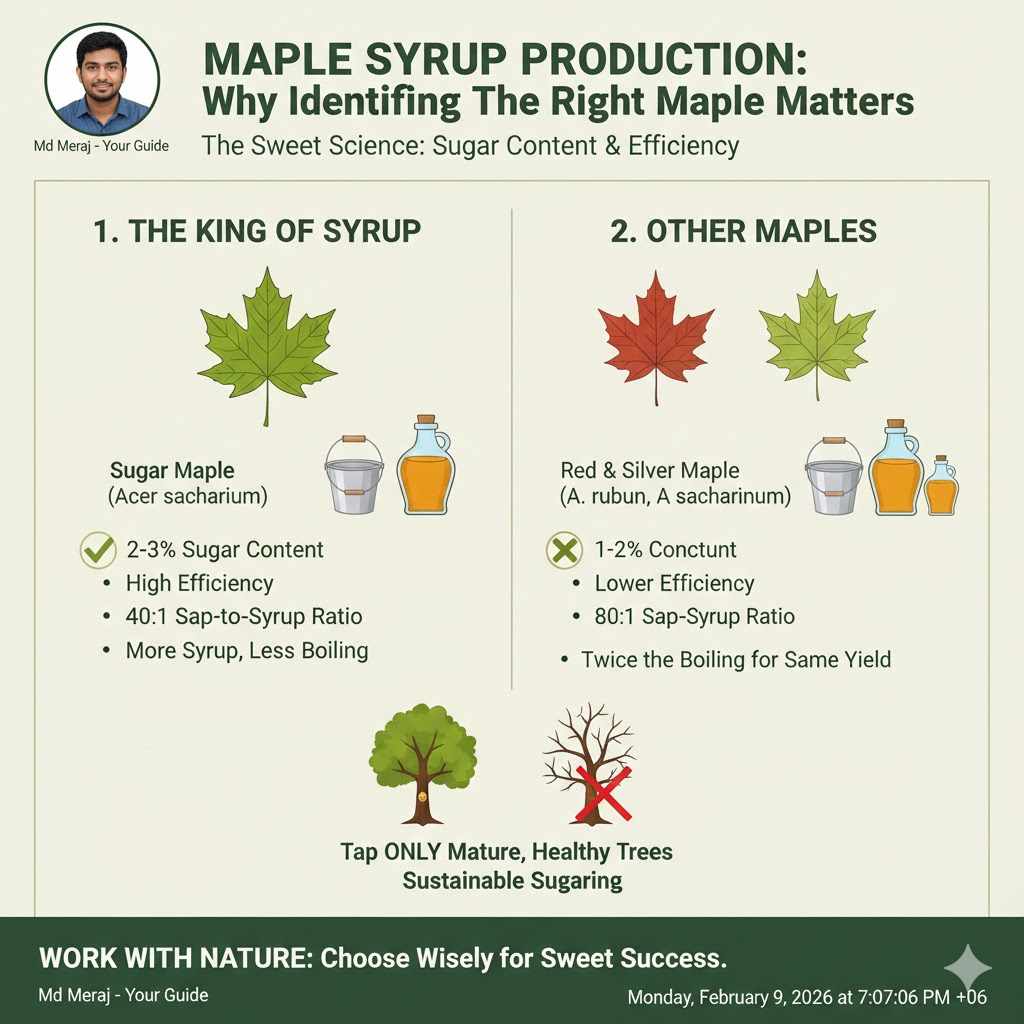
You might be thinking, “A maple is a maple, right?” Well, not exactly. While you can technically tap several types of maple trees, not all of them are created equal when it comes to syrup production. The reason is simple: sugar content. Some maples produce sap with a much higher sugar concentration, which means you get more syrup with less boiling.
The king of syrup is the Sugar Maple (Acer saccharum). Its sap can have a sugar content of 2% to 3%, sometimes even higher. This is the gold standard. Other maples, like the Red Maple (Acer rubrum) and Silver Maple (Acer saccharinum), also produce usable sap, but their sugar content is typically lower, around 1% to 2%. This means you’ll need to collect and boil twice as much sap from a Red or Silver Maple to get the same amount of syrup as you would from a Sugar Maple.
Beyond efficiency, choosing the right tree also ensures its health. You should only tap mature, healthy trees. A young tree or one that is stressed or damaged won’t handle tapping well. Learning to identify the right species and the right individual tree is the first and most important step in a successful and sustainable sugaring season. It’s about working with nature, not against it.
The Best Time to Identify Maple Trees
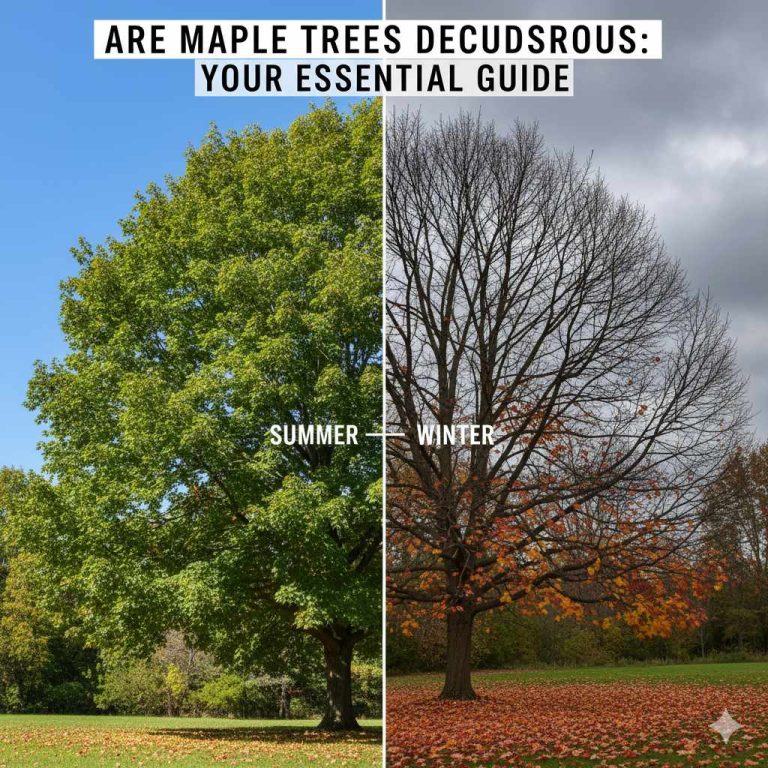
You can identify maple trees year-round, but certain seasons make it easier. Since tapping season happens in late winter and early spring, learning to identify trees without their leaves is a crucial skill.
Winter Identification (The Tapping Season)
Identifying trees in the winter is the most practical skill for a syrup maker. With no leaves to guide you, you’ll rely on other clues. This is the perfect time to get familiar with the tree’s structure and bark.
- Bark: The texture and color of the bark are your best friends in winter.
- Branching Pattern: This is a giveaway feature for maples.
- Buds: The shape and color of the buds at the tips of the twigs are unique to each maple species.
Walking through the woods in winter allows you to see the tree’s silhouette clearly. You can spot the branching patterns from a distance, which helps narrow down your search quickly.
Summer and Fall Identification (Practice Time)
Summer and fall are your training seasons. The leaves make identification much easier, so you can find and mark your target trees before winter arrives. It’s like getting a “cheat sheet” from nature.
- Leaves: Maple leaves have a classic, easily recognizable shape. Use them to confirm your finds.
- Practice Makes Perfect: Find a tree you think is a maple in the summer. Study its bark, branches, and overall shape. Then, return in the winter. See if you can recognize it again without the leaves. This is how you build true confidence.
I recommend taking a walk in your local woods during the fall. As the leaves change color, Red Maples will often have brilliant red leaves, while Sugar Maples turn shades of orange, yellow, and red. It’s a beautiful way to get to know your future syrup-producers.
Step 1: Look for the Opposite Branching Pattern
This is the first and most important clue. Maple trees have an “opposite” branching pattern. This means that for every branch on one side of a limb, there is another branch growing directly opposite it.
Imagine your arms stretched out to your sides—that’s opposite. Most other trees have an “alternate” pattern, where branches stagger up the limb, more like your footsteps when you walk.
The “MAD Buck” Acronym
To help you remember which trees have opposite branching, use the handy acronym MAD Buck:
- M – Maple
- A – Ash
- D – Dogwood
- Buck – Buckeye (and Horse Chestnut)
In most forests where you’d be tapping, Maple and Ash will be the most common large trees you’ll encounter from this list. Dogwoods are typically smaller, understory trees. Once you’ve confirmed opposite branching, you’ve narrowed it down significantly. Now, you just need to distinguish a maple from an ash.
How do you do that? The bark and buds will be your next clues. Ash trees have a distinct diamond-patterned bark that is quite different from the bark of a mature maple.
Take your time and look closely. Find a young twig and see if the small side shoots and buds are opposite each other. Then, look at the larger branches and the main trunk. This pattern should hold true throughout the tree. Remember to look up! Sometimes lower branches break off, so the pattern might be more obvious higher up the tree.
Step 2: Examine the Bark
The bark of a tree is like its fingerprint. As maples mature, their bark changes, becoming a reliable identifier. Here’s what to look for in the most common tappable maples.
Sugar Maple (Acer saccharum)
This is your prime target. Young Sugar Maples have smooth, light gray bark. But the ones you want to tap are mature, and their bark is very distinctive. Look for:
- Thick, irregular plates or ridges.
- A shaggy appearance. The bark often looks like it’s peeling away from the trunk in long, thick, vertical strips. It’s not papery like a birch, but rather stiff and curling outward on the edges.
- Color: Generally grayish-brown.
I always tell beginners to look for bark that looks like peeling gray paint on an old barn. It’s rugged and full of character.
Red Maple (Acer rubrum)
Red Maples are also good for tapping, though their sap isn’t as sweet. A young Red Maple has very smooth, light gray bark, often looking like the skin of an elephant. As it gets older, the bark changes, but it doesn’t get as shaggy as a Sugar Maple.
- Mature Bark: Develops narrow, vertical plates that are scaly or shaggy but typically not as long or thick as Sugar Maple plates.
- Appearance: It can look a bit “warty” or “bubbly” in some areas, where the smooth young bark transitions to the rougher mature bark.
- Color: Can have a reddish tinge, especially on the upper branches and new growth.
Silver Maple (Acer saccharinum)
Silver Maples grow quickly, often near water. Their bark is similar to Red Maples but often becomes much shaggier with age.
- Young Bark: Smooth and silver-gray.
- Mature Bark: Develops long, thin, scaly plates that can peel away from the trunk, giving it a very shaggy look. It often looks like it’s constantly shedding.
For more detailed images and descriptions, the Penn State Extension offers a great visual guide to help you compare different maple species side-by-side. Seeing photos while you learn is incredibly helpful.
Step 3: Check the Buds
If you’re identifying trees in the winter or early spring, the buds at the tips of the twigs are a fantastic clue. Get up close to a low-hanging branch for a good look.
Sugar Maple Buds
The Sugar Maple bud is the easiest one to identify. It’s the “smoking gun” that confirms you’ve found your tree.
- Shape: Very sharp and pointy, like a tiny brown spear.
- Color: Dark brown.
- Scales: Covered in many overlapping scales.
- Arrangement: You’ll see a large terminal bud (at the very tip of the twig) with smaller, opposite lateral buds just below it.
Red Maple Buds
Red Maple buds look quite different. They are your clue that you’re not looking at a Sugar Maple.
- Shape: Rounded and blunt, not sharp. They often appear in clusters.
- Color: Reddish. This is where the tree gets its name!
- Appearance: They look like small, red balls at the end of the twig.
Silver Maple Buds
Silver Maple buds are similar to Red Maple buds but are often larger and can have a slightly more greenish or light-brownish red color.
- Shape: Also rounded and clustered.
- Smell: If you crush a Silver Maple bud or twig, it often gives off a slightly unpleasant or rank odor. Red Maple twigs do not have this smell.
| Feature | Sugar Maple (Best for Tapping) | Red Maple (Good for Tapping) | Silver Maple (Okay for Tapping) |
|---|---|---|---|
| Bark (Mature) | Grayish-brown, thick, shaggy plates. | Gray, narrower scaly plates, less shaggy. | Silvery-gray, long thin plates, very shaggy. |
| Branching | Opposite | Opposite | Opposite |
| Buds | Sharp, pointy, brown. | Rounded, clustered, reddish. | Rounded, larger, sometimes with an odor. |
| Leaf (Summer) | 5 distinct lobes, U-shaped valleys (sinuses). | 3-5 lobes, V-shaped, toothy valleys. | 5 deep lobes, very deep valleys, silvery underside. |
Step 4: Confirm with Leaves (If Available)
If you’re scouting in the summer or fall, the leaves make identification almost foolproof. All maple leaves have lobes (points) and sinuses (the valleys between the points).
Sugar Maple Leaf
- Lobes: 5 distinct lobes with smooth edges (not serrated or “toothy”).
- Sinuses: The valleys between the lobes are rounded and form a “U” shape.
- Underside: Pale green.
Red Maple Leaf
- Lobes: 3-5 lobes (usually 3 main ones).
- Sinuses: The valleys are jagged and “toothy,” forming a sharp “V” shape.
- Stems: The leaf stem (petiole) is often red.
Silver Maple Leaf
- Lobes: 5 lobes with very deep, sharp sinuses.
- Appearance: The leaf looks deeply cut and delicate.
- Underside: The bottom of the leaf is a distinct silvery-white color, which is how it gets its name. When the wind blows, the leaves flash a silvery color.
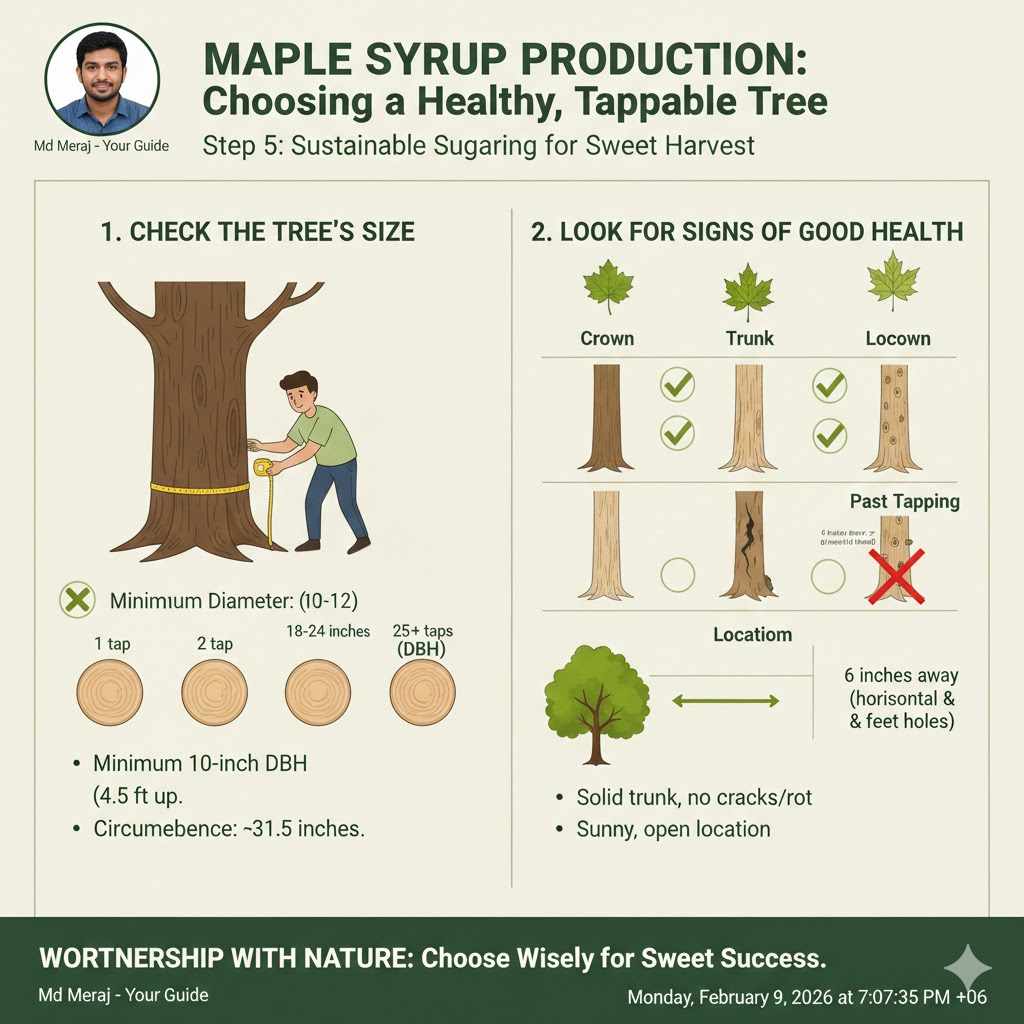
Step 5: Choose a Healthy, Tappable Tree
Once you’ve correctly identified a Sugar or Red Maple, the final step is to make sure it’s the right size and health for tapping. This is vital for sustainability and protecting the tree.
Check the Tree’s Size
Size matters. Tapping a tree that is too small can permanently damage or even kill it.
- Minimum Diameter: The tree should be at least 10-12 inches in diameter, measured about 4.5 feet up from the ground (this is called “diameter at breast height” or DBH). A simple way to measure this is with a flexible measuring tape; a 10-inch diameter is about 31.5 inches in circumference.
- Number of Taps: Use this as a general rule:
- 10 to 18 inches diameter: 1 tap
- 18 to 24 inches diameter: 2 taps
- 25 inches or more diameter: 3 taps maximum
Never put more than three taps in a single tree, no matter how large it is.
Look for Signs of Good Health
A healthy tree will give you a better sap flow and will recover easily from the taphole. Look for the signs of a vigorous, happy tree.
| Indicator | What to Look For |
|---|---|
| Crown | A full, round canopy of branches and twigs at the top. Avoid trees with large, dead branches or a thinning crown. |
| Trunk | A solid, straight trunk without large cracks, holes, or signs of rot. Avoid trees with cankers, large wounds, or fungus growing on them. |
| Location | Trees growing in the open with lots of sunlight tend to have higher sugar content. Look for trees on the edge of the woods or in a less crowded area. |
| Past Tapping | Check for old tapholes. They look like round scars. Make sure your new taphole is at least 6 inches away (horizontally) and 2 feet away (vertically) from any old holes. |
By taking the time to choose the right tree, you’re not just ensuring a great harvest of syrup for yourself; you’re also acting as a good steward of the forest. It’s a partnership between you and the tree, and it’s a wonderful tradition to uphold.
Frequently Asked Questions (FAQ)
What is the best type of maple tree for tapping?
The Sugar Maple (Acer saccharum) is by far the best. Its sap has the highest sugar content, typically between 2-3%. This means you need to boil less sap to produce a gallon of syrup, saving you time and fuel.
Can I tap any maple tree?
You can tap most species of maple, including Red, Silver, and Box Elder maples. However, their sap has a lower sugar content than Sugar Maples, so you will need to collect significantly more sap. Sugar Maples are the most efficient choice.
How big does a maple tree need to be for tapping?
A maple tree should be at least 10 inches in diameter (about 31.5 inches around) before you place a single tap in it. Larger trees can support more taps, but never place more than three taps in any one tree, regardless of its size.
How can I tell a Sugar Maple from a Red Maple in winter?
Look at the buds! Sugar Maple buds are sharp, pointy, and dark brown. Red Maple buds are rounded, clustered, and reddish in color. This is the most reliable way to tell them apart when there are no leaves.
Is it bad for the tree to tap it?
When done correctly on a healthy, mature tree, tapping is not harmful. Tapping removes only a small fraction of the tree’s total sap. The taphole will heal over in a year or two. Following proper guidelines for size and tap placement is key to sustainable tapping.
Does the bark of a maple tree change as it gets older?
Yes, absolutely. Young maples often have smooth, light gray bark. As they mature, the bark becomes rougher. A mature Sugar Maple develops thick, shaggy plates, while a mature Red Maple develops more narrow, scaly ridges.
What if I misidentify a tree and tap it?
Don’t panic. If you accidentally tap another hardwood tree like an oak or an ash, it likely won’t produce much sap, and it won’t harm the tree long-term if you remove the tap. If you tap a different kind of maple, like a Red or Silver Maple, the sap is perfectly safe and usable—you’ll just need more of it. Just use it as a learning experience!
Conclusion
There you have it—a clear path to finding the perfect maple for your sweet-tasting adventure. Identifying a maple tree might seem like a challenge at first, but it’s really just about learning to notice a few key details. Start with the opposite branching, then look closely at the bark and the buds. Before you know it, you’ll be spotting Sugar Maples from a distance with confidence and ease.
Remember, this is a skill that grows with practice. Don’t be afraid to get out there and just look at trees. Take notes, snap photos, and compare what you see to this guide. Every walk in the woods is a chance to learn something new. The journey from tree to table is a special one, and it all starts with this first simple step: saying “hello” to the right tree.
So grab your coat, head outside, and start looking. Your first batch of homemade maple syrup is waiting for you. Happy tapping!