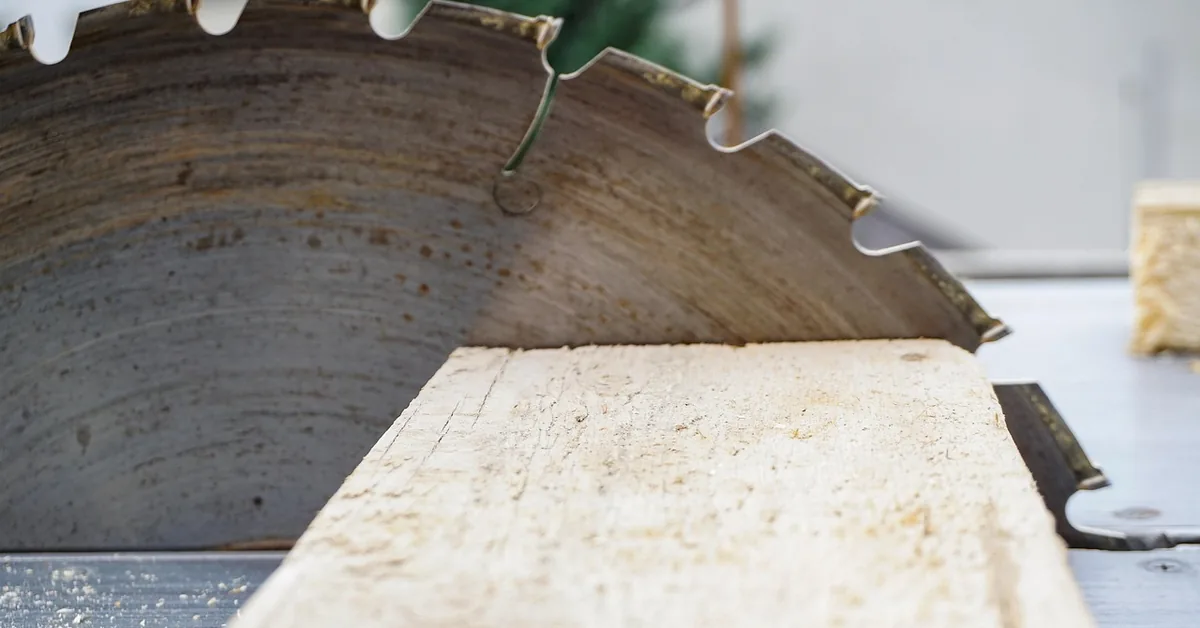
How to Trim a Door With a Circular Saw
A circular saw fitted with a fine-tooth blade trims a door bottom cleanly in about 20 minutes — but never remove more than 1 inch total, since hollow-core doors hold only about an inch of solid wood at the frame. Cut past that and you’ll expose the honeycomb core or hit a solid door’s structural dowels. This guide covers marking the cut, stopping splinters with tape and a scored line, and how much you can trim by door type.
This post contains affiliate links. As an Amazon Associate we earn from qualifying purchases.
What You’ll Need
Best Door-Trimming Guide Pick
Kreg KMA2400 Rip-Cut Circular Saw Guide
An adjustable rip guide that rides along the door’s own edge, so you don’t need a separate straightedge for the main cut.
- Best for: One long, straight guided cut across a door’s width without clamping down a separate rail
- Why we picked it: Adjusts up to roughly 24 in. and doubles as its own fence — no extra clamps needed for the cut itself
- Main drawback: Only rip-cuts parallel to an edge; it won’t guide an angled or beveled cut
Compare more door-trimming options
 Option 1 FOXBC 60-Tooth Fine Finish Blade
|
 Option 2 IRWIN QUICK-GRIP 12″ Bar Clamp
|
 Option 3 BORA NGX 50″ Guide Rail
|
As an Amazon Associate we earn from qualifying purchases.
Beyond what’s listed here, our guide to woodworking saws covers when a circular saw is the right call versus a jigsaw or track saw.
- Circular saw with a sharp, fine-tooth blade (40–60 teeth cuts far cleaner than the 18–24-tooth framing blade most saws ship with — see our guide to circular saw blade types)
- Straightedge or clamp-on guide rail, at least as long as the door is wide
- Masking tape, 2–3 inches wide
- Utility knife
- Tape measure and pencil
- Sawhorses or another stable, padded surface
- Bar or trigger clamps
- Sandpaper (120–180 grit) or a hand plane, for hollow-core doors and final smoothing
- Dust mask and safety glasses
- Matching paint, stain, or polyurethane to reseal the cut edge
How Much Can You Safely Trim Off a Door?
How much you can safely remove depends on what’s inside the door, not just how much clearance you need. If the real issue is a warped or out-of-square opening rather than an oversized door, trimming won’t fix it — check our guide to fixing a door frame first.
| Door Type | Safe Trim Limit | Why |
|---|---|---|
| Hollow-core | ~1 in. total (about 1/4 in. per side, conservatively) | Only about 1 in. of solid wood frames the perimeter; go further and you expose the honeycomb or cardboard core |
| Solid wood | ~1 in. (25mm) total | Deeper cuts risk hitting the mortise-and-tenon or dowel joints holding the rails and stiles together |
| Solid-core / veneer | More forgiving, but check the spec sheet | The engineered wood core (HDF) is uniform, but the thin face veneer can chip past the maker’s stated limit |
📊 Door manufacturers commonly cap safe trimming at 5–10mm (about 3/16–3/8 in.) per edge — always check the door’s own spec sheet before cutting if one is available. Source: Homebuilding & Renovating, door-trimming guidance.
How to Trim a Door With a Circular Saw (Step by Step)

- Measure and mark: Measure the amount to remove and transfer that mark to both faces and both edges of the door with a pencil and straightedge.
- Tape the cut line: Run a strip of masking tape along the marked line on the face you’ll cut from — it protects the finish from the saw’s base plate and helps the blade exit cleanly.
- Score the line: Press a utility knife along the taped line about 1/16 in. deep, through the tape and the top wood fibers. This step — not blade sharpness alone — is what actually stops splintering.
- Set up the guide: Clamp a straightedge or guide rail parallel to the line, offset for your saw’s base-plate width, so the blade rides exactly on the mark. If you don’t already own a guide, see our full guide to cutting straight lines with a circular saw.
- Set the blade depth: Adjust the saw so the blade extends only about 1/4 in. past the door’s thickness — deep enough to cut through, shallow enough to reduce binding and tear-out.
- Make the cut: Rest the saw’s base plate against the guide, start the motor before contact, and feed it through in one slow, steady pass.
- Sand and refinish: Ease the cut edge with 120–180 grit sandpaper, then seal it with matching paint, stain, or polyurethane so moisture can’t swell the raw wood.
A blade that’s already been through a season of framing work rarely still counts as sharp for this kind of finish cut — see how long a circular saw blade actually lasts before it needs replacing.
“The score line is the step beginners skip — and it’s the step that actually matters. Even a brand-new 60-tooth blade will still chip the top veneer on a fast, unscored cut. Score first, then cut slow, and the difference shows up immediately at the edge.”
How to Trim a Hollow-Core Door Without Exposing the Core
A hollow-core door is a door with a lightweight honeycomb or cardboard cell structure sandwiched between two thin wood-veneer faces, framed by a solid wood block only around the outer perimeter. That solid framing is usually about 1 in. wide, which is the entire safety margin you have to work with.

For less than 1/8 in. per side, use a hand plane instead of the saw — it removes material in thin, controlled passes, which matters when the safety margin is only about an inch. For anything more than 1/8 in., use the circular saw steps above, then plane or sand the edge flush. Either way, never trim more than roughly 1 in. total off a single edge of a hollow-core door.
Can You Trim a Door Without Taking It Off the Hinges?
You can, for small amounts. A circular saw guided by a clamped straightedge can shave up to about 1/4 in. off a hanging door’s top or long edge for carpet clearance, without removing it. For the bottom edge, or for anything over about 1/4 in., take the door off its hinges first — a freehand cut on a hanging door is far more likely to wander off the line, and the last few inches of a bottom cut are hard to support without the door shifting mid-cut.
Common Mistakes When Trimming a Door With a Circular Saw
- Skipping the utility-knife score line and relying on blade sharpness alone — this is the single biggest cause of splintering.
- Guessing the blade depth instead of setting it — too much blade exposed raises both kickback risk and tear-out.
- Trimming more than about 1 in. total off a hollow-core door and exposing the internal honeycomb.
- Cutting a solid door without checking for dowel or mortise-and-tenon joints near the edge you’re trimming.
- Not clamping the guide rail down, which lets the saw drift off the line partway through the cut.
- Leaving the freshly cut edge unsealed, which lets the raw wood swell and stick during humid months.
FAQ: Trimming a Door With a Circular Saw
Can you use a circular saw to trim a door?
Yes. A circular saw with a fine-tooth (40–60 tooth) blade and a clamped straightedge makes a clean, straight cut across a door’s bottom or side edge. Score the cut line with a utility knife first and keep the blade depth set just past the door’s thickness to avoid splintering the face.
How much can you trim off the bottom of a door?
As a general rule, keep total trim under 1 in. on both hollow-core and solid wood doors. Hollow-core doors have only about 1 in. of solid wood framing the perimeter, and solid doors risk exposing dowel or mortise-and-tenon joints past that point. Always check the manufacturer’s spec sheet if one is available.
Can you trim a door without taking it off the hinges?
Yes, for small amounts. A circular saw guided by a clamped straightedge can trim up to about 1/4 in. off a hanging door’s top or long edge for carpet clearance. For the bottom edge, or for more than 1/4 in., take the door off its hinges — it’s easier to support and far less likely to wander off the line.
What blade should you use to cut a door?
Use a fine-tooth, carbide-tipped blade with 40 to 60 teeth. The framing blades many circular saws ship with (18–24 teeth) are built for speed on rough lumber, not a clean finish edge, and will tear the face veneer of a door.
How do you stop a circular saw from splintering a door?
Run masking tape along the cut line, then score through the tape and the top wood fibers with a utility knife about 1/16 in. deep before you saw. The scored line — not blade sharpness alone — is what stops the fibers from tearing out ahead of the blade.
How much can you trim off a hollow-core door?
Keep total trim under about 1 in., or roughly 1/4 in. per side if you’re trimming both edges. Hollow-core doors have a solid wood block only around the perimeter; cut past it and you’ll expose the honeycomb or cardboard core inside.
Conclusion
Trimming a door with a circular saw comes down to two things: a scored line to stop splintering, and knowing your stopping point before you start. Tape and score the cut, guide the saw with a clamped straightedge, and stay under about 1 in. of total trim — more than that on a hollow-core door risks the honeycomb core, and more than that on a solid door risks the joinery holding it together. Sand and reseal the edge when you’re done, and the cut will hold up as well as the rest of the door.
Sponsored / affiliate links. As an Amazon Associate I earn from qualifying purchases. I may earn additional commission from eligible campaigns.