Is Hevea Wood Good for Butcher Block Countertops?
Yes, Hevea wood (rubberwood) works well for butcher block countertops, but it’s genuinely softer than the classic benchmark — about 960 lbf on the Janka hardness scale versus 1,450 lbf for hard maple. That gap means a Hevea countertop picks up knife marks and dents faster unless you keep it sealed with food-safe mineral oil. This guide covers the real hardness numbers, the food-safety question, how to seal one properly, and when a harder wood is the smarter buy.
What Is Hevea Wood?
Hevea wood is rubberwood — lumber cut from Hevea brasiliensis, the rubber tree, after it stops producing latex efficiently (typically around 25–30 years old). It’s a genuine hardwood by botanical classification, not a maple relative — a claim repeated on several retail sites is simply wrong; Hevea brasiliensis belongs to the Euphorbiaceae family, unrelated to maple’s Sapindaceae family. Because the tree is already being grown commercially for latex, using the wood afterward is a genuine plantation byproduct, which is why it’s often marketed as an eco-friendly or sustainable wood choice.
Best Hevea Butcher Block Pick
 |
Hevea Butcher Block Countertop, 25"x24"x1.5" – $99.99 A compact, pre-sanded solid hevea slab sized for a small counter section or island top — the size this guide recommends sealing with mineral oil before first use.
|
As an Amazon Associate we earn from qualifying purchases.
Hevea Wood Hardness vs. Maple (Real Janka Numbers)
Hevea wood measures 960 lbf on the Janka hardness scale, the standard test for how much force it takes to embed a steel ball halfway into the wood. Hard maple — the wood butcher block is traditionally benchmarked against — measures 1,450 lbf, about 51% harder. In practice, that means a Hevea countertop will show knife nicks, dents from dropped pans, and general wear noticeably sooner than a maple one under the same daily use.
📊 Hevea/rubberwood: 960 lbf Janka hardness vs. 1,450 lbf for hard maple — Source: The Wood Database, Rubberwood species profile
| Wood | Janka Hardness | Best For |
|---|---|---|
| Hevea (Rubberwood) | 960 lbf | Budget builds, light-duty prep areas |
| Black Walnut | 1,010 lbf | Dark-toned decorative countertops |
| Yellow Birch | 1,260 lbf | Mid-range durability, light color |
| American Beech | 1,300 lbf | Tight grain, good bacteria resistance |
| Hard Maple | 1,450 lbf | Heaviest daily chopping, commercial kitchens |
Source values above are pulled from The Wood Database species profiles for each wood, not manufacturer marketing copy — which is where the false “Hevea is part of the maple family” claim originates.
Is Hevea Wood Food-Safe? (The Latex Allergy Question)
Yes — finished Hevea butcher block is food-safe for normal kitchen use, including for most people with latex allergies, because the natural latex sap is tapped out of the tree and processed away long before the wood is cut into lumber. The Wood Database’s own safety notes do flag that people with a known natural rubber latex allergy may still react to raw, unsealed rubberwood or its sawdust — so the real risk window is while a board is being sanded or before it’s sealed, not while eating off a finished, oiled countertop.
“Individuals with natural latex or rubber allergies may have reactions to rubberwood” — a caution aimed primarily at raw wood dust and sap exposure during milling, not finished, sealed furniture or countertops.
If anyone in your household has a severe latex allergy, the safer move is buying a pre-sealed board, sealing every surface yourself before first use, and avoiding sanding it unsealed indoors without a respirator and dust extraction — not avoiding Hevea butcher block altogether.
Advantages of Hevea Wood for Butcher Block
- Cost: Hevea butcher block typically runs $100–$400 for a standard countertop section, well under equivalent hard maple or walnut of the same dimensions.
- Workability: It cuts, sands, glues, and stains easily with standard shop tools, making DIY installs realistic for a first-time project.
- Consistent grain: Finger-jointed Hevea slabs have a light, even, low-figure grain that takes stain predictably — useful if you want a uniform look rather than heavy character marks.
- Sustainability angle: Because it’s a byproduct of latex-tapped trees already being farmed, no additional forest is cut solely for the lumber.
The tradeoff for that lower cost and easy workability is durability: Hevea is genuinely more prone to warping in humid environments than tighter-grained hardwoods, and its lower Janka rating means less resistance to gouging near a stove or sink where splashing and heat cycle the wood repeatedly.
Where Hevea Butcher Block Works Best (and Where It Doesn’t)
Hevea makes the most sense as a secondary prep surface, a kitchen island top, or a laundry-room countertop — spots that get moderate use and where a lower price matters more than maximum lifespan. It’s a weaker fit as the single main countertop in a kitchen that sees heavy daily chopping directly on the surface, or in a consistently humid climate without air conditioning, since its lower density both dents faster and moves more with humidity swings than tighter-grained hardwoods.
A practical rule of thumb: if you’d be upset seeing the first knife mark within a year, budget for hard maple or American beech instead. If you’re outfitting a rental, a workshop, or a secondary counter on a tight budget and you’re genuinely willing to re-oil it every 4–6 weeks, Hevea is a reasonable, honest tradeoff — not a compromise the marketing copy needs to hide.
How to Seal and Maintain a Hevea Butcher Block
Because Hevea is softer and more moisture-sensitive than maple, sealing matters more here, not less. Use a food-safe mineral oil or tung oil — never beeswax alone, which doesn’t penetrate deeply enough to protect end grain.
- Sand the surface: Start with 120-grit and work up to 220-grit if the board is unfinished or has visible tool marks.
- Clean and dry: Wipe down with a barely damp cloth, then let it dry fully before oiling.
- Apply food-safe oil: Coat every surface, including the underside and edges, with mineral oil or tung oil using a lint-free cloth.
- Let it soak: Leave the oil to penetrate for at least 20–30 minutes, longer for a first seal on unfinished wood.
- Wipe off excess: Buff away anything the wood hasn’t absorbed with a clean cloth.
- Repeat coats: Apply 2–3 coats for a new board, then re-oil every 4–6 weeks (more often than the 4–6 months typical for harder maple) since Hevea’s softer, more open grain dries out faster.
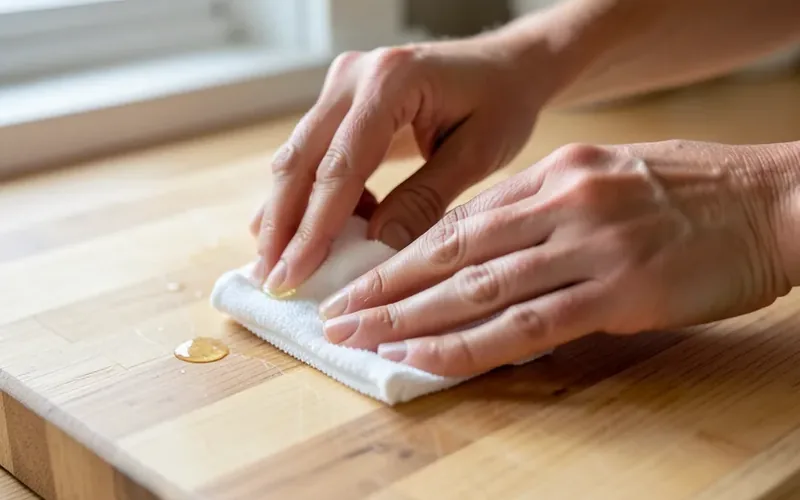
- Never put hot pots or pans directly on the surface — always use a trivet.
- Use a separate cutting board for raw meat rather than cutting directly on the countertop.
- Don’t soak it or run it through a dishwasher; wipe with a barely damp cloth only.
Hevea vs. Other Butcher Block Wood Options
If durability matters more than upfront cost, it’s worth comparing Hevea against the alternatives directly. Our Hevea wood vs. birch comparison breaks down hardness and cost side by side, and our broader guide to the best wood for butcher block countertops ranks maple, walnut, and oak options if you want maximum longevity over budget.
Acacia is the other budget-friendly wood most often cross-shopped against Hevea for countertops — it has a more pronounced grain pattern and comparable pricing, but different movement characteristics in humid kitchens. And if moisture exposure is a bigger concern than knife marks (a sink-adjacent section, for example), check whether rubberwood is actually waterproof before committing to that placement — it isn’t, without consistent sealing.
Frequently Asked Questions
Is Hevea wood good for a countertop?
Yes, with caveats: Hevea (rubberwood) is a genuine hardwood at 960 lbf Janka hardness, softer than the 1,450 lbf of hard maple. It works well for countertops and butcher block if you seal it regularly and accept it will show wear sooner than harder woods.
Is Hevea wood the same as rubberwood?
Yes. Hevea wood is rubberwood — lumber from Hevea brasiliensis, the rubber tree, harvested after the tree stops producing latex efficiently. “Hevea” and “rubberwood” are two names for the same material, and neither is related to maple despite that claim appearing on some retail sites.
Is Hevea wood safe if I have a latex allergy?
Finished, sealed Hevea butcher block is safe for normal kitchen use for most people with latex allergies, since the latex sap is processed out during lumber production. The real caution applies to raw, unsealed wood dust during sanding — not eating off a finished, oiled countertop.
What is the most durable wood for butcher block countertops?
Hard maple (1,450 lbf Janka) is the traditional standard for durability, followed by American beech (1,300 lbf) and yellow birch (1,260 lbf). Hevea (960 lbf) and acacia are softer, budget-friendly alternatives that need more frequent oiling to compensate.
Conclusion
Hevea wood is a legitimate, food-safe, budget-friendly option for butcher block countertops — just go in knowing it’s a genuinely softer wood than maple (960 vs. 1,450 Janka lbf), not an equal substitute marketed with inflated durability claims. Seal it on every side before first use, re-oil every 4–6 weeks, and it will hold up well for light-to-moderate kitchen use at a fraction of hard maple’s cost.
Sponsored / affiliate links. As an Amazon Associate I earn from qualifying purchases. I may earn additional commission from eligible campaigns.
 72 in x 26 in x 1.5 in Wood Butcher Block Countertop, Natural Chevron Acacia, Unfinished Solid Tabletop – Ideal for DIY Kitchen/Dining Room/Home Office
 Howizz 60 x 30 Inch Solid Hevea Wood Table Top – 1 Inch Thick Butcher Block Countertop for Standing Desk, Office Table, Workbench, DIY Furniture Projects, Unfinished Hevea