Makita Guide Rail vs Festool: Price, Fit, and Which to Buy
The Makita 194368-5 guide rail costs around $110 versus the Festool FS 1400/2 at around $150 for the same 55-inch length — a 35% premium for Festool. Both rails partially cross-fit with adapters, but Makita’s glide strips are rougher and can wear a Festool saw’s base over extended use. This guide covers exact dimensional differences, which tools each rail accepts, all available lengths, and when paying the Festool premium makes sense.
Quick Answer
The Makita 194368-5 is the better buy for woodworkers who already own Makita track saws or want to save $40 on each 55-inch rail. Festool’s FS 1400/2 earns its premium through smoother glide strips, more length options (32″ to 197″), and tighter accessory compatibility. Both rails fit each other’s saws with minor adjustments — Makita under Festool saws may cause glide strip wear over time.
Makita vs Festool Guide Rail: Specifications Side by Side
Best Guide Rail Pick
Makita 194368-5 55″ Guide Rail
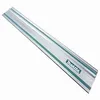
Solid aluminum 55-inch rail with rubber anti-slip strips and splinter guard. Fully compatible with Makita’s SP6000J, XPS01, and XPS02 track saws. Works with Festool plunge saws using the 194579-2 adapter or a masking tape ridge shim.
- Best for: Makita track saw users and anyone who wants reliable guide rail performance without the Festool price
- Why we picked it: Verified Amazon-listed rail at ~$110, 4.6-star rating, works with both Makita and Festool saws with minor adjustment
- Main drawback: Only 4 length options vs Festool’s 8; rubber splinter guard less precise on finished surfaces
Compare more guide rail options
 Option 1 POWERTEC 71387 110″ Joining Set
|
 Option 2 WEN CT9110 110″ Track Saw Rail
|
 Option 3 BORA NGX 100″ Saw Guide Rail
|
As an Amazon Associate we earn from qualifying purchases.
Before picking a rail, compare the exact specs. The Makita 194368-5 and Festool FS 1400/2 are the most common 55-inch models buyers compare. Both are solid aluminum extrusions — the differences come down to glide strip quality, anti-slip design, and the connector system.
| Specification | Makita 194368-5 | Festool FS 1400/2 |
|---|---|---|
| Length | 55 in (1,400 mm) | 55 in (1,400 mm) |
| Price (approx.) | ~$110 | ~$150 |
| Material | Aluminum alloy | Precision-extruded aluminum |
| Anti-slip strip | Rubber, underneath | Adhesive cushion, underneath |
| Splinter guard | Soft rubber | Thicker rigid plastic |
| Guide ridge width | Standard (wider) | Standard (approx. 0.01 in narrower) |
| Connector system | Simple clamp | Patented tool-free snap |
| Length options | 39″, 55″, 78″, 118″ (4 sizes) | 32″ to 197″ (8 sizes) |
| Cross-compatible? | Yes, with adjustments | Yes, with adjustments |
The splinter guard is where Festool pulls ahead for fine finish work. Festool’s thicker, more rigid plastic guard produces a cleaner kerf edge on melamine, veneered plywood, and other materials prone to chipping. On construction lumber and rough sheet goods, the Makita’s softer rubber guard is adequate.
Price Per Length: Where the Real Value Difference Shows
Festool’s price premium grows with rail length. A single 55-inch Makita rail costs about $110; a Festool FS 1400/2 of the same length runs around $150. But for longer cuts, you typically join two rails — and that’s where Makita’s cost advantage compounds significantly. Two 55-inch Makita rails with a connector costs roughly $230 total. Two 55-inch Festool rails and Festool’s proprietary connector runs closer to $320.
| Cut Length Needed | Makita Setup | Festool Setup | Festool Premium |
|---|---|---|---|
| Up to 55 in | 1x 194368-5 (~$110) | 1x FS 1400/2 (~$150) | +$40 (36%) |
| Up to 78 in | 1x 78in rail (~$170) | 1x FS 2000/2 (~$215) | +$45 (26%) |
| Up to 110 in | 2x 55in + connector (~$230) | 2x FS 1400/2 + connector (~$325) | +$95 (41%) |
| Full sheet (8 ft) | 1x 118in rail (~$220) | 1x FS 3000/2 (~$310) | +$90 (41%) |
If you regularly cut full sheets of plywood, Festool’s 8-size length lineup gives you the exact rail for any cut without joining — the FS 3000/2 (118 inches) handles a full 8-foot rip in one piece. Makita’s largest single rail (118 inches) covers the same ground, but you only have 4 size options to choose from vs Festool’s 8.
Cross-Compatibility: Can You Use a Makita Rail With a Festool Saw?
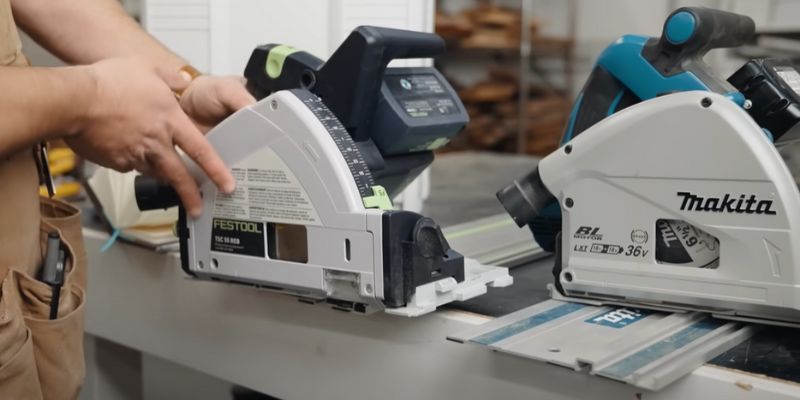
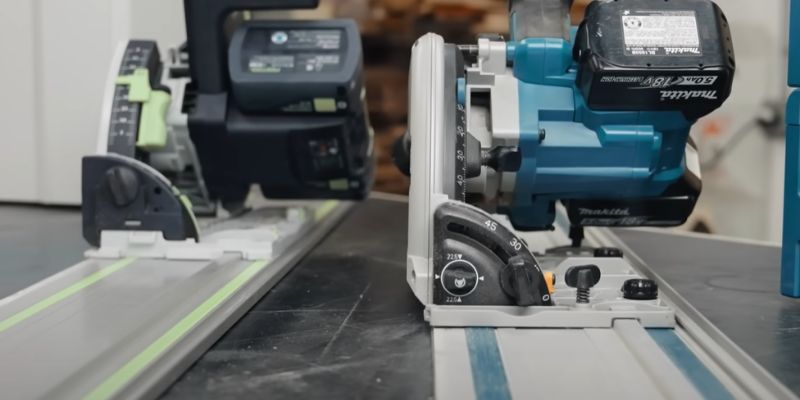
Yes — Makita and Festool guide rails are partially cross-compatible. A Festool TS 55 or TSC 55 plunge saw will ride a Makita guide rail, and a Makita SP6000J will run on a Festool FS rail. The two systems share the same general channel profile, but a roughly 0.01-inch difference in guide ridge width means the fit is not perfect out of the box.
The most common cross-compatibility issue: a Festool saw on a Makita rail can feel slightly looser than on its native Festool track. The fix is simple — apply a strip of masking tape along the Makita rail’s guide ridge to shim the gap. This takes two minutes and eliminates the wobble. For the reverse (Makita saw on Festool rail), the fit is typically tighter and usually needs no adjustment.
Which Festool Accessories Work on Makita Rails?
Most Festool guide rail accessories fit Makita rails with minor caveats. Festool’s rail connectors, parallel guides, and clamps fit the Makita T-slot without modification. The exception is Festool’s LR 32 hole-drilling system — it requires Festool’s own rail because the spacing relies on the Festool rail’s exact internal slot geometry. Makita’s own adapter (part number 194579-2) is designed to fit the Makita router on Festool rails, not the other direction.
Glide Strip Compatibility Warning
One long-term concern woodworkers report: Makita’s anti-slip rubber strips are more abrasive than Festool’s adhesive cushion strips. When a Festool plunge saw rides a Makita rail for extended periods, the rougher rubber texture can gradually wear into the saw’s guide shoe. This does not affect cut quality immediately, but it can degrade precision over thousands of feet of cuts. If you own a Festool saw, using Festool rails preserves the system’s tolerances longer.
Performance and Accuracy Comparison
Both rail systems produce accurate, splinter-free cuts on sheet goods when properly set up. The difference shows on precision cabinet and finish joinery work, not on standard framing or rough rips.
Festool’s zero-play guide strip system holds the saw shoe firmly in the rail channel, eliminating the slight lateral movement that is possible on Makita rails. In practice, on a freshly calibrated Makita system, this difference is minimal — most woodworkers cannot detect it in cut quality. But for 32-foot room-length panel cuts or repeated fine crosscuts on hardwood veneer, Festool’s tighter tolerances compound into measurably cleaner edges.
Makita’s anti-slip strips grip the workpiece from underneath, preventing rail shift without clamping. This is a practical advantage on job sites where stopping to clamp every cut slows production. Festool’s adhesive cushion strip provides similar grip but is slightly more compliant — it conforms better to slightly uneven panel surfaces, which can improve accuracy on warped sheet goods.
Durability and Outdoor Use
Both rails are aluminum alloy and resist rust, but they perform differently in outdoor and high-humidity environments. Festool’s guide rail undergoes a harder anodizing process than Makita’s standard finish, which gives it better resistance to surface scratches and oxidation. In a controlled shop environment, both rails will outlast any reasonable working life.
For outdoor decking, roofing, and site work in rain or high humidity, the Makita rail’s standard aluminum finish can develop surface corrosion that roughens the glide strip groove over time, degrading cut straightness. If most of your cutting happens outdoors, the Festool rail’s harder surface finish justifies the higher price. For dedicated shop use, either rail is comparable in durability.
Which Guide Rail Should You Buy?
The right choice depends on your saw brand, the work you do, and how much you will actually use the system.
- Buy Makita 194368-5 if: You already own a Makita track saw (SP6000J, XPS01, or XPS02), you work primarily indoors, and you need to outfit multiple cutting stations without breaking the budget. At roughly $110 per 55-inch rail, the savings compound quickly when you buy two or three rails.
- Buy Festool FS 1400/2 if: You own a Festool TS 55 or TSC 55 saw, you do precision cabinet or furniture work where kerf quality matters on every cut, you work outdoors frequently, or you want access to Festool’s full accessory ecosystem (LR 32 drilling, parallel guides, and future system expansion).
- Buy an aftermarket rail if: You own a standard circular saw (not a dedicated plunge saw) or need long cutting lengths at under $80. The POWERTEC 71387 (110-inch, ~$140) and WEN CT9110 (110-inch, ~$74) both cross-fit Makita and Festool saws without modification.
“In my shop, the Makita rail handles 90% of sheet goods breakdown without issue. I switch to the Festool rail only when I’m cutting expensive veneer plywood where a single chip means scrapping a panel. For most woodworkers, that split is not worth maintaining two rail systems — pick the brand your saw came from.”
Frequently Asked Questions
Are Makita guide rails compatible with Festool track saws?
Yes, with adjustments. Makita guide rails work with Festool TS 55, TSC 55, and TS 75 plunge saws. The approximately 0.01-inch guide ridge width difference means a Festool saw may feel slightly loose on a Makita rail. Applying a strip of masking tape along the Makita rail’s guide ridge eliminates the wobble and restores tight saw-to-rail contact.
What guide rails are compatible with Makita track saws?
Makita track saws (SP6000J, XPS01, XPS02) are designed for Makita’s own guide rails, but they also run on Festool FS rails, POWERTEC rails, and most aftermarket guide rails that use the same channel profile. Festool rails provide a slightly tighter fit for Makita saws because the Festool channel is marginally narrower, which can improve cut precision compared to Makita’s own, slightly looser-tolerance channel.
Is the Festool guide rail worth the extra cost over Makita?
For professional cabinetmakers, furniture builders, and anyone cutting expensive veneered or solid hardwood panels regularly, yes. Festool’s zero-play guide system, harder anodized finish, and 8-length lineup justify the 35% premium for users who need the system to perform precisely across thousands of cuts per year. For occasional DIY use or rough construction work, the Makita guide rail delivers the same practical result at a lower cost.
Can you use Festool accessories on a Makita guide rail?
Most Festool accessories fit Makita guide rails. Festool rail connectors, parallel guides, and standard clamps slot into the Makita T-track without modification. The exception is the Festool LR 32 hole-drilling rail — its 32mm hole-spacing system requires Festool’s own rail geometry and does not transfer to Makita rails.
What is the price difference between Makita and Festool guide rails?
At the 55-inch length, Makita’s 194368-5 costs approximately $110 while Festool’s FS 1400/2 costs approximately $150 — a roughly 35% Festool premium. For a full sheet-cutting setup requiring two joined rails, that gap grows: two Makita 55-inch rails with a connector costs around $230, versus two Festool FS 1400/2 rails with connector at roughly $325. Prices vary by retailer and change seasonally.
Conclusion
Both Makita and Festool guide rails are well-engineered aluminum systems that produce accurate, straight cuts. Makita wins on price and cross-brand value — at about $110 for a 55-inch rail, it costs 35% less than the equivalent Festool and works with both saw brands using a simple masking-tape shimming fix. Festool wins on glide strip quality, available lengths, accessory compatibility, and outdoor durability, making it the right choice for professional cabinet shops and finish woodworkers who need reliable performance across thousands of cuts. If you own a Makita track saw, start with Makita rails. If you own a Festool saw, buy Festool rails to preserve the system’s precision and protect your saw’s guide shoe from abrasive wear.
Sponsored / affiliate links. As an Amazon Associate I earn from qualifying purchases. I may earn additional commission from eligible campaigns.