What Size Dado Blade for a 10″ Table Saw? (8″ Is the Max)
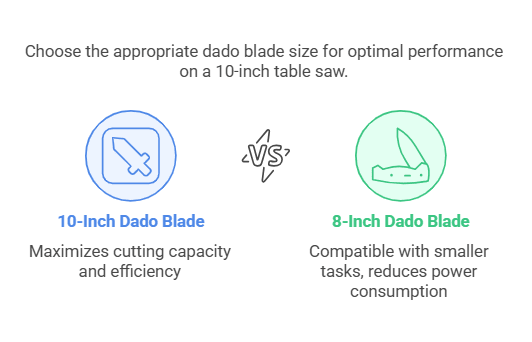
An 8-inch dado stack is the practical maximum for a 10-inch table saw — true 10-inch dado sets barely exist, and most 10-inch saws share the same 5/8″ arbor as their 8-inch counterparts. Going bigger than your saw is rated for can overload the motor or void the warranty. This guide covers arbor and horsepower requirements, 6-inch vs 8-inch depth of cut, and what SawStop owners need before installing one.
What Arbor Size and Horsepower Do You Actually Need?
Best Compatibility Pick

FOXBC 8″ Carbide Stacking Dado Blade Set (14pc)
Cuts 1/4″ to 13/16″ widths in 1/16″ steps on the standard 5/8″ arbor — explicitly listed compatible with SawStop, Jet, DeWalt, and Bosch saws.
- Best for: woodworkers who want confirmed multi-brand saw compatibility
- Why we picked it: matches this guide’s exact spec range (1/4″-13/16″, 5/8″ arbor) and is one of the few sets that lists SawStop compatibility by name
- Main drawback: 14-piece case is bulkier to store than a basic 8-piece set
Compare more 8-inch dado set options
 Option 1 Tooltech 8″ Dado Set (23pc, 5,500 RPM)
|
 Option 2 CMT Orange Tools 8″ Dado Set (premium)
|
 Option 3 Mibro Group 8″ Carbide Dado Set (14pc)
|
As an Amazon Associate we earn from qualifying purchases.
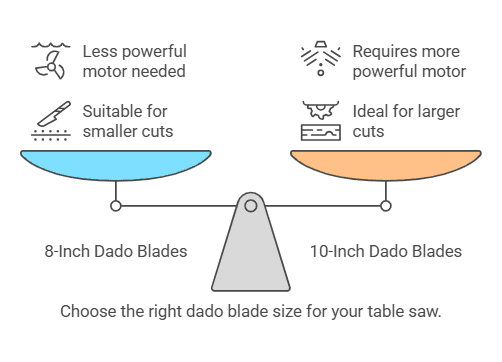
Almost every 10-inch table saw uses a 5/8″ arbor — the same bore size used by every standard 6-inch and 8-inch dado stack, so no adapter is normally needed. What actually limits you is horsepower and the saw’s rated max RPM for a dado stack, not the arbor.
A real spec sheet makes this concrete: the Freud SD208S 8″ Pro Dado Set runs a 5/8″ arbor, 12 teeth, and a 6,000 max RPM rating, cutting widths from 1/4″ to 13/16″ — and 13/16″ is also the widest opening most 10-inch saw throat plates and dado inserts are built for (confirmed on DeWalt’s own DWE7402DI dado throat plate spec). Saws under roughly 2 HP should stay with a 6-inch stack; an 8-inch stack asks more of the motor, especially cutting 3/4″-wide grooves in hardwood. Check your owner’s manual for the saw’s own dado rating before buying — some compact benchtop/jobsite saws have arbors too short to safely clear a full dado stack of washers, chippers, and locking nut. For more on matching blades to your specific saw setup, see our table saw blade and arbor guide.
Why Don’t True 10-Inch Dado Sets Exist?
A dado stack has to spin faster at its outer edge than a standard blade of the same diameter, because the chippers and outer blades are wider and remove far more material per rotation. A 10-inch dado stack would need either a lower RPM rating (weaker performance) or a stronger arbor and motor than most consumer saws are built with — so manufacturers standardized on 6-inch and 8-inch stacks instead, sized to fit safely inside a 10-inch saw’s throat plate opening (typically 13/16″ wide) without redesigning the saw itself.
The other constraint is depth. Most 10-inch saws have roughly 3-1/2″ of total blade height available; an 8-inch dado stack uses up more of that just reaching the table, leaving about 2″ to 2-1/2″ of usable dado depth, while a 6-inch stack leaves closer to 1-1/2″. A theoretical 10-inch dado stack would eat almost all of that clearance before cutting anything — which is the practical reason it never became a standard product, not a missing manufacturing capability.
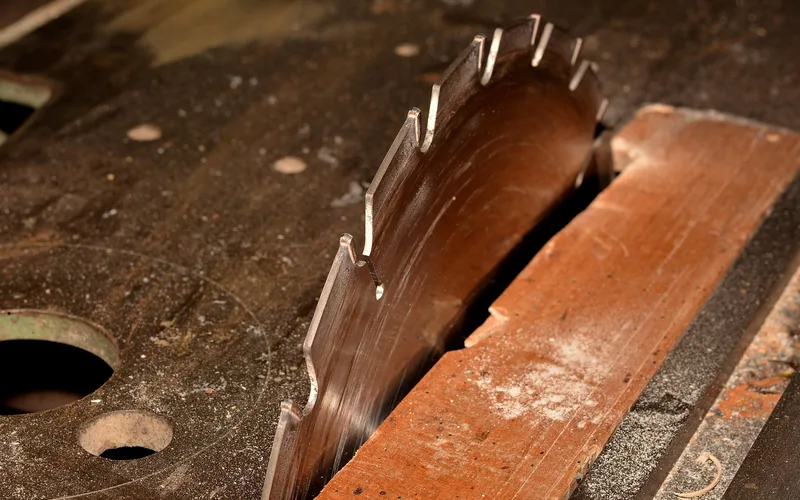
A dado blade is a stacked set of two outer blades and adjustable chippers that mounts on a table saw arbor in place of a single blade to cut a flat-bottomed groove (a dado) in one or a few passes. It differs from a standard blade in that its total cutting width is adjustable, from about 1/4″ up to 13/16″ on most 10-inch saws, rather than fixed at a single thin kerf.
6-Inch vs. 8-Inch Dado Stack: Which Fits Your Saw?
Most 10-inch saws can run either size, but the right choice comes down to your saw’s horsepower and how deep you actually cut.
| Spec | 6-Inch Stack | 8-Inch Stack |
|---|---|---|
| Max practical depth | ~1-1/2″ | ~2″ to 2-1/2″ |
| Minimum saw power | Under 2 HP is fine | 3 HP+ recommended |
| Best for | Shelf dadoes, drawer bottoms, most hobby work | Deep grooves, thick stock, cabinet-grade production |
How Deep Can an 8-Inch Dado Blade Cut on a 10-Inch Saw?
An 8-inch dado stack typically cuts about 2″ to 2-1/2″ deep on a 10-inch table saw, versus roughly 1-1/2″ for a 6-inch stack. That’s deep enough for most cabinet shelf dadoes and drawer-bottom grooves; you’d only run into the limit on thick stock or deep rabbet joints that need to go past 2-1/2″.
Do You Need a Special Throat Plate for a Dado Blade?
Yes. A standard throat plate’s slot is cut for a thin single blade and will not clear a dado stack’s full width. You need a dedicated dado insert — sized to your saw’s maximum dado width (commonly 13/16″ on 10-inch saws) — installed before you mount the stack, or the insert itself will bind or splinter.
📊 At 3,500 RPM, an 8-inch dado blade’s rim speed works out to roughly 7,326 surface feet per minute, versus about 5,495 SFM for a 6-inch blade at the same RPM — the faster rim speed is part of why 8-inch stacks cut cleaner in hardwood, but it’s also why they load the motor harder. Source: rim-speed calculation (blade circumference × RPM), cross-checked against Freud’s published 6,000 max RPM rating for its SD208S 8″ set.
Do You Need Anything Different for a SawStop?
Yes — on a SawStop, you can’t just swap in a dado stack the way you would on a standard saw. SawStop’s flesh-detection brake needs a dedicated Dado Brake Cartridge before you install the dado set; without it, the saw won’t run with a dado stack mounted, and the standard cartridge isn’t rated to handle one safely. Current dado brake cartridges are compatible with standard 8″ dado sets up to 13/16″ wide and 29/32″ thick. For the full buying breakdown and cartridge compatibility by SawStop model, see our dedicated SawStop dado blade guide.
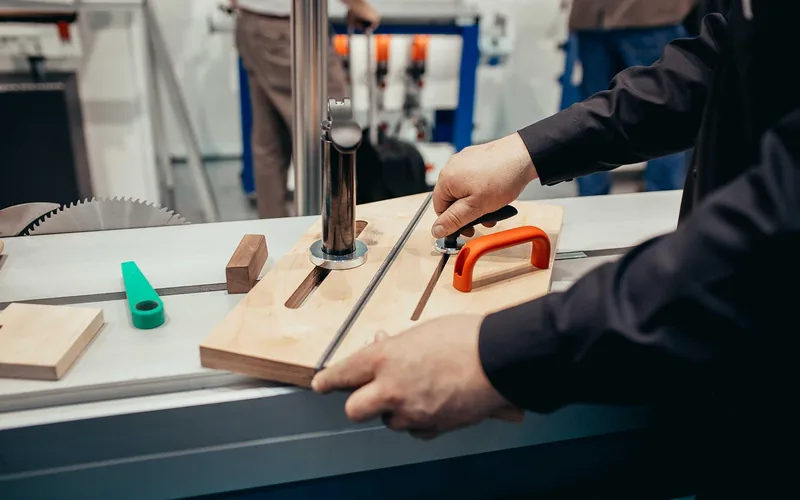
Brand-Specific Notes Before You Buy
Dado compatibility varies by model, not just by “10-inch saw” as a category. If you own a DeWalt jobsite saw, check your specific model — the DW745 and DWE7480 are explicitly not rated for dado use, while other DeWalt 10-inch saws are. Cabinet-style saws generally have longer arbors and more power headroom for a full 8-inch stack than compact jobsite saws do.
Once you’ve got the right blade sorted out, dado joinery is also the basis for a lot of the table saw jigs woodworkers build for repeat cuts. For a broader rundown of table saw setup and maintenance topics, see our table saw hub.
“The mistake I see most often on a 10-inch contractor saw is buying the full-width 8-inch stack and then stalling it on a 3/4-inch-wide cut in oak. If your saw is under 3 HP, run the cut in two shallower passes instead of forcing one wide pass — it’s slower, but it doesn’t bog the motor or leave a burnt edge.”
Frequently Asked Questions
Can you use an 8-inch dado blade on a 10-inch table saw?
Yes — an 8-inch dado stack is the standard, recommended choice for most 10-inch table saws. Both share the same 5/8″ arbor, so no adapter is needed on a saw the manufacturer rates for dado use. The main limits are your saw’s horsepower (3 HP+ is best for a full 8-inch stack) and your throat plate’s max width, typically 13/16″.
Do they make a 10-inch dado blade?
Not as a mainstream product. The largest commonly sold dado stacks are 8 inches. A true 10-inch stack would need a higher RPM rating and more depth clearance than most saws or motors are built to handle safely, so manufacturers standardized on 6-inch and 8-inch sizes instead.
Can you use a dado blade on a 10-inch DeWalt table saw (DW745)?
No — DeWalt does not recommend a dado blade on the DW745 or DWE7480. The issue isn’t the 5/8″ arbor diameter, which is standard; it’s arbor length — the DW745’s arbor is too short to stack a dado wide enough for a 3/4″ groove, and the saw ships with no dado throat plate. Use multiple passes with the standard blade, or a router, instead.
Will a dado blade fit any table saw?
No. Dado use depends on the saw manufacturer’s own rating, not just arbor diameter — arbor length, throat plate design, and motor power all have to support it. Some benchtop and jobsite saws (like the DW745 above) are explicitly not rated for dado blades even though the arbor bore matches. Always check your owner’s manual first.
Do you need a special blade guard or riving knife setup for a dado blade?
Yes — the standard blade guard and riving knife are sized for a single thin blade and must be removed before installing a dado stack, since neither will clear the wider cut. Run dado cuts with extra caution and feed control to compensate for the missing guard; see our guide to removing a riving knife safely before your first dado cut.
What’s the difference between a stacked dado set and a wobble dado blade?
A stacked dado set uses two outer blades plus chippers between them for a flat-bottomed cut, adjusted by adding or removing chippers and shims. A wobble dado is a single blade mounted on an angled hub that wobbles side to side as it spins, cutting a wider but slightly rounded-bottom groove. Stacked sets cost more but cut cleaner, flatter bottoms — most woodworkers prefer them for visible joinery.
The Bottom Line
For most 10-inch table saws, an 8-inch stacked dado set is the right size — it shares the standard 5/8″ arbor, fits a standard 13/16″ dado throat plate, and needs no adapter. Drop to a 6-inch stack if your saw is under 2-3 HP or you rarely cut deeper than 1-1/2″. Whichever size you choose, confirm your specific saw model is dado-rated in its owner’s manual before you buy — not every “10-inch table saw” is built the same, and a few well-known jobsite models explicitly aren’t.
Sponsored / affiliate links. As an Amazon Associate I earn from qualifying purchases. I may earn additional commission from eligible campaigns.