What Wood to Use for Cabinets: Best Species by Part (2026)
Use 3/4-inch hardwood plywood for the cabinet boxes and solid hardwood for doors and face frames: hard maple, red oak, cherry or walnut if you will stain, maple or poplar if you will paint. Most cabinet problems come from the wrong material in the wrong part, not a bad species. This guide gives hardness and movement numbers by species, the best material for each cabinet part, and what to check before you buy.
What Wood Should You Use for Cabinets?
Best Lumber Moisture Check Pick |
|
 |
General Tools MMD4E Moisture Meter for Wood, Walls & Water Leak Detection ($39.98) Whatever species you pick, check each board before you cut it. This is a pin-type meter, the style used to confirm lumber has settled near the 6 to 8 percent range covered in the moisture section below.
|
As an Amazon Associate we earn from qualifying purchases.
The right wood depends on the part. The box carries the weight and needs stability, the face frame and doors are what you see, and the back and drawer bottoms only need to be thin and flat. Choosing a species only matters for the visible parts, so do not pay hardwood prices for a hidden back panel.
| Cabinet part | Best material | Typical thickness | Why |
|---|---|---|---|
| Box sides, top, bottom | Hardwood plywood, birch or maple veneer | 3/4 in | Cross-laminated layers stay flatter through humidity swings than wide solid boards |
| Face frame | Solid hardwood matching the doors | 3/4 in | Hides plywood edges and stiffens the front of the box |
| Door frame (rails and stiles) | Solid hardwood | 3/4 in | Holds joinery and takes stain or paint well |
| Door panel | Solid wood, plywood or MDF | 1/4 in plywood, or thicker solid panel | MDF panels paint smoothly; solid panels must be free to move in the groove |
| Drawer sides | Solid maple, birch or poplar | Varies by design | Smooth, stable, and tough enough for daily wear |
| Back and drawer bottom | Plywood | 1/4 in | Thin and flat; the box does the structural work |
Cabinet Wood Species Compared: Hardness and Movement
Janka hardness shows how well a species resists dents, which matters most on doors and drawer fronts. The shrinkage columns show how much it moves as it dries, which matters for panels and wide boards. Every figure below comes from the Wood Database species pages.
| Species | Janka (lbf) | Tangential shrinkage | T/R ratio | Finishing note |
|---|---|---|---|---|
| Shagbark hickory | 1,880 | 10.5% | 1.5 | Hardest on the list; strong grain contrast |
| Hard maple | 1,450 | 9.9% | 1.9 | Can blotch with stain; use conditioner, gel stain or toner |
| White oak | 1,350 | 10.5% | 1.9 | Classic stained grain; large pores |
| Yellow birch | 1,260 | 9.5% | 1.3 | Fine even texture; good with paint or clear coat |
| Red oak | 1,220 | 8.6% | 2.2 | Very open pores; takes stain well |
| Black walnut | 1,010 | 7.8% | 1.4 | Stains and finishes well; good stability |
| Black cherry | 950 | 7.1% | 1.9 | Darkens with light; may blotch, so seal before staining |
| Red alder | 590 | 7.3% | 1.7 | Soft, economical; clear grade suits cabinets |
| Yellow poplar | 540 | 8.2% | 1.8 | Excellent paint surface; green or gray streaks |
| Eastern white pine | 380 | 6.1% | 2.9 | Softest; dents easily, finishes well |
The T/R ratio is tangential shrinkage divided by radial shrinkage. A lower number means the board shrinks more evenly and is less likely to cup. Walnut (1.4) and yellow birch (1.3) are the steadiest here, while red oak (2.2) and white pine (2.9) are the most likely to distort. Shrinkage values are green to oven-dry totals, so real movement in a heated room is a fraction of them.
Maple
Hard maple is the toughest of the mainstream cabinet species at 1,450 lbf and has a clean, pale face. It is also the species most likely to blotch under a wiping stain, so plan on a pre-conditioner, gel stain or toner, or leave it natural or painted. Soft maple is a commercial grouping that runs 700 to 950 lbf, close to cherry and walnut, and is easier to machine.
Oak
Red oak is the familiar stained-cabinet look, and its pores are so open that air can pass along the grain. White oak is a little harder at 1,350 lbf and has the same strong grain pattern. Neither is a good choice for a smooth painted finish unless you are willing to fill the pores.
Cherry and walnut
Cherry starts light pinkish brown and deepens to a medium reddish brown with light exposure, so a new door beside an old one will not match for a while. Walnut is more stable, with a T/R ratio of 1.4, and finishes without much fuss. Both sit near 1,000 lbf, which is hard enough for doors but softer than maple.
Birch, alder, poplar and pine
These are the budget-friendly choices. Yellow poplar and red alder are soft at 540 and 590 lbf, and poplar is the standard paint-grade wood. If you are weighing it against a similar light wood, see our comparison of aspen versus poplar for cabinets. Pine is softest of all at 380 lbf, so use it where a lived-in, dented look is acceptable.
For a wider view of how hardwoods, softwoods and engineered panels differ, see our guide to types of wood.
Best Wood for Painted Cabinets
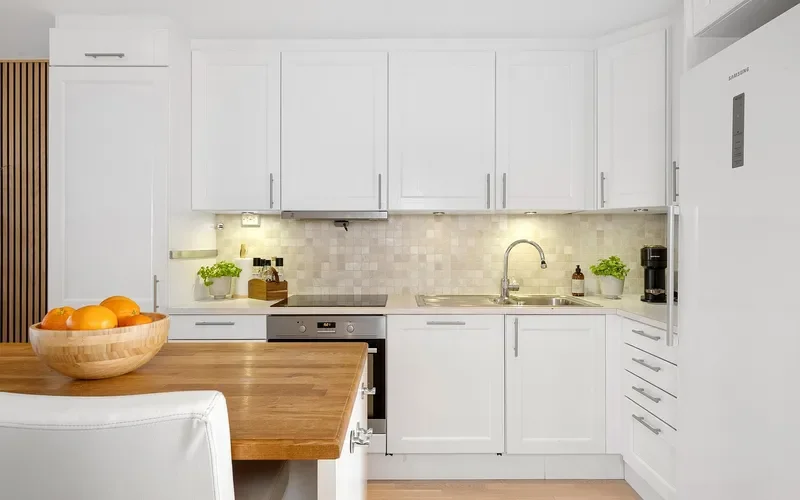
For paint, you want a tight, even surface and stable joints. Hard maple, yellow birch and yellow poplar are the usual solid-wood choices because their fine grain shows little through paint. Poplar in particular takes paint exceptionally well because of its fine, uniform grain.
Red oak and white oak are the woods to avoid for a glass-smooth painted look, because the open pores telegraph through the finish. MDF is a common choice for painted door panels because it has no grain at all, but its cut edges swell if water gets in, so seal them before painting.
Plywood, MDF or Particleboard for Cabinet Boxes
Hardwood plywood is the best all-round material for boxes. It holds screws well, resists warping, and can be edge-banded. For a full breakdown of grades and stamps, see our guide to DOC PS 1 plywood.
MDF is smooth and cheap but heavy and weak at screwed edges, which is why it is better for painted doors and panels than for load-bearing sides; our MDF pros and cons article scores it against real spec numbers. Particleboard is the lowest-cost carcass material, and our guide to types of particle board explains the ANSI grades and moisture-resistant ratings.
A common misconception is that an all-solid-wood box is always the premium choice. Wide solid sides are fixed across their width, so seasonal movement can split a panel or loosen a joint, which is why plywood boxes with solid hardwood fronts are a normal, well-regarded build rather than a shortcut.
Formaldehyde is the other point to check on any composite panel. In the United States, compliant plywood, MDF and particleboard carry a TSCA Title VI label, so ask for the label or spec sheet when buying. The emission limits for each panel type are covered on the pages linked above.
How Dry Should Cabinet Lumber Be?
Hardwood lumber for furniture, flooring, cabinets and millwork is usually dried to 6% to 8% moisture content, according to the USDA Forest Products Laboratory Wood Handbook, and softwood for the same uses to 7% to 9%.
Lumber that is wetter than that will keep shrinking after you build, and doors and face frames will pull at their joints. Check boards with a meter before milling, and let new stock sit in your shop for a few days first. Our guide to acceptable moisture levels in wood has a chart by use.
Common Cabinet Wood Mistakes
- Using red oak for painted doors, then fighting pore show-through.
- Staining hard maple or cherry without a conditioner or sealer, which risks a blotchy finish.
- Building a wide solid-wood box that cannot move, instead of a plywood box.
- Pairing stained doors made in different years and expecting cherry to match.
- Buying panels with no TSCA Title VI label or spec sheet.
- Skipping a moisture check and building with lumber well above 8%.
Cabinet Wood FAQ
Which wood is best for cabinets?
There is no single best wood, because cabinets use several parts. Use 3/4-inch hardwood plywood for the boxes and solid hard maple, oak, cherry or walnut for the doors and face frames. For painted cabinets, hard maple or poplar gives the smoothest surface.
What type of wood is used to make cabinets?
Most cabinets combine materials: hardwood plywood or particleboard boxes, solid hardwood face frames and door frames, and thin plywood backs and drawer bottoms. Species such as maple, oak, cherry, walnut, birch, alder and poplar are used for the visible parts.
Is plywood or solid wood better for cabinets?
Plywood is better for the boxes because its cross-laminated layers stay flatter through humidity changes than wide solid boards. Solid wood is better for doors and face frames, where you want real edges, joinery and a visible species.
What thickness of wood should I use for cabinets?
Use 3/4-inch plywood for box sides, tops and bottoms, and 3/4-inch solid wood for face frames and door frames. Backs, drawer bottoms and thin door panels are commonly 1/4-inch plywood.
Can you use pine for cabinets?
Yes, mainly for painted or rustic cabinets. Eastern white pine rates only 380 lbf on the Janka scale, so doors and drawer fronts dent more easily than maple at 1,450 lbf. Expect to touch up dings over time.
Conclusion
Pick the material by part: hardwood plywood for the box, solid hardwood for the frame and doors, and a thin plywood back. Then choose the species by finish and by how much dent resistance you need, using the Janka and movement figures above.
Sponsored / affiliate links. As an Amazon Associate I earn from qualifying purchases. I may earn additional commission from eligible campaigns.