Can Apple Trees Pollinate Cherry Trees? An Essential Fact
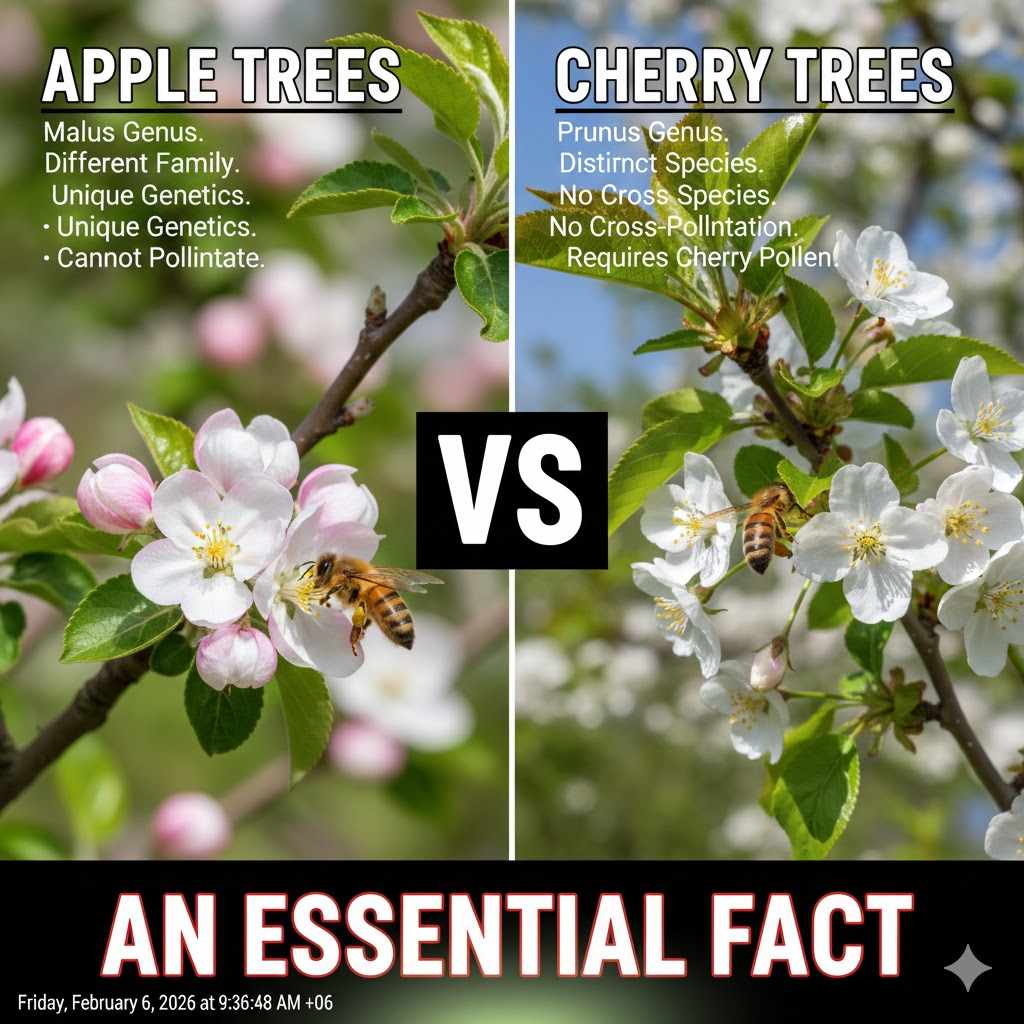
No, apple trees cannot pollinate cherry trees. These two fruit trees belong to different, genetically incompatible groups (or genera). For successful pollination that leads to fruit, you need two trees from the same or very closely related species that bloom at the same time. An apple can only pollinate another apple, and a cherry needs another cherry.
Hello there! Md Meraj here. In my workshop, I spend a lot of time helping people build beautiful and functional things for their homes and yards. One of the most rewarding projects is planting a backyard orchard. You imagine picking fresh apples and cherries right off the branch. But then a tricky question pops up: if you plant an apple tree next to a cherry tree, will they help each other produce fruit? It’s a great question many new gardeners ask.
It can be frustrating when your beautiful trees bloom but never give you any fruit. Often, the reason is a simple mix-up in pollination. But don’t worry! Understanding this process is much easier than you think. Today, we’re going to clear up the confusion about apples, cherries, and pollination once and for all. I’ll guide you through the simple science and give you practical steps to ensure your trees are happy, healthy, and fruitful for years to come.
The Simple Science of Pollination: Why Apples and Cherries Don’t Mix
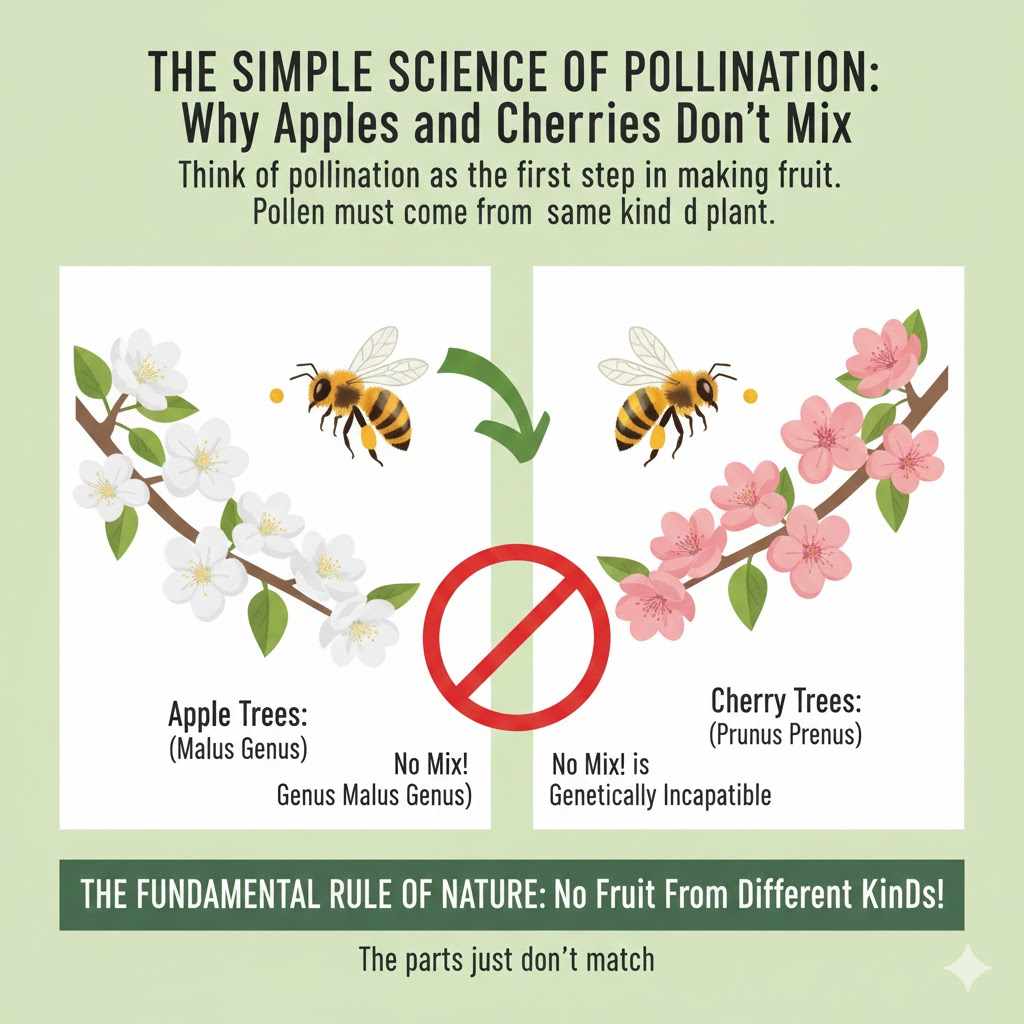
Think of pollination as the first step in making a fruit. For a flower to become a juicy cherry or a crisp apple, it needs to receive pollen. This pollen carries genetic information, and it usually has to come from a flower of the same kind of plant. Bees, butterflies, and the wind are the busy workers that move this pollen from one blossom to another.
Now, here’s the most important part: not just any pollen will work. The flower receiving the pollen is very picky. It’s like trying to use a car key from one brand to start a car from a completely different brand—the parts just don’t match. In the plant world, this compatibility is determined by plant families, or more specifically, their scientific genus.
- Apple Trees belong to the genus Malus.
- Cherry Trees belong to the genus Prunus.
Because they are in two completely different groups, their pollen is genetically incompatible. The pollen from an apple blossom simply cannot fertilize a cherry blossom. It’s a fundamental rule of nature. No matter how close you plant them or how many bees buzz between them, an apple tree can never pollinate a cherry tree, and a cherry tree can never pollinate an apple.
Meet the Fruit Tree Families: Who Pollinates Whom?
To have a successful backyard orchard, you need to be a good matchmaker for your trees. Knowing which trees belong to which family is the key. The three most common fruit tree families you’ll find in home gardens are apples, pears, and stone fruits (like cherries and plums).
Let’s break down who gets along with whom. Think of this table as a “compatibility chart” for your garden.
| Fruit Tree Genus (Family) | Common Trees in this Group | Pollination Rules |
|---|---|---|
| Malus | Apples, Crabapples | Apples need another apple or a suitable crabapple variety for pollination. They cannot pollinate cherries, pears, or plums. |
| Prunus | Cherries, Plums, Peaches, Nectarines, Apricots | Cherries need other cherry varieties. Plums need other plum varieties. While they are in the same genus, they don’t always cross-pollinate well (e.g., a cherry cannot pollinate a plum). It’s best to stick to partners of the same exact fruit type. |
| Pyrus | European Pears, Asian Pears | Pears need another pear variety for pollination. They are not compatible with apples or cherries. European and Asian pears generally do not pollinate each other well. |
As you can see, the general rule is to keep it in the family. An apple needs another apple, and a cherry needs another cherry. Even within the large Prunus family, it’s best to stick with the same type of fruit for reliable results.
How Do You Properly Pollinate a Cherry Tree?
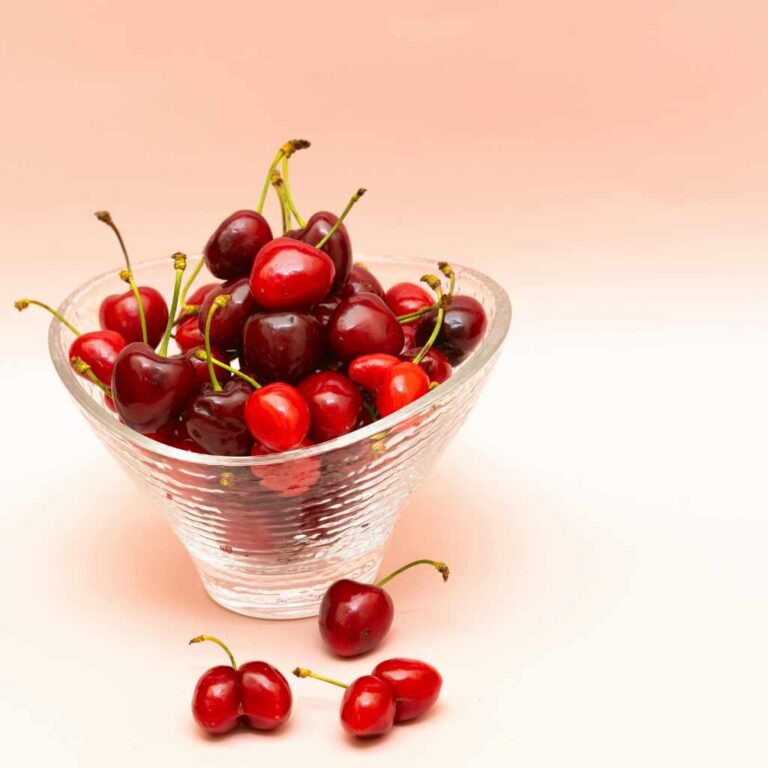
So, we’ve established that your apple tree isn’t going to help your cherry tree. What will? The answer is another compatible cherry tree. However, there’s one more detail to consider: not all cherry trees need a partner.
Step 1: Identify if Your Cherry is Self-Fertile or Self-Unfertile
Cherry trees fall into two categories for pollination:
- Self-Fertile (or Self-Pollinating): These trees are one-stop shops. A single self-fertile tree can pollinate itself and produce fruit all on its own. They are a perfect choice if you only have space for one tree. Most sour cherries (the kind used for pies, like Montmorency) are self-fertile. Some sweet cherries, like the popular Stella, are also self-fertile.
- Self-Unfertile (or Self-Sterile): These trees need a partner. They cannot produce fruit with their own pollen and require pollen from a different, compatible cherry variety to bear fruit. Most sweet cherry varieties, including Bing, Lambert, and Rainier, are self-unfertile.
When you buy a cherry tree, the tag or description should tell you whether it is self-fertile. If it doesn’t, a quick search online for the variety name will give you the answer. Knowing this is the most critical step.
Step 2: Find the Perfect Partner for Your Cherry Tree
If you have a self-unfertile cherry tree, you need to play matchmaker. Here’s what to look for in a partner tree:
- It must be a different variety of cherry. For example, you can’t pollinate a Bing cherry with another Bing cherry. You need a different sweet cherry variety, like a Rainier or a Van.
- It must be the same type of cherry. A sweet cherry tree needs another sweet cherry tree. A sour cherry needs another sour cherry (though most are self-fertile). Sweet and sour cherries generally don’t pollinate each other.
- They must bloom at the same time. Pollination can only happen when both trees have open flowers. Nurseries often group cherry trees by their bloom time (early, mid, or late season) to make choosing a partner easier.
Here is a simple chart to help you find a partner for some of the most common sweet cherry varieties.
| If You Have This Cherry Tree… | Is it Self-Unfertile? | Good Pollination Partners Include… |
|---|---|---|
| Bing | Yes | Rainier, Stella, Van, Montmorency |
| Rainier | Yes | Bing, Stella, Van, Black Tartarian |
| Lambert | Yes | Stella, Van, Rainier |
| Black Tartarian | Yes | Bing, Rainier, Stella |
| Stella | No (Self-Fertile) | Doesn’t need one, but is a “universal pollinator” that can pollinate most other sweet cherries. |
| Montmorency (Sour) | No (Self-Fertile) | Doesn’t need one. |
What About Apple Tree Pollination?
Just like cherries, apple trees have their own set of rules. Understanding them will ensure your apple trees are just as productive as your cherry trees.
Nearly all apple tree varieties are self-unfertile. This means you will almost always need at least two different apple tree varieties for a successful harvest. A single apple tree planted by itself is a lonely tree that likely won’t give you much, if any, fruit.
The partner tree doesn’t have to be a standard apple tree. A crabapple tree can be an excellent pollinator for an apple tree, as long as it blooms at the same time. In fact, some crabapple varieties produce so much pollen for so long that they are known as “super-pollinators.”
Key Rules for Apple Pollination:
- You need two different varieties (e.g., a Granny Smith cannot pollinate another Granny Smith).
- Both trees must have overlapping bloom times.
- A crabapple tree can pollinate an apple tree.
- A very small number of apple varieties are self-fertile, but even they produce more and better fruit with a pollination partner nearby.
For detailed apple pollination charts, it’s always a good idea to consult a local nursery or your state’s university extension service, like the comprehensive guide from the University of Maryland Extension, which provides fantastic, region-specific advice.
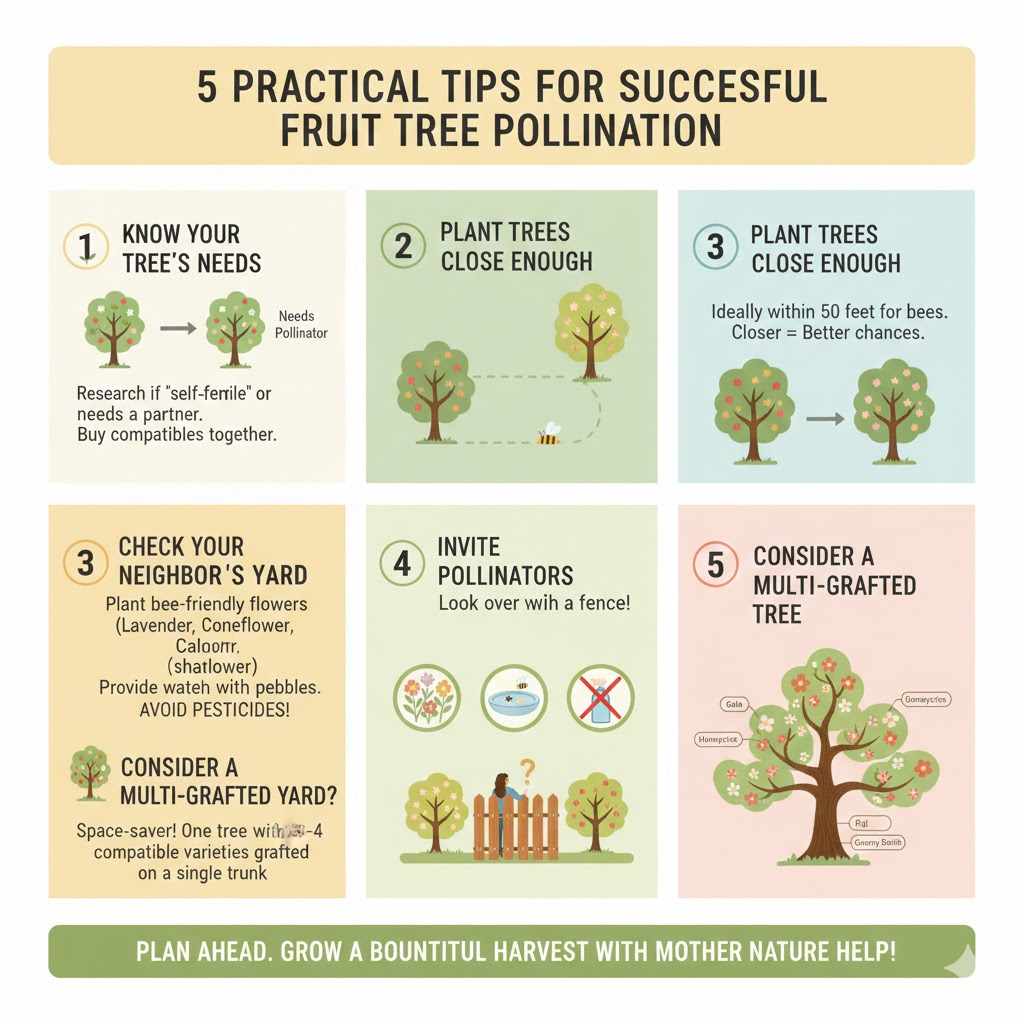
5 Practical Tips for Successful Fruit Tree Pollination
Getting your trees to produce fruit is a rewarding DIY project. It just takes a little planning. Here are five simple tips to ensure you get a great harvest every year.
1. Know Your Tree’s Needs Before You Buy
The most common mistake is buying a tree without knowing its pollination needs. Before you head to the nursery, do a little research. Decide which variety you want, and find out if it is self-fertile. If it isn’t, identify which pollinators are compatible with it so you can buy them at the same time.
2. Plant Trees Close Enough
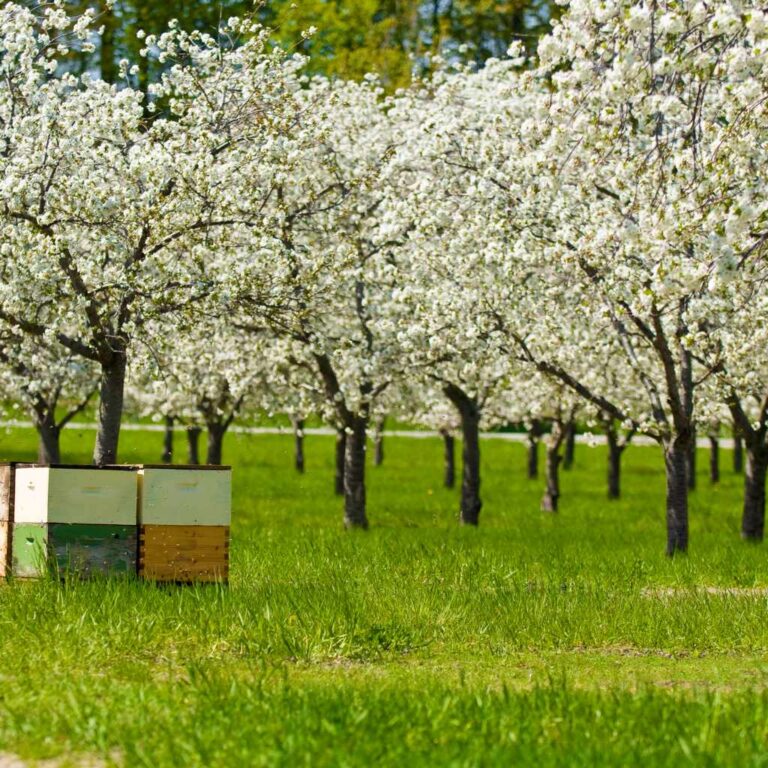
Pollinator partners need to be planted relatively close to each other. For bees to do their job effectively, the trees should ideally be within 50 feet of one another. They can be a bit farther apart, but the closer they are, the better the chances of successful cross-pollination.
3. Invite Pollinators into Your Yard
You can have the most compatible trees in the world, but without pollinators like bees, you won’t get any fruit. Make your yard a welcoming place for these essential workers.
- Plant bee-friendly flowers: Flowers like lavender, bee balm, coneflowers, and crocuses provide nectar and attract bees to your yard.
- Provide a water source: A shallow dish of water with some pebbles or marbles for the bees to land on gives them a place to drink.
- Avoid pesticides: Never spray insecticides on or near your fruit trees when they are in bloom. These chemicals can harm or kill the bees you need for pollination. To learn more about protecting these crucial insects, check out the resources provided by the U.S. Department of Agriculture on pollinators.
4. Check Your Neighbor’s Yard
Sometimes you can get lucky! If your neighbor has a compatible apple or crabapple tree within 100 feet of your apple tree, you might not need to plant a second one. The same goes for cherries. It’s worth taking a peek over the fence during bloom season to see what might be growing nearby.
5. Consider a Multi-Grafted Tree
What if you only have space for one tree but need a pollinator? There’s a clever solution for that! A multi-grafted tree, sometimes called a “fruit salad tree,” has several different compatible varieties grafted onto a single trunk. For example, you can buy an apple tree that has 3-4 different apple varieties on its branches, all of which will pollinate each other. This is the ultimate space-saver for small yards.
Frequently Asked Questions (FAQ)
1. Can a crabapple tree pollinate a cherry tree?
No, a crabapple cannot pollinate a cherry tree. Crabapples are in the Malus genus, just like regular apples. They can pollinate apple trees very well, but they are not genetically compatible with cherry trees, which are in the Prunus genus.
2. How close do pollinator trees need to be to each other?
For best results, pollinator trees should be planted no more than 50 feet apart. Bees are the primary pollinators for fruit trees, and they tend to forage in a concentrated area. The closer the trees are, the more likely a bee will travel from one to the other, carrying pollen with it.
3. What if I only have space for one fruit tree in my yard?
You have a few great options. You can choose a self-fertile variety, like a Stella sweet cherry or a Montmorency sour cherry. Another fantastic solution is to plant a multi-grafted tree, which has several compatible varieties grafted onto one trunk, allowing the tree to pollinate itself.
4. Do I really need bees for pollination?
Yes, absolutely. While some pollen can be moved by wind, fruit trees like apples and cherries are almost entirely dependent on insects for pollination. Bees are by far the most efficient pollinators, so creating a bee-friendly yard is one of the best things you can do to ensure a good fruit harvest.
5. Can I pollinate my tree by hand?
Yes, you can! If you have poor fruit set or notice a lack of bees, you can take matters into your own hands. Use a small, soft paintbrush or a cotton swab to gently collect pollen from the flowers of one tree (the pollinator) and carefully transfer it to the flowers of the other tree. It’s a bit tedious, but it can be very effective, especially for a single small tree.
6. Why did my tree have lots of flowers but no fruit?
This is a classic sign of pollination failure. Other causes can include a late frost that damaged the blossoms, heavy rain that washed away pollen, or poor tree health. But most often, a lack of a compatible pollinator tree nearby is the reason.
Putting It All Together for a Fruitful Yard
Creating a backyard where you can pick your own fresh fruit is one of the most satisfying projects a homeowner can undertake. It connects you to nature and rewards you with delicious, healthy food. The key to success is understanding that nature has its own set of rules, and our job is to work with them.
The answer to our main question is clear: apple trees and cherry trees cannot pollinate each other. They may look beautiful planted side-by-side, but they are simply not from the same family. To get fruit, an apple needs another apple, and a cherry needs a compatible cherry.
By taking a little time to choose the right trees, ensuring they have a proper partner, and making your yard a friendly place for bees, you are setting yourself up for success. Don’t be discouraged if it sounds complicated—it all comes down to a few simple principles. Now you have the knowledge to plan your little orchard with confidence. Happy planting!