How Much Weight Can Plywood Hold? (Real APA Load Data)
APA-rated 3/4-inch plywood carries roughly 350 psf of evenly spread weight at 16-inch spacing by engineered design — but one concentrated load, like a floor jack or a stack of paint cans, sags the same panel far sooner than that number suggests. The real capacity isn’t one figure: it shifts with span rating, spacing, and grain direction. This guide covers real APA load-span numbers by thickness, point loads versus spread-out weight, and how to size a shelf that won’t sag.
Plywood’s Real Load Capacity, by APA Span Rating
Best Shelf Bracket Pick
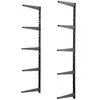
Delta 12in Adjustable Shelf Brackets (Set of 10) – $58.97
Rated to 480 lbs per the manufacturer and sized to cut a 32-inch shelf span down to roughly 16 inches — the exact spacing change this guide’s APA table shows nearly triples a panel’s safe load.
- Best for: garage, closet, and shop shelving carrying tools or stock
- Why we picked it: closing the span to 16 inches is the single biggest lever this guide covers for raising a panel’s safe load
- Main drawback: exposed steel brackets read as utilitarian, not a finished-furniture look
Compare more shelf-support options
 Option 1 CLT 20in Folding Brackets – $35.99
|
 Option 2 12-Pack L-Brackets 12x8in – $35.95
|
 Option 3 EZStudRack 8-Pack – $27.99
|
As an Amazon Associate we earn from qualifying purchases.
Thickness alone does not set a panel’s weight capacity — its span rating (stamped on the panel, e.g. 32/16, 40/20, 48/24) and the support spacing underneath it do. The span rating is a performance category defined by APA – The Engineered Wood Association, the industry standards body for plywood and OSB, not a marketing number. Panels marked “CDX” are simply Exposure 1 bond classification — suitable for construction that won’t sit exposed to weather long-term, not a strength grade on their own. See our full plywood buying and use guides for grade-by-grade breakdowns.
APA’s own Load-Span Tables (Technical Note Z802K) publish the allowable uniform live load for each span rating and spacing combination, face grain running across the supports:
| Span Rating | Support Spacing (o.c.) | Allowable Live Load |
|---|---|---|
| 32/16 (nominal 1/2″) | 16″ | ~155 psf |
| 32/16 (nominal 1/2″) | 24″ | ~53 psf |
| 40/20 (nominal 5/8″) | 16″ | ~283 psf |
| 40/20 (nominal 5/8″) | 24″ | ~91 psf |
| 48/24 (nominal 3/4″) | 16″ | ~353 psf |
| 48/24 (nominal 3/4″) | 24″ | ~151 psf |
These are engineering allowables (bending-stress limited, normal duration, dry conditions, 10 psf dead load already subtracted) — not the point where a panel visibly sags or breaks. Real-world use rarely approaches these numbers; they exist so a subfloor or roof deck has margin far beyond the actual design loads it will ever see.
📊 A 3/4-inch (48/24) panel at 16-inch spacing is engineered for roughly 353 psf of live load — nearly 9x the 40 psf a typical residential floor is designed to carry. Source: APA – The Engineered Wood Association, Load-Span Tables for PS-1 Plywood (Z802K)
Why “How Much Weight” Doesn’t Have One Answer
The psf numbers above describe uniformly distributed load — weight spread evenly across the whole panel. A single concentrated (point) load — a jack stand, a stack of paint cans, one heavy tool box — behaves completely differently. For the same total weight, a center point load produces roughly four times more deflection than the identical weight spread across the span, using the standard center-load deflection formula:
δ = P × L³ ÷ (48 × E × I) — where P is the point load, L is the span, E is the panel’s modulus of elasticity, and I is the moment of inertia (I = width × thickness³ ÷ 12).
This is also why APA’s own literature notes that residential floor spans are not actually governed by the huge uniform-load numbers in the table above — they’re governed by how the floor performs under foot traffic and concentrated loads, plus a subjective “feel” standard. A panel rated for 350 psf uniform can still feel bouncy under one person standing at mid-span if the span is pushed to its maximum.
How Much Weight Can a 3/4-Inch Plywood Shelf Hold?
For shelving, deflection — not breakage — is almost always the practical limit. A common target is the L/360 rule: maximum sag no more than the span divided by 360. A 3/4-inch shelf spanning 32 inches should deflect under roughly 1/11 inch under normal loading to stay visually flat. Because deflection scales with the cube of the span, cutting a shelf’s span in half — by adding one center bracket — cuts sag to about 1/8 of what it was, not half.
That single change (adding a mid-span support) is the highest-leverage fix available for a sagging shelf, and it applies whether the shelf is holding tools in a garage, storage bins in a closet, or lumber offcuts in a shop. If you’re building a shed floor instead of a shelf, thickness selection matters even more — see our guide on whether 1/2-inch plywood is enough for a shed floor for that specific span-and-joist math. The same span-versus-thickness tradeoff is why picking the right plywood thickness for a bed base matters too — a bed base spans further than most shelving brackets ever will.
“In the shop, plywood shelving that sags almost never fails from total weight — it’s nearly always one heavy, concentrated item sitting mid-span with no support underneath it. Add a bracket at the middle of the span before you add more shelves, not after.”
Grain Direction: The Factor Most Guides Skip
Plywood’s face grain must run perpendicular (across) the supports, not parallel to them — and the difference is not minor. APA’s own load tables show 1/2-inch (32/16) plywood at 16-inch spacing rated for about 181 psf with face grain across the supports, but only around 13 psf with the same panel turned so the grain runs parallel to the supports — a roughly 14-fold difference from orientation alone, with nothing else about the panel changed. Before fastening any panel down, confirm which way the surface grain runs relative to your joists, studs, or brackets.
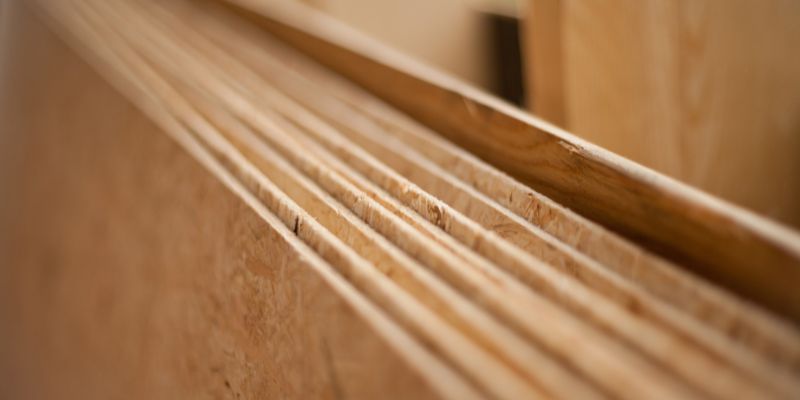
Grade matters too, but less dramatically than orientation or spacing. Higher grades (fewer voids and face defects) hold their rated capacity more consistently, which is part of why roof sheathing is often specified differently than CDX or OSB used for wall sheathing — the exposure and load conditions differ even when the panels look similar.
How to Calculate Your Panel’s Safe Load
- Identify the span rating: Check the panel edge or packaging for its span rating stamp (32/16, 40/20, 48/24) or nominal thickness — this is the starting point for every other step.
- Confirm support spacing: Measure the actual center-to-center distance between the joists, studs, or brackets the panel will rest on — don’t assume a standard 16 or 24 inches without checking.
- Look up the allowable load: Match the span rating and spacing to APA’s published load-span table above, or run the numbers through our wood load capacity calculator for a quick estimate.
- Subtract dead load: Subtract the weight of the panel itself and any permanent flooring, tile, or finish material to get the safe live load that’s actually available for your stuff.
- Check point loads separately: For one heavy item, apply the deflection formula above or simply add a center support to cut the span in half — the fastest practical fix for any concentrated load.
For a directory of every calculator on the site — lumber, wood weight, framing, and more — see the woodworking calculators guide.
How Plywood’s Load Capacity Differs From a Wood Beam’s
These are two different engineering questions, even though both get asked as “how much weight can wood hold.” A dimensional-lumber beam resists bending along its length using its own cross-section, species, and grade — worked through the bending-stress formula in our wood beam load capacity guide. Plywood is a thin sheet good that resists deflection across a span rating and support spacing, governed by APA’s panel design tables, not a beam formula. In a real floor or deck, the beam carries the joists, the joists carry the plywood, and the plywood carries the point and distributed loads on its own surface — three separate calculations, not one.
Frequently Asked Questions
How much weight can 3/4-inch plywood hold?
At 16-inch support spacing, APA-rated 3/4-inch (48/24 span rating) plywood is engineered for roughly 350 psf of evenly distributed live load, bending-stress limited. Spaced at 24 inches, that drops to about 150 psf. These numbers assume face grain running perpendicular to the supports; a single heavy point load will sag the panel well before it reaches these uniform-load limits.
How much weight can 1/2-inch plywood hold?
APA-rated 1/2-inch (32/16 span rating) plywood holds about 155 psf of distributed live load at 16-inch spacing, dropping to roughly 50 psf at 24-inch spacing — both figures assume face grain across the supports. That’s noticeably less reserve than 3/4-inch stock, so 1/2-inch panels need closer support spacing for shelving or subfloor use.
Does plywood grain direction really affect strength?
Yes, dramatically. For 1/2-inch (32/16) plywood at 16-inch spacing, APA’s own load tables show about 181 psf with the face grain running across the supports versus roughly 13 psf with the grain running parallel to them — a 14-fold difference from orientation alone. Always run the face grain perpendicular to the supports.
How much weight can a plywood shelf hold without sagging?
A shelf’s practical limit is usually deflection, not breakage. Under the L/360 rule of thumb (max sag of span ÷ 360), a 3/4-inch shelf spanning 32 inches should deflect under about 1/11 inch under normal loading. Adding a center support or bracket that cuts the span in half reduces sag to roughly 1/8 of the original, since deflection scales with the cube of the span.
Is 3/4-inch plywood strong enough for a workbench top?
Yes, for typical shop use. At the support spacing most workbenches use (16 to 24 inches between stretchers), 3/4-inch APA-rated plywood carries well over 100 psf uniformly — far beyond hand tool and light machine use. The practical concern is surface durability and point-load dents, not structural failure, so many builders add a hardboard or MDF sacrificial top layer instead of relying on thicker plywood alone.
What’s the difference between plywood’s load capacity and a wood beam’s?
They’re different engineering questions. A dimensional-lumber beam resists bending along its length using its own cross-sectional bending-stress formula. Plywood is a thin sheet that resists deflection across a span rating and support spacing, governed by APA’s panel design tables. A beam supports a plywood floor — it isn’t sized the same way the panel on top of it is.
Conclusion
Plywood’s weight capacity was never really a single number — it’s a function of span rating, support spacing, grain direction, and whether the load is spread out or sitting in one spot. Use APA’s own published numbers as your baseline, run face grain across the supports, and close up the span before you assume a panel is undersized. Thicker plywood helps, but spacing and orientation usually matter more.
Sponsored / affiliate links. As an Amazon Associate I earn from qualifying purchases. I may earn additional commission from eligible campaigns.