Fractal Wood Burning: Why DIY Kills + How to Get the Look Safely
Warning: fractal (Lichtenberg) wood burning is not a beginner or home DIY project. The hobby version, built around a salvaged microwave oven transformer, has been linked to at least 35 deaths since 2017, and it is not made safe by a GFCI outlet, rubber gloves or care. This page does not give build or wiring steps. It explains the real risk, then shows how to get the same branching look with a pyrography pen. See also our report on fractal wood burning injuries.
How to Get the Fractal Look Safely With a Pyrography Pen
Best Safe Pyrography Starter Pick | |
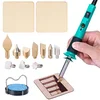 |
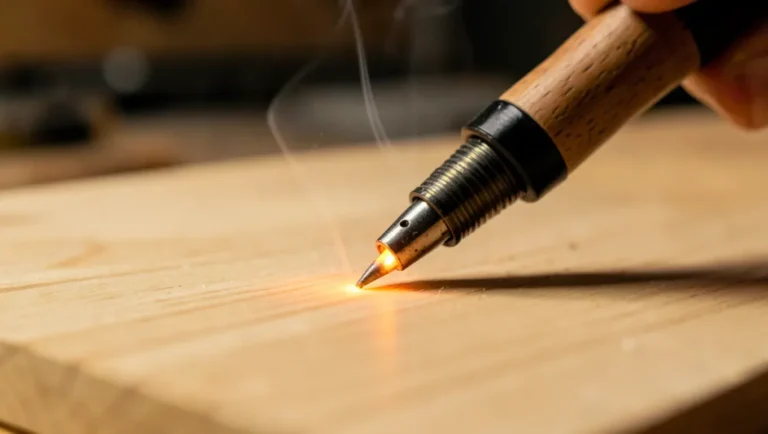
YIHUA 930-IV Pyrography Wood Burning Pen Kit – $15.19 A small adjustable-heat pen that lets you draw the fern and lightning-branch pattern covered below at low risk. The kit ships with 10 tips and 2 blank wood pieces, so you can practice before touching a finished project.
|
As an Amazon Associate we earn from qualifying purchases. | |
The appeal of fractal burning is the pattern: a trunk line that splits into branches, then twigs, then hairlines, like a fern or a lightning bolt frozen in the grain. That look does not need electricity running through the wood. A pyrography (wood burning) pen heats a metal tip with a small element, and you draw the pattern yourself. It is slower, but you control every branch, and nothing in the workpiece can shock you.
A starter kit is enough. The pen above comes with 10 tips and 2 blank wood pieces, which matters more than it sounds: the first few branching patterns you burn will look uneven, and a practice blank costs nothing compared with a finished cutting board or sign.
Why Fractal Burning Is Lethal: The Numbers
Most pages on this topic say “be careful” and stop. The figures from the medical literature are what make the point. The table below pulls them together from the 2025 review by Byard and Langlois in Forensic Science, Medicine and Pathology, a burn-center case report, and the summary on Wikipedia’s fractal burning page.
| Measure | Figure | Why it matters |
|---|---|---|
| Recorded deaths, 2017 to 2022 | At least 35, mostly men in the US | This counts only documented cases, so it is a floor |
| Mortality of an inadvertent shock | About 71 percent | Lightning strikes are cited at 10 to 30 percent |
| Output of a modified microwave transformer | 1,000 to 15,000 volts at 0.5 to 2.0 amps | Household outlets are 120 volts and trip a breaker on a fault |
| Current that can paralyze breathing muscles | 20 to 50 milliamps | A 500 to 2,000 milliamp source is roughly 10 to 100 times that range |
| One documented nonfatal injury | 37-year-old, 15,000 volt homemade device, full-thickness burns to two fingers | Treatment was a two-stage reconstruction including skin grafting |
The ratio in the fourth row is the part most guides skip. The threshold for paralysis of the breathing muscles is a few dozen milliamps, while these rigs can deliver hundreds to thousands. There is no margin for a small mistake.
Three Safety Myths That Keep Getting Repeated
- “A GFCI outlet will protect me.” It will not. The transformer’s output side is galvanically isolated from the wall circuit, so a GFCI cannot break the circuit if current passes through a person.
- “Gloves, a rubber mat and a kill switch make it safe.” The American Association of Woodturners lists these precautions and states they cannot guarantee safety. Deaths have followed contact with an electrode, the electrolyte solution, a loose wire, and even standing on a conductive floor.
- “I will only do it once, carefully.” The same group put it plainly in its safety statement: “It only takes one small mistake and you are dead.”
The AAW banned the process at its sponsored events in 2017 after a woodturner in Washington died, and it will not run articles about it except warnings (reported by Woodworking Network). For the full picture of how these accidents happen, read our guides on what fractal wood burning is and on why doing it at home is the most dangerous version.
What Professional Makers Do Differently
Some artists do sell Lichtenberg pieces for a living. At a conceptual level, the difference between them and a hobbyist with a salvaged transformer is the equipment and the training, not the technique. Professional work is generally done on dedicated, purpose-built equipment with protective circuitry rather than improvised parts, by people with electrical training.
That is also the limit of what we will say. Even with commercial equipment, the AAW position quoted above is that precautions cannot guarantee safety, and it is why we do not publish build steps, voltages, parts lists or a recommendation to buy any high-voltage kit. If you are an experienced electrician who still wants to pursue it, the decision belongs with you and the maker of a certified product, not with a web tutorial.
Safe Ways to Get a Similar Look
| Method | Shock hazard to you | Skill needed | What you get |
|---|---|---|---|
| Freehand with a pyrography pen | None from the workpiece; the tip is hot | Low to medium | Fern, branch and lightning designs you fully control |
| Tracing a printed pattern with a pen | None from the workpiece; the tip is hot | Low | Repeatable symmetrical branching on coasters, signs and boards |
| Laser engraving a fractal design | No current through the wood; lasers need eye protection | Medium | Very fine branch detail from a digital file |
| Stain, dye or clear resin over a burned pattern | None | Low | Color in the branches or a glossy river-like finish |
A pen is the lowest-cost route and the best fit if the goal is a hand-made piece. A laser engraver makes sense if you already have access to one, for example through a makerspace. Either way, the burn is only half the project; the finish does a lot of the visual work, which the steps below cover.
How to Burn a Fern or Lightning Branch Pattern With a Pen
These steps use only a pyrography pen. Before you start, tighten the tip and remove any silicone cover on the pen as the kit instructions state, and set the pen in its stand whenever you put it down.
- Pick the wood: basswood is the usual beginner choice because it is soft with minimal grain, and birch is a good second option. Avoid cedar and resinous pine, which burn unevenly and give off harmful fumes.
- Sketch first: draw one central trunk line in light pencil, then side branches that angle away from the base, and split each branch into two smaller ones. Every level should be shorter and thinner than the last, which is what gives the fractal feel.
- Test the heat: burn a few lines on a scrap piece. Start low for fine detail and light shading, then raise the heat for darker, deeper lines.
- Burn the trunk and main branches: move the pen like a pencil, in steady strokes. Too much pressure cuts a deep groove and too little leaves a faint line.
- Work outward: use lighter pressure and a finer tip on the smaller branches, then add hairline twigs. Rotate the board rather than your hand so the stroke direction stays comfortable.
- Clean the tip: carbon builds up on the tip and makes lines uneven, so wipe it on the damp sponge or clean it as the kit instructs.
- Seal the piece: once the wood is cool, apply a wood finish to protect the burn and deepen the contrast.
Ventilation matters because burning wood releases fumes and fine particles. Work near an open window or with a fan pulling air away from you, and unplug the pen when you finish.

Adding Color and a Finish
Once the lines are burned, color is where a fractal-style piece starts to look finished. Wipe on a thin stain so the pen lines stay dark, or flood the branches with dye or acrylic paint thinned with water. Sanding lightly with fine paper lifts stray smudges without removing the burned lines. If you want a glossy, river-like look, a clear coat or resin pour over the finished burn adds depth.
If you plan to char the wider surface as well, our guide on how to seal charred wood covers which finishes bond to carbon. For a different take on the electrical side of this hobby, see why using a battery charger to burn wood is dangerous too.
Frequently Asked Questions
Is fractal wood burning dangerous?
Yes. Medical literature records at least 35 deaths from fractal wood burning between 2017 and 2022, with a mortality rate of roughly 71 percent for inadvertent shocks. The equipment typically uses a modified microwave oven transformer that can output 1,000 to 15,000 volts at 0.5 to 2.0 amps. It is not a beginner or home DIY project.
Does a GFCI outlet protect you from fractal burning?
No. A GFCI is designed to trip on a fault in the household circuit, but the high-voltage output of a transformer is galvanically isolated from that circuit, so a GFCI cannot break the circuit if current passes through a person. Gloves, rubber mats and a kill switch also cannot guarantee safety, according to the American Association of Woodturners.
Can you fractal burn wood with a car battery or battery charger?
We do not recommend it and do not explain how it is done. Improvised electrical setups of any kind are the source of the deaths described above. See our separate page on battery chargers and burning wood for why we advise against it.
What is the safest way to get a fractal wood burning look?
Draw the branching pattern with a pyrography pen on basswood or birch. A pen produces no shock path through the workpiece, and a laser engraver can reproduce a fractal design as well. You can then add stain, dye or clear resin to bring out the branches.
Is a pyrography pen safe for beginners?
It is far safer than any high-voltage method, but not risk-free. The tip gets hot enough to burn skin and scorch wood, so use the stand, work in a ventilated space, avoid resinous woods like cedar, and unplug the pen when you step away.
Bottom Line
Because a single contact can be fatal and no common precaution reliably prevents it, the safest advice is to skip the electrical method entirely. A pyrography pen, a piece of basswood and an hour of practice will give you a branching fern or lightning pattern you made yourself. Start with the kit above or any adjustable pen, and put your effort into the design and the finish instead.
Sponsored / affiliate links. As an Amazon Associate I earn from qualifying purchases. I may earn additional commission from eligible campaigns.