What Size Drill Bit to Use Local Guide
Choosing the right drill bit size can seem tricky, especially when you’re just starting out with DIY projects or home repairs. It’s easy to get confused with all the different numbers and types. But don’t worry, finding the perfect fit for your hole is simpler than it looks!
This guide will walk you through everything you need to know, step by step, so you can create clean, accurate holes every time. We’ll cover the basics and give you the confidence to tackle any drilling task with ease.
What Size Drill Bit to Use For Your Project
Selecting the correct drill bit size is the most important step in achieving a clean and functional hole. This choice directly impacts how well a screw will fit, how securely an anchor will hold, or how a piece of hardware will function. Using a bit that’s too large can strip the material or make the hole too loose, leading to weak connections.
Conversely, a bit that’s too small might make it difficult or impossible to insert the fastener, or it could even split softer materials like wood.
The key to knowing what size drill bit to use is understanding the relationship between the drill bit diameter and the fastener or object you are working with. For instance, when drilling a pilot hole for a screw, the drill bit should generally be the same diameter as the screw’s shank (the solid part without threads) or slightly smaller. For wall anchors, the drill bit size is usually specified on the anchor’s packaging, and it’s critical to follow these instructions precisely.
Consider the material you are drilling into as well. Softwoods might require a slightly smaller pilot hole than hardwoods to prevent splitting. Metal often needs precise hole sizes for bolts and machine screws.
Even the purpose of the hole matters. Are you drilling a hole for a dowel? You’ll want a snug fit.
Are you creating a decorative hole? Precision might be less critical than a smooth finish.
Understanding Drill Bit Sizing Systems
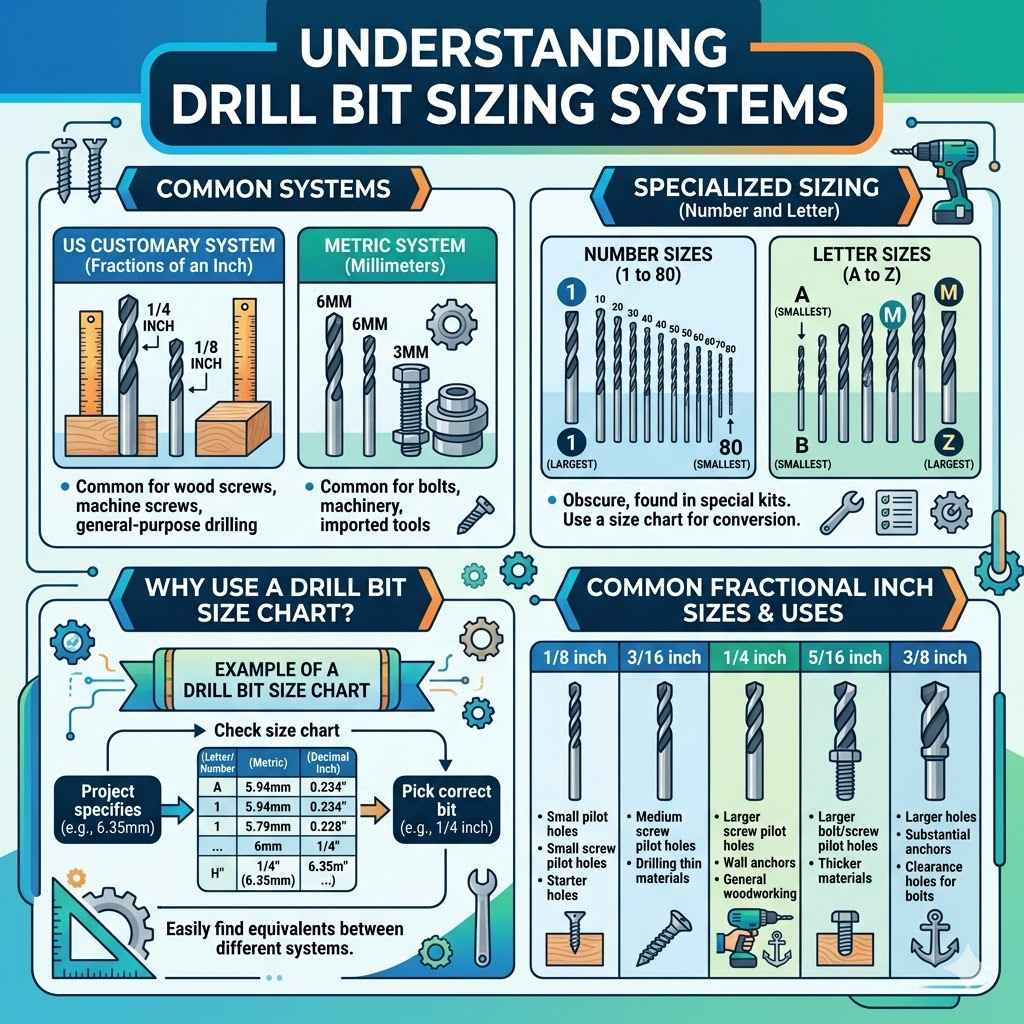
Drill bits come in various sizing systems, and knowing these will help you interpret the measurements. The two most common systems are the US customary system, measured in fractions of an inch (e.g., 1/4 inch, 1/8 inch), and the metric system, measured in millimeters (e.g., 6mm, 3mm). Sometimes, you’ll also encounter letter-sized drill bits, which are part of a larger set ranging from A (smallest) to Z (largest), and number-sized drill bits, ranging from 1 (smallest) to 80 (largest).
For most home improvement tasks, you’ll likely be using fractional inch sizes. These are very common for wood screws, machine screws, and general-purpose drilling. For example, a 1/4 inch drill bit is a workhorse for many common tasks.
Metric sizes are prevalent for bolts and machine screws used in machinery and imported tools, often found in millimeters.
The letter and number sizes can be a bit more obscure for the average user but are often found in specialized tool kits. It’s helpful to have a drill bit size chart handy, which converts these different systems into one another. This way, if a project specifies a particular letter or metric size, you can easily find the equivalent fractional inch size and pick the right bit from your toolbox.
Here’s a quick look at some common fractional inch drill bit sizes and their general uses:
- 1/8 inch: Useful for small pilot holes, pilot holes for small screws, and starter holes for smaller fasteners.
- 3/16 inch: Good for pilot holes for medium-sized screws and for drilling small holes in thinner materials.
- 1/4 inch: A very common size for pilot holes for larger screws, for creating holes for some types of wall anchors, and for general woodworking.
- 5/16 inch: Often used for pilot holes for larger bolts or screws, and for creating holes in thicker materials where more stability is needed.
- 3/8 inch: Suitable for larger holes, such as those for substantial anchors or for creating clearance holes for bolts.
Choosing a Drill Bit for Wood
When drilling into wood, the size of the drill bit you choose depends on what you want to achieve. For most applications, like driving screws, you’ll be drilling pilot holes. A pilot hole is a small hole drilled before the screw is inserted.
It guides the screw and prevents the wood from splitting, especially in hardwoods or near the edges of boards.
The general rule of thumb for pilot holes in wood is to use a drill bit that is the same diameter as the screw’s shank (the solid part without threads). If the screw has a tapered tip, you might even go slightly smaller. For very soft woods or when working close to the edge of a piece, it’s often wise to choose a pilot hole bit that is one size smaller than the screw’s shank to minimize the risk of splitting.
For example, if you are using a #8 wood screw, which typically has a shank diameter of about 5/32 inches (or roughly 0.156 inches), you would use a drill bit around that size for your pilot hole. Many drill bit charts will tell you that a 5/32 inch bit is ideal for #8 screws in hardwood, and a slightly smaller bit like 9/64 inch might be better for softwood.
If you’re joining two pieces of wood with a dowel, the drill bit should match the diameter of the dowel exactly. This ensures a tight, secure fit. For larger projects that require clearance holes, such as passing a bolt through, you would use a drill bit that matches the diameter of the bolt itself.
Consider these scenarios for drilling in wood:
- Attaching a cabinet hinge: You’ll likely be screwing into relatively thin wood. Choose a pilot bit slightly smaller than the screw threads.
- Joining two pieces of 2×4 lumber with wood screws: Use a pilot bit that matches the shank of your screws, or slightly smaller for hardwoods.
- Hanging a heavy shelf: You might need to drill larger holes for lag screws or use a drill bit that matches the size of your wall anchors.
Selecting a Drill Bit for Metal
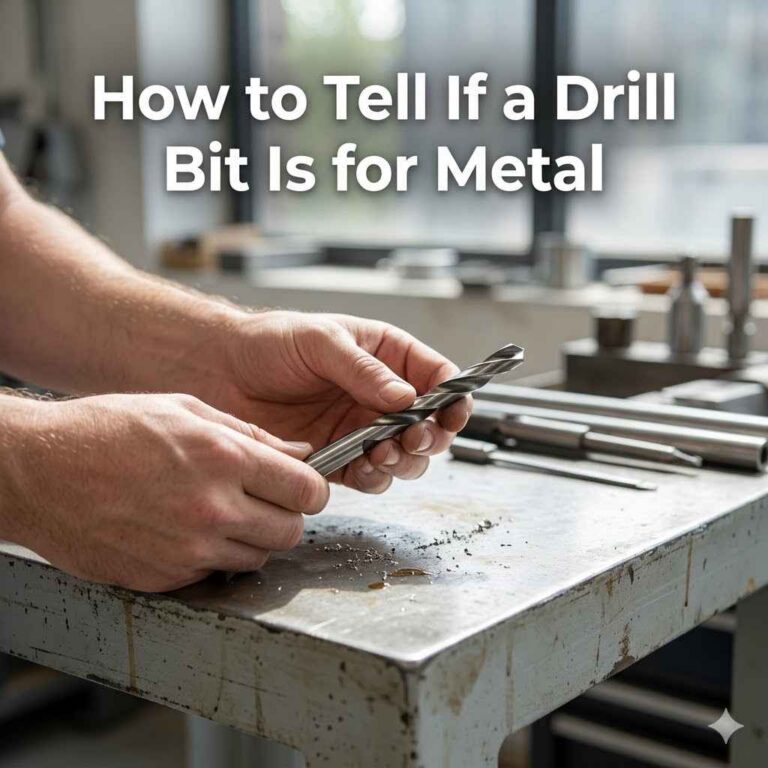
Drilling into metal requires a bit more precision and the right type of drill bit. For metal, you will typically use high-speed steel (HSS) drill bits. These are designed to withstand the heat and abrasion that comes with drilling through metal.
When selecting a drill bit for metal, the size is critical. You generally need a hole that perfectly matches the size of the bolt or screw you intend to use. If you’re creating a tapped hole (a hole that will have threads cut into it), you’ll need a “tap drill” size.
This is a specific size drill bit recommended for each tap size, ensuring enough material is left for the tap to cut threads.
For clearance holes (holes that allow a bolt or screw to pass through freely), the drill bit should be the exact same diameter as the bolt or screw. For example, if you need to pass a 1/4 inch bolt through a metal plate, you would use a 1/4 inch drill bit.
When drilling machine screws into a tapped hole, the process is different. You first determine the size of the machine screw. Then, you find the corresponding tap drill size.
For example, a 10-32 machine screw (meaning a size 10 screw with 32 threads per inch) requires a #21 drill bit (which is approximately 0.159 inches in diameter). If you are not tapping the hole and instead plan to use a nut and bolt, you would use a drill bit equal to the diameter of the bolt.
Here are some common drill bit sizes for metal projects and their uses:
- 3/32 inch: Good for small machine screws and tapping small holes.
- 1/8 inch: Suitable for small bolts, clearance holes for small fasteners, and tapping medium-sized holes.
- 3/16 inch: Useful for clearance holes for slightly larger bolts and for tapping.
- 1/4 inch: A common size for clearance holes for larger bolts and for tapping larger threads.
It is also important to use a lubricant like cutting oil when drilling metal. This helps to cool the drill bit and the metal, reducing friction and making the drilling process smoother and safer. It also extends the life of your drill bits.
Proper speed is also important; slower speeds are generally better for drilling metal to prevent overheating.
Drilling for Wall Anchors
Wall anchors are essential for hanging items on drywall or other hollow wall materials. The most crucial part of using wall anchors is selecting the correct drill bit size. This information is almost always printed on the packaging of the wall anchors themselves.
For example, if you purchase a box of plastic expansion anchors, the packaging might say “For use with 1/4 inch drill bit.” This means you need to drill a hole that is precisely 1/4 inch in diameter to ensure the anchor fits snugly. If you drill a hole that is too small, you won’t be able to insert the anchor. If the hole is too large, the anchor will be loose and won’t hold any weight.
Some types of anchors, like toggle bolts, have larger wings that fold up. For these, you’ll need to drill a hole large enough to accommodate the folded wings. Again, the packaging will specify the required drill bit size.
When in doubt, always check the anchor’s packaging first. If you’ve lost the packaging, it’s often possible to find the anchor’s specifications online by searching for the brand and model number. If you cannot find the exact size, a good general-purpose size for common plastic anchors is often between 1/4 inch and 3/8 inch.
However, this is just a rough guide, and checking the specific anchor is always the best approach.
Here’s a practical scenario for using wall anchors:
- You want to hang a picture frame on drywall.
- You buy a pack of plastic screw anchors.
- You look at the packaging and see it says “Drill bit size: 5/16 inch.”
- You select a 5/16 inch drill bit and drill a hole into the drywall.
- You insert the plastic anchor into the hole; it should fit snugly.
- You then drive the screw into the anchor to hang your picture.
The importance of this precise sizing cannot be overstated. A properly sized hole ensures the anchor can expand or deploy correctly behind the drywall, providing the necessary support for the item you’re hanging.
Specialty Drill Bits and Their Sizes
Beyond standard twist drills, there are many specialty drill bits designed for specific tasks. Each of these has its own set of size considerations.
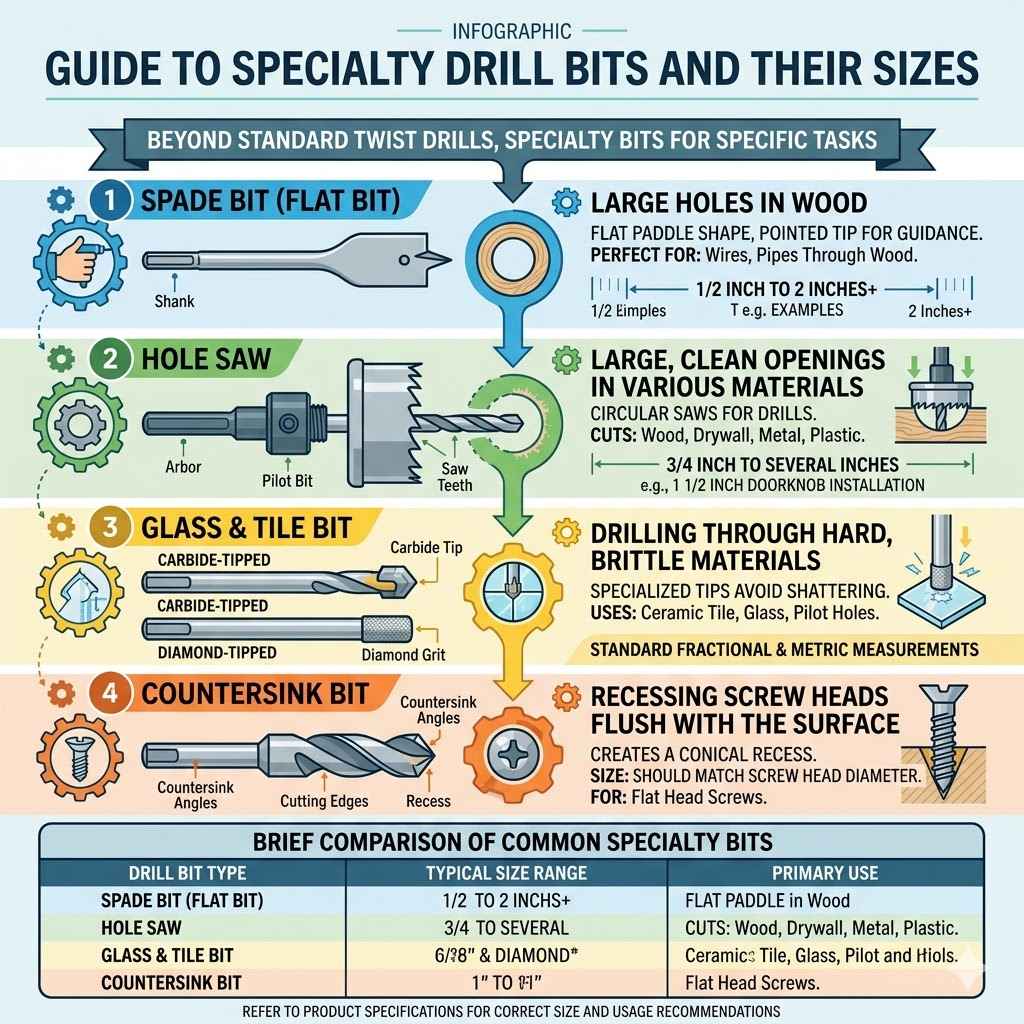
For instance, spade bits, also known as flat bits, are used for drilling larger holes in wood, typically from 1/2 inch up to 2 inches or more. They have a flat, paddle-like shape with a pointed tip to help guide the bit. When you need to drill a large hole for running wires or pipes through wood, a spade bit is often the tool of choice.
Hole saws are another type of specialty bit. These are circular saws that attach to a drill and are used to cut large-diameter holes in materials like wood, drywall, metal, and even plastic. They come in a wide range of sizes, from about 3/4 inch up to several inches in diameter, and are ideal for making clean, precise large openings.
For drilling into glass or tile, you’ll need special carbide-tipped or diamond-tipped drill bits. These bits are designed to cut through hard, brittle materials without shattering them. The size of these bits is usually expressed in standard fractional or metric measurements, but it’s the material of the bit that’s key for these applications.
Countersink bits are used to create a conical recess at the top of a drilled hole. This allows the head of a screw to sit flush with or below the surface of the material. The size of the countersink bit should match the diameter of the screw head you are using.
These specialty bits offer enhanced capabilities for particular jobs. Always refer to the product’s specifications for the correct size and usage recommendations. For example, a 1 1/2 inch hole saw is perfect for installing a doorknob mechanism, while a small carbide-tipped bit is essential for drilling a pilot hole for a screw in a ceramic tile.
Here is a brief comparison of common specialty bits:
| Drill Bit Type | Typical Size Range | Primary Use |
|---|---|---|
| Spade Bit | 1/2 inch to 2 inches+ | Large holes in wood |
| Hole Saw | 3/4 inch to several inches | Large, clean openings in various materials |
| Glass/Tile Bit | Small to medium (varies) | Drilling through glass and ceramic |
| Countersink Bit | Matches screw head size | Recessing screw heads |
Frequently Asked Questions
Question: How do I know what size drill bit to use for a screw?
Answer: For most screws, you’ll want to drill a pilot hole that is the same diameter as the screw’s shank (the solid part without threads). For hardwoods or when drilling near the edge, go slightly smaller. For softwoods, you might go a bit larger than the shank.
Always check screw size charts if unsure.
Question: What if I don’t have the exact drill bit size?
Answer: If you don’t have the exact size, try to use the closest size available. If the hole needs to be precise, like for a wall anchor, it’s best to get the correct size. For pilot holes, you can sometimes get away with a slightly different size, but it might affect how well the screw holds or if the wood splits.
Question: Can I use a drill bit that is too large for a screw?
Answer: Using a drill bit that is too large for a screw will create a hole that is too big. This means the screw will not have enough material to grip, and it will likely not hold securely. In wood, it can also lead to splitting.
It’s better to use a bit that’s too small and enlarge the hole slightly than to use one that’s too large.
Question: Do metric and imperial drill bit sizes correspond directly?
Answer: While there are many common sizes that are very close, metric and imperial (US customary) drill bit sizes do not always correspond directly. For example, a 6mm drill bit is not exactly the same as a 1/4 inch drill bit. It’s best to use a drill bit size chart to find the exact equivalent when converting between systems.
Question: When should I use a drill bit that is the same size as the object I am drilling through?
Answer: You would use a drill bit the same size as the object you are drilling through when you need a clearance hole. This is for when the object, like a bolt or a dowel, needs to pass freely through the material without being held by it. For example, if a 3/8 inch bolt needs to go through two pieces of metal, you would use a 3/8 inch drill bit to create the holes.
Summary
Knowing What Size Drill Bit to Use is key for successful projects. For screws, match the pilot hole to the screw shank. Wall anchors need the size specified on their packaging.
Metal and wood have different needs, with HSS bits best for metal and care needed to prevent splitting in wood. Always check your materials and fasteners for the best fit.