16-Gauge vs 18-Gauge Nailer Which Should You Choose
Choosing the right nailer can feel tricky when you’re starting out. Lots of people wonder about the 16-Gauge vs 18-Gauge Nailer: Which Should You Choose? because they all look pretty similar. But they do different jobs!
Don’t worry, we’ll make it simple. This guide breaks down what each one is best for, step-by-step, so you can pick the perfect tool for your project without any confusion.
Understanding Nailer Gauges Explained
The gauge of a nailer refers to the diameter of the nails it uses. A lower gauge number means a thicker nail, while a higher gauge number means a thinner nail. This difference in nail thickness directly impacts the strength and appearance of the fastened material.
For example, a 16-gauge nail is thicker and stronger than an 18-gauge nail. This makes the choice of nailer gauge crucial for achieving the desired results in woodworking, carpentry, and DIY projects. Understanding this fundamental concept is the first step in deciding which nailer best suits your needs.
Nail Diameter and Strength Differences
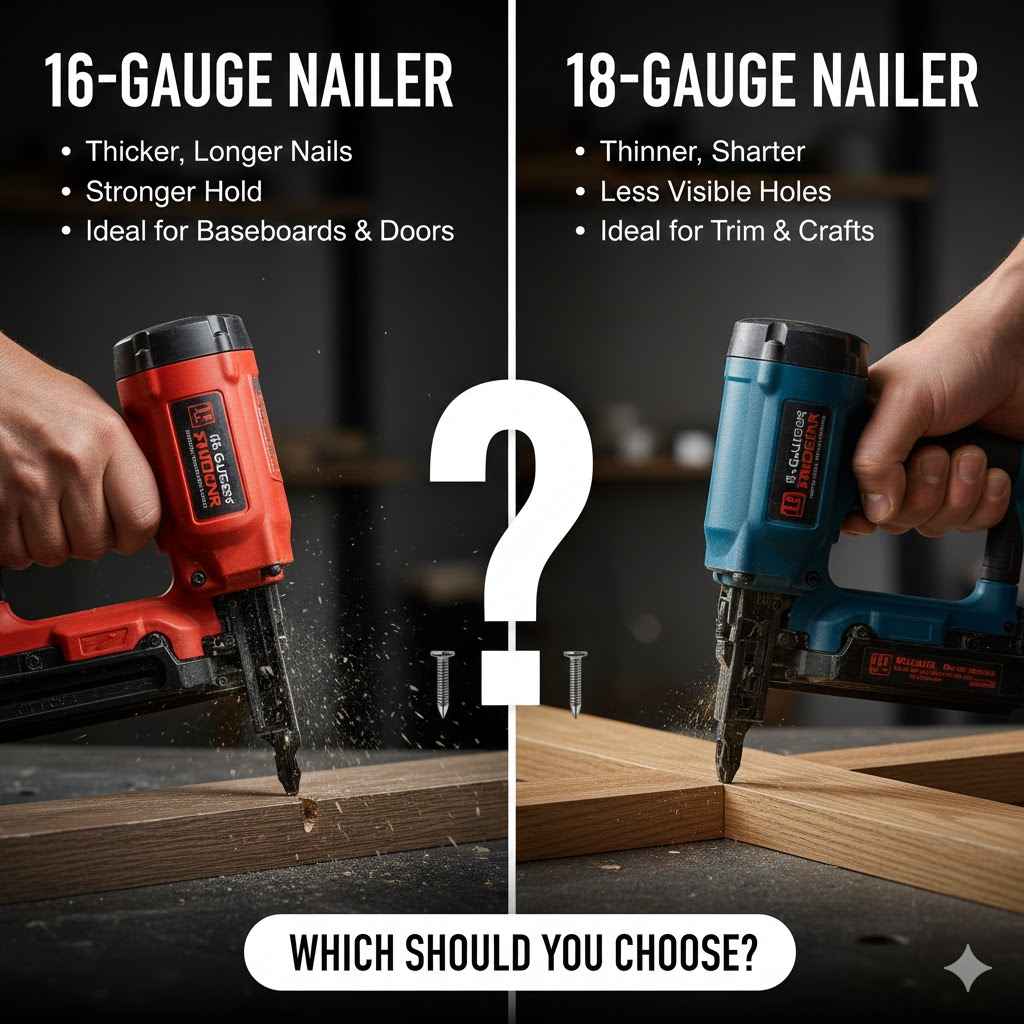
The core difference between 16-gauge and 18-gauge nailers lies in the nails they fire. A 16-gauge nail has a diameter of about 1.6mm, while an 18-gauge nail is thinner, around 1.2mm. This thickness is important because it affects how much holding power the nail provides.
Thicker nails generally offer more strength and are less likely to bend or break under stress. This makes 16-gauge nails ideal for structural applications where a strong bond is essential.
-
16-Gauge Nails Thicker and Stronger
The 16-gauge nail is robust. Its larger diameter provides significantly more holding power. When you need to join pieces of wood that will bear weight or endure movement, the 16-gauge nail stands up to the task.
They are the go-to choice for framing, deck building, and other construction jobs where durability is paramount. You’ll find they create a secure connection that you can rely on for the long term.
-
18-Gauge Nails Finer and Less Visible
On the other hand, the 18-gauge nail is much more delicate. Its slim profile means it leaves a smaller hole, which is often less noticeable. This makes them perfect for projects where aesthetics are important, such as trim work, molding installation, and furniture assembly.
You can often get away with minimal or no filling of the nail holes. This makes for a cleaner finished product without sacrificing too much holding strength for these applications.
Material Penetration Capabilities
The thickness of the nail also influences how easily it can penetrate different materials. Thicker 16-gauge nails can drive through denser woods and even some softer hardwoods with less effort, especially when powered by a strong air compressor or battery. Thinner 18-gauge nails are better suited for softer woods and materials where you want to avoid splitting or damaging the surface.
For instance, working with delicate hardwoods might require pre-drilling for 16-gauge nails to prevent splitting, whereas 18-gauge nails can often go in without issue.
A 16-gauge nailer is designed for projects that demand sturdy connections. Think about building a fence or assembling a heavy-duty cabinet. The wider head and thicker shaft of a 16-gauge nail provide a secure anchor.
This prevents pieces from separating over time due to stress or wear. The increased surface area of the nail head also helps to distribute the force, reducing the chance of pull-through in softer woods.
Conversely, an 18-gauge nailer excels in situations where a clean finish is a priority. When installing baseboards, crown molding, or decorative trim, you don’t want large, obvious nail holes marring the appearance. The fine, slender nails from an 18-gauge tool blend in much better.
They secure the trim without drawing undue attention to the fasteners themselves, allowing the beauty of the wood or paint to shine through.
When to Choose a 16-Gauge Nailer
The 16-gauge nailer is your workhorse for projects that require serious holding power and durability. If you’re building furniture that needs to last, framing a shed, or attaching heavier materials, this is the tool you’ll want in your hand. Its ability to drive thicker nails means stronger joints and a more robust final product.
You can rely on it for structural integrity, making it a staple for serious DIYers and professional contractors alike.
Best Projects for 16-Gauge Nailers
Several types of projects are perfectly suited for a 16-gauge nailer. These include framing walls for small structures like sheds or playhouses, building sturdy wooden decks, or constructing durable furniture frames. If you are installing heavier trim, such as thick baseboards or sturdy chair rails, a 16-gauge nailer can provide the necessary strength to keep them securely in place.
The thicker nails also make them suitable for attaching subflooring or roof sheathing, where the connection needs to withstand significant forces.
-
Framing and Structural Work
When you’re putting up the skeleton of a project, like walls for a small structure or the frame for a large cabinet, a 16-gauge nailer is invaluable. The nails provide strong connections that are essential for the stability and longevity of the build. You won’t have to worry about the structure coming apart because the nails are robust enough to handle the load and stress.
-
Cabinet and Furniture Construction
Building cabinets and furniture requires joints that are not only strong but also able to withstand regular use. A 16-gauge nailer helps create these secure bonds. Whether you’re attaching drawer slides, reinforcing cabinet corners, or assembling the main body of a workbench, the thicker nails offer peace of mind.
This ensures your creations are built to last for years to come.
-
Deck Building and Outdoor Projects
For any outdoor projects, especially decks, the strength provided by 16-gauge nails is critical. Decks are exposed to weather and weight, so the connections need to be exceptionally secure. Attaching deck boards, railings, or structural supports with a 16-gauge nailer ensures that your outdoor spaces are safe and resilient against the elements and use.
Power and Air Requirements
To effectively use a 16-gauge nailer, you’ll typically need a capable air compressor. The thicker nails require more force to drive into wood. A compressor with a higher cubic feet per minute (CFM) rating and a larger tank will provide consistent power, preventing the nailer from stalling or failing to drive nails fully.
For pneumatic models, a good quality air hose is also important to maintain sufficient pressure. Cordless electric models have their own battery power systems, and their performance can depend on the battery’s charge and capacity.
Consider a scenario where you are building a sturdy workbench. You need to join thick pieces of lumber for the legs and the top. Using a 16-gauge nailer will ensure that these joints are strong enough to support heavy tools and materials.
The nails will drive deep into the wood, creating a solid connection that won’t loosen over time. This is a task where the robustness of the 16-gauge nail is clearly beneficial.
When to Choose an 18-Gauge Nailer
The 18-gauge nailer is your best friend for projects where a clean, almost invisible finish is paramount. If you’re working with trim, molding, or building delicate furniture, this is the tool you’ll reach for. The fine nails it uses create minimal damage to the wood, making for a professional-looking outcome.
It’s perfect for those detailed tasks where appearance matters just as much as function.
Ideal Applications for 18-Gauge Nailers
There are many situations where an 18-gauge nailer shines. Installing delicate trim around windows and doors, attaching baseboards, or putting up crown molding are prime examples. It’s also excellent for building fine furniture where you want the fasteners to be hidden or easily concealed.
Upholstery work, attaching decorative elements, and even some light framing where the finish is important can benefit from the precision of an 18-gauge nailer. The small nail heads are easily filled with wood putty and painted over.
-
Trim and Molding Installation
When you’re adding decorative trim to walls, cabinets, or furniture, an 18-gauge nailer is the preferred tool. The small, thin nails leave tiny holes that are easy to fill and paint over. This means your trim work will look smooth and professional, without noticeable nail pops or large divots in the wood.
It’s essential for achieving that polished, high-end finish.
-
Furniture Building and Repair
For assembling finer pieces of furniture or making repairs, an 18-gauge nailer offers the precision needed. You can secure delicate joints, attach decorative elements, or reattach loose trim without damaging the wood. This tool allows for a level of detail that is difficult to achieve with larger nailers, ensuring your furniture looks as good as it functions.
-
Picture Frames and Craft Projects
Creating picture frames, birdhouses, or other craft projects often involves working with thinner materials or when you want the fasteners to be unobtrusive. An 18-gauge nailer is perfect for these tasks. It provides enough holding power to keep pieces together securely while leaving minimal marks, which is ideal for decorative items that will be on display.
Nail Size and Visibility
The 18-gauge nail is significantly smaller than its 16-gauge counterpart. This means it creates a much smaller hole when driven into wood. For most projects, especially those involving visible surfaces, this small hole is a huge advantage.
It makes the nail heads much harder to spot once the job is done. You can often get away with simply sanding and painting or staining over the nail heads, giving your project a very clean and seamless appearance.
Imagine you are installing new baseboards in your living room. You want them to look seamless. Using an 18-gauge nailer will allow you to secure the baseboards tightly to the wall with minimal impact on the wood.
The small nail holes are easily hidden with wood filler, and after painting, they are practically invisible. This is the kind of project where an 18-gauge nailer truly proves its worth for achieving a professional finish.
Comparing Performance and Features
Both 16-gauge and 18-gauge nailers are available in various power types, including pneumatic (air-powered), cordless electric (battery-powered), and even some corded electric models. The choice of power type can affect portability, cost, and maintenance. Pneumatic nailers are often lighter and more powerful, but require an air compressor and hose.
Cordless models offer freedom of movement but can be heavier and require battery charging.
Power Source Options Pneumatic vs Cordless
Pneumatic nailers are powered by compressed air from an air compressor. They are generally known for their power, reliability, and lighter weight compared to cordless models. The main drawback is the need for a compressor, hoses, and an available power outlet to run the compressor.
Cordless nailers use rechargeable batteries and offer great portability. They eliminate the need for air hoses, making them convenient for working in remote locations or when mobility is key. However, they can be more expensive upfront, heavier, and their run time is limited by battery life.
-
Pneumatic Nailers Pros and Cons
Pneumatic nailers are a favorite for many professionals because they are often more powerful and less expensive per tool than cordless equivalents. They typically have fewer moving parts to wear out, leading to longer tool life. The main constraint is the need for an air compressor, which adds bulk and noise to the worksite.
They are also tethered by an air hose, which can limit range of movement.
-
Cordless Nailers Advantages
Cordless nailers offer unparalleled freedom. You can take them anywhere without worrying about air lines or power cords. This is a huge advantage for large job sites or when working at heights.
Modern cordless nailers are also very powerful and can handle many tasks that once required pneumatic tools. The inconvenience of charging batteries is a small price to pay for the convenience.
Nail Magazine Capacity and Loading
The capacity of the nail magazine, which is the part of the nailer that holds the nails, varies between models and types. A larger capacity means you can fire more nails before needing to reload, which can speed up your work, especially on large projects. Reloading mechanisms also differ; some are easier and faster than others.
Quick-release latches or easy-slide systems make reloading a breeze, minimizing downtime.
When you’re working on a large trim project, the number of nails you can load at once really matters. A nailer with a magazine that holds 100 nails will let you work longer without stopping to refill compared to one that holds only 50. This can make a big difference in the overall time it takes to complete the job.
Think about installing trim in a whole house; reloading hundreds of times would be very time-consuming.
Ergonomics and Weight Considerations
The weight and balance of a nailer are crucial for comfort and control, especially during extended use. A heavier nailer can lead to fatigue, while a well-balanced tool feels natural in your hand and allows for precise placement of nails. Ergonomic grips, rubberized coatings, and adjustable depth settings also contribute to a more user-friendly experience.
These features help reduce strain and improve accuracy, making the tool a pleasure, not a burden, to use.
Imagine you are working overhead, installing crown molding. The weight of the nailer becomes a significant factor. A lighter, well-balanced 18-gauge nailer will be much easier to hold steady for longer periods.
This not only prevents arm fatigue but also helps ensure that the nails are driven straight and true. The difference a good ergonomic design makes can be substantial over the course of a project.
16-Gauge vs 18-Gauge Nailer Which Should You Choose? Summary Table
To help you make a clear decision, here’s a quick comparison of the key features and ideal uses for both 16-gauge and 18-gauge nailers. This table highlights the main differences so you can quickly assess which tool is the best fit for your upcoming projects.
| Feature | 16-Gauge Nailer | 18-Gauge Nailer |
|---|---|---|
| Nail Diameter | Thicker (approx. 1.6mm) | Thinner (approx. 1.2mm) |
| Nail Strength | Higher Holding Power | Lower Holding Power |
| Visibility of Nail Holes | More Noticeable | Less Noticeable |
| Ideal Projects | Framing, Decking, Structural Woodworking, Heavy Trim | Fine Trim, Molding, Furniture Assembly, Craft Projects |
| Material Penetration | Good for Harder Woods | Best for Softer Woods, Prevents Splitting |
| Common Tool Types | Framing Nailers, Finish Nailers | Brad Nailers |
| Aesthetics | Less Critical | Highly Important |
Choosing Your First Nailer A Practical Guide
When you are just starting out with nail guns, it’s easy to feel overwhelmed by the choices. The core question of 16-Gauge vs 18-Gauge Nailer: Which Should You Choose? often comes down to the types of projects you plan to tackle most often. Think about what you want to build or repair.
If your focus is on solid construction and structural integrity, a 16-gauge is likely the way to go. If you’re more interested in detailed work and achieving a polished look, an 18-gauge will serve you better.
Consider Your Typical Projects
The best way to decide is to think about the projects you are most excited to start. Are you planning to build a new bookshelf, assemble some outdoor furniture, or perhaps tackle some interior renovations? If building sturdy furniture or structural components is your goal, the strength of a 16-gauge nailer will be more beneficial.
For tasks like installing baseboards, window casings, or decorative trim, the subtle finish of an 18-gauge nailer is essential.
-
DIY Home Improvement
For most home improvement tasks, like hanging shelves, installing new trim, or building simple furniture, an 18-gauge nailer is often a great starting point. It’s versatile enough for many common DIY jobs and provides a cleaner finish. However, if you anticipate needing to frame small projects or build stronger cabinetry, a 16-gauge might be a more practical first investment.
-
Professional Carpentry
Professionals typically own both 16-gauge and 18-gauge nailers because different jobs require different tools. A carpenter framing a house will use a 16-gauge for structural work, but will switch to an 18-gauge for installing intricate molding. If you are looking to become a professional, acquiring both types will expand your capabilities significantly.
-
Hobbyist Woodworking
For hobbyist woodworkers, the choice often depends on the style of projects. If you enjoy building functional, sturdy items, lean towards 16-gauge. If your passion lies in creating fine decorative pieces, intricate inlays, or furniture with a refined finish, the 18-gauge is the better option.
Starting with One or Both
Many beginners find that starting with one nailer that covers their most frequent needs is a smart approach. For general DIY and decorative tasks, an 18-gauge nailer is often more versatile. However, if your primary interest lies in construction or building stronger items, the 16-gauge should be your first choice.
As you gain experience and take on more varied projects, you may find yourself investing in the other type to expand your toolkit.
A common scenario for a homeowner is wanting to update their interior trim. This involves installing new baseboards and possibly door casings. For these tasks, an 18-gauge nailer is ideal because the nail holes will be small and easy to hide, leading to a professional-looking finish.
If you were to use a 16-gauge nailer for this, the larger holes would be much more difficult to conceal, potentially detracting from the aesthetic appeal of the new trim.
Maintenance and Safety Tips
Regardless of which nailer you choose, proper maintenance is key to its longevity and safe operation. Always keep your nailer clean and lubricated according to the manufacturer’s instructions. Before use, inspect it for any damage.
When operating, always wear safety glasses to protect your eyes from flying debris. Ensure you are familiar with the depth adjustment settings to avoid driving nails too deep or not deep enough, which could lead to damage or unsafe connections.
Frequently Asked Questions
Question: What is the difference between a 16-gauge and 18-gauge nail?
Answer: The primary difference is their thickness. A 16-gauge nail is thicker and stronger, while an 18-gauge nail is thinner and leaves a smaller, less visible hole.
Question: Which nailer is better for framing a shed?
Answer: For framing a shed, a 16-gauge nailer is better because it provides stronger connections needed for structural integrity.
Question: Can I use an 18-gauge nailer for baseboards?
Answer: Yes, an 18-gauge nailer is excellent for baseboards because its thin nails leave small holes that are easy to conceal for a clean finish.
Question: Do I need an air compressor for both 16-gauge and 18-gauge nailers?
Answer: Pneumatic versions of both types require an air compressor. However, both 16-gauge and 18-gauge nailers are also available in cordless electric models that do not need a compressor.
Question: Which nailer is best for beginners?
Answer: For most general DIY tasks where appearance is important, an 18-gauge nailer is often a good starting point for beginners due to its versatility and clean finish.
Summary
Choosing between a 16-gauge and 18-gauge nailer depends on your projects. The 16-gauge offers superior strength for structural work, while the 18-gauge excels at providing a clean, nearly invisible finish for trim and delicate tasks. Consider your typical projects to make the best choice.