3 Wood vs Driver Distance: Essential Guide
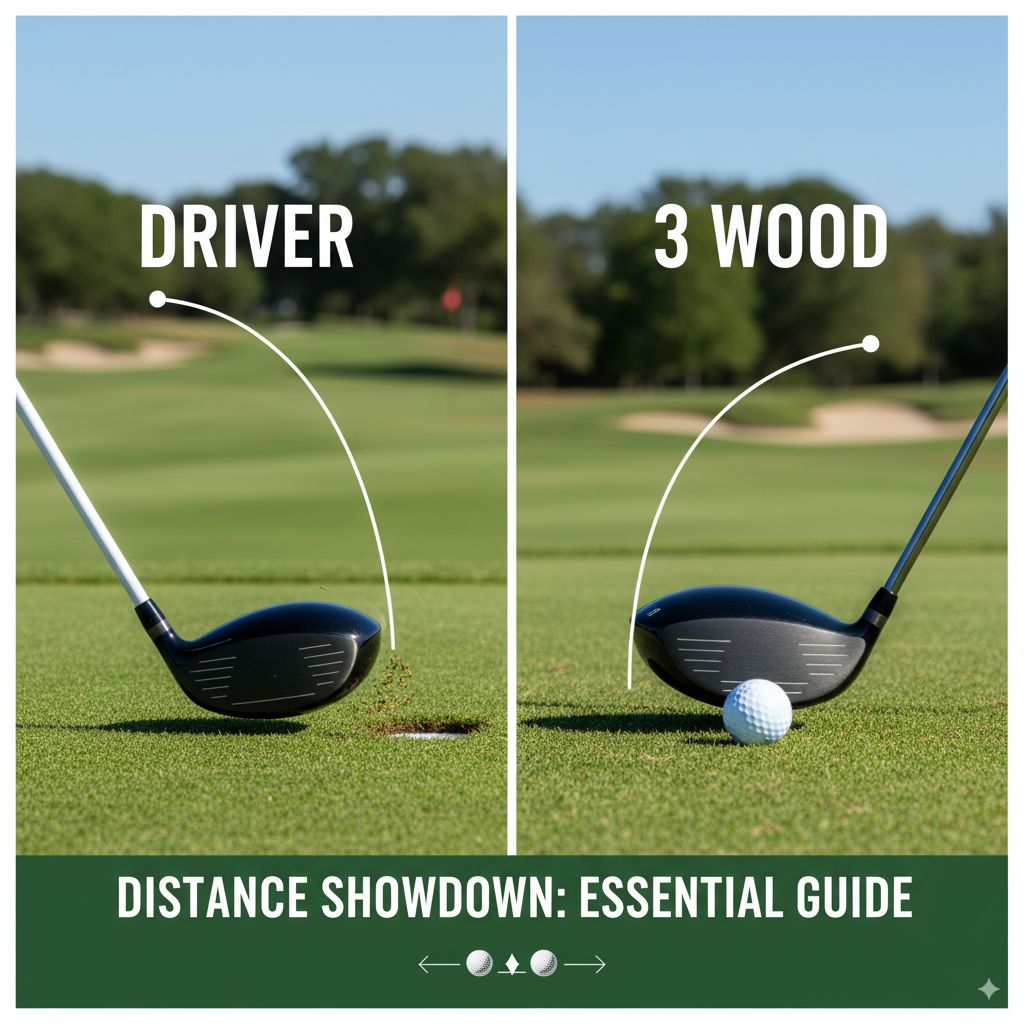
A driver typically goes farther than a 3-wood for most golfers due to its lower loft and longer shaft. However, a 3-wood can be more accurate and easier to control, making it a great choice for golfers seeking consistency or facing challenging courses. Understanding their differences helps you choose the right club for maximum distance and control.
3 Wood vs Driver Distance: An Essential Guide for Every Golfer
Picking the right club off the tee can feel like a puzzle, especially when you’re deciding between your driver and your 3-wood. You want that satisfying thwack and a ball soaring down the fairway, right? It’s a common question for golfers of all levels: just how much farther does a driver go compared to a 3-wood? And when should you reach for one over the other? Don’t worry, it’s not as complicated as it seems. We’ll break down the key differences, what affects their distance, and how to make the best choice for your game. Let’s get your drives straighter and longer!
Understanding the Core Differences: Driver vs. 3 Wood
At first glance, your driver and 3-wood might look similar, but they’re designed with distinct purposes in mind. These differences directly impact how far and how straight the ball will fly. Think of them as specialized tools for different jobs on the golf course.
Loft: The Angle That Matters
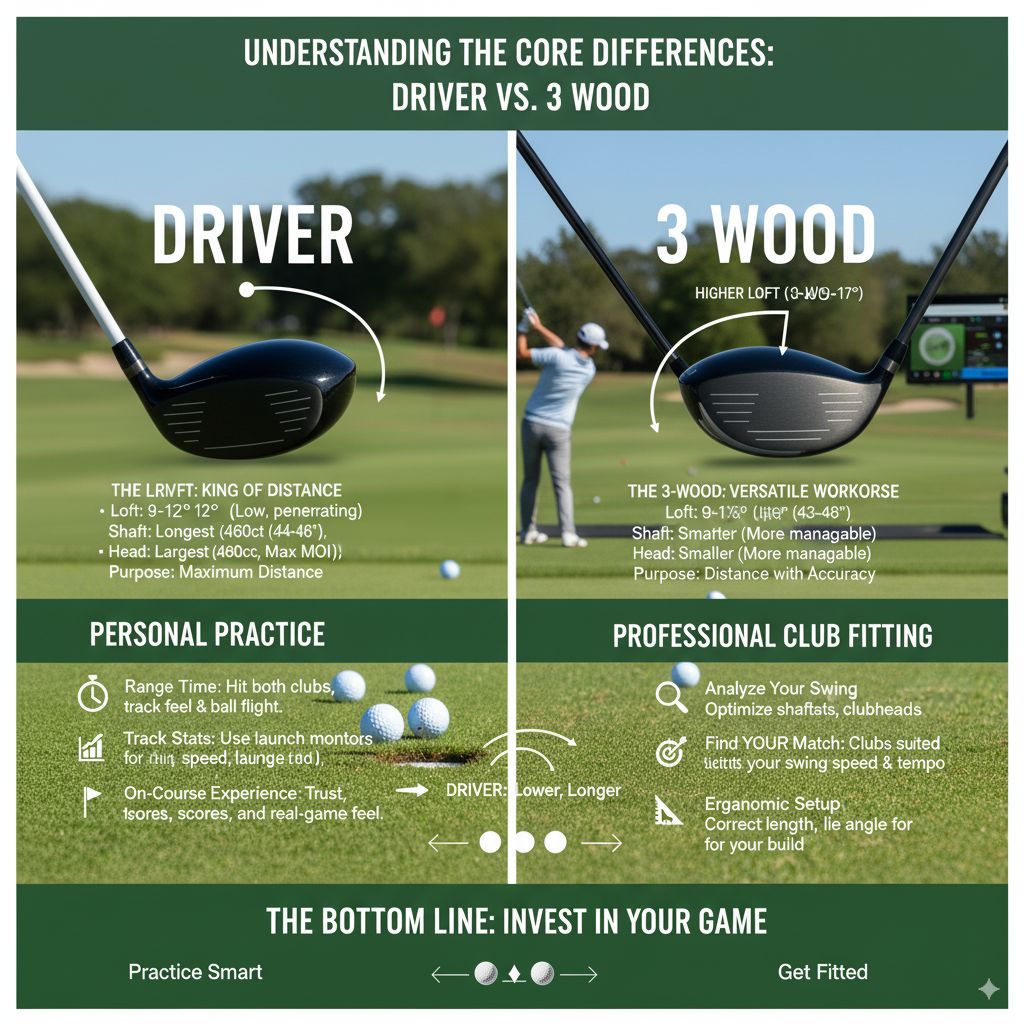
The most significant difference between a driver and a 3-wood is their loft. Loft refers to the angle of the clubface, which is crucial for getting the ball airborne and controlling its trajectory.
Driver: Typically has a loft between 9 to 12 degrees. Some drivers can be adjusted to be even lower. This lower loft is designed to produce a lower, penetrating ball flight that, with enough clubhead speed, encourages maximum distance.
3-Wood: Usually has a loft between 13 to 17 degrees. This higher loft makes it easier to get the ball up in the air, even when hit off the deck (from the fairway).
This difference in loft is the primary reason why drivers are generally longer than 3-woods. A lower loft on the driver allows the clubface to strike the ball more squarely, launching it with less backspin and a lower trajectory that can travel farther when hit correctly.
Shaft Length: The Reach Factor
Another key distinction is the length of the shaft:
Driver: Drivers have the longest shafts in a golfer’s bag, typically ranging from 44 to 46 inches. The longer shaft allows for a greater arc of swing, translating into higher clubhead speed. More speed generally means more distance.
3-Wood: The shaft of a 3-wood is shorter than a driver, usually around 42 to 43 inches. This shorter length makes it easier to control the clubface through impact, promoting more accuracy and consistency, though at the cost of some potential speed.
The combination of lower loft and longer shaft is what gives the driver its potential for maximum distance on a well-struck shot. However, the trade-off is control.
Clubhead Size and Design
Drivers also boast the largest clubheads allowed under the Rules of Golf, with a maximum volume of 460 cubic centimeters. This larger size often creates a higher moment of inertia (MOI), which helps the clubface resist twisting on off-center hits, leading to straighter shots.
3-woods, on the other hand, have smaller clubheads. While still forgiving, they don’t offer the same extreme forgiveness as a driver on mishits. Their design is more about versatility, allowing them to be struck effectively from both the tee and the turf.
How Distance is Calculated: The Physics of a Golf Shot
Understanding why one club goes farther than another involves a bit of physics you can see on the course. It’s not just about swinging hard; it’s about how the club and ball interact.
Clubhead Speed
This is arguably the most significant factor in golf ball distance. The faster your clubhead moves through the impact zone, the faster the ball will leave the clubface.
Driver: The longer shaft and often lighter weight allow golfers to generate higher clubhead speeds, typically 5-10 mph faster than with a 3-wood for the average amateur.
3-Wood: The shorter shaft makes it harder to generate the same level of speed.
Launch Angle
This is the angle at which the ball leaves the clubface relative to the ground.
Driver: With its lower loft, the driver launches the ball lower. For maximum distance, especially with a faster swing speed, a lower launch angle combined with lower spin generally yields the longest shots.
3-Wood: The higher loft helps get the ball up in the air more easily, resulting in a higher launch angle.
Spin Rate
Golf ball spin is divided into backspin and sidespin. For distance, we’re primarily concerned with backspin.
Driver: Designed to impart less backspin on the ball. For bombers, lower spin is key to preventing the ball from ballooning and losing distance. High-handicap golfers might actually benefit from a bit more spin from a driver to help get the ball airborne.
3-Wood: Tends to impart slightly more backspin than a driver due to its higher loft. More spin can lead to the ball stopping more quickly on the green.
The ideal combination for maximum distance is high clubhead speed, a launch angle appropriate for that speed, and the optimal spin rate for that launch angle. As a general rule, faster swing speeds benefit from lower launch and lower spin, which the driver is designed to facilitate.
For more on the physics of golf, check out the USGA’s equipment rules and standards, which indirectly govern club design and its effects on play.
Ball Speed
This is how fast the ball leaves the clubface. It’s influenced by clubhead speed, the efficiency of the strike (smash factor), and the loft of the club.
Driver: Typically produces higher ball speeds because the combination of higher clubhead speed and lower loft creates a more efficient transfer of energy, assuming a solid strike.
3-Wood: Generally produces lower ball speeds because the clubhead speed is lower and the loft is higher, which can sometimes reduce energy transfer efficiency.
Typical Distance Differences: What to Expect
So, what’s the magic number? How much farther does a driver really go? The answer varies greatly from player to player, but we can look at general averages.
For an average male amateur golfer with a moderate swing speed (around 90 mph), a driver might travel 15 to 25 yards farther than a 3-wood. For faster swingers, this gap can widen to 30 yards or more. For slower swingers, the difference might be less pronounced, perhaps only 10-15 yards, and sometimes a well-struck 3-wood can even be longer for them due to better control and launch.
Here’s a table showing typical distance ranges, keeping in mind these are generalizations:
| Club | Typical Loft (Degrees) | Typical Shaft Length (Inches) | Average Driver Distance (Yards) | Average 3-Wood Distance (Yards) | Typical Distance Difference (Yards) |
|---|---|---|---|---|---|
| Driver | 9-12 | 44-46 | 220-250+ | N/A | N/A |
| 3-Wood | 13-17 | 42-43 | N/A | 200-230+ | 15-25+ |
It’s important to remember that these are just averages. Factors like your swing speed, ability to strike the ball cleanly, course conditions, and even the specific models of clubs you’re using will play a huge role.
When to Use Your Driver
The driver is your go-to club for maximum distance when accuracy isn’t the absolute top priority, or when you have a wide-open fairway.
Key Scenarios for Driver Use:
Wide-Open Fairways: If the fairway is generous and there are no significant hazards like water or out-of-bounds close to the tee, the driver is your best bet for chewing up yardage.
Reaching Par 5s in Two: On longer par-5 holes, achieving maximum distance off the tee is crucial if you want a chance to reach the green in two shots.
Downwind Holes: Using a driver on holes where you have a strong tailwind can really maximize the carry and roll.
When you have a clear path: If you know you can keep it in play, the driver is the obvious choice for distance.
Tips for Hitting Your Driver Longer:
Tee it High: Tee the ball up so that about half the ball is above the crown of the club. This promotes hitting the ball on the upswing.
Swing Smoothly: Focus on a smooth, accelerating swing rather than just trying to “muscle” the ball.
Proper Setup: Ensure you have a good stance with the ball positioned forward in your stance, aligned with the inside of your lead heel.
Practice Tempo: Finding a consistent swing tempo is more important than raw power.
When to Use Your 3-Wood
The 3-wood shines when control and accuracy are more important than pure distance, or when the driver is simply too risky. It’s a versatile club that can save strokes by keeping you in play.
Key Scenarios for 3-Wood Use:
Tight Fairways: If the fairway is narrow or lined with trees, trouble, or out-of-bounds, the more controllable 3-wood is a much safer choice.
Windy Conditions: When playing into a strong headwind, the higher loft of the 3-wood can help get the ball up and create a better trajectory against the wind.
Dogleg Holes: On holes that turn sharply, you might need to strategically “lay up” short of the corner with a 3-wood to set up a better angle for your next shot.
When the Driver Isn’t Working: We all have those days. If you’re struggling to hit your driver straight, switching to a 3-wood can be a confidence-builder and help you get the ball in play.
Second Shots on Par 5s: The 3-wood is often used for long second shots on par-5s that are too far to reach with an iron but too risky to try and force with a driver.
Off the Deck: The 3-wood is designed to be hit off the turf as well as from the tee. It can be a great club for a long fairway shot.
Tips for Hitting Your 3-Wood Consistently:
Tee it Lower: Tee the ball up lower than your driver, with the ball positioned slightly forward of the center of your stance. This encourages hitting down on the ball.
Ball Position: Play the ball slightly more towards the center of your stance compared to the driver.
Focus on Impact: Concentrate on making solid contact. Since the shaft is shorter, you have more control over the clubface.
Swing Path: Maintain a smooth, balanced swing. Don’t try to swing harder than you can control.
Comparing Distance and Control: A Quick Overview
To sum up the trade-offs, consider this comparison:
| Material | Purpose | Notes |
|---|---|---|
| Firebrick | Internal combustion zones, heat riser, and high-heat areas. | Withstands extreme temperatures without cracking; essential for core durability. |
| Insulation (Perlite, Vermiculite, Ceramic Fiber) | To insulate the heat riser and combustion chamber. | Crucial for efficiency—retains heat to ensure complete combustion and reduces fuel waste. |
| Cob (Clay, Sand, Straw) | For constructing the outer thermal mass. | Natural, durable, and aesthetic; stores heat effectively. Requires thorough drying to prevent cracking. |
| Sand & Cement | Sometimes used for outer mass construction or as insulation layers. | Provides durability and heat retention but less sustainable than cob. |
| Metal Tubing (Steel or Similar) | Fuel feed tube and/or internal structural support. | Must be heat-resistant; prone to eventual burnout if directly exposed to combustion. |
| Standard Chimney Pipe | For the final exhaust venting. | Needs proper sizing and installation to ensure draft and safety. |
Understanding the science behind golf clubs, including materials and design principles, can be fascinating. Resources like Golf Distillery’s breakdown of golf physics offer further insights without being overly technical.
Factors Beyond the Club Itself
While the club’s design is crucial, many other elements influence how far your ball travels.
Your Swing Speed
As we’ve discussed, this is paramount. A faster swing speed means more potential distance from any club. If you’re a beginner with a slower swing speed, focusing on a smooth tempo and solid contact with a 3-wood might yield better driving results than trying to force distance with a driver.
Your Ball Striking Ability
Even the longest driver won’t go far if you consistently hit it thin, fat, or off the toe. A slightly weaker or shorter club like a 3-wood, if hit solidly, can often outperform a poorly struck driver. Forgiveness in club design plays a role here, but technique is king.
Course Conditions
Firmness of the Fairway: A firm fairway allows for more roll, increasing total distance. A soft, wet fairway will stop the ball much quicker.
Wind: As mentioned, a headwind kills distance, while a tailwind adds it. Crosswinds can affect direction more than distance.
Elevation: Hitting uphill or downhill significantly impacts trajectory and distance estimations.
Your Golf Ball
Different golf balls are designed with varying compression rates and cover materials to optimize distance and spin for different swing speeds. A ball designed for slower swing speeds might add a few yards to your shots if that’s what you need.
Getting the Most Out of Your Clubs: Practice and Customization
The best way to figure out the optimal strategy for you is through practice and, if possible, customization.
Personal Practice
Range Time: Spend time on the driving range hitting both your driver and 3-wood. Pay attention to how they feel, where the ball goes, and how many fairways you hit.
Track Your Stats: If you can use a launch monitor (many ranges have them), you can get precise data on swing speed, ball speed, launch angle, and spin rate for each club. This is invaluable.
On-Course Experience: Pay attention during your rounds. Which club do you trust more on certain holes? Which one leads to better scores?
Club Fitting
If you’re serious about improving your game, a professional club fitting is one of the best investments you can make. A fitter can:
Analyze your swing with different shafts, lofts, and clubheads.
Help you find the driver and 3-wood that are optimally suited to your swing speed and tempo.
Ensure your clubs are the correct length and lie angle for your physical build.
A good fitting can often reveal that a different shaft in your current driver, or even a driver with a slightly different loft setting, could add significant distance and accuracy compared to what you’re currently using. For example, many modern drivers have adjustable hosels allowing you to change the loft and lie angle. Resources from organizations like the PGA of America can explain the benefits of club fitting.

FAQ: Your Burning Questions Answered
Q1: Will a driver always go farther than a 3-wood?
A1: For most golfers, yes, a driver will typically go farther due to its lower loft and longer shaft, which allow for higher swing speeds and a more penetrating ball flight. However, for some golfers with slower swing speeds, a well-struck 3-wood might rival or even surpass their driver distance due to better control and a more consistent launch.
Q2: How much distance difference is normal between a driver and 3-wood?
A2: The average difference for an amateur male golfer is often around 15 to 25 yards. This gap can be larger for faster swingers and smaller for slower swingers.
Q3: Can I hit my 3-wood off the tee on every hole?
A3: Absolutely! Many golfers choose to use their 3-wood off the tee on holes where accuracy is critical, such as tight fairways, doglegs, or when playing in windy conditions. It’s a strategic choice that often leads to lower scores.
Q4: Is a 3-wood easier to hit than a driver?
A4: Generally, yes. The shorter shaft and slightly higher loft of a 3-wood make it easier to control, leading to more consistent contact and better accuracy for many golfers, especially beginners.
Q5: What is a “3-wood off the deck”? Does that mean hitting it from the fairway?
A5: Yes, that’s exactly what it means! “Off the deck” is golf slang for hitting a ball that is resting on the turf (like the fairway or rough), rather than from the tee. Because 3-woods have more loft than drivers, they are designed to be hit effectively from the ground.