Space Between Bookshelf Shelves: 8-16 Inch Chart + Sag Limits
The right space between bookshelf shelves is your tallest book plus 1 to 2 inches: about 8 to 9 inches for paperbacks and 10 to 12 inches for most hardcovers. Measuring beats guessing, because an extra inch repeated across six shelves adds 6 inches to the case. Below are spacing by book type, the clear-opening math, shelf sag limits, and pin-hole layout.
Standard Space Between Bookshelf Shelves by Book Type
Best Shelf Pin Jig Pick
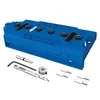 |
Kreg Shelf Pin Jig 1/4 Inch (KMA3225) – $39.00
|
These are clear openings, meaning the empty space from the top of one shelf to the underside of the shelf above. Each recommended range is the typical tallest book in the category plus 1 to 2 inches of finger room.
| Item | Typical height | Recommended clear opening |
|---|---|---|
| Mass-market paperback | About 6.9 in | 8 – 9 in |
| Trade paperback | 8.5 – 9 in | 10 – 11 in |
| Standard hardcover novel | 9 – 9.5 in | 10.5 – 11.5 in |
| Textbooks and cookbooks | 10 – 11.5 in | 12 – 13 in |
| Oversized art books and atlases | 12 – 15 in | 14 – 16 in |
For a general-purpose case that holds a mix, 10 to 12 inches is the safe middle. It swallows almost every hardcover while wasting only 2 to 3 inches above a trade paperback. Pick one taller shelf for the oversized books rather than making every opening 16 inches.
Clear Opening vs. Center-to-Center: The Math Most Plans Skip
Book heights give you the clear opening, but you cut and drill around the shelf thickness. A 3/4 inch shelf steals 3/4 inch from every gap, so a plan that says “11 inch spacing” can mean two different things. Center-to-center spacing is the clear opening plus the shelf thickness, so an 11 inch opening with 3/4 inch shelves puts hole marks 11-3/4 inches apart.
To divide a case evenly, subtract the top, bottom and shelf thicknesses from the total height, then divide by the number of openings. Here is a worked example for a 72 inch tall case built from 3/4 inch material with a fixed top and bottom:
- Interior height: 72 – (2 x 0.75) = 70.5 in
- Six openings need five shelves: 5 x 0.75 = 3.75 in of shelf material
- Each clear opening: (70.5 – 3.75) / 6 = 11.125 in (11-1/8 in)
- Five openings need four shelves: (70.5 – 3.0) / 5 = 13.5 in, too tall for a hardcover shelf and better suited to a media or display case
If you want a taller bottom shelf for oversized books, decide those openings first, then split the remaining height among the rest. Doing it in that order keeps you from ending up with a 9-3/4 inch top opening that nothing fits in.
How to Measure Your Own Books in 3 Steps
- Sort by height. Pull the books you plan to store and make four piles: small paperbacks, standard books, tall books, and oversized.
- Measure the tallest in each pile. Use the spine height, not the average, because one tall outlier decides the opening.
- Add 1 to 2 inches. Use 1 inch for paperbacks and 1.5 to 2 inches for heavy hardcovers you pull out with one hand. Example: a 9.5 inch hardcover plus 1.5 inches gives an 11 inch opening.
Leaving the extra room also lets you tip a book out by its top edge instead of pinching the spine, which is what damages spines over time.
Shelf Depth: Match It to the Books
Depth is the other half of shelf sizing. A depth of 10 to 12 inches holds standard books fully supported. Oversized art books and binders need about 12 to 15 inches so they do not overhang the front edge. Deeper shelves also carry more weight per foot, which feeds directly into the sag numbers below.
Spacing for Records, Binders, DVDs and Display Items
Bookcases rarely hold only books. Use the same rule, tallest item plus 1 to 2 inches, with these typical sizes:
| Item | Typical height | Clear opening |
|---|---|---|
| Vinyl LP (sleeve) | About 12-3/8 in | 13.5 – 14.5 in |
| 3-ring binder | About 11.5 in | 12.5 – 13.5 in |
| DVD case | About 7.5 in | 8.5 – 9 in |
| CD jewel case | About 5.6 in | 6.5 – 7 in |
| Vase or framed photo (display) | Varies | Object height plus 50 to 100 percent for a gallery look |

That mixed layout is the practical argument for adjustable shelves in at least the middle of the case. Records and binders want 14 inches while paperbacks want 8 or 9, and one fixed number cannot serve both without waste.
Shelf Sag: How Far Can a 3/4 Inch Shelf Span?
Myth corrected: the space between shelves has no effect on sag. Span, thickness, material stiffness and load decide it. To put real numbers on it, I ran the standard beam deflection formula (uniform load, shelf resting on pins at both ends) for a 10 inch deep, 3/4 inch thick shelf carrying 25 lb per running foot of books, a commonly quoted figure for a full shelf of hardcovers. The table shows the calculated sag at the center, in inches.
| Material (approx. stiffness) | 24 in span | 30 in span | 36 in span | 42 in span |
|---|---|---|---|---|
| Solid oak (1.8 million psi) | 0.01 | 0.04 | 0.07 | 0.13 |
| Birch plywood (1.4 million psi) | 0.02 | 0.05 | 0.09 | 0.17 |
| Pine (1.2 million psi) | 0.02 | 0.05 | 0.11 | 0.20 |
| MDF (0.45 million psi) | 0.06 | 0.14 | 0.29 | 0.53 |
| Particleboard (0.35 million psi) | 0.07 | 0.18 | 0.37 | 0.69 |
A common visual limit is the span divided by 360, which works out to about 0.07 inch at 24 inches, 0.08 inch at 30 inches and 0.10 inch at 36 inches. Read the table against those limits and the pattern is clear. Solid wood and plywood pass through 36 inches on day one, while MDF and particleboard are already at or past the limit at 24 to 30 inches. Wood also creeps under constant load, so a shelf that looks straight today can droop noticeably after months of carrying books. Treat these as best-case numbers.
Fixes that work
- Add a nosing. Gluing and screwing a 1×2 hardwood strip (3/4 x 1-1/2 in) on edge under the front of the shelf makes it roughly five times stiffer by my calculation, which cuts sag to about a fifth.
- Shorten the span. A vertical divider at the midpoint cuts the span in half and reduces sag by a factor of 16, because deflection scales with the fourth power of length.
- Change the material. Moving from MDF to plywood of the same thickness cuts sag by about two-thirds.
- Use thicker stock if you must span long: stiffness rises with the cube of thickness, so 1 inch material is about 2.4 times stiffer than 3/4 inch.
You can plug in your own numbers with the free Sagulator, and our woodworking calculators guide covers the other calculators worth bookmarking.
Fixed vs. Adjustable Shelves
Fixed shelves are glued into dados or screwed into the case. They add rigidity, stop the case from racking, and are the better choice for heavy, uniform collections and built-in units. Adjustable shelves rest on pins or clips in a column of drilled holes, so you can re-space them when your collection changes. The tradeoff is looks and a little rigidity.
| Feature | Fixed shelves | Adjustable shelves |
|---|---|---|
| Strength | Very rigid; resists racking | Strong, but the case is less rigid |
| Flexibility | None | Move any shelf at any time |
| Appearance | Clean, no visible holes | Visible pin holes along the sides |
| Best for | Heavy loads, built-ins, uniform books | Mixed media, kids rooms, general storage |
If you go adjustable, the holes have to be identical on both sides or every shelf will rock. A shelf pin jig gives repeatable, evenly spaced holes, and a story stick (a scrap 1×2 with every hole location marked once) lets you transfer the same marks to both case sides without re-measuring. Because holes come in fixed steps, your final shelf heights will land on the nearest hole rather than an exact fraction, so choose a hole pattern with a small step.
Layout Tips for a Better-Looking Case
- Make the bottom opening the tallest (14 to 16 inches). It looks grounded and holds the heaviest oversized books near the floor.
- Keep the top opening shorter or match it to your most common book size.
- Keep every opening in the same column consistent. Varied heights are fine, but random ones look accidental.
- For very wide cases, remember the sag limits above and place a vertical divider every 30 inches or so if you use 3/4 inch plywood, or every 24 inches for MDF.
- Planning a wall unit? See our guides to building shelves between wall studs and built-in bookshelf design ideas, or bracket ideas for shelves if you prefer floating shelves.
Frequently Asked Questions
What is the standard height between shelves on a bookshelf?
Between 10 and 12 inches of clear opening is standard for a mixed collection. Paperbacks fit in 8 to 9 inches, and oversized books need 14 to 16 inches.
How much space should be above a book on a shelf?
Leave 1 to 2 inches above your tallest book so you can tip it out by the top edge without jamming it against the shelf above.
Can shelves be too far apart?
Yes. Beyond about 13 inches, standard books lean over and the shelf looks half empty, unless the opening is meant for oversized books, records or display items.
How far can a 3/4 inch shelf span without sagging?
By calculation with a 25 lb per foot load, solid wood and plywood stay under the visual limit through about 36 inches, while MDF and particleboard should stay at or under 24 inches. A front nosing or center divider lets any of them go further.
Does the height between shelves affect shelf strength?
No. Sag depends on span, thickness, material and load. Shelf spacing only affects how many shelves fit in the case.
How deep should bookshelf shelves be?
10 to 12 inches suits standard books, and 12 to 15 inches suits oversized art books and binders.
Is it better to have fixed or adjustable shelves?
Adjustable is more forgiving and better for mixed items. Fixed is stiffer and better for heavy, uniform collections and built-ins.
Conclusion
Measure your tallest book in each group, add 1 to 2 inches, and convert that clear opening to center-to-center by adding the shelf thickness. Then check the span against the sag table before you cut, because a perfectly spaced shelf that droops still looks wrong. Stick with 10 to 12 inches for a general case, add one tall shelf for oversized books, and use adjustable holes anywhere you are unsure.
Sponsored / affiliate links. As an Amazon Associate I earn from qualifying purchases. I may earn additional commission from eligible campaigns.