7 Best Mahogany Finishes Compared: Cost Per 100 Sq Ft (2026)
For most mahogany furniture, Minwax PolyShades in Bombay Mahogany Satin is the best all-around finish — it lays down color and protection in one step for about $26.10 per 100 sq ft at the two coats Minwax recommends. For an exterior door or deck, skip stain-only products entirely and budget for a real marine spar varnish like TotalBoat Gleam, which needs 4-6 coats (not 1-2) to actually hold up outdoors.
Mahogany’s open, porous grain absorbs unevenly, which is exactly where most “best mahogany finish” advice goes generic. Below is a comparison of 7 real, currently-available finishes normalized to what they actually cost to cover 100 square feet at each manufacturer’s own stated coat count — not a single-coat sample can, and not a guess.
Mahogany Finish Comparison: Real Cost to Cover 100 Sq Ft
Every cell below is sourced from the product’s own Amazon listing (price, live-checked) or its manufacturer technical data sheet (coverage, coats, VOC). Where a manufacturer doesn’t publish a number, the cell says so instead of guessing — see the note on Danish Oil below the table.
| Finish | Type | Mfr. Coats | Coverage / Qt | VOC | Cost / 100 Sq Ft* | Best For |
|---|---|---|---|---|---|---|
| Minwax PolyShades (Bombay Mahogany, Satin) | Stain + poly, 1-step | 2 | ~135 sq ft | 275 g/L | $26.10 | Overall / furniture |
| General Finishes Oil Base Gel Stain (Brown Mahogany) | Gel stain, color only | 1 | ~175 sq ft | Not published | $32.29 + topcoat | Blotchy, open-grain wood |
| Watco Danish Oil (Natural) | Penetrating oil | Not fixed† | Not published† | 441–492 g/L | Not computable† | Hand-rubbed look |
| TotalBoat Gleam Marine Spar Varnish (Satin) | Marine spar varnish | 4–6 | ~95 sq ft | Not published | $210–$316 | Exterior doors & decks |
| Varathane Premium Wood Stain (Red Mahogany) | Oil stain, color only | 1 | ~250 sq ft | <550 g/L | $5.11 + topcoat | Budget / value |
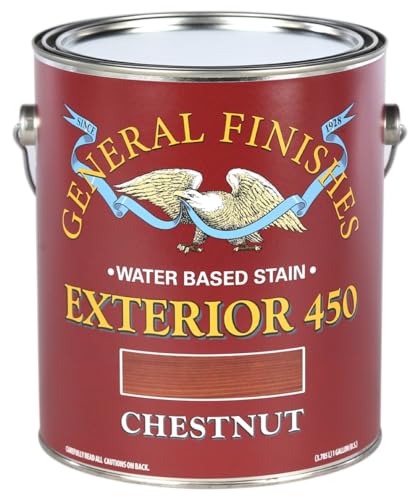
| General Finishes Exterior 450 (Red Mahogany) | Water-based exterior stain | 1 | ~112 sq ft | <150 g/L | $40.13 + topcoat | Low-VOC exterior color |
| Rubio Monocoat Oil Plus 2C (Pure) | Hardwax oil, 1-step | 1 (max) | ~175 sq ft | 0% VOC | $35.99 | One-coat, zero-VOC |
*Computed: (100 sq ft × manufacturer’s own minimum stated coat count) ÷ the manufacturer’s stated coverage per quart, then multiplied by the live Amazon quart price checked for this article. Stain-only products still need a separate clear topcoat, priced separately and not included in that column.
† The Danish Oil correction: several retailers and blogs quote a fixed coverage figure (commonly “125 sq ft per quart”) for Watco Danish Oil. Rust-Oleum’s own current technical data sheet for Watco Danish Oil does not publish a coverage number at all — it states coverage “varies with type and porosity of wood” and gives no fixed application count, just “apply one coat… if additional coats are needed, reapply.” The same sheet lists a recoat window of 72 hours (not the 4–6 hours some retail pages claim) and a VOC range of 441–492 g/L. On mahogany’s open pores specifically, expect the first coat to disappear into the wood faster than a tighter-grained species like maple or cherry — buy an extra can for a first project rather than trusting any single coverage number.
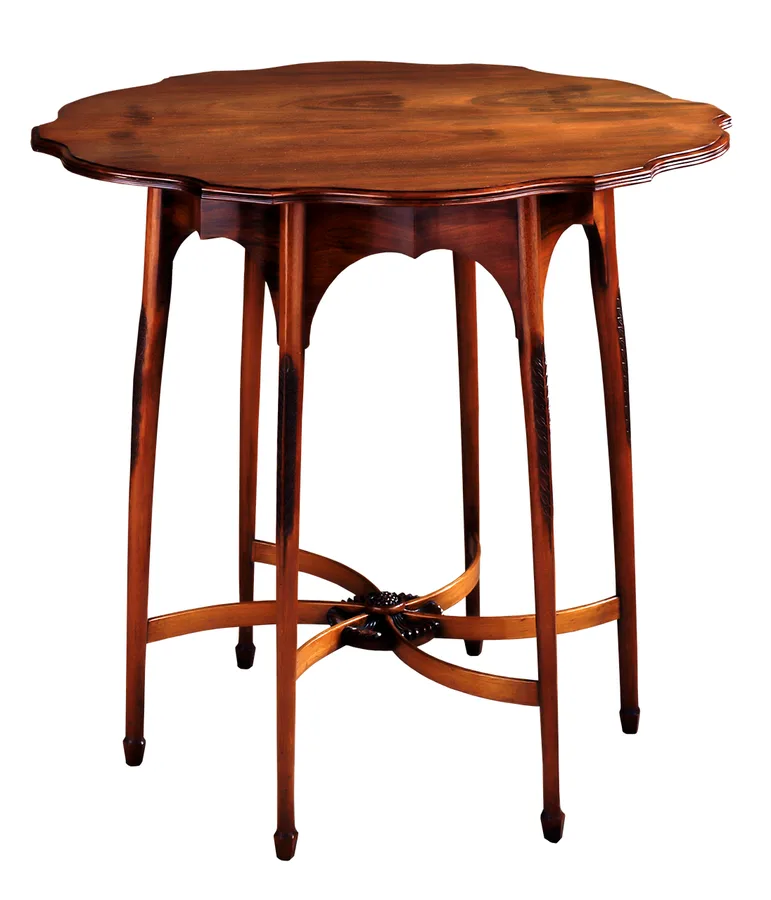
Best Mahogany Finishes
1. Minwax PolyShades (Bombay Mahogany, Satin) — #1 Best Overall
Price: $17.62/qt · View on Amazon
- Stain + polyurethane in one step — no separate topcoat
- 275 g/L VOC, oil-based
- 2 coats recommended, 8-hour recoat window
- Covers roughly 135 sq ft per quart per coat
PolyShades is the one-can answer to “what do I put on this mahogany table.” It’s an oil-based stain and polyurethane combined, so there’s no second product to buy and no separate topcoat step — at $26.10 to cover 100 sq ft in the two coats Minwax specifies, it’s also the cheapest way in this table to get a finished, protected surface in one product.
Main drawback: because color and film are the same coat, you’re brushing a film finish, not wiping a stain — on a wide tabletop that means working fast enough to keep a wet edge, or lap lines will telegraph through the topcoat where they won’t on a wipe-on product.
Pros:
- One can does color and protection — fastest real project here
- Bombay Mahogany is a genuinely warm, reddish match for real mahogany, not an orange “wood-tone” guess
- Widely stocked, easy to buy a second can mid-project
Cons:
- Because stain and poly are combined, you can’t wipe off excess color the way you can with a pure stain — lap marks show on large flat panels if you don’t keep a wet edge
- Not rated for exterior/UV exposure
2. General Finishes Oil Base Gel Stain (Brown Mahogany) — Best Gel Stain for Blotchy or Open-Grain Wood
Price: $56.50/qt · View on Amazon
- Gel consistency sits on the surface instead of soaking in unevenly
- 150–200 sq ft coverage per quart
- Dry to touch on raw wood: 8+ hours; full recoat: 12–24+ hours
- Requires a separate clear topcoat
Gel stains solve a specific mahogany problem: the wood’s open pores and occasional grain reversal absorb thin liquid stain unevenly, leaving dark blotches. Because General Finishes’ gel sits on the surface rather than flooding into the grain, color comes out more even coat to coat — the tradeoff is real cost. At $32.29 in stain alone per 100 sq ft (before a topcoat), it’s the priciest color-only product in this roundup.
Main drawback: it’s stain, not a finish — budget a separate can of wipe-on poly or oil topcoat, and budget the extra 1-2 days General Finishes’ own dry-time chart calls for before that topcoat goes on.
Pros:
- The thick gel resists diving into mahogany’s open pores unevenly, which is exactly the blotching problem straight liquid stains cause on this wood
- Rich, consistent “Brown Mahogany” color even over old finish or a wipe-off repair
Cons:
- At $56.50/qt it’s the most expensive stain-only product here, and still needs a separate topcoat purchase
- Long true recoat window (12–24+ hours on raw wood per General Finishes’ own numbers) means this is a multi-day project, not a weekend one
3. Watco Danish Oil (Natural) — Best Oil Finish for Mahogany
Price: $20.53/qt · View on Amazon
- Penetrating oil — hardens inside the wood, not as a surface film
- 441–492 g/L VOC (Rust-Oleum TDS)
- Touch-dry: 6–8 hours; recoat: 72 hours
- Coverage not published by manufacturer — varies with wood porosity
This is the closest thing in the lineup to the classic “hand-rubbed” mahogany look — oil that soaks into the pores and hardens from within rather than sitting on top as a film. Because coverage genuinely isn’t fixed (see the correction above), it doesn’t get a computed cost-per-100-sq-ft figure in the dataset table; budget for buying a second can on the first project rather than trusting a number this manufacturer itself won’t publish.
Main drawback: on its own it offers real but modest protection — for a dining table or anything that sees regular use, plan on a polyurethane topcoat after the 72-hour recoat window, not Danish Oil alone.
Pros:
- “Natural” shade lets mahogany’s own reddish-brown color and chatoyance show through instead of adding a stain tint
- No film to crack, peel, or show lap marks — refresh scratches by wiping on more oil
- Real Rust-Oleum polyurethane can be layered over it after 72 hours for extra protection
Cons:
- No published coverage figure — you’re buying by trial on the actual piece, not a spec sheet
- Minimal standalone water/heat resistance without a topcoat — needs coasters-and-placemats-level care indoors, and isn’t an exterior product
4. TotalBoat Gleam Marine Spar Varnish (Satin) — Best Exterior Finish for Mahogany
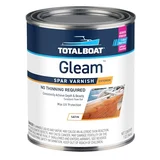
Price: $49.99/qt · View on Amazon
- True marine spar varnish with UV blockers and phenolic resins
- Manufacturer recommends 4–6 coats on bare wood
- Recoat in as little as 1 hour at 72°F; up to 3 coats/day
- Covers roughly 90–100 sq ft per quart per coat
Every interior stain and oil in this roundup will fail on an exterior mahogany door or deck within a season or two — UV breaks down pigments and film finishes that aren’t built for it. TotalBoat Gleam is an actual marine spar varnish: tung oil, phenolic resins, and UV blockers, applied in a real 4-6 coat build the manufacturer specifies for bare wood, not the 1-2 coats an interior product gets away with.
Main drawback: that durability is expensive to achieve — expect to spend $210 to over $300 per 100 sq ft once you’re actually applying the coat count TotalBoat’s own instructions call for, plus an annual 1-2 coat refresh to keep UV protection intact.
Pros:
- Built specifically for UV and weather exposure — the marine-varnish category exists because interior finishes fail outdoors
- Fast recoat window lets you build the full 4-6 coats in 2 days instead of 2 weeks
Cons:
- Real cost to do this right is $210–$316 per 100 sq ft at 4-6 coats — 8–40× more than an interior stain, and that’s before the annual 1-2 coat maintenance recoat the manufacturer recommends
- Overkill (and needless expense) for indoor furniture
5. Varathane Premium Wood Stain (Red Mahogany) — Best Value
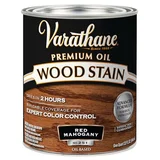
Price: $12.78/qt · View on Amazon
- Oil-based, dries to touch in about 1 hour
- 225–275 sq ft coverage per quart (Rust-Oleum TDS)
- <550 g/L VOC
- Requires a separate polyurethane or Varathane topcoat
If PolyShades’ one-step price ($26.10/100 sq ft) still feels like too much for a small project, Varathane’s plain stain is a fifth of that in material cost — $5.11 per 100 sq ft — and its 1-hour dry time means you’re not waiting overnight between color and topcoat.
Main drawback: it’s a thin liquid stain with no gel body, so on mahogany’s more porous sections it will absorb faster and darker than on tighter grain — test on an offcut and consider a pre-stain wood conditioner if evenness matters more than the extra few dollars a gel stain costs.
If you are comparing other color-only oil stains in this price range, ZAR Oil-Based Wood Stain 118 Dark Mahogany is another well-known option in the same category — see our full breakdown of its dry time, real specs, and current stock status.
Pros:
- Cheapest stain in the table at $5.11 per 100 sq ft in stain alone
- Fast 1-hour dry-to-touch means same-day staining and topcoating is realistic
- “Red Mahogany” is a true-to-name warm, saturated color
Cons:
- Straight liquid stain, no gel thickener — more prone to blotching on mahogany’s open grain than the gel stain pick
- Still needs a separate topcoat can, which erases some of the sticker-price advantage
6. General Finishes Exterior 450 (Red Mahogany) — Best Low-VOC / Water-Based Finish
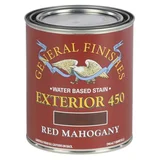
Price: $44.95/qt · View on Amazon
- Water-based, formulated for exterior vertical surfaces (doors, garage doors, furniture)
- <150 g/L VOC — the lowest of any pigmented stain in this table
- 112 sq ft coverage per quart; recoat in 2 hours
- Cures in 21 days; light use after 7–10 days
Between an interior stain and a full marine varnish sits this: a genuinely exterior-rated, water-based pigmented stain built for doors and outdoor furniture, with the lowest VOC content (<150 g/L) of any colored product in this roundup. It’s the pick for anyone who wants real UV/mildew resistance and mahogany color together without going to a clear marine varnish.
Main drawback: it’s still a stain, not a full film system — General Finishes sells a matching Exterior 450 water-based topcoat separately, and skipping it leaves the color exposed to weather without a protective layer.
Pros:
- Real UV absorbers and mildewcides built in, unlike an interior water-based stain repurposed for outdoor use
- Low odor and easy soap-and-water cleanup, genuinely useful on an occupied entry door
Cons:
- At $40.13 per 100 sq ft in stain alone (before topcoat), it’s priced closer to the marine varnish than to a budget interior stain
- 21-day full cure is a long window to keep a front door protected from handling
7. Rubio Monocoat Oil Plus 2C (Pure) — Best One-Coat, Zero-VOC Finish
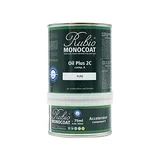
Price: $62.99 · View on Amazon
- Two-component hardwax oil — color and protection in exactly one coat
- 0% VOC, plant-based, near-odorless
- Covers 300–500 sq ft per liter (this container: ~175 sq ft)
- A second coat will not bond — the finish is designed to fully saturate in one pass
Rubio Monocoat’s whole pitch is in its name: one coat, done. The accelerator component (Part B) reacts with the oil to fully cure the wood surface in a single application — a second coat literally won’t bond, which is unusual among finishes but genuinely eliminates the multi-coat cost most of this table is built around. At $35.99 per 100 sq ft it beats every stain-plus-topcoat combination here once you price the topcoat in, and at 0% VOC it’s the cleanest-air option on the list.
Main drawback: the container tested here is the natural “Pure” shade, which enhances rather than colors the wood — if you want a deeper, more saturated mahogany tone, budget for one of Rubio’s tinted Oil Plus 2C shades instead, at the same one-coat coverage.
Pros:
- Only genuinely one-coat, zero-VOC system in this roundup — usable indoors the same day with minimal ventilation concerns
- At $35.99 per 100 sq ft it undercuts every film-forming stain-plus-topcoat combination once the topcoat cost is added in
- “Pure” shade lets mahogany’s natural color read through rather than tinting it
Cons:
- Tested in the natural “Pure” shade here, not a mahogany-specific tint — Rubio sells separate colored Oil Plus 2C shades if you want to deepen the tone
- Two-part mixing (Part A + accelerator) is a different, less forgiving workflow than opening a single can
How We Picked These
We have not physically tested these 7 finishes side by side on our own mahogany samples this session, so we’re not going to claim we did. What we did do: pull each product’s live Amazon price and buy-box status through Amazon’s Creators API on the date this article was last updated, cross-check coverage, coat count, dry time and VOC against each manufacturer’s own technical data sheet where one is published, and flag every spec a manufacturer doesn’t publish as “not published” rather than inventing a number (see the Danish Oil coverage correction above — that’s exactly what happened when we checked a commonly-repeated retailer figure against Rust-Oleum’s actual TDS).
Where a product’s own Amazon listing data was thin, we sourced from the manufacturer’s product page or TDS instead and said so. We did not fabricate star ratings or review counts — Amazon’s review data wasn’t reliably available for these listings this session, so none are shown here.
What to Consider When Buying a Mahogany Finish
Penetrating Oil vs. Film-Forming Finish
A penetrating oil (Danish Oil, Rubio Monocoat) soaks into the wood and hardens from within — there’s no film to crack or peel, but standalone water resistance is modest. A film-forming finish (PolyShades, spar varnish, any stain-plus-poly system) sits on top of the wood as a continuous layer — more protection per coat, but a film can eventually crack, cloud, or peel and needs full stripping to repair rather than a quick oil refresh.
Indoor vs. Outdoor / UV Exposure
This is the single biggest factor in this table. Interior stains and oils are not UV-stabilized; on an exterior door or deck they’ll fade or fail within a season. A true marine spar varnish or an exterior-rated water-based stain is a different product category, not just a “tougher” interior one — and it costs more because it needs more coats.
Oil-Based vs. Water-Based Stain
Oil-based stains (Minwax, Varathane) penetrate deeper and read richer on mahogany’s reddish tone, but have stronger odor and longer true cure times. Water-based stains (General Finishes Exterior 450) dry faster, clean up with soap and water, and typically carry a much lower VOC number — useful if the piece stays indoors during finishing.
Coat Count & Real Cost to Finish
The dataset above exists because coat count, not can price, drives real cost. A $12.78 can of stain that needs a topcoat and two coats of that topcoat can end up costing more per 100 sq ft than a $62.99 one-coat hardwax oil. Check the manufacturer’s stated minimum coat count before comparing sticker prices.
VOC Content & Ventilation
VOC content in this table ranges from Rubio Monocoat’s 0% to Watco Danish Oil’s 441–492 g/L. For an indoor project in an occupied home, that range is the difference between finishing at the kitchen table and needing the garage door open with a fan running.
Grain Filling & Blotch Control
Mahogany’s open pores and occasional grain reversal are the reason gel stains exist as a category. If you’re seeing dark, uneven blotching on a test piece with a liquid stain, that’s the wood, not a defect in the product — switch to a gel stain or fill the grain first.
Sheen Level
Satin is the most common sheen for mahogany furniture because it reads as a hand-rubbed finish rather than a plastic-looking shell. Gloss shows more depth in the grain but also shows every dust nib and fingerprint; matte hides both but can look flat on figured mahogany.
Not All “Mahogany” Is the Same Wood
“Mahogany” on a lumber tag can mean genuine Honduran/Genuine Mahogany (Swietenia macrophylla), African mahogany (Khaya species), or Philippine mahogany — a trade name that isn’t a true mahogany at all but a Shorea species (meranti/lauan). They don’t absorb finish identically: true mahogany’s alternating grain direction is what causes the blotching that makes gel stains and grain fillers worth the extra cost, while Philippine mahogany/meranti is generally more porous and uniform. Check what species you actually have — see our guide to mahogany wood types — before assuming a finish that worked on one will behave the same on the other.
Dry Time & Recoat Windows
These vary far more than most buying guides admit: Varathane’s stain is dry-to-touch in about an hour, while General Finishes’ gel stain can need 12–24+ hours on raw wood before a safe recoat, and General Finishes Exterior 450 isn’t fully cured for 21 days. Plan the project calendar around the slowest product in your combination, not the fastest.
Topcoat Compatibility
Four of the seven picks here are stain only and need a separate clear topcoat — that’s a second product, a second cost, and a second dry-time window not shown in the sticker price. The other three (PolyShades, TotalBoat Gleam, Rubio Monocoat) are complete systems in one can.
What This Actually Costs: Two Real Projects
The per-100-sq-ft figures above are useful for comparing products, but most people want to know what a specific project costs. Using two common rule-of-thumb finishable-surface-area estimates (all faces, edges and legs included, not just the visible top) applied to the coverage and coat-count data already sourced above:
| Project | Est. Finishable Area | Finish (from dataset above) | Material Cost |
|---|---|---|---|
| 6-ft mahogany dining table | ~40 sq ft | Minwax PolyShades, 2 coats | $10.44 |
| 6-ft mahogany dining table | ~40 sq ft | Rubio Monocoat Oil Plus 2C, 1 coat | $14.40 |
| Single exterior mahogany door (both faces + edges) | ~40 sq ft | TotalBoat Gleam, 4 coats (mfr. minimum) | $84.18 |
| Single exterior mahogany door (both faces + edges) | ~40 sq ft | TotalBoat Gleam, 6 coats (mfr. maximum) | $126.35 |
The 40 sq ft figure is a common rule-of-thumb estimate for total finishable surface on a 6-ft dining table or a full door (both faces plus edges), not a measurement of a specific product — measure your own piece for an exact number. The per-100-sq-ft rates are the same computed figures from the comparison table above.
The gap between the two table finishes is small — a few dollars either way. The gap between finishing that same table indoors and finishing an exterior door correctly is not: real marine-grade UV protection on a door costs 6–12× more in material than a one-coat interior hardwax oil, because the door needs 4-6 coats to actually work and the table needs 1-2.
How to Apply a Mahogany Finish
The exact process depends on which finish you pick above, but the sequence is the same for almost all of them:
- Sand in the direction of the grain, working through #120, #150, #180 and #220 grit. Stop at 220 — sanding mahogany finer than that can burnish the pores and make stain absorb unevenly.
- Remove all dust with a vacuum, then a tack cloth or a rag dampened with mineral spirits.
- Test on an offcut or a hidden area first, especially with a liquid stain — mahogany’s grain reversal and figure can absorb color differently even on the same board.
- Apply the finish per its own label: wipe-and-remove for oils and gel stains, brush or roller for film finishes like PolyShades and spar varnish.
- Respect the real recoat window from the dataset table above, not a guess — recoating a film finish too early is the most common cause of a cloudy or wrinkled topcoat.
- Apply the manufacturer’s stated minimum coat count, not just however many coats looks even. This is where the outdoor picks in particular get shorted — one coat of spar varnish on an exterior door is not a finished exterior door.
- Let the finish reach its full cure time (not just dry-to-touch) before regular use — General Finishes Exterior 450, for example, is usable in 7–10 days but not fully cured for 21.
Frequently Asked Questions About Mahogany Finish
What is the best oil finish for mahogany?
Watco Danish Oil in Natural is the most widely available true penetrating oil for mahogany — it hardens inside the wood rather than forming a surface film, and the Natural shade lets mahogany’s own color show through. For more protection, a Rust-Oleum polyurethane can be layered over it after the 72-hour recoat window on the product’s own technical data sheet.
What is the best exterior finish for mahogany?
A true marine spar varnish, such as TotalBoat Gleam, is the right category for exterior mahogany doors, decks and outdoor furniture — it’s formulated with UV blockers that interior stains and oils don’t have. Manufacturer instructions call for 4–6 coats on bare wood plus an annual 1-2 coat maintenance recoat, which is why it costs several times more per 100 sq ft to apply correctly than any interior product in this comparison.
How many coats of finish does mahogany need?
It depends entirely on the product, not the wood — and that’s the biggest gap in most buying advice. Minwax PolyShades specifies 2 coats; General Finishes gel stain and Varathane’s stain are typically 1 coat plus a separate topcoat; TotalBoat’s marine spar varnish needs 4–6 coats on bare wood; Rubio Monocoat is designed for exactly 1 coat and a second coat won’t bond. Always check the specific product’s own instructions rather than assuming a universal number.
Does mahogany need to be sealed before staining?
Mahogany’s open grain and pores can benefit from a grain filler before finishing, particularly under a film-forming finish where you want a glass-smooth surface — see our guide to finishing mahogany and why a grain filler comes first for the full process. It’s not mandatory for every finish; wipe-on oils and gel stains are commonly used without a filler step.
Can I put polyurethane over Danish oil on mahogany?
Yes. Watco’s own technical data sheet states any Rust-Oleum polyurethane finish can be applied over Watco Danish Oil, but only after a minimum 72-hour dry time — darker Danish Oil shades may need longer. Applying polyurethane before the oil has fully dried is a common cause of a cloudy or slow-curing topcoat.
Is water-based or oil-based stain better for mahogany?
Oil-based stains like Minwax and Varathane penetrate deeper and tend to read richer and warmer on mahogany’s reddish tone, but have stronger odor and longer cure times. Water-based options like General Finishes Exterior 450 dry faster, clean up with soap and water, and carry a much lower VOC content — a real advantage for an occupied home or an exterior door where ventilation is limited.
Do I need a grain filler under a gel stain or oil finish?
Not necessarily. Grain filler is mainly worth the extra step under a glass-smooth film finish where you want the pores fully leveled before the topcoat goes on — see our mahogany finishing and grain filler guide for that process. A wipe-on gel stain or a penetrating oil like Danish Oil is commonly used directly on properly sanded mahogany without a filler step; the open pores become part of the wood’s natural texture rather than a defect to hide.
Final Thoughts
For most indoor mahogany furniture, Minwax PolyShades in Bombay Mahogany Satin remains the best overall pick: one can, two coats, about $26 per 100 sq ft, done. The one number worth remembering from the whole comparison: an exterior mahogany door or deck finished correctly with a real marine spar varnish costs $210–$316 per 100 sq ft once you apply the 4-6 coats the manufacturer actually specifies — not the 1-2 coats an interior stain gets away with. Budget for the coat count, not just the can.
Related Guides
- Mahogany Finishing: Why You Need a Grain Filler First
- How to Finish Mahogany for Outdoor Use
- How to Stain Mahogany
- Matte vs. Satin Finish
- What Is the Best Clear Finish for Wood?
- Mahogany Wood Grain
- Characteristics of Mahogany Wood
Sponsored / affiliate links. As an Amazon Associate I earn from qualifying purchases. I may earn additional commission from eligible campaigns.