Chestnut Oak Vs Swamp Chestnut Oak: The Essential Guide
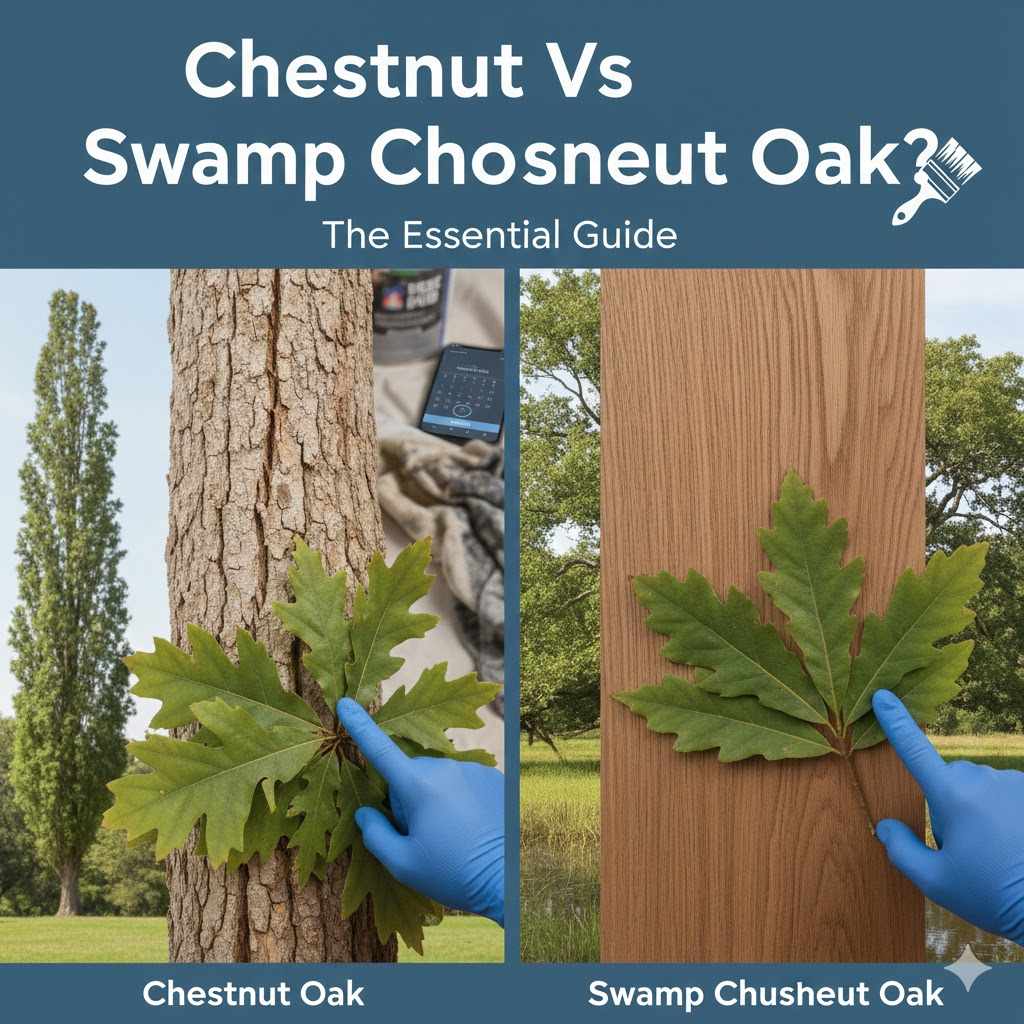
Chestnut Oak grows on dry, rocky ridges and has dark, deeply furrowed bark. Swamp Chestnut Oak prefers wet, bottomland soils and has lighter, scaly bark. The easiest way to tell them apart is by their habitat and bark, as their leaves can appear similar but have distinct differences upon closer inspection.
Hello friend! Welcome to the workshop. Have you ever come across a beautiful piece of oak and wondered which type you’re holding? You are not alone. Many woodworkers, even experienced ones, get puzzled by the similarities between certain woods. Chestnut Oak and Swamp Chestnut Oak are two perfect examples. They look alike and even share a name, which can make things confusing.
But don’t worry one bit. Telling them apart is easier than you think once you know what to look for. Think of it like learning a new secret handshake—it just takes a little practice. In this guide, I’ll walk you through the simple clues that will help you confidently identify each tree and its wood. We’ll look at everything from where they grow to the texture of their bark, so you’ll be able to spot the difference like a pro. Let’s get started!
Understanding the White Oak Family: A Quick Primer
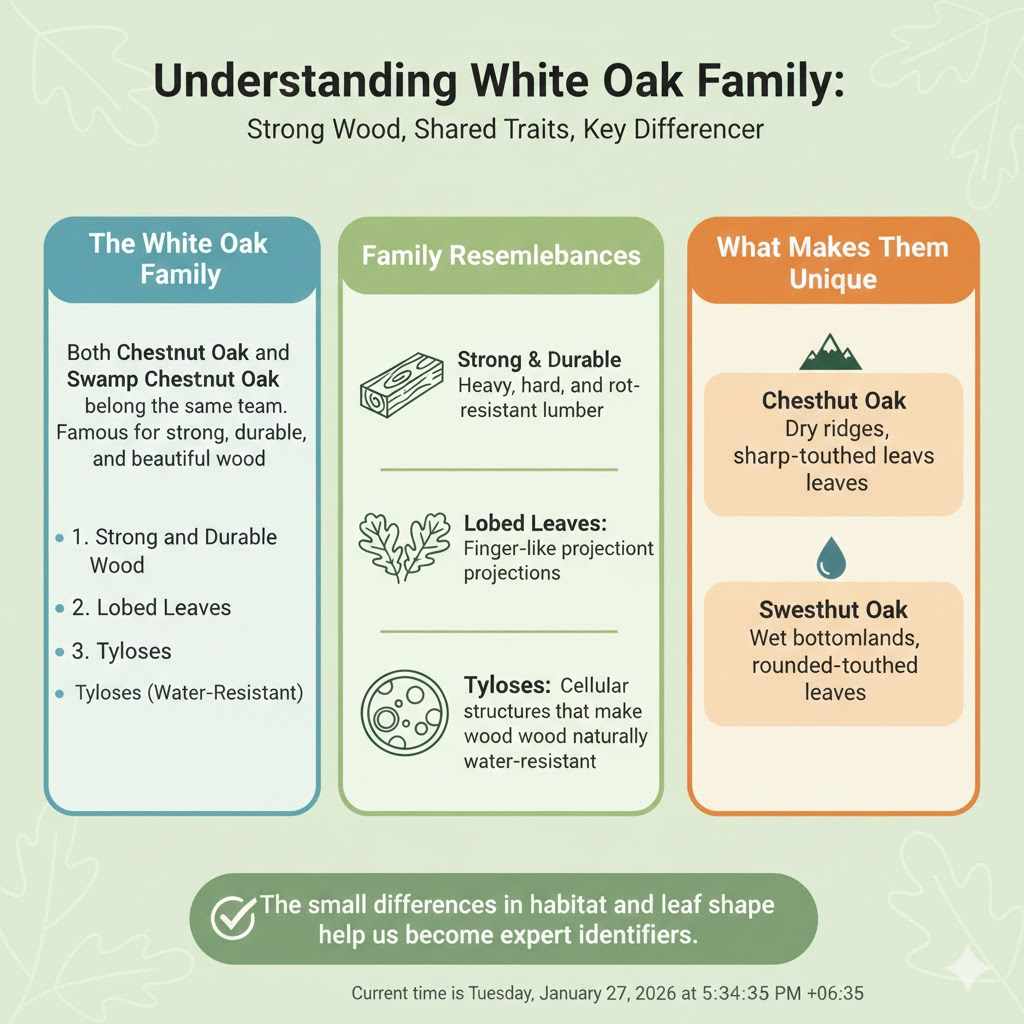
Before we dive into the details, it helps to know that both Chestnut Oak and Swamp Chestnut Oak belong to the same team: the white oak group. This is a big reason why they share so many qualities. Trees in the white oak family are famous for their strong, durable, and beautiful wood. They are a favorite for everything from furniture and flooring to barrel making.
Because they are relatives, you can expect some family resemblances:
- Strong and Durable Wood: Both produce heavy, hard, and rot-resistant lumber, a classic trait of white oaks.
- Lobed Leaves: Their leaves have lobes, or finger-like projections, but the shape and style of these lobes are one of our biggest clues.
- Tyloses: White oaks have cellular structures called tyloses that block up their pores. This makes the wood naturally water-resistant, which is why it’s so prized for outdoor projects and barrels.
Knowing they come from the same family helps explain why their wood can be so similar. But now, let’s focus on what makes them unique. The small differences are what will help us become expert identifiers.
Key Differences at a Glance: A Comparison Table
Sometimes, the easiest way to see the differences is to put them side-by-side. I’ve created this simple table to give you a quick reference. You can even print this out and keep it in your workshop or take it with you on a walk in the woods.
| Feature | Chestnut Oak (Quercus montana) | Swamp Chestnut Oak (Quercus michauxii) |
|---|---|---|
| Common Names | Rock Oak, Rock Chestnut Oak | Basket Oak, Cow Oak |
| Natural Habitat | Dry, rocky slopes and upland ridges | Moist, swampy areas, river bottoms |
| Bark Appearance | Dark gray, very thick, with deep, V-shaped ridges | Light gray or brownish-gray, flaky or scaly, not deeply ridged |
| Leaf Shape | Wedge-shaped base with rounded, uniform “scalloped” lobes | Broader leaf with more pointed, saw-tooth like lobes |
| Acorn | Medium-sized, oval acorn with a warty, bowl-shaped cap covering 1/3 of the nut | Very large, plump acorn with a bowl-shaped cap covering about 1/3 of the nut; known to be sweet |
| Wood Properties | Slightly harder, often has more character from growing on tough sites | Excellent workability, prized for its straight grain; considered a premium white oak |
Deep Dive: Identifying Chestnut Oak (Quercus montana)
Let’s get to know the Chestnut Oak, a true survivor. This tree is tough as nails, and that toughness shows in its appearance and its wood. Its scientific name is Quercus montana, and “montana” gives us a hint—it loves mountains and hillsides.
Where It Grows: Habitat and Range
The number one clue for identifying a Chestnut Oak is looking down at your feet. Where are you standing? If you are on a dry, rocky, or sandy ridge, there’s a good chance you’ve found one. These trees thrive in places where other trees might struggle. They don’t like “wet feet,” so you will almost never find them in damp, swampy areas.
Their natural range extends across the eastern United States, from southern Maine down through the Appalachian Mountains to Mississippi. According to the U.S. Forest Service, it is a dominant tree in many upland hardwood forests. So, if you’re hiking in the mountains, keep an eye out!
The Look and Feel: Bark and Form
The bark of a Chestnut Oak is its most recognizable feature. It is very thick, dark gray, and has deep, rough furrows that run up and down the trunk. These ridges often form a distinct diamond or “V” pattern. The bark looks and feels rock-solid, which is why it’s often called “Rock Oak.” Run your hand over it, and you’ll feel just how rugged it is. It’s built to protect the tree from fires that can sometimes sweep through its dry habitat.
Reading the Leaves
The leaves are another great clue. A Chestnut Oak leaf is typically between 4 to 8 inches long. It has a classic oval shape that is widest above the middle. The key feature is the edge of the leaf. Instead of sharp, pointy lobes like some oaks, the Chestnut Oak has shallow, rounded lobes. They look more like uniform, wavy scallops along the edge. The base of the leaf is often wedge-shaped. The top surface is a shiny dark green, while the underside is a paler green.
Acorns: The Telltale Sign
The acorns of a Chestnut Oak are about 1 to 1.5 inches long and have an oval shape. The cap is a key identifier. It looks like a little bowl and is covered in warty scales. The cap covers about one-third of the nut. These acorns are a favorite food for deer, squirrels, and turkeys.
Working with Chestnut Oak Wood
As a woodworker, this is where it gets exciting. Chestnut Oak wood is heavy, hard, and very strong. It has excellent rot resistance, making it fantastic for outdoor projects like fence posts, railroad ties, and decking. Because these trees often grow in tough conditions, the grain can sometimes be a bit more unpredictable than other oaks, but this can also add a lot of character to a finished piece.
It can be a bit tough on your tools because of its density, so make sure your blades are sharp! Once it’s finished, it looks beautiful, with a light to medium brown color that darkens with age. It’s a reliable, sturdy wood you can count on for projects that need to last a lifetime.
Deep Dive: Identifying Swamp Chestnut Oak (Quercus michauxii)
Now let’s head from the rocky ridges down to the lowlands to meet the Swamp Chestnut Oak. Its scientific name is Quercus michauxii, and it’s a much more refined cousin. This tree enjoys a life of luxury with plenty of water, and that comfortable lifestyle is reflected in its appearance and the quality of its wood.
Where It Grows: Habitat and Range
Just like with Chestnut Oak, the biggest clue for the Swamp Chestnut Oak is its home. As the name suggests, it loves water. You will find this tree in moist, rich soils in river bottoms, floodplains, and the edges of swamps. It thrives where its roots can stay damp. You will never find this tree naturally growing on a dry, rocky hillside. Its range is mostly in the southeastern United States, from the coastal plains of Virginia down to Florida and west to Texas.
For more detailed information, university resources like the University of Missouri Extension offer excellent guides on native trees and their habitats.
The Look and Feel: Bark and Form
The bark of a Swamp Chestnut Oak is quite different from its rugged cousin. It is much lighter in color, typically a light ash-gray or silvery-gray. Instead of deep furrows, the bark is flaky or scaly. It often peels off in long, thin plates, giving it a somewhat shaggy look. It is not nearly as thick or deeply ridged as the Chestnut Oak’s bark. Swamp Chestnut Oaks also tend to grow very straight and tall, especially when growing in a forest, reaching for sunlight.
Reading the Leaves
The leaves of a Swamp Chestnut Oak are often larger than those of the Chestnut Oak, sometimes reaching up to 10 inches long. While they have a similar overall shape, the lobes are more distinct and often come to a small point, looking more like large teeth on a saw blade. The leaf is typically wider near the tip than at the base. The top side is dark green, and the underside is a pale, fuzzy silver-green, which is a lovely feature to look for.
| Leaf Characteristic | Chestnut Oak | Swamp Chestnut Oak |
|---|---|---|
| Lobe Shape | Rounded, shallow, “scalloped” appearance | More pointed, uniform, “saw-tooth” appearance |
| Underside Color | Pale green, smooth | Silvery-white, often fuzzy to the touch |
| Overall Size | 4-8 inches long | 5-10 inches long |
Acorns: Sweet and Sought-After
The acorns are another star feature of the Swamp Chestnut Oak. They are some of the largest acorns of any native oak, often over 1.5 inches long. They are plump and sweet-tasting (for an acorn!), which is why this tree is also called “Cow Oak”—cows love to eat them! The cap is bowl-shaped with gray, fuzzy scales and covers about one-third of the nut. Finding these giant acorns on the ground is a sure sign you’re standing under a Swamp Chestnut Oak.
Working with Swamp Chestnut Oak Wood
For woodworkers, Swamp Chestnut Oak is a dream come true. It’s considered one of the highest-quality white oaks you can find. Because it grows in rich, consistent soil, its grain is often very straight and uniform. This makes it incredibly easy to work with. It cuts, glues, and finishes beautifully.
It has all the classic white oak qualities—strength, durability, and water resistance—but with a more predictable and pleasing grain pattern. This makes it a top choice for high-end furniture, cabinetry, interior trim, and hardwood flooring. If a project calls for beautiful, reliable white oak, Swamp Chestnut Oak is one of the best you can choose.
Which Oak Is Right for Your Project?
Now that you can tell these two oaks apart, you might be wondering which one to use for your next project. Both are fantastic woods, but their strengths make them better suited for different tasks. Here’s a simple guide to help you decide.
For Outdoor Projects (Fencing, Landscaping Timbers, Decks)
Winner: Chestnut Oak
While both oaks have excellent rot resistance, the rugged, dense nature of Chestnut Oak makes it a champion for tough outdoor jobs. Its ability to withstand the elements is proven by where it grows. If you’re building a fence post, a retaining wall, or anything that will be exposed to moisture and soil, Chestnut Oak is an incredibly durable and reliable choice. It’s built to last.
For Indoor Furniture and Fine Cabinetry
Winner: Swamp Chestnut Oak
When it comes to beautiful indoor pieces, Swamp Chestnut Oak is the star. Its straight, clear grain and consistent texture make it a pleasure to work with. It produces stunning results for tabletops, chairs, cabinets, and chests. The wood’s predictable nature means fewer surprises during cutting and assembly, which is a huge bonus for any woodworker, especially a beginner. Its clean look fits perfectly with both traditional and modern designs.
For Rustic or Character-Filled Pieces
Winner: Chestnut Oak
If you love wood with a story, Chestnut Oak is your friend. The tough life it lives on rocky ridges can create more knots, mineral streaks, and interesting grain patterns. This “character” can bring a wonderfully rustic and authentic feel to a project. A mantlepiece, a rustic bench, or a farmhouse table made from Chestnut Oak will have a unique personality all its own.
For Flooring
Winner: Tie (with a slight edge to Swamp Chestnut Oak)
Both are extremely hard and durable, making them excellent choices for flooring that needs to stand up to heavy foot traffic. Swamp Chestnut Oak is often preferred because its straighter grain provides a more uniform and classic look. However, Chestnut Oak flooring can be just as beautiful, offering a bit more rustic charm. The choice here really comes down to the style you are trying to achieve.
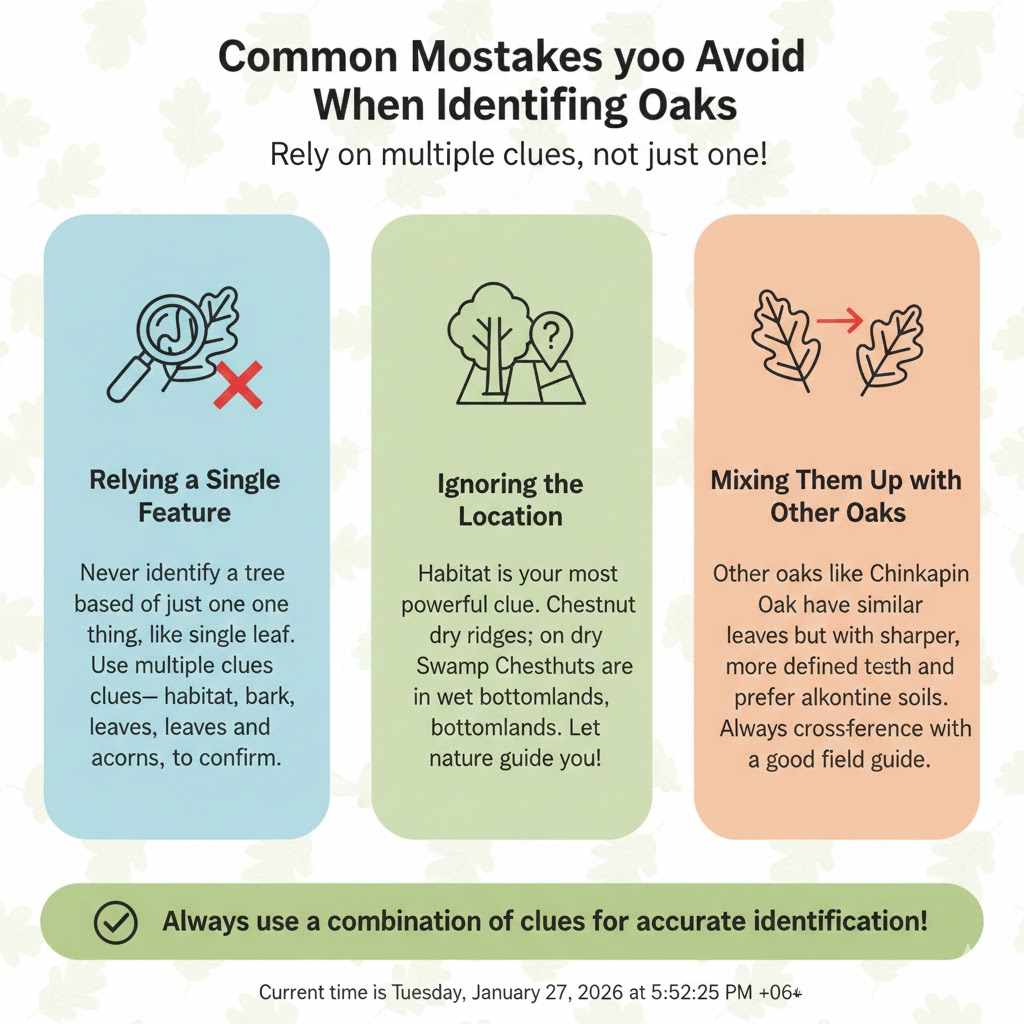
Common Mistakes to Avoid When Identifying Oaks
It’s easy to get excited and jump to conclusions, but here are a few common slip-ups to watch out for on your identification journey:
- Relying on a Single Feature: Never identify a tree based on just one thing, like a single leaf. Leaves can vary from tree to tree, or even on the same branch. Always use multiple clues—habitat, bark, leaves, and acorns—to confirm your identification.
- Ignoring the Location: The habitat is your most powerful clue. If you find an oak with chestnut-like leaves on a dry ridge, it’s almost certainly a Chestnut Oak. If you find one in a wet, swampy bottomland, it’s almost certainly a Swamp Chestnut Oak. Let nature guide you!
- Mixing Them Up with Other Oaks: There are other oaks with similar leaves, like the Chinkapin Oak (Quercus muehlenbergii). However, Chinkapin Oak usually has sharper, more defined teeth on its leaves and prefers alkaline (limestone) soils. Always cross-reference with a good field guide if you’re unsure.
Frequently Asked Questions (FAQ)
Are both Chestnut Oak and Swamp Chestnut Oak good for beginner woodworkers?
Yes, both are great choices! However, Swamp Chestnut Oak is often considered more beginner-friendly because its straight, consistent grain makes it easier to cut, join, and finish. Chestnut Oak can be a bit harder on tools due to its density, but it’s still a wonderful and rewarding wood to work with.
Which tree has bigger acorns?
Swamp Chestnut Oak has some of the largest acorns of all North American oaks. They are noticeably larger and plumper than the acorns of the Chestnut Oak. Plus, they are much sweeter and are a favorite food for wildlife and livestock.
Can I use them for the same projects?
For many projects, you can use them interchangeably. Both are strong, hard white oaks suitable for furniture, flooring, and general construction. However, for specialized uses, like outdoor projects that need maximum rot resistance (Chestnut Oak) or fine furniture that needs a clear, straight grain (Swamp Chestnut Oak), choosing the right one can make a big difference.
Is one type of wood more expensive than the other?
Generally, Swamp Chestnut Oak is considered a premium hardwood and may be more expensive and harder to find. It is often sold specifically for high-end uses like furniture and architectural millwork. Chestnut Oak is more commonly used for industrial purposes like railroad ties and pallets, but it can still be sourced for beautiful lumber, sometimes at a lower price point.
Why are they called “Chestnut” oaks?
They get their name because their leaves look very similar to the leaves of the American Chestnut tree (Castanea dentata). Both have long leaves with toothed or lobed edges. It’s a great example of how a common name can point you to a key identification feature!
Which wood is harder?
Both are very hard woods. On the Janka hardness scale, which measures a wood’s resistance to denting, Chestnut Oak typically scores around 1450 lbf (pounds-force), while Swamp Chestnut Oak scores around 1530 lbf. They are very close in hardness, but Swamp Chestnut Oak is technically a bit harder, making them both exceptionally durable for flooring and furniture.
Wrapping It Up with Confidence
And there you have it! The mystery of Chestnut Oak versus Swamp Chestnut Oak is solved. It all comes down to paying attention to a few simple clues. Remember to look at where the tree is growing first—is it a dry ridge or a wet bottomland? Then, feel the bark. Is it dark and deeply ridged, or light and flaky?
By combining these clues with the shape of the leaves and acorns, you can confidently tell these two wonderful trees apart. This knowledge doesn’t just make you a better naturalist; it makes you a smarter woodworker. Now you can choose the perfect wood for your project, knowing exactly what qualities you’re getting.
So next time you’re out for a walk or visiting a lumberyard, take a closer look. Practice your new identification skills. Building confidence in woodworking starts with understanding your materials, and you’ve just taken a huge step forward. You’ve got this! Happy building, my friend.