Difference Between Sycamore And Maple: Essential Differences
The key difference is that the American Sycamore (Platanus occidentalis) and Maple (Acer) are entirely different trees. However, the European Sycamore is a type of maple (Acer pseudoplatanus), which causes the confusion. For woodworkers, Maple is typically harder with a finer grain, while American Sycamore has a coarser texture with prominent rays.
Hello, fellow makers! Welcome to the workshop. Today, we’re clearing up a question that puzzles a lot of new woodworkers and even seasoned gardeners: What’s the real difference between a Sycamore and a Maple tree? It’s easy to get them mixed up, especially since their names are often used interchangeably in different parts of the world. But don’t worry, it’s not as tricky as it seems.
Whether you’re trying to identify a tree in your yard or picking out lumber for your next project, knowing how to tell them apart is a handy skill. We’ll walk through everything from the leaves and bark to the wood itself. By the end of this guide, you’ll be able to spot the differences with confidence. Let’s get started!
The Great Sycamore vs. Maple Mix-Up: Why It Happens
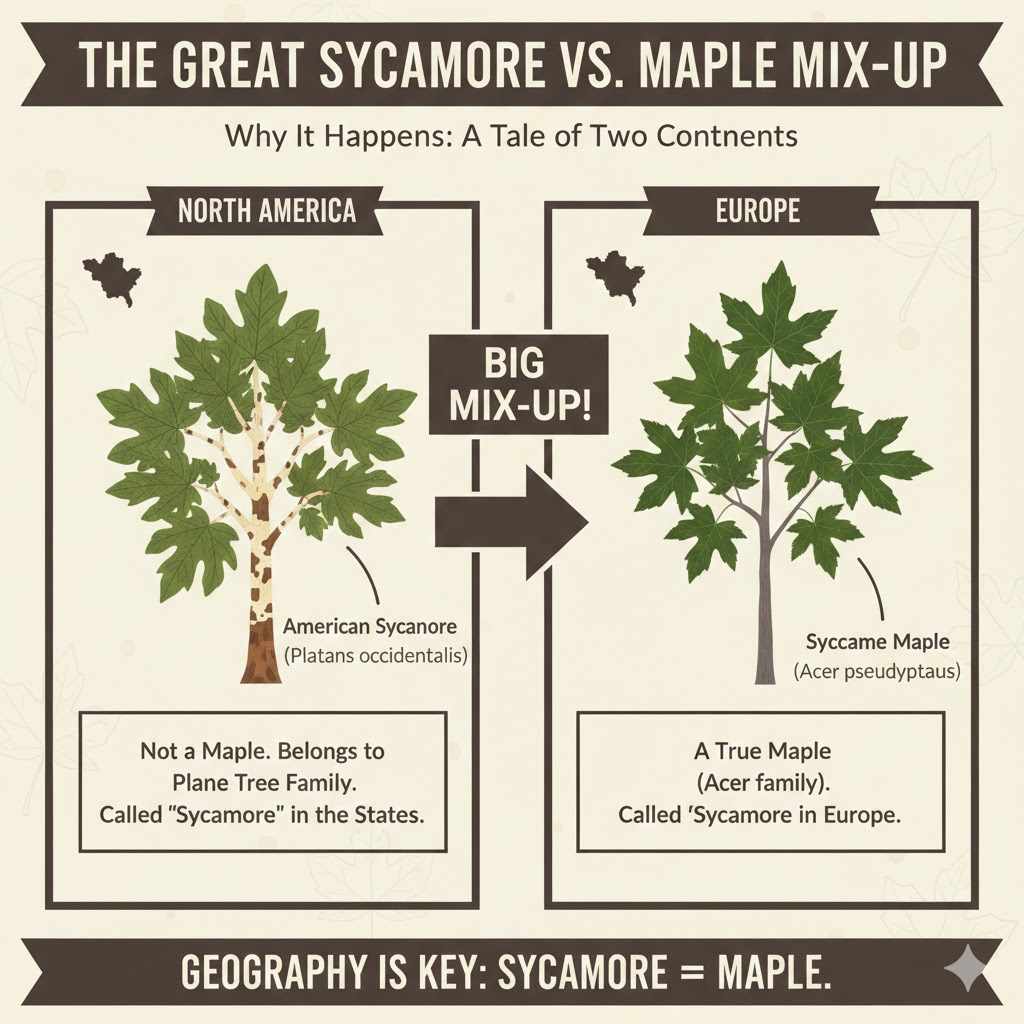
The main reason for all the confusion comes down to geography and a case of mistaken identity. What people call a “sycamore” in Europe is completely different from what Americans call a “sycamore.”
- In North America: When someone says “Sycamore,” they are almost always talking about the American Sycamore tree, whose scientific name is Platanus occidentalis. It belongs to the Plane tree family and is not a maple at all.
- In Europe: The tree commonly called a “Sycamore” is actually a type of maple tree. Its scientific name is Acer pseudoplatanus, often called the Sycamore Maple. It is a true member of the Maple (Acer) family.
So, the big mix-up starts right there! A Sycamore in London is a Maple, while a Sycamore in New York is something else entirely. For this guide, we’ll focus mostly on comparing the true American Sycamore (Platanus) with the general Maple family (Acer), because this is where the key differences lie for most of us in the States.
A Tree Detective’s Guide: Identifying Sycamore vs. Maple in the Wild
When you’re out and about, you don’t need a science lab to tell these trees apart. You just need to know what to look for. Think of it as being a tree detective—the clues are right there on the leaves, bark, and seeds.
The Easiest Clue: Look at the Leaves
The leaves are your number one clue. The way they are shaped and how they grow on the branch is a dead giveaway.
Maple Leaves (Acer):
- Arrangement: Maple leaves grow in pairs, directly opposite each other on the stem. If you find one leaf, its partner will be right across from it.
- Shape: This is the classic leaf shape many of us recognize! They have several distinct, pointed lobes (usually 3 to 5) that radiate out from a central point, like fingers on a hand.
- Edges: The valleys between the lobes, called sinuses, are usually V-shaped and deep. Think of the iconic Canadian flag maple leaf.
American Sycamore Leaves (Platanus occidentalis):
- Arrangement: Sycamore leaves grow in an alternating pattern on the stem. One leaf will appear, and the next one will be a little further up on the other side. They are never in pairs.
- Shape: These leaves are huge! They are much broader and larger than most maple leaves. They have lobes, but the lobes are wide and shallow.
- Edges: The valleys between the lobes are very shallow and wide, not sharp and deep like a maple’s.
| Feature | Maple Leaf | American Sycamore Leaf |
|---|---|---|
| Arrangement on Stem | Opposite (in pairs) | Alternate (staggered) |
| Overall Shape | Distinct pointed lobes (3-5) | Broad, large with shallow lobes |
| “Valleys” (Sinuses) | Deep and V-shaped | Shallow and wide |
| Typical Size | Medium | Large to very large |
Look at the Bark: A Telltale Sign
If the leaves are gone for the winter, the bark is your next best friend. The difference here is striking.
Maple Bark:
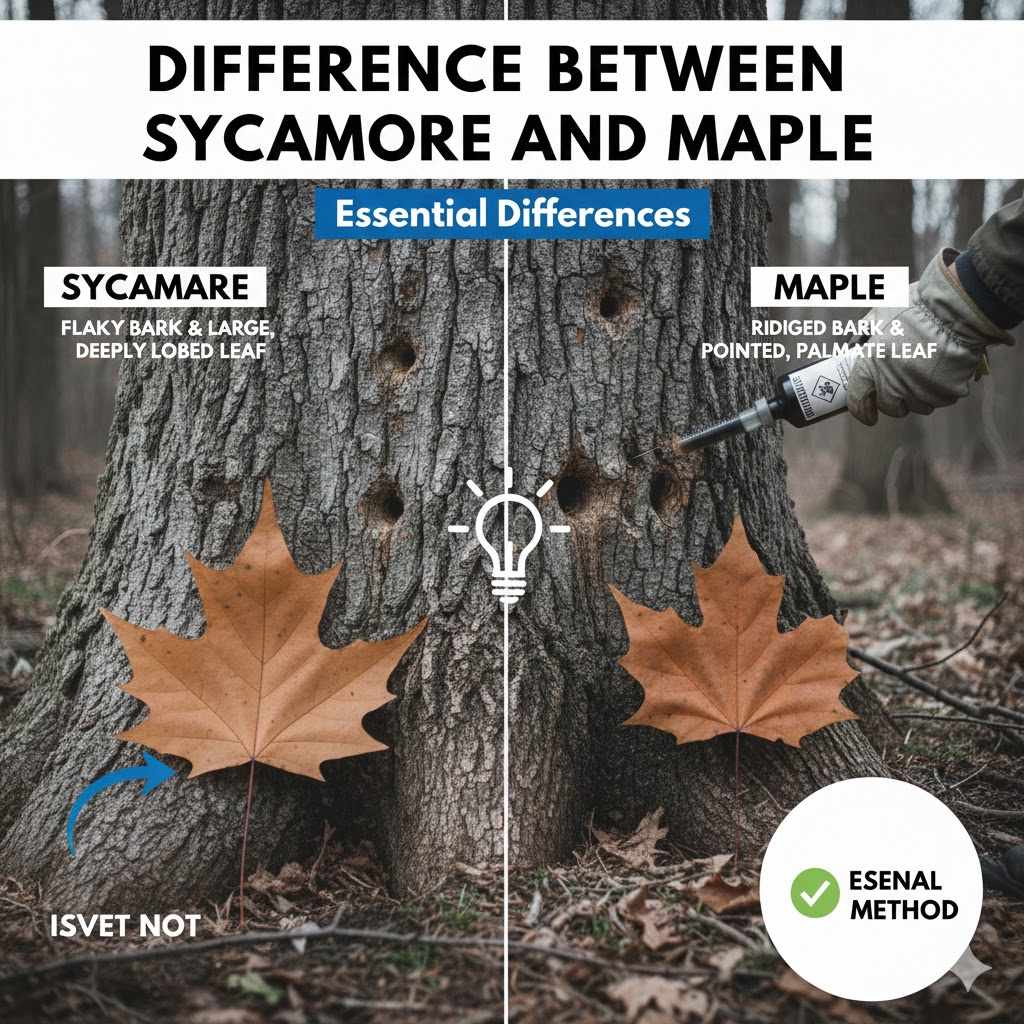
On young maple trees, the bark is typically smooth and gray. As the tree gets older, the bark becomes darker and develops deep furrows, ridges, or shaggy plates, depending on the species. A mature Sugar Maple, for example, has thick, irregular plates that look like they could peel off.
American Sycamore Bark:
This is the sycamore’s most famous feature! The bark is a beautiful, mottled patchwork of gray, brown, tan, and creamy white. The outer, darker bark peels away in large, irregular sheets, revealing the lighter, almost white, inner bark. It often looks like camouflage. You can spot a sycamore from a distance just by its unique, patchy trunk, especially on the upper branches where it’s almost pure white.
Don’t Forget the Seeds!
The seeds, or fruits, are another easy way to tell them apart.
Maple Seeds:
Maple seeds are unmistakable. They are called “samaras,” but most of us know them as “helicopters” or “whirlybirds.” They come in a connected pair with papery wings that make them spin as they fall from the tree. It’s a classic sign of autumn fun!
American Sycamore Seeds:
Sycamore seeds are very different. They are packed together into a tight, fuzzy, round ball about one inch in diameter. These seed balls hang from the branches throughout the winter and break apart in the spring, releasing hundreds of tiny, tufted seeds to be carried by the wind.
In the Workshop: A Woodworker’s Comparison
Okay, let’s bring it back to the workshop. As woodworkers, we care just as much about what the wood looks like and how it behaves. Here’s how Sycamore and Maple stack up when you’re ready to build.
Wood Grain, Color, and Figure
At first glance, boards of Maple and American Sycamore can look similar, but a closer look reveals key differences.
Maple Wood:
- Color: Maple is known for its light, creamy white to off-white sapwood. Some species, like Red Maple, can have reddish-brown heartwood. Its color is generally very uniform.
- Grain: It has a very fine, straight grain with a smooth, even texture. This clean look is why it’s so popular for modern furniture.
- Figure: Maple is famous for its beautiful figuring. You can find “curly” (wavy grain), “bird’s-eye” (small swirling patterns), and “quilted” or “spalted” varieties that are highly prized by woodworkers for special projects.
American Sycamore Wood:
- Color: The sapwood is white to light tan, while the heartwood is a darker reddish-brown. It looks a bit like maple but is often less bright.
- Grain: Sycamore grain can be straight, but it is often interlocked or wavy. A defining feature is its prominent “ray flecks.” These are small, silvery specks that show up when the wood is quartersawn, giving it a unique speckled appearance sometimes called lacewood.
- Figure: While it doesn’t have the famous figures of maple, its ray flecks give it a distinct and decorative character of its own.
Hardness and Durability
How tough is the wood? This is crucial for projects that will see a lot of wear and tear, like flooring or cutting boards. We measure wood hardness using the Janka hardness test, which measures the force needed to embed a steel ball into the wood. A higher number means harder wood.
There are two main types of maple used in woodworking: hard maple and soft maple.
- Hard Maple (Sugar Maple): This is the heavyweight champion. With a Janka rating of around 1,450 lbf (pounds-force), it’s incredibly dense, hard, and durable. This makes it perfect for flooring, workbenches, and butcher blocks.
- Soft Maple (Red Maple, Silver Maple): Despite its name, “soft” maple is still a very durable hardwood. It just isn’t as hard as Sugar Maple. Its Janka rating is usually between 700 and 950 lbf. It’s a great, more affordable choice for furniture and cabinets.
- American Sycamore: This wood lands squarely in the middle. Its Janka rating is about 770 lbf, making it very similar in hardness to soft maple. It’s tough enough for many applications but will dent more easily than hard maple.
Workability: Cutting, Shaping, and Sanding
How a wood behaves with your tools can make a project a joy or a chore. Here’s what to expect.
Maple Wood:
Hard maple can be tough on tools due to its density. You’ll need sharp blades to avoid burning when cutting or routing. It machines beautifully, leaving a very clean edge, and it sands to a silky-smooth finish. Soft maple is much easier to work with, both with hand and power tools.
American Sycamore Wood:
Sycamore is generally easy to work with. It cuts and sands well. However, its interlocked grain can sometimes cause tear-out during planing or jointing, especially on flatsawn boards. Using sharp blades and taking shallow passes will help you get a great result. It also glues and holds screws very well.
Staining and Finishing
Getting a perfect finish is the final touch on any project. Maple and Sycamore each have their own quirks here.
Maple Wood:
Because of its dense, tight grain, maple can be tricky to stain. It has a tendency to look blotchy, with some areas soaking up more stain than others. To get an even color, it’s highly recommended to use a pre-stain wood conditioner first. Many woodworkers prefer to use a clear finish like lacquer or polyurethane on maple to show off its natural, creamy beauty.
American Sycamore Wood:
Sycamore is much more forgiving when it comes to finishing. It takes stains evenly and finishes beautifully with oils, varnishes, or lacquers. Its natural luster and ray flecks really pop under a clear coat.
Practical Uses: Where Do These Woods Shine?
Different woods are suited for different jobs. Here’s where you’ll most often find Maple and Sycamore being used.
Common Uses for Maple:
- Furniture: A favorite for everything from chairs and tables to cabinets.
- Flooring: Hard maple is the go-to choice for basketball courts and dance floors for a reason!
- Butcher Blocks & Cutting Boards: Its hard, dense, closed-grain nature makes it food-safe and durable.
- Musical Instruments: Used for violins, cellos, guitars, and drum shells.
- Woodturning & Small Crafts: Great for bowls, toys, and other detailed work.
Common Uses for American Sycamore:
- Butcher Blocks: Like maple, it’s used for cutting surfaces, especially in commercial settings.
- Boxes, Crates, and Pallets: Its toughness and affordability make it useful for utility items.
- Veneer and Plywood: The decorative quartersawn figure is often used as a surface layer.
- Furniture Components: Used for parts that are not highly visible, like drawer sides and frames.
- Interior Trim and Millwork: Can be used for decorative moldings and panels.
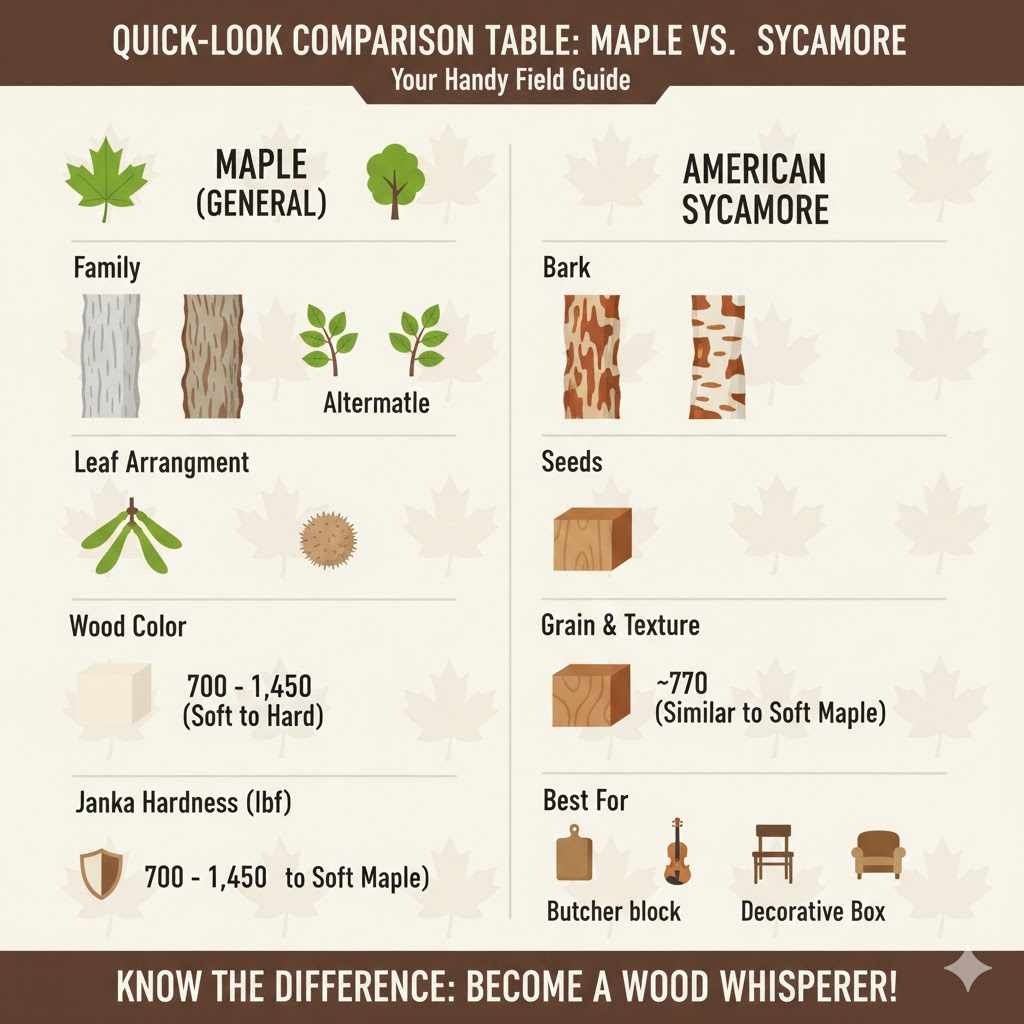
Quick-Look Comparison Table: Maple vs. American Sycamore
Let’s put all of that information into one simple table for a quick reference.
| Feature | Maple (General) | American Sycamore |
|---|---|---|
| Family | Acer | Platanus |
| Leaf Arrangement | Opposite | Alternate |
| Bark | Smooth and gray when young, furrowed or shaggy when old | Mottled, camouflage-like pattern; peels in large flakes |
| Seeds | Paired “helicopters” (samaras) | Single, round, fuzzy seed ball |
| Wood Color | Creamy white to light reddish-brown, very uniform | White to tan with reddish-brown heartwood, less uniform |
| Grain & Texture | Fine, straight grain with smooth texture; known for figuring | Interlocked grain with a coarser texture and prominent ray flecks |
| Janka Hardness (lbf) | 700 – 1,450 (Soft to Hard Maple) | ~770 (Similar to Soft Maple) |
| Best For | Flooring, fine furniture, cutting boards, musical instruments | Butcher blocks, veneers, decorative boxes, utility furniture |
Frequently Asked Questions (FAQ)
Is sycamore a hardwood or a softwood?
American Sycamore is a hardwood. The terms “hardwood” and “softwood” refer to the type of tree, not the actual hardness of the wood. Hardwoods come from deciduous trees (trees that lose their leaves), like oak, maple, and sycamore. Softwoods come from coniferous trees (trees with needles and cones), like pine and fir.
Can I use sycamore wood for outdoor projects?
No, American Sycamore is not a good choice for outdoor projects. It has very low resistance to rot and decay, and it is also susceptible to insect attack. If used outdoors, it must be thoroughly treated and sealed with a protective finish, and even then, it will not last as long as naturally rot-resistant woods like cedar, cypress, or white oak.
Is maple wood more expensive than sycamore wood?
Generally, yes. Standard soft maple and American Sycamore are often similarly priced and are quite affordable. However, hard maple is usually more expensive due to its higher demand and desirable properties. Highly figured maple, like bird’s-eye or curly maple, can be very expensive and is sold as a premium specialty wood.
Which is better for a cutting board, maple or sycamore?
Both are excellent choices! Hard maple is the industry standard for cutting boards because it is incredibly durable, has a closed grain that helps keep bacteria out, and is “knife-friendly” (it won’t dull your knives too quickly). American Sycamore is also traditionally used for butcher blocks for the same reasons. It’s tough, has a closed grain, and is considered food-safe. You can’t go wrong with either one, but hard maple has a slight edge in pure hardness.
Why is my sycamore tree’s bark peeling?
The peeling, flaky bark is a completely natural and healthy process for an American Sycamore tree. The bark of a sycamore is not very elastic. As the trunk grows and expands, the rigid outer bark cracks and flakes off, revealing the lighter-colored inner bark. This is what creates its beautiful, distinctive camouflage pattern. It’s a sign of a healthy, growing tree!
Are European sycamore and American sycamore the same?
No, they are not the same. This is the biggest point of confusion. The European Sycamore (Acer pseudoplatanus) is a type of maple. The American Sycamore (Platanus occidentalis) is a member of the Plane tree family. They are completely different species, so it’s important to know which one you are talking about.
Choosing the Right Wood for Your Project
So, there you have it! The mystery of Sycamore versus Maple is solved. It all comes down to knowing which sycamore you’re talking about—the American one or its European maple cousin. Once you know how to spot the differences in the leaves, bark, and seeds, you’ll never mix them up again.
In the workshop, both Maple and American Sycamore are fantastic woods with unique personalities. If you need something incredibly hard and durable with a clean, modern look, hard maple is an unbeatable choice. If you’re looking for an affordable, easy-to-work hardwood with a beautiful and unique speckled figure, give American Sycamore a try.
The next time you’re at the lumberyard or walking through a park, take a closer look. You now have the skills of a tree detective to confidently tell these two amazing trees apart. Happy building, and remember to always enjoy the process of learning and creating in your workshop.