Golf Wood vs Driver Key Differences Golfers Need
Many new golfers get a little confused when they first look at golf clubs. They see the driver, which is big and looks powerful. Then they see woods, which are smaller but still seem important.
It’s easy to wonder what makes them different and when to use each one. This is a common puzzle for beginners, but don’t worry! We’ll make it super simple to figure out the Golf Wood vs Driver: Key Differences Golfers Should Know.
We’ll walk through it step by step so you can feel confident on the course.
Understanding Golf Clubs Drivers vs Woods
The driver and woods are both vital clubs in a golfer’s bag, often used for hitting the ball long distances. While they share a similar purpose, they have distinct designs and are suited for different situations on the golf course. Understanding these differences helps golfers choose the right club for the job, improving their game.
This section explores the fundamental distinctions between drivers and fairway woods, setting the stage for a deeper understanding of their roles.
What Is a Golf Driver
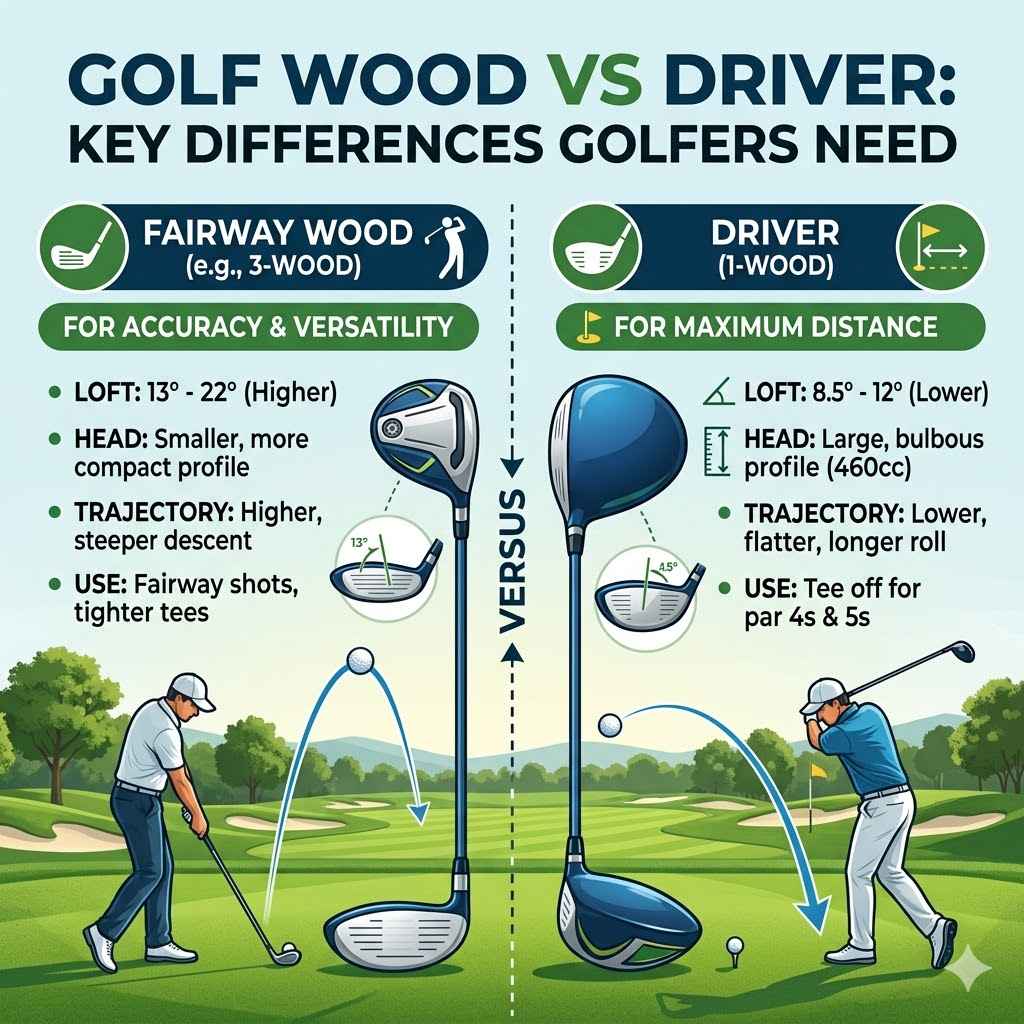
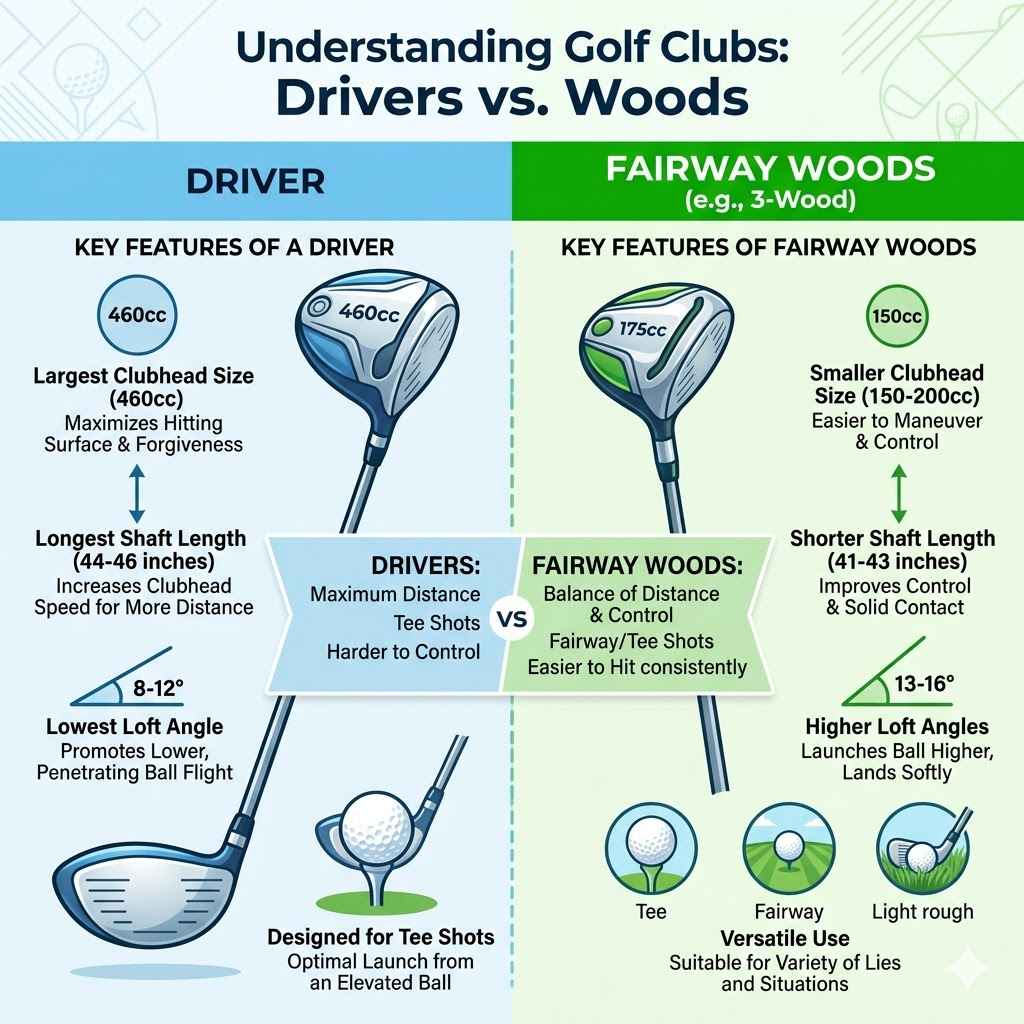
A golf driver is the longest club in your bag, designed to hit the ball the farthest. It has the largest clubhead, often around 460 cubic centimeters, which is the maximum allowed by golf rules. The clubface is usually the largest and thinnest, allowing for maximum energy transfer to the ball.
The shaft is also the longest, which helps generate higher clubhead speed. This combination is meant to send the ball soaring down the fairway on long holes.
The driver is specifically designed for tee shots. When you’re on the first tee of a hole, you want to hit the ball as far as possible to set up your next shot. The large head and long shaft of the driver allow for this incredible distance.
However, because of its design, it’s also the hardest club to control. Hitting the sweet spot consistently can be tricky, and a slight miss-hit can send the ball way off course.
Key Features of a Driver
- Largest Clubhead Size: Typically 460cc, maximizing the hitting surface and forgiveness. This large volume helps golfers who don’t hit the center of the clubface perfectly, still getting a decent shot.
- Longest Shaft Length: Standard drivers have shafts around 44 to 46 inches. This increased length is designed to increase clubhead speed, which directly translates to more distance.
- Lowest Loft Angle: Drivers usually have lofts ranging from 8 to 12 degrees. Loft refers to the angle of the clubface. A lower loft promotes a lower, penetrating ball flight, which is ideal for maximizing distance.
- Designed for Tee Shots: The driver’s primary use is on the tee box, where the ball is elevated on a tee. This elevated position allows golfers to hit up on the ball, which is necessary for optimal launch conditions with a driver.
What Is a Golf Fairway Wood
Golf fairway woods are the clubs you’ll see after the driver in terms of length and clubhead size. They are designed to hit the ball long distances, but they are more versatile than drivers. You can use them from the tee box, but they are also excellent for hitting shots from the fairway or even light rough.
They have smaller clubheads than drivers and slightly more loft.
Fairway woods come in different numbers, like a 3-wood, 5-wood, or 7-wood. The higher the number, the shorter the club, the smaller the head, and the higher the loft. A 3-wood is the longest and has the least loft, making it the closest in performance to a driver.
A 7-wood is much shorter and has more loft, making it easier to hit high and land softly.
Fairway woods offer a great balance between distance and control. While they won’t typically match the absolute longest drives a driver can produce, they are much easier to hit consistently and accurately. This makes them invaluable for golfers who need to lay up on a par 5, hit a long approach shot on a par 4, or even get out of a tricky situation off the tee.
Key Features of Fairway Woods
- Smaller Clubhead Size: Fairway woods have clubheads smaller than drivers, usually ranging from 150cc to 200cc for a 3-wood. This smaller profile makes them easier to maneuver and control.
- Shorter Shaft Length: The shafts of fairway woods are shorter than drivers, typically ranging from 41 to 43 inches for a 3-wood. Shorter shafts improve control and make it easier to make solid contact.
- Higher Loft Angles: Fairway woods have more loft than drivers, with a 3-wood typically having a loft between 13 and 16 degrees. Higher lofts help launch the ball higher, making it easier to get airborne and land softly.
- Versatile Use: While they can be used off the tee, fairway woods are commonly used from the fairway or even light rough. Their design makes them suitable for a variety of lies and situations.
Comparing Golf Wood vs Driver Key Differences Golfers Should Know
The core of golf Wood vs Driver: Key Differences Golfers Should Know lies in how they are built and what that means for your game. Think of them like tools in a toolbox; you wouldn’t use a hammer to tighten a screw. Similarly, you wouldn’t use a driver for every long shot.
Let’s break down the specifics to see why each club is special.
Clubhead Size and Shape
The most visually obvious difference between a driver and a fairway wood is the size and shape of their clubheads. Drivers are designed to be as large as the rules allow, maximizing the hitting surface. This large size helps with forgiveness.
If you don’t hit the ball perfectly in the center of the clubface, the larger surface area still gives you a decent shot.
Fairway woods, on the other hand, have noticeably smaller clubheads. This is intentional. The smaller profile makes them more aerodynamic and easier to swing, especially when the ball is not on a tee.
The reduced size also contributes to a feeling of greater control. Golfers often feel more confident swinging a smaller head with more precision.
Driver Clubhead
- Maximum Permitted Size: Drivers are built to the maximum allowed size, which is 460 cubic centimeters (cc). This large volume increases the moment of inertia (MOI), making the club more stable on off-center hits.
- Round and Deep Design: The typical driver head is round and deep from front to back. This shape is optimized for hitting the ball at a high angle of attack, ideal for maximizing launch angle and distance from a tee.
- Large Sweet Spot: The large surface area and optimized weighting create a large “sweet spot” where the ball is struck for optimal performance. This increases forgiveness for imperfect strikes.
Fairway Wood Clubhead
- Smaller and Shallower Design: Fairway woods have clubheads that are significantly smaller than drivers, often ranging from 150cc to 200cc for a 3-wood. They are also generally shallower from front to back.
- More Compact Shape: The shape is more compact, which helps players get the clubhead under the ball more easily, especially from lies on the ground. This makes them more versatile for different situations.
- Easier to Maneuver: The reduced size and weight distribution make fairway woods easier to swing with control and accuracy. This makes them a good choice for players seeking consistency.
Shaft Length and Flexibility
The length of the shaft plays a huge role in how a club performs. Drivers have the longest shafts in a golfer’s bag, typically around 44 to 46 inches. A longer shaft allows a golfer to generate more clubhead speed through a larger arc.
More clubhead speed, when combined with a good swing, translates directly into greater ball speed and thus, more distance.
However, longer shafts also make the club harder to control. The longer lever makes it more difficult to keep the clubface square at impact. This is a primary reason why many golfers struggle with accuracy with their driver.
Fairway woods have shorter shafts, usually ranging from 41 to 43 inches for a 3-wood. This reduction in length significantly improves control and makes it easier to make solid contact.
The flexibility, or flex, of the shaft is also important. Shaft flex is rated by terms like Ladies (L), Senior (A), Regular (R), Stiff (S), and Extra Stiff (X). The correct flex matches a golfer’s swing speed.
A shaft that is too flexible can cause the clubface to twist open or closed, leading to errant shots. A shaft that is too stiff won’t flex enough to generate power. While shaft flex is important for both drivers and woods, the specific flex recommendations can differ based on the golfer’s swing speed and the club’s intended use.
Driver Shaft Characteristics
- Maximum Length for Speed: Driver shafts are designed to be as long as possible within regulations (typically 44-46 inches) to maximize potential swing speed and thus distance.
- Potential for Control Issues: The extra length can make the driver more difficult to control, leading to inconsistency for some players if not swung properly.
- Varying Flex Options: Available in a wide range of flexes (L, A, R, S, X) to match different swing speeds and golfer profiles, ensuring optimal energy transfer.
Fairway Wood Shaft Characteristics
- Shorter for Enhanced Control: Fairway wood shafts are shorter than driver shafts (e.g., 41-43 inches for a 3-wood), providing better accuracy and a more consistent strike.
- Easier to Square the Clubface: The reduced length makes it easier for golfers to square the clubface at impact, improving directional control.
- Often Matched to Driver Flex: While similar flex designations are used, the actual flex might feel slightly different due to the shorter length and different clubhead design.
Loft Angle and Ball Flight
The loft of a golf club is the angle of the clubface relative to the shaft. It’s a critical factor in how high and far the ball will travel. Drivers have the lowest loft angles in the bag, typically between 8 and 12 degrees.
This low loft is designed to produce a lower, more penetrating ball flight when hit with a powerful upward swing from the tee. This trajectory is optimal for maximizing distance with the club’s speed.
Fairway woods have progressively higher lofts as the number of the wood increases. A 3-wood might have a loft of 13 to 16 degrees, a 5-wood around 17 to 20 degrees, and a 7-wood often has 21 to 24 degrees. This higher loft is essential because these clubs are often used from the ground, where it’s harder to get the ball airborne.
The extra loft helps the golfer get the ball up in the air with a desirable trajectory for distance and also helps it stop more quickly on the green.
The loft directly influences the launch angle and spin rate of the ball. A driver, with its low loft and high swing speed, is meant to launch the ball high with low spin for maximum carry. Fairway woods, with higher lofts, launch the ball higher with more spin, which aids in control and stopping power.
This difference in flight characteristics is one of the most significant factors differentiating their use.
Driver Loft Characteristics
- Low Loft for Distance: Drivers typically have lofts between 8° and 12°. This low loft promotes a penetrating ball flight that maximizes carry distance when struck on the upswing.
- Optimized for High Swing Speeds: The low loft works in conjunction with high clubhead speed to create optimal launch conditions for maximum distance off the tee.
- Less Forgiveness on High Shots: Shots hit too high with a driver can sometimes balloon and lose distance due to excessive spin.
Fairway Wood Loft Characteristics
- Higher Loft for Versatility: Fairway woods have higher lofts, with a 3-wood around 13°-16°, a 5-wood 17°-20°, and so on. This makes them easier to get airborne from various lies.
- Increased Control and Softer Landing: The higher loft helps launch the ball higher with more spin, allowing it to stop more quickly on the green, which is crucial for approach shots.
- Adaptable to Different Needs: The range of lofts in fairway woods allows golfers to choose a club that fits their specific distance gaps and trajectory preferences.
Weighting and Center of Gravity
The weighting and the position of the center of gravity (CG) within the clubhead significantly impact how the club performs. In drivers, manufacturers often position the CG low and back in the clubhead. This design helps to launch the ball higher and with more spin, which is beneficial for maximizing distance when hitting up on the ball.
For fairway woods, the CG position can vary. Some fairway woods are designed with a CG that is lower and more forward than drivers. This can promote a lower spin rate and a more penetrating ball flight, similar to a driver but with more control.
Other fairway woods might have a CG that is more rearward, helping to launch the ball higher for easier use from the fairway or rough.
Adjustable weighting technology is becoming more common in both drivers and fairway woods. This allows golfers to fine-tune the club’s performance by moving weights within the clubhead to alter the CG. This can influence launch angle, spin rate, and draw or fade bias.
For example, moving weight towards the heel of the club can help promote a draw, while moving it towards the toe can help reduce slicing.
Driver Weighting and CG
- Low and Back CG: Often designed with the center of gravity positioned low and towards the rear of the clubhead. This promotes a higher launch angle and higher spin for maximum distance off the tee.
- Forgiveness Through MOI: The weight distribution contributes to a higher Moment of Inertia (MOI), making the club more stable and forgiving on off-center strikes.
- Adjustable Weights Common: Many modern drivers feature adjustable weights to fine-tune trajectory, spin, and bias (draw/fade).
Fairway Wood Weighting and CG
- Varied CG Placement: The CG in fairway woods can be more varied, sometimes forward for lower spin and penetrating flight, or rearward for higher launch and easier lift.
- Promotes Versatility: The design aims to balance distance with the ability to hit effectively from different lies, including the fairway and light rough.
- Focus on Control and Forgiveness: While distance is important, fairway woods often prioritize a combination of control, forgiveness, and ease of launch from the turf.
When to Use Your Driver
The driver is your longest club, built for one primary purpose: maximum distance off the tee. You’ll reach for your driver on holes where distance is your main goal and accuracy is less of a concern. These are typically the tee shots on longer holes, like par 4s and par 5s.
On these holes, carrying the ball as far as possible down the fairway sets you up for a much easier second or third shot.
Think about when you have a wide-open fairway with no trouble (like water, out-of-bounds, or thick rough) on either side. These are ideal conditions for a driver. If you’re confident in your swing and the course layout allows for it, unleashing the driver can significantly shorten the hole and give you a much better chance at scoring well.
It’s about optimizing your starting position for the rest of the hole.
However, it’s crucial to know when NOT to use your driver. If the fairway is narrow, or if there are significant hazards lining the fairway, choosing a more controllable club like a fairway wood or even a hybrid might be a wiser strategic decision. Prioritizing getting the ball in play is often more important than hitting the absolute longest shot possible.
Ideal Scenarios for Driver Use
- Long Par 4s and Par 5s: When you need maximum distance to reach the green in fewer strokes or to set up a manageable second shot. The driver is engineered to provide the longest possible carry distance.
- Wide and Open Fairways: On holes with generous fairways and minimal hazards, the driver’s length can be used to its full potential without high risk.
- When Distance is Paramount: In situations where a significant distance advantage off the tee will clearly benefit your play for the remainder of the hole.
- Confidence in Control: If you have a reliable driver swing and are confident in keeping the ball on the fairway, it’s your go-to club for distance.
When to Avoid the Driver
- Narrow Fairways: When the fairway is tight and accuracy is critical, a smaller clubhead and shorter shaft offer better control.
- Fairways with Hazards: If out-of-bounds, water, or deep rough closely border the fairway, the risk of a miss-hit with a driver is too high.
- Strong Crosswinds: A driver’s low loft and long shaft can make it more susceptible to being affected by strong crosswinds.
- When Course Management Dictates Laying Up: On certain holes, a strategic approach might involve hitting a shorter, more accurate club to a specific yardage rather than trying to bomb it.
Real-World Example: Imagine a par 5 that is 550 yards long. If a golfer can consistently hit their driver 250 yards, they are left with 300 yards to the green. This is still a long way, but much more manageable than 400 yards if they only hit their 3-wood 220 yards off the tee.
The driver gives them a better opportunity to reach the green in two shots or set up a comfortable pitch for their third.
When to Use Your Fairway Woods
Fairway woods are incredibly versatile clubs, filling a crucial gap between your longest irons and your driver. They are your go-to clubs for longer shots when you need more distance than an iron can provide, but more control than a driver offers. This makes them perfect for a variety of situations on the course.
One of the most common uses for fairway woods is for your second shot on par 5s, especially if you didn’t hit your driver as far as you’d hoped or if the fairway is tighter. They are also excellent for tee shots on shorter par 4s, where accuracy is more important than pure distance. If your driver tends to be a bit wild, opting for a 3-wood or 5-wood off the tee can help you keep the ball in play and avoid penalty strokes.
Furthermore, fairway woods are invaluable for approach shots on longer par 4s. If you’re 180-220 yards from the green, a 5-wood or 7-wood can give you the loft and distance needed to hit the green. They are also very useful for getting out of light rough or tricky lies where a lower-lofted club might get stuck.
Their design allows them to glide through the grass more effectively.
Key Situations for Fairway Woods
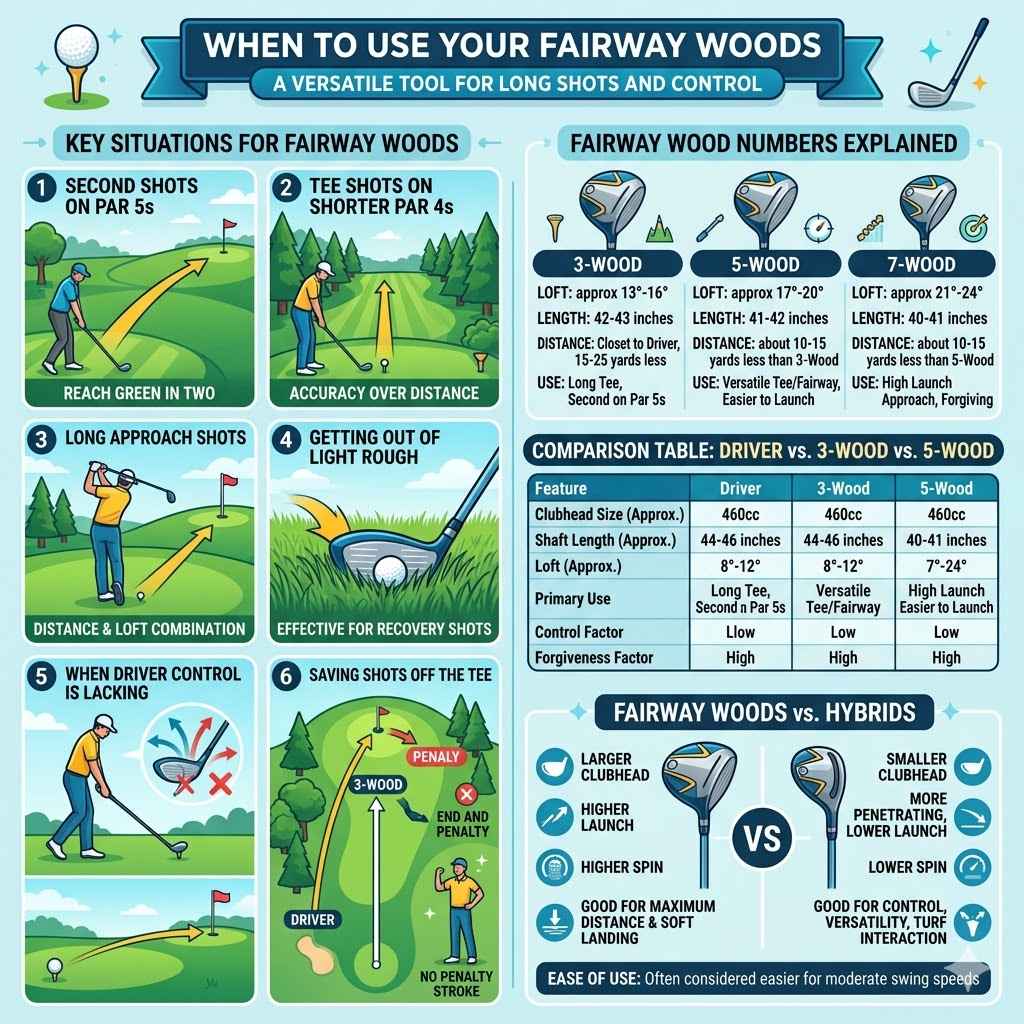
- Second Shots on Par 5s: When you need significant distance from the fairway to reach the green in two shots, but want more control than a driver. A 3-wood is common here.
- Tee Shots on Shorter Par 4s: If a hole is too short or too narrow for a driver, a fairway wood provides sufficient distance with improved accuracy.
- Long Approach Shots: For shots ranging from 170 to 220+ yards, fairway woods offer a great combination of distance and loft to hit greens. A 5-wood or 7-wood is typical.
- Getting Out of Light Rough: The clubhead design helps them to easily get under the ball and glide through longer grass, making them effective for recovery shots.
- When Driver Control is Lacking: If your driver is proving difficult to control, switching to a fairway wood off the tee can help you find the fairway more often.
Sample Scenario: The 3-Wood Save
- You’re on the first tee of a hole that’s 380 yards long. The fairway is quite narrow, with trees lining both sides. You’ve been struggling with your driver lately, and the risk of hitting it out of bounds is high.
- Instead of reaching for your driver, you select your 3-wood. Its shorter shaft and slightly higher loft give you more confidence in controlling your swing.
- You make a solid swing, and the ball flies straight down the middle of the fairway, landing about 210 yards away. You’ve successfully put the ball in play and are now left with a manageable 170-yard approach shot, far better than facing a penalty stroke from the trees.
Statistical Insight: According to a study by GolfTEC, the average PGA Tour professional hits their 3-wood approximately 250-270 yards, while their driver averages 280-300+ yards. However, the dispersion (how far off-line the shot goes) for the 3-wood is often significantly tighter, highlighting its control advantage.
Fairway Wood Numbers Explained
Fairway woods are distinguished by numbers, such as 3-wood, 5-wood, and 7-wood. Each number represents a different club with a specific loft, shaft length, and clubhead size, offering a range of distances and trajectories. Understanding these numbers is key to choosing the right fairway wood for your needs.
The 3-wood is the longest and lowest-lofted fairway wood. It’s the most difficult to hit from the ground for beginners but offers the greatest distance, often approaching that of a driver. It’s a powerful tool for tee shots on shorter par 4s or for long carries from the fairway.
As the number increases, so does the loft and the ease of hitting the club. A 5-wood has more loft than a 3-wood, making it easier to get airborne and typically travels about 10-15 yards less. This makes it a great option for golfers who find the 3-wood difficult to launch consistently or need a club for shots between their longest iron and their 3-wood.
The 7-wood, and sometimes even higher-numbered woods like 9-woods, have even more loft and are shorter in length. These clubs are designed for golfers who need help getting the ball up in the air and have distances that fall between their longest fairway wood and their longest iron. They are often very forgiving and easy to use, providing a good option for those seeking height and control over maximum distance.
Breakdown of Fairway Wood Numbers
- 3-Wood:
- Loft: Approximately 13°-16°
- Shaft Length: Longest among fairway woods, typically 42-43 inches.
- Distance: Closest to driver distance, often 15-25 yards less than driver.
- Use: Long tee shots, second shots on par 5s, long approach shots.
- 5-Wood:
- Loft: Approximately 17°-20°
- Shaft Length: Shorter than 3-wood, typically 41-42 inches.
- Distance: About 10-15 yards less than a 3-wood.
- Use: Versatile for tee shots, fairway shots, easier to launch than 3-wood.
- 7-Wood:
- Loft: Approximately 21°-24°
- Shaft Length: Shorter than 5-wood, typically 40-41 inches.
- Distance: About 10-15 yards less than a 5-wood.
- Use: High launch shots, approach shots from longer distances, easier to hit than lower-numbered woods.
Comparison Table: Driver vs. 3-Wood vs. 5-Wood
| Feature | Driver | 3-Wood | 5-Wood |
|---|---|---|---|
| Clubhead Size (Approx.) | 460cc | 150-200cc | 130-180cc |
| Shaft Length (Approx.) | 44-46 inches | 42-43 inches | 41-42 inches |
| Loft (Approx.) | 8°-12° | 13°-16° | 17°-20° |
| Primary Use | Tee shots for maximum distance | Long tee shots, fairway shots for distance & control | Fairway shots, easier launch than 3-wood |
| Control Factor | Lowest | Medium | High |
| Forgiveness Factor | High (due to size) | Medium-High | High |
Fairway Woods vs Hybrids
Often, golfers will face a choice between using a fairway wood or a hybrid club for certain shots. Both clubs are designed to fill distance gaps and offer more forgiveness than long irons, but they have distinct characteristics. Understanding the Golf Wood vs Driver: Key Differences Golfers Should Know also means knowing how woods compare to hybrids.
Hybrids, also known as rescue clubs, were developed to combine the best features of fairway woods and irons. They typically have smaller clubheads than fairway woods and are shaped more like an iron, but with a rounded sole. This design makes them easier to hit from tight lies and more predictable through the turf.
A key difference is that hybrids generally have a lower profile and a CG that is further forward than a fairway wood. This often results in a more penetrating ball flight with less spin compared to a similar-numbered fairway wood. For golfers who struggle to get fairway woods airborne, a hybrid might offer an easier solution.
They are also often easier to control for shots where you need to keep the ball low or shape it intentionally.
Fairway woods, with their larger heads and often deeper CG, tend to launch the ball higher with more spin. This makes them great for getting the ball up quickly and stopping it on the green. For pure distance and a softer landing, a fairway wood might be the better choice, whereas for versatility, ease of use from various lies, and a more controlled trajectory, a hybrid is often preferred.
Hybrid Club Characteristics
- Clubhead Design: Smaller than fairway woods, with a more rounded, iron-like shape. Designed to be easier to swing through the turf.
- Center of Gravity (CG): Typically positioned more forward and lower than in fairway woods, promoting a lower, more penetrating ball flight with reduced spin.
- Versatility from Lies: Excellent for hitting from tight lies, light rough, and even bunkers due to their sole design and profile.
- Ease of Use: Often considered easier to hit consistently than long irons and many fairway woods, especially for golfers with moderate swing speeds.
Fairway Wood vs. Hybrid Comparison
| Feature | Fairway Wood | Hybrid |
|---|---|---|
| Clubhead Size | Larger, more rounded | Smaller, more iron-like |
| Launch Angle | Higher | More penetrating, lower |
| Spin Rate | Higher | Lower |
| Ease of Hitting from Turf | Good, can glide | Excellent, designed for turf interaction |
| Best For | Maximum distance, high launch, soft landing | Control, versatility, penetrating flight, ease of use |
Conclusion: Choosing the Right Club for You
Understanding the Golf Wood vs Driver: Key Differences Golfers Should Know is key to playing better golf. The driver is your longest club for maximum distance off the tee. Fairway woods are your versatile long-game companions, offering distance with more control from the fairway or tee.
Your choice depends on the hole, your strengths, and the risks involved.
Frequently Asked Questions
Question: Is a driver always longer than a fairway wood?
Answer: Generally, a driver is designed to hit the ball farther than any fairway wood due to its longer shaft, larger clubhead, and lower loft. However, a very skilled golfer might hit a 3-wood with perfect consistency on a well-struck shot that travels nearly as far as a slightly mishit driver.
Question: Can I use my driver on the fairway?
Answer: While technically possible, it is not recommended. Drivers are designed for tee shots where the ball is on a tee. Trying to hit a driver from the fairway is very difficult, often results in a low, weak shot, and can damage the club if it hits the ground first.
Question: What is the difference between a 3-wood and a 5-wood?
Answer: A 3-wood is longer and has less loft than a 5-wood. This means the 3-wood will typically travel farther with a lower ball flight, while the 5-wood is easier to hit higher and offers more control but less distance.
Question: Do I need both a driver and fairway woods?
Answer: Most golfers benefit greatly from having both. The driver is essential for maximizing distance on long holes. Fairway woods provide crucial options for varying distances and situations where control is more important than sheer length.
Question: Which club should I use if I slice my driver?
Answer: If you consistently slice your driver, using a fairway wood like a 3-wood or 5-wood off the tee can often help. Their shorter shafts and higher lofts provide more control and can make it easier to square the clubface at impact, reducing the slice.
Final Thoughts
Deciding between a driver and a fairway wood comes down to distance and control. Use your driver when pure distance off the tee is the goal and the fairway is forgiving. Reach for your fairway woods when you need long-game power but with greater accuracy and versatility from various spots on the course.
Choose wisely for better scores.