Hard Maple Vs Soft Maple Bark: The Ultimate, Best Guide
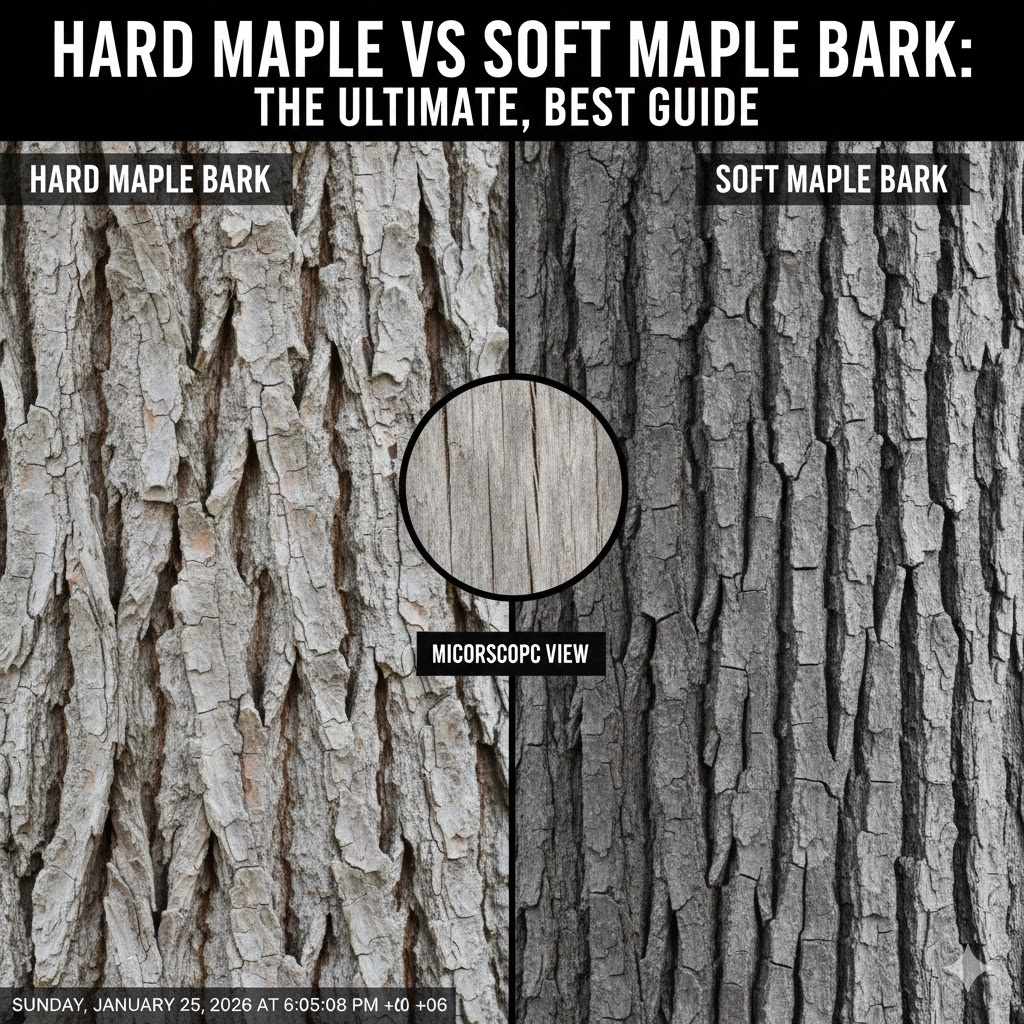
Distinguishing between hard maple and soft maple bark is simple with practice. Hard maple bark on mature trees is thick, rugged, and dark gray with deep furrows and shaggy, plate-like ridges. Soft maple bark is smoother, lighter gray, and thinner, with narrower ridges that often look flaky or peel away from the trunk.
Hello, fellow makers! I’m Md Meraj, and in my workshop, I’ve seen countless woodworkers get stuck on a common puzzle: telling hard maple from soft maple. It’s a question I get all the time. You’ve found a beautiful fallen tree or a stack of lumber, but what exactly are you working with? Guessing can lead to a wobbly table or a dented cutting board. But don’t you worry! Learning to read a tree’s bark is a skill anyone can learn. Together, we are going to walk through the simple, clear signs that separate these two amazing woods, starting with their bark. Let’s get you identifying wood like a pro!
Why Does Telling Hard vs. Soft Maple Bark Even Matter?
You might be thinking, “It’s all maple, right? How different can they be?” That’s a great question! While they come from the same family, hard and soft maple are more like cousins than identical twins. Knowing the difference before you start a project can save you a world of frustration and ensure your finished piece is strong, beautiful, and lasts a lifetime.
Think of it like choosing the right ingredient for a recipe. You wouldn’t use cake flour to bake a crusty loaf of bread, right? The same principle applies here. Each type of maple has its own special qualities.
For Woodworkers and DIY Enthusiasts
The differences in the wood itself are huge for any project you plan to build. Here’s a quick rundown of why it pays to know your maple:
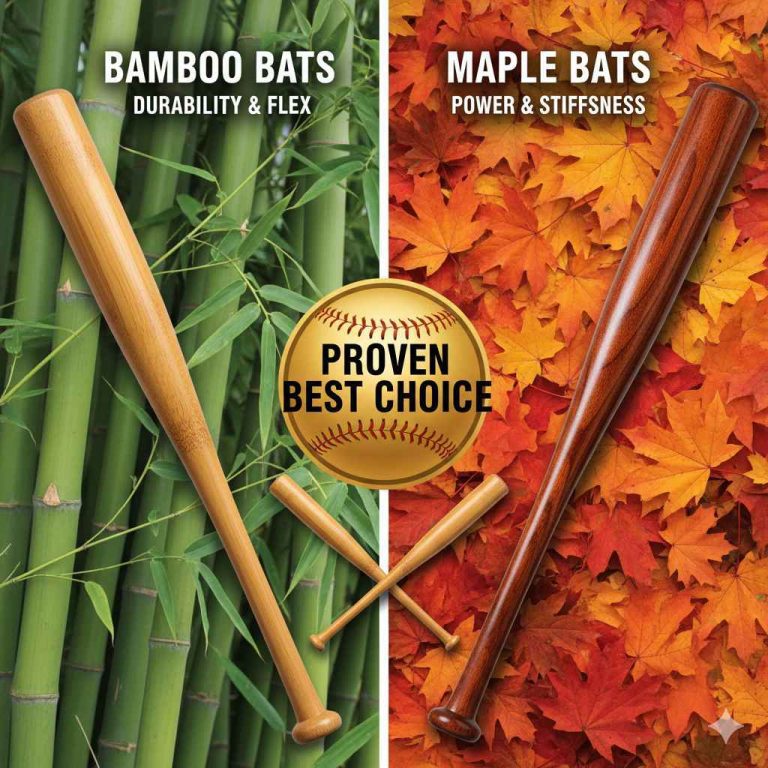
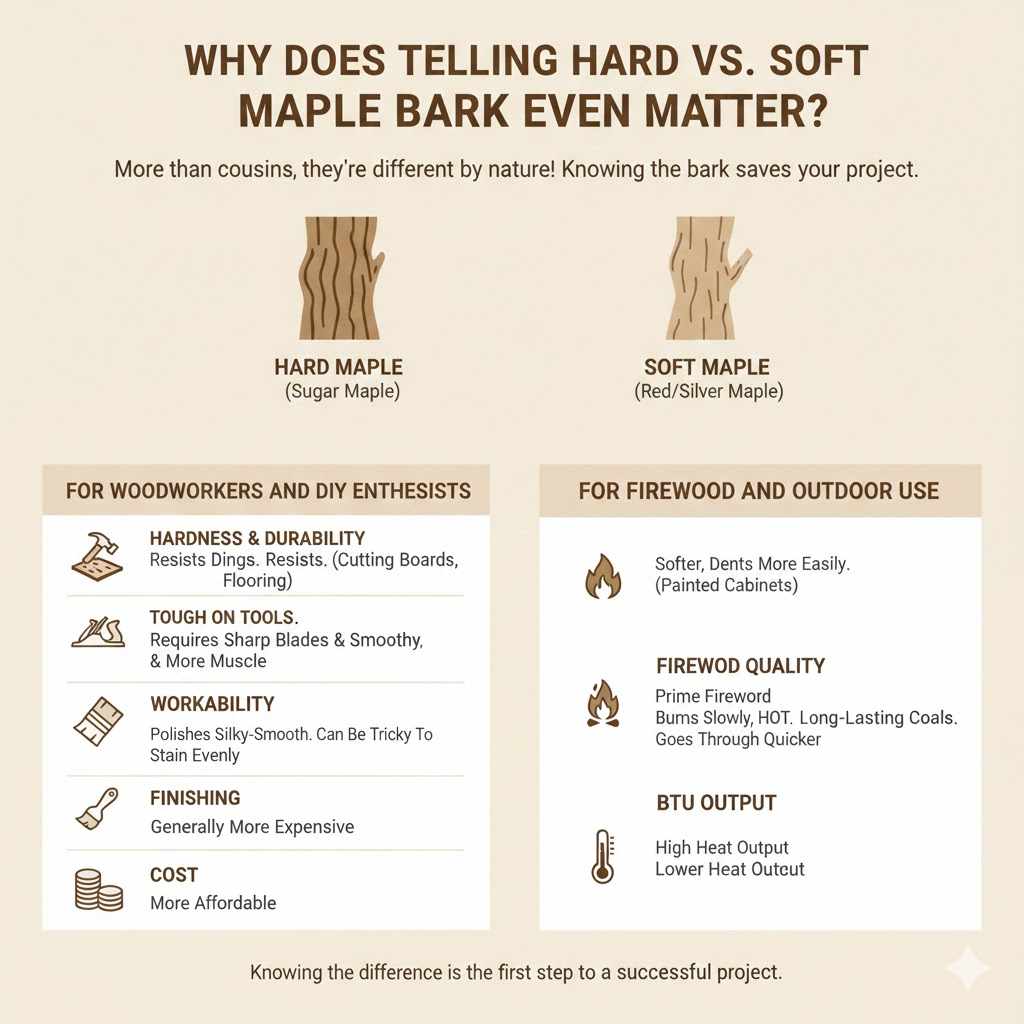
- Hardness & Durability: This is the big one. Hard maple (like Sugar Maple) is incredibly dense and tough. It stands up to dings, dents, and heavy use. This makes it a perfect choice for things like kitchen cutting boards, workshop benchtops, flooring, and fine furniture that needs to last for generations. Soft maple (like Red or Silver Maple) is still a hardwood, but it’s significantly softer and will dent much more easily.
- Workability: Because it’s so dense, hard maple can be tough on your tools. It requires sharp blades and a bit more muscle to cut and shape. Soft maple is a dream to work with by comparison. It cuts smoothly, sands easily, and is more forgiving, especially if you’re using hand tools.
- Finishing: Hard maple has a fine, tight grain that can be polished to a silky-smooth finish. However, it can sometimes be tricky to stain evenly due to its density. Soft maple, with its slightly more porous grain, often accepts stains and dyes more uniformly, making it a great choice for painted projects or when you want a deep, even color.
- Cost: Generally, lumber from soft maple trees is less expensive than lumber from hard maple. If you’re working on a budget for a project like painted cabinets or a simple bookshelf, soft maple is an excellent and affordable choice.
For Firewood and Outdoor Use
If you’re looking at a fallen tree for firewood, identification is key for a good fire.
- Firewood Quality: Hard maple is prime firewood. It’s dense, so it burns slowly, hot, and creates long-lasting coals. It’s the kind of wood you want for heating your home on a cold winter night.
- BTU Output: Soft maple will burn just fine, but it burns much faster and produces less heat (lower BTUs) than hard maple. You’ll go through a stack of soft maple much quicker.
As you can see, taking a moment to check the bark isn’t just a fun nature lesson—it’s a practical first step that sets your project up for success from the very beginning.
The Main Event: A Deep Dive into Hard Maple Bark
When we talk about “hard maple,” we are almost always talking about the Sugar Maple (Acer saccharum). This is the famous tree known for its spectacular fall colors and, of course, delicious maple syrup. Its bark is one of the most reliable ways to identify it, but it changes dramatically as the tree ages.
Bark on a Young Hard Maple
When a Sugar Maple is young, its bark can easily fool you. It is surprisingly smooth and has a light, silvery-gray or brownish-gray color. At this stage, it looks very similar to a young Red Maple or even a Beech tree. You won’t see the deep furrows or rugged texture yet. Don’t worry if you find this stage confusing—most people do! The real tell-tale signs appear as the tree matures.
Bark on a Mature Hard Maple
This is where the hard maple shows its true character. As a Sugar Maple grows older and its trunk thickens, the bark transforms into something truly distinctive. Look for these key features:
- Rugged and Sturdy Appearance: The overall impression of a mature hard maple’s bark is one of strength and old age. It looks tough and deeply textured.
- Deep Furrows: The bark develops deep, vertical grooves or channels, called furrows. These are not shallow lines; they look like they’ve been carved into the trunk over many decades.
- Thick Plates or Ridges: Between the furrows, the bark forms thick, irregular plates or vertical ridges. These plates often lift away from the tree on one or both sides, giving the bark a very shaggy or “platy” look. Think of it like pieces of a broken clay pot sticking to the trunk.
- Dark Color: The color is typically a deep, dark gray, sometimes with brownish tones, especially inside the furrows. It looks much darker than the bark of a soft maple.
A great way to remember it is to think of an old, weathered alligator’s back—deeply grooved, thick, and rugged. If you were to run your hand over it, it would feel very rough and uneven. This sturdy, fortress-like bark is the classic sign of a mature Sugar Maple.
Getting to Know Soft Maple Bark
The “soft maple” category includes several species, but the two you’ll encounter most often are the Red Maple (Acer rubrum) and the Silver Maple (Acer saccharinum). Their bark is quite different from hard maple and also different from each other, though they share a “softer” overall look.
Bark on a Young Soft Maple
Just like the hard maple, young soft maples have very smooth, light gray bark. A young Silver Maple is especially smooth and almost silvery in color, which is how it gets its name. A young Red Maple’s bark is also smooth and light gray but can sometimes have a slightly reddish tint. At this early stage, it can be tough to distinguish them from a young Sugar Maple without looking at other clues like the buds or leaves.
Bark on a Mature Soft Maple (Red Maple)
As a Red Maple matures, its smooth bark begins to break up and form ridges, but it does so in a very different way than a Sugar Maple.
- Shallow Furrows: The grooves on a Red Maple are much shallower than on a hard maple.
- Narrow Ridges: The bark forms narrow, plate-like strips that look like they could be peeled off. Sometimes they are described as “scaly” or “flaky.”
- Lighter Color: The overall color remains a lighter gray, though the older plates may darken slightly. It doesn’t develop that deep, dark, rugged appearance of a Sugar Maple.
Bark on a Mature Soft Maple (Silver Maple)
A mature Silver Maple has some of the most distinctive bark of all the maples. It shares the lighter gray color of the Red Maple but takes the shagginess to a whole new level.
- Long, Peeling Strips: The defining feature of Silver Maple bark is its long, thin strips that peel away from the trunk at the top and bottom. This gives the tree a very shaggy, almost messy look.
- Flaky and Detached: The bark plates are much longer and more separated than on any other maple. It’s very common to see large pieces that you could easily grab and pull off (though it’s best not to harm the tree!).
- Softer Texture: The bark itself feels softer and less solid compared to the rock-hard plates of a Sugar Maple.
So, for soft maples, think “smoother, lighter, and flakier.” The Red Maple has scaly plates, and the Silver Maple looks like its bark is peeling off in long ribbons.
Side-by-Side Comparison: A Cheat Sheet for Identification
Sometimes, the best way to see the differences is to put them right next to each other. Use this table as a quick reference guide next time you’re out in the woods or looking at a log pile. This focuses on mature trees, as that’s where the differences are most clear.
| Feature | Hard Maple (Sugar Maple) | Soft Maple (Red & Silver Maple) |
|---|---|---|
| Overall Texture | Very rough, rugged, and hard. Feels thick and solid. | Smoother, softer, and often feels thin or brittle. |
| Color | Dark gray to grayish-brown. Looks deeply weathered. | Light gray to silvery-gray. Red Maple can have darker patches. |
| Ridges / Plates | Thick, irregular, vertically-oriented plates. Looks very “chunky.” | Narrow, thin ridges (Red Maple) or long, peeling strips (Silver Maple). |
| Furrows (Grooves) | Deep and pronounced. Gives the bark a very three-dimensional look. | Shallow and less defined. |
| Shagginess / Peeling | Can be shaggy, with plates lifting at the sides, but plates are thick. | Can be scaly (Red Maple) or extremely shaggy with long, peeling strips (Silver Maple). |
| Tree Shape | Often has a rounded, dense crown. Very stout trunk. | Silver Maple often has a V-shaped trunk that splits low to the ground. |
Beyond the Bark: Other Clues to Confirm Your ID
Bark is your best friend for identification, but nature loves to throw us curveballs! A tree growing in a strange spot or one that’s middle-aged might have ambiguous bark. When you’re not 100% sure, it’s time to look for other clues. These can help confirm what the bark is telling you.
1. Check the Leaves (If Available)
If it’s spring, summer, or early fall, the leaves are your easiest secondary clue. All maple leaves have a similar lobed shape, but the details are different.
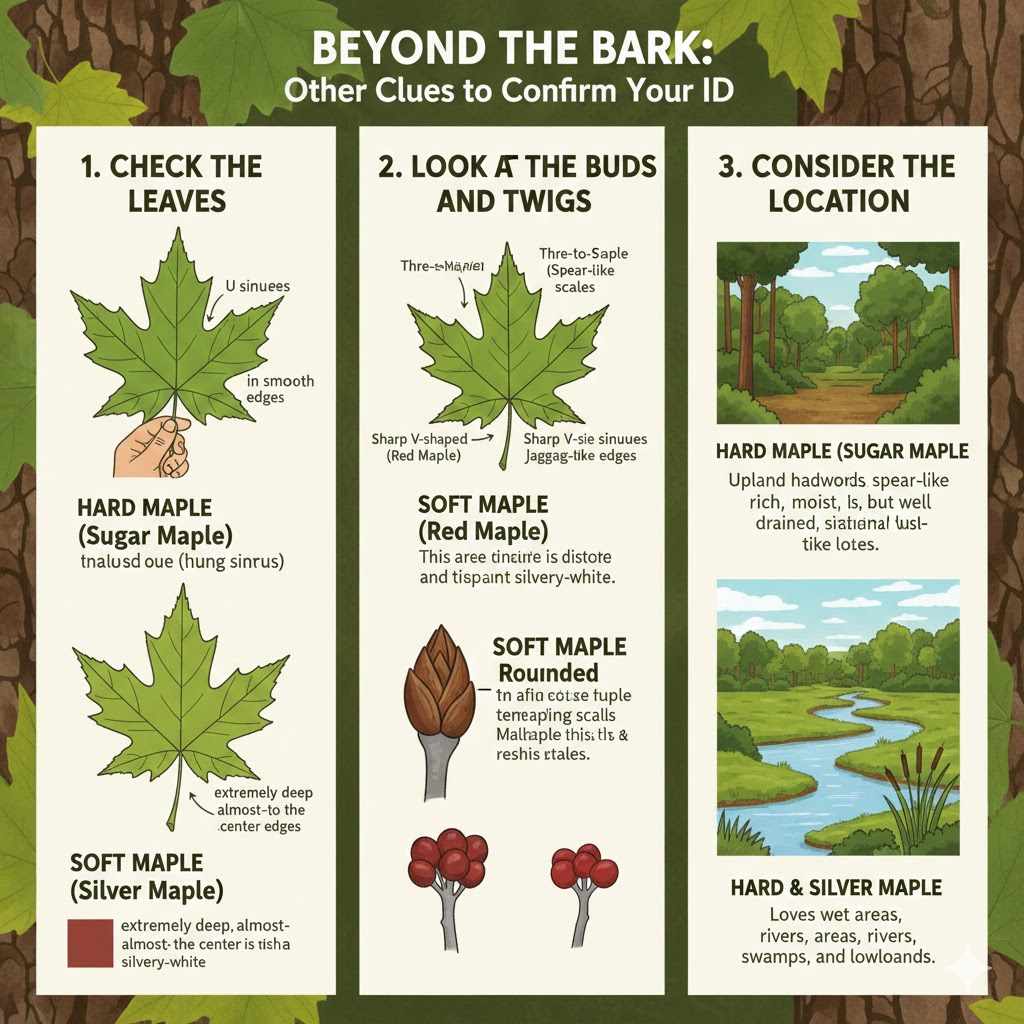
- Hard Maple (Sugar Maple): Has 5 distinct lobes. The key is to look at the valleys between the lobes, called sinuses. On a Sugar Maple, the sinuses are rounded and U-shaped. The edges of the lobes themselves are smooth, without a lot of small teeth.
- Soft Maple (Red Maple): Usually has 3-5 lobes. The sinuses are sharp and V-shaped, and the edges of the leaf are very jagged or “toothy,” like a saw blade.
- Soft Maple (Silver Maple): Has 5 lobes, but the sinuses are extremely deep—they almost cut to the center of the leaf. The underside of the leaf is a distinct silvery-white color, which is easy to spot when the wind blows.
For a fantastic visual guide to leaf shapes, the University of New Hampshire Extension has a simple and clear page for identifying maple trees.
2. Look at the Buds and Twigs (Great for Winter ID)
No leaves? No problem! The twigs and their terminal buds (the bud at the very tip of a branch) are incredibly helpful.
- Hard Maple (Sugar Maple): The terminal bud is one of its most defining features. It is very sharp, pointed, and looks like a tiny, brown spear tip. There are many overlapping scales, and it’s completely different from the soft maple buds.
- Soft Maple (Red Maple): The terminal bud is rounded or blunt, not sharp. The buds are typically a bright, glossy red color, which makes them easy to spot against a gray winter sky. You’ll see several buds clustered at the tip.
3. Consider the Location
While maples can grow in many places, they do have preferences. This is a general rule, not a strict one, but it can provide a good hint.
- Hard Maple (Sugar Maple): Prefers rich, moist, but well-drained soils. You’ll often find it in upland forests mixed with other hardwoods like oak, hickory, and beech.
- Soft Maple (Red & Silver Maple): Are more adaptable and famously love wet areas. They are common along rivers, in swamps, and in poorly-drained lowlands. If you are standing in a wet, marshy area, you are far more likely to be looking at a soft maple.
Frequently Asked Questions (FAQ)
Is one type of maple better than the other?
Not at all! They are just different. Hard maple is better for projects needing extreme durability, like flooring and cutting boards. Soft maple is fantastic for projects that will be painted, for cabinetry, and is much easier for beginners to work with. The “better” wood is always the one that’s right for your specific project.
Can I tell the difference in winter when there are no leaves?
Absolutely! Winter is a great time to practice identifying trees by their bark. Without leaves to distract you, you can focus on the texture, color, and pattern of the bark. If you can get a close look at a low-hanging branch, the sharp, brown bud of a hard maple is a dead giveaway compared to the round, red buds of a soft maple.
Does the bark look the same on a young tree versus an old tree?
No, and this is the most common point of confusion for beginners. Young maple trees of all types have smooth, light gray bark. The distinctive rugged or flaky features only develop as the tree gets older and the trunk grows wider. Always try to find a mature specimen to learn the key differences first.
What is the easiest way to remember the difference?
Here’s a simple trick: Hard maple has “hard-looking” bark—thick, rugged, and deeply grooved like armor. Soft maple has “soft-looking” bark—smoother, thinner, and often peeling or flaky.
Can I use soft maple for firewood?
Yes, you can. Soft maple is a decent firewood, but it contains less wood density than hard maple. This means it will burn much faster and produce less heat. It’s great for kindling or for a quick, cheerful fire on a cool autumn evening, but hard maple is the better choice for heating a home through a long winter.
Is Sugar Maple the only type of hard maple?
Sugar Maple is the primary and most common hard maple species in North America. There is another species called Black Maple (Acer nigrum) which is also considered a hard maple and is very similar. For most woodworking and identification purposes, you can treat them as the same.
Are there other types of soft maple besides Red and Silver?
Yes, there are several others. The Boxelder (Acer negundo) and the Bigleaf Maple (Acer macrophyllum) found on the West Coast are also in the soft maple category. However, Red and Silver maples are the most widespread and the ones you are most likely to encounter in the eastern and central parts of North America.
Conclusion: Your New Superpower in the Woods
Congratulations! You now have all the tools you need to step outside and confidently tell the difference between hard maple and soft maple bark. It might feel like a lot to remember at first, but don’t feel pressured to get it right every single time. The best way to learn is by doing.
Next time you’re on a walk in the park, a hike in the woods, or even just strolling down your street, take a moment to pause and really look at the trees. Feel the texture of the bark. Notice the color and the depth of the furrows. Compare one maple to another. The more you observe, the more these differences will jump out at you until it becomes second nature.
Knowing your wood is a fundamental skill that connects you more deeply to your craft and to the natural world around you. It’s a bit of ancient knowledge that makes you a more thoughtful, capable, and confident woodworker. Now get out there and start identifying!