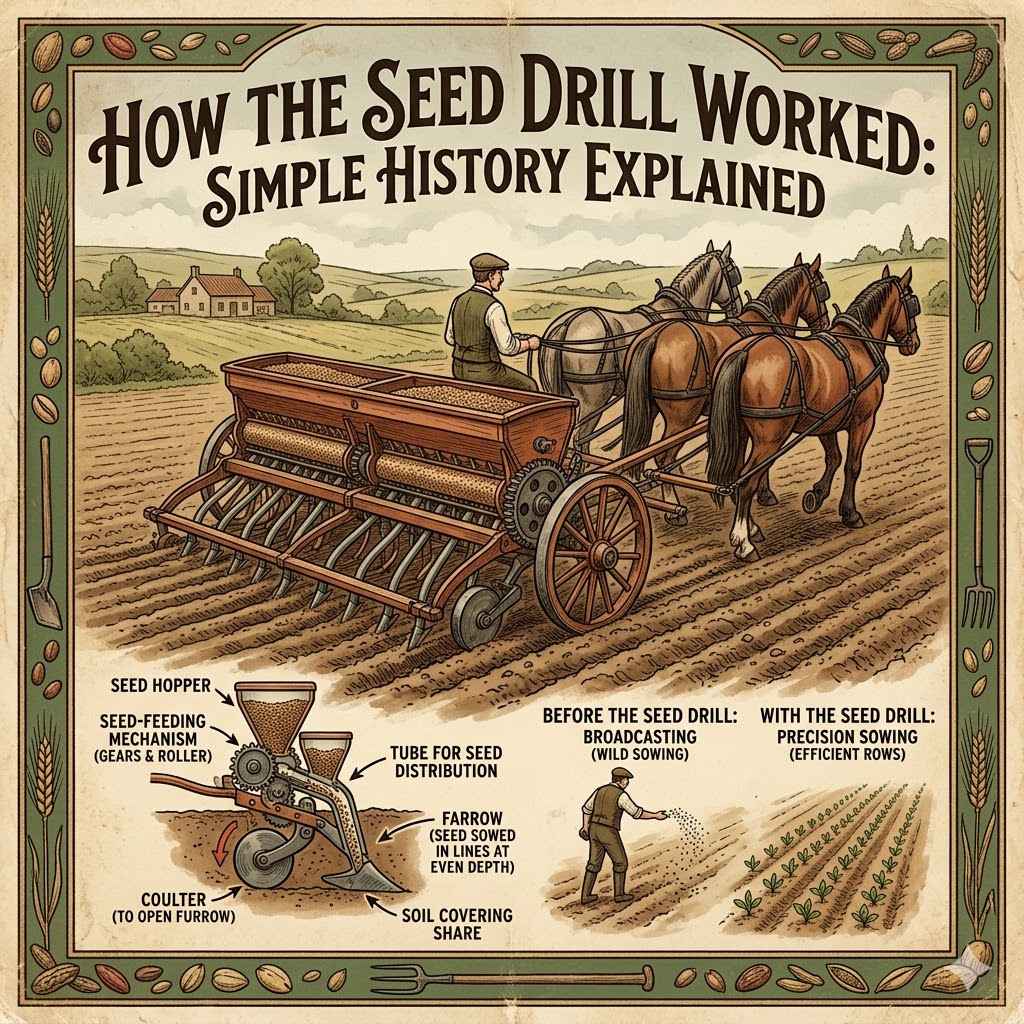
How the Seed Drill Worked: Simple History Explained.
Learning about old farming tools can be super interesting! Sometimes the name sounds tricky, like “seed drill,” and you might wonder how it actually worked back in the day. It’s not as hard to grasp as it seems.
We’ll walk through it step-by-step so you can totally get it. Let’s see what made this invention so special and how it changed things for farmers. Get ready for a clear and simple explanation of How the Seed Drill Worked: Simple History Explained.
Understanding the Seed Drill and Its Early Impact
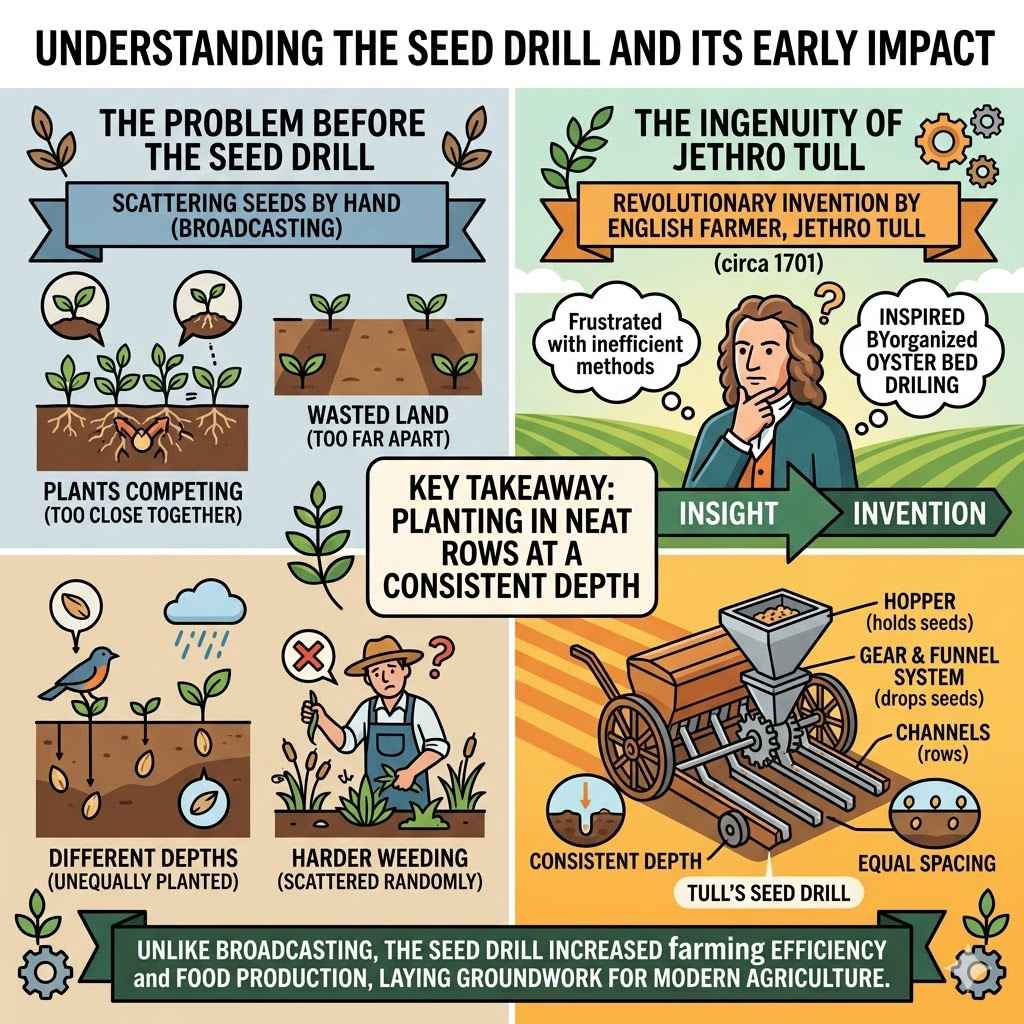
The seed drill was a truly revolutionary invention that completely changed how farmers planted seeds. Before it, farmers mostly just scattered seeds by hand. This meant seeds were often planted too close together, too far apart, or at the wrong depth.
This led to a lot of wasted seeds and not as good a harvest as could be. The seed drill solved these problems by planting seeds in neat rows at a consistent depth and spacing. This simple change made a huge difference in farming efficiency and food production, laying the groundwork for modern agriculture.
The Problem Before the Seed Drill
Farming was a much harder job before the seed drill came along. Farmers would grab handfuls of seeds and toss them across the field. This was called broadcasting.
It sounds simple, but it caused many issues.
- Seeds could land too close together. This meant plants would compete for sunlight, water, and nutrients. Many seedlings would not grow strong enough to produce a good crop.
- Seeds could also land too far apart. This left empty spaces in the field where no crops grew, meaning wasted land and potential food.
- Planting seeds by hand meant they went into the ground at different depths. Some seeds might be too deep and never sprout, while others might be too shallow and get eaten by birds or washed away by rain.
- Weeding was also much harder when seeds were scattered randomly. It was tough to tell the difference between a crop seedling and a weed when they were all mixed up.
The Ingenuity of Jethro Tull
The most famous seed drill was invented by Jethro Tull, an English farmer and inventor, around 1701. He was frustrated with the inefficient methods of his time and saw the need for a better way to plant. Tull’s design was clever and addressed the main problems with broadcasting seeds.
His invention was a major step forward in agricultural technology.
Tull was inspired by the idea of planting seeds in a more organized way. He observed how oysters were drilled and planted in beds, and this gave him the idea for his machine. His goal was to make farming more efficient and productive.
How the Seed Drill Actually Worked
The seed drill worked by mechanically depositing seeds into the soil at precise intervals and depths. This was a huge improvement over hand-sowing. The machine was typically pulled by horses or oxen.
It had a hopper to hold the seeds, and a mechanism that dropped them out at controlled rates. Furrows were made in the soil, the seeds were dropped into them, and then the soil was covered back up. This ensured each seed had the best chance to grow.
Key Components of a Seed Drill
A seed drill has several important parts that work together. Each part has a specific job to help plant seeds correctly.
- Seed Hopper: This is like a container where you put all the seeds you want to plant. It’s usually at the top of the machine.
- Seed Dispensing Mechanism: This is the clever part that controls how many seeds come out and when. It’s driven by the wheels of the drill as it moves.
- Coulters or Ploughshares: These are sharp metal blades that cut a furrow or trench in the soil. This trench is where the seeds will fall.
- Covering Device: After the seeds are dropped, something needs to push the soil back over them. This could be a small plough or a set of brushes that smooth the soil.
The Planting Process Step-by-Step
Let’s imagine you are using a seed drill in a field. Here’s what happens:
- The farmer fills the seed hopper with seeds.
- The seed drill is attached to a horse or oxen, and they begin to move across the field.
- As the wheels of the drill turn, they power the seed dispensing mechanism.
- The coulters at the front of the drill cut a straight furrow in the soil.
- The dispensing mechanism drops a specific number of seeds into the furrow at regular intervals.
- A covering device, like a small plough or brush, then pushes the soil back over the furrow, covering the seeds.
- The horse or oxen move forward, and the process repeats, creating a neat row of seeds.
Variations and Improvements
Over time, seed drills became more advanced. Early versions might have had one hopper and one drill for a single row. Later models had multiple hoppers and drills, allowing farmers to plant many rows at once.
This made planting much faster and more efficient for larger fields. Different types of seeds also required different settings on the dispensing mechanism to ensure the correct number of seeds were planted.
Benefits of Using a Seed Drill
The seed drill brought about significant advantages for farmers. These benefits directly led to better crop yields and more efficient farming practices. The impact was felt across the agricultural community.
Increased Crop Yields
One of the most important benefits was a much better harvest. Because seeds were planted at the right depth and spacing, more seeds successfully sprouted and grew into healthy plants.
- Consistent Depth: Planting at a uniform depth meant seeds received the right amount of moisture and were protected from pests. This led to more seeds germinating.
- Optimal Spacing: When plants are spaced correctly, they don’t compete as fiercely for resources. This allows each plant to grow stronger and produce more grain or fruit.
- Reduced Waste: Less seed was wasted because fewer seeds were lost to birds, weather, or improper planting. This meant more of the farmer’s seed investment grew into crops.
Studies from the time showed that fields planted with a seed drill could produce 20-30% more grain than those planted by broadcasting. This was a substantial increase that helped feed more people.
Saving Time and Labor
The seed drill significantly reduced the amount of manual labor required for planting. Instead of several people scattering seeds by hand, one person could operate the seed drill with animal power.
- Efficiency: Planting a whole field took much less time. This allowed farmers to focus on other important tasks like weeding and harvesting.
- Reduced Strain: The back-breaking work of broadcasting seeds was replaced by the more manageable task of guiding a horse-drawn machine.
- Fewer Workers Needed: This meant farmers could manage larger areas of land with a smaller workforce, making agriculture more scalable.
In the 18th century, a farmer might have spent days broadcasting seeds for a large field. With a seed drill, this could be accomplished in a fraction of the time.
Improved Weed Control
Planting in straight rows made a big difference in managing weeds. Farmers could easily see the difference between crop rows and weeds.
- Easier Cultivation: Straight rows allowed for easier use of horse-drawn cultivators between the rows. These tools could effectively remove weeds without damaging the crops.
- Clearer Identification: When crops are planted randomly, it’s hard to distinguish them from weeds. Rows make it simple to identify and remove unwanted plants.
- Reduced Competition: By removing weeds more effectively, farmers ensured their crops got even more of the available nutrients and water, further boosting yields.
The Historical Significance and Evolution
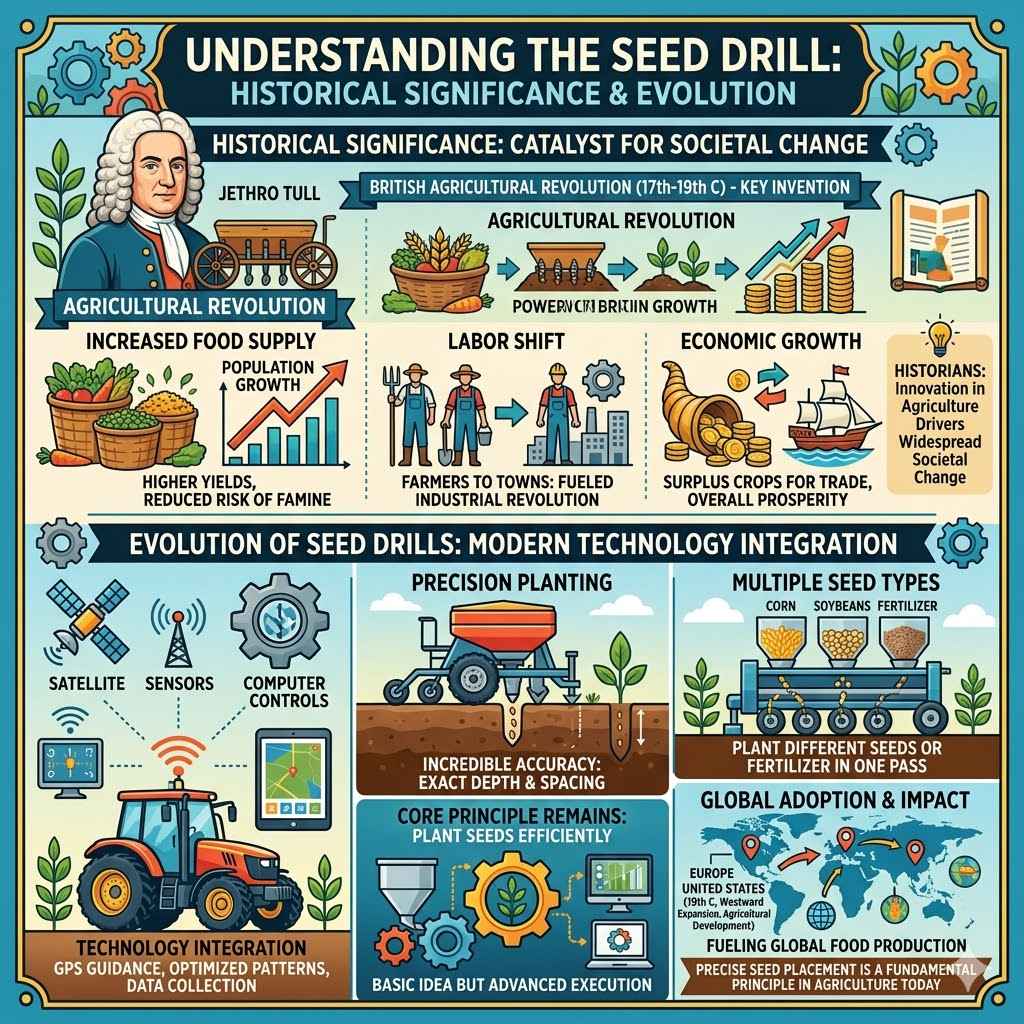
The seed drill was not just a farming tool; it was a catalyst for major societal and economic changes. Its invention marked a turning point in agricultural history, contributing to the agricultural revolution and beyond. The principles behind it continue to influence modern planting machinery.
The Agricultural Revolution
Jethro Tull’s seed drill is often credited as one of the key inventions of the British Agricultural Revolution, which spanned from the 17th to the 19th centuries. This period saw massive improvements in farming techniques and productivity.
- Increased Food Supply: Higher yields meant more food was available. This helped support a growing population and reduced the risk of famine.
- Labor Shift: With more efficient farming, fewer people were needed to work the land. This led to a migration of workers from farms to towns and cities, fueling the Industrial Revolution.
- Economic Growth: Increased agricultural output contributed to overall economic prosperity. Farmers could produce more for trade and sell surplus crops.
Historians often point to the seed drill as an example of how innovation in one sector, like agriculture, can drive widespread societal change.
Evolution of Seed Drills
Since Jethro Tull’s original design, seed drills have undergone continuous improvement. Modern planters are highly sophisticated machines that use advanced technology.
- Precision Planting: Today’s drills can plant seeds with incredible accuracy, placing each seed at an exact depth and spacing based on soil conditions and crop type.
- Multiple Seed Types: Many modern machines can plant different types of seeds or fertilizers in the same pass, further increasing efficiency.
- Technology Integration: GPS guidance, sensors, and computer controls allow for optimized planting patterns and data collection, helping farmers make better decisions.
The basic principle of the seed drill remains the same: to plant seeds efficiently and effectively. However, the execution has become far more advanced.
Global Adoption and Impact
As the benefits became clear, the seed drill was gradually adopted by farmers not just in Britain but across Europe and eventually the world. Its impact on food production was global.
For instance, in the United States, the adoption of improved seed drills in the 19th century helped fuel westward expansion and agricultural development. The ability to plant larger areas more effectively was crucial for settlers.
The concept of precise seed placement is a fundamental principle in agriculture today. Even advanced machines that might look very different still follow the core idea Tull introduced: controlled, accurate seed delivery.
Frequently Asked Questions
Question: Who invented the seed drill
Answer: Jethro Tull is credited with inventing the most famous and influential seed drill around the year 1701.
Question: What was the main problem with planting seeds before the seed drill
Answer: Before the seed drill, seeds were mostly scattered by hand, leading to uneven spacing, incorrect depths, and wasted seeds.
Question: How did the seed drill help crops grow better
Answer: It planted seeds at a consistent depth and spacing, giving each plant the right amount of resources to grow strong and healthy.
Question: What was a major benefit for farmers using a seed drill
Answer: Farmers saved a lot of time and labor because the machine could plant seeds much faster than by hand.
Question: Does the seed drill still matter today
Answer: Yes, the principles of precise seed placement that the seed drill pioneered are still used in modern agricultural planting machines.
Summary
The seed drill transformed farming by precisely placing seeds in rows. This invention saved time, reduced waste, and led to much larger harvests. Its impact helped feed growing populations and changed how agriculture was done forever.
This simple yet brilliant machine laid the groundwork for modern farming technology.