How to Make Your Own Wooden Handscrew Clamps
A real wooden handscrew clamp needs two jaws and two independently-adjustable screws — not a single screw holding four boards together. That two-screw design is what actually makes a handscrew clamp useful: unlike a simple bar or C-clamp, each screw can be turned independently, letting the jaws grip a workpiece either perfectly parallel or at an angle, which is exactly what makes handscrews so good at holding irregular or tapered stock.
The Correct Two-Jaw, Two-Screw Design
Skip The Build, Buy A Real Pair
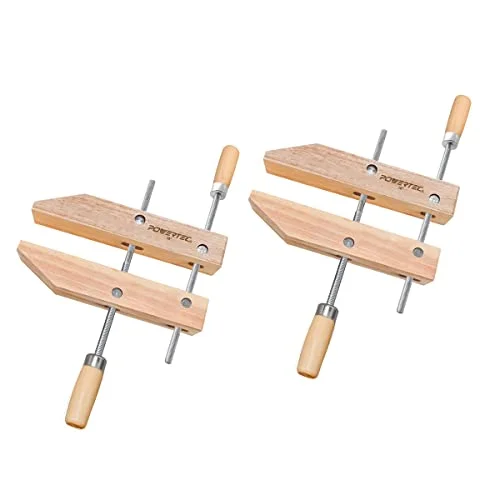 |
POWERTEC 10″ Wooden Handscrew Clamp, 2-Pack – $34.99 Acme-thread stainless spindles, hardwood jaws with a 3″ clamping range — a real, ready-made alternative if the build isn’t worth your time for just a clamp or two.
|
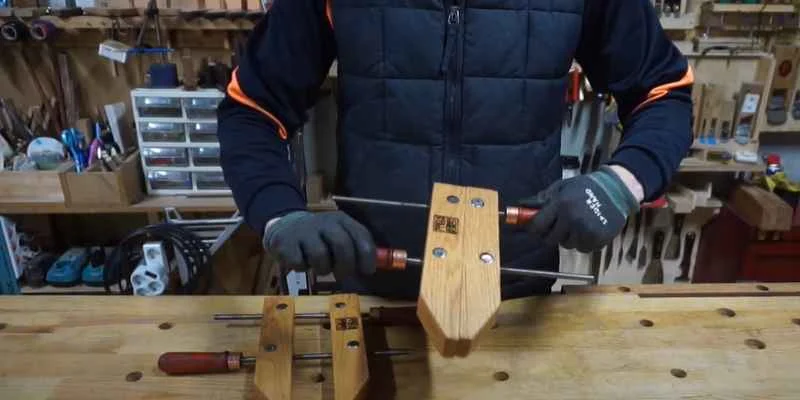
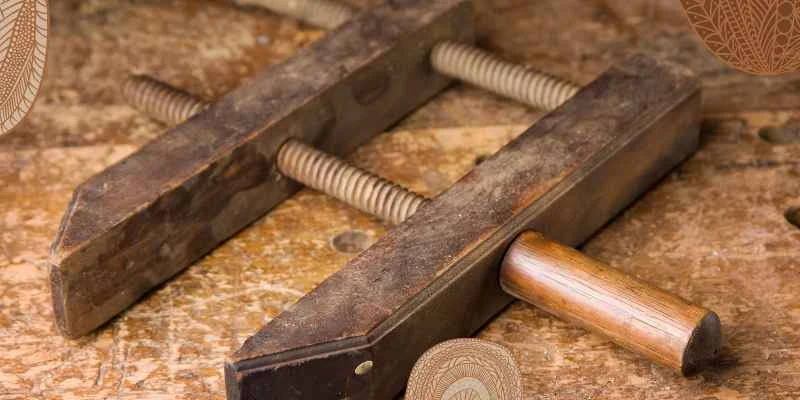
Each handscrew clamp uses two matching wooden jaws (bars), and two threaded rods that both pass through BOTH jaws — one rod near the front (clamping) end, one near the back end. Because each rod threads independently through both jaws, turning only the front screw closes the front of the jaws while the back stays open (or vice versa), letting you angle the jaws to match a tapered or irregular workpiece. Turning both screws together closes the jaws in parallel, for standard flat-face clamping. This is the mechanism the single-screw, four-board version entirely misses — without two independent screws, you just have a crude vise with no ability to angle the grip.
Building One
- Cut two identical jaws from straight-grained hardwood (maple or beech are traditional choices for durability) — a common shop-made size runs around 12-14″ long and roughly 2-2.5″ wide, though you can scale this to your typical clamping needs.
- Drill two holes through each jaw at matching positions — one hole nearer the clamping (front) end, one nearer the back end. Both holes must line up precisely between the two jaws, or the screws won’t thread through both cleanly.
- Thread a rod or lag screw through the front holes of both jaws, with a handle, wing nut, or turned wooden knob on each end so it can be hand-tightened independently.
- Repeat for the back holes with a second independent screw.
- Test the action before using it on real work: confirm both screws turn smoothly and the jaws can open/close both in parallel and at an angle.
Using It
For standard flat, parallel-face clamping, turn both screws roughly evenly so the jaws close square to the workpiece. For a tapered or irregular piece, close the screw nearer the wider section less than the screw nearer the narrower section, angling the jaws to match the workpiece’s actual shape — this is the real advantage over a bar clamp, which can only apply even pressure across a flat, parallel surface. Don’t over-tighten either screw individually; snug pressure evenly distributed across both screws holds better and risks less damage to the work than one screw cranked far tighter than the other.
Common Mistakes When Building One
- Misaligned holes between jaws: if the front and back holes don’t line up precisely between both jaws, the screws bind or won’t thread through smoothly — clamp the two jaw blanks together and drill both at once to guarantee alignment, rather than drilling each jaw separately.
- Using a single screw and calling it done: as covered above, this produces a basic vise-like clamp, not a real handscrew — both screws are required for the angled-grip capability that defines the tool.
- Threads cut too close to the jaw’s edge: a threaded hole positioned too near the wood’s edge is prone to splitting out under clamping pressure — leave adequate margin, especially on the front hole, which sees the most stress.
- Skipping a test run before real use: confirm the jaws open, close, and angle smoothly on a piece of scrap before trusting the clamp on an actual glue-up or workpiece you can’t afford to have slip.
Frequently Asked Questions
How do you make a wooden handscrew clamp?
Cut two matching wooden jaws, drill two aligned holes through each (one near the front, one near the back), then thread two independent screws or rods through the matching holes in both jaws, each with its own hand-turnable handle or knob.
Why does a handscrew clamp need two screws?
Two independent screws let the jaws close either in parallel or at an angle, which is what lets a handscrew clamp grip tapered or irregular stock — a single-screw design can only clamp evenly, like a basic vise.
What wood is best for making a handscrew clamp?
Straight-grained hardwoods like maple or beech hold up best to repeated clamping pressure and threading. Softer woods work for occasional light use but wear at the threaded holes faster under regular use.
Conclusion
A real wooden handscrew clamp works because of its two independently-adjustable screws, not despite it — that’s the mechanism that lets it grip tapered and irregular stock a standard clamp can’t handle. Get the two-jaw, two-screw design right and the build itself is a straightforward, satisfying shop project.
Sponsored / affiliate links. As an Amazon Associate I earn from qualifying purchases. I may earn additional commission from eligible campaigns.