MDF Sheet Sizes: Standard Dimensions, Thickness & Cost
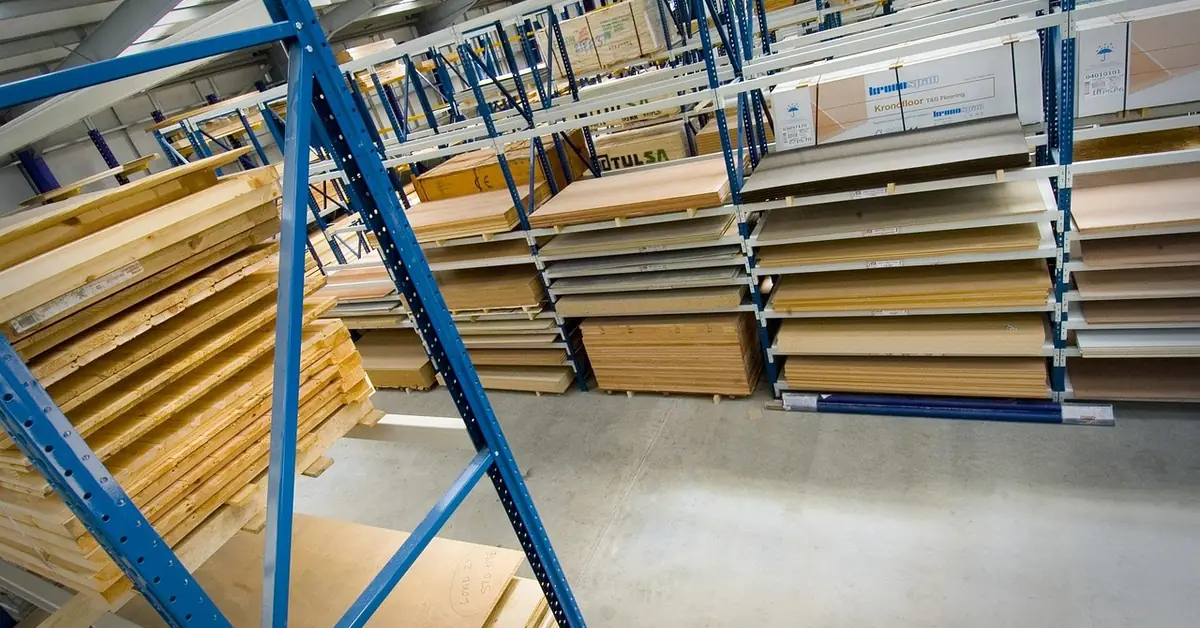
MDF sheets come in one standard size, 4×8 feet (1220 x 2440mm), but thickness from 1/8 inch to a full inch is what determines strength, weight, and price. Too thin under a load-bearing shelf and it sags permanently. Too thick for drawer bottoms and you pay for weight you do not need. This guide covers the size and thickness chart, what each grade is for, and what a sheet costs.
Affiliate disclosure: This article contains Amazon affiliate links. As an Amazon Associate we earn from qualifying purchases at no extra cost to you.
Standard MDF Sheet Sizes
Best Straight-Edge Guide Pick
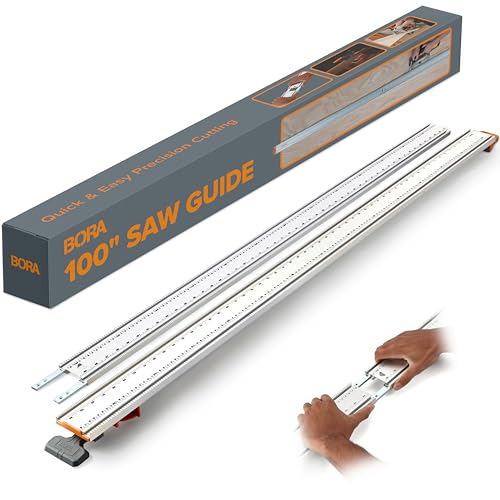
Bora NGX Circular Saw Guide Rail, 100″ Straight Edge Clamp
A full-length track saw rail that clamps down and guides a circular saw dead straight across a full 8-foot MDF sheet in one pass.
- Best for: ripping full 4×8 MDF sheets to size in one straight pass
- Why we picked it: 100″ length spans a full sheet without repositioning mid-cut
- Main drawback: long rail needs storage space and is overkill for occasional small cuts
Compare more MDF cutting guide options
 Option 1 Horusdy 2-Pc Track Saw Clamps, 6-Inch
|
 Option 2 24″ ProGrip Straight Edge Clamp and Guide
|
 Option 3 Kreg Straight Edge Guide XL, 98 Inch
|
As an Amazon Associate we earn from qualifying purchases.
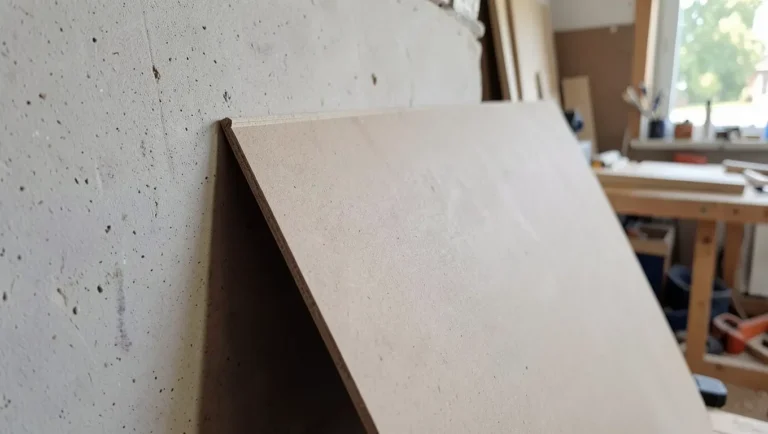
The overwhelming majority of MDF sold at U.S. lumberyards and home centers comes in one sheet footprint: 4 feet by 8 feet (48 x 96 inches, or 1220 x 2440mm). That is the size a table saw, a delivery truck, and a standard door opening are all built around, which is why manufacturers rarely deviate from it for stock inventory.
- 4′ x 8′ (1220 x 2440mm) — the universal standard, stocked by every major supplier
- 2′ x 4′ (600 x 1220mm) — a common pre-cut “half sheet,” easier to transport in a car
- 5′ x 10′ or larger (1525 x 3050mm+) — oversized sheets, special-order only at most yards, used for large architectural panels
If you only need a small piece, most Lowe’s and Home Depot locations will make a few straight rip cuts for free or a small fee — worth asking about before you try to wrestle a full 4×8 sheet into a sedan.
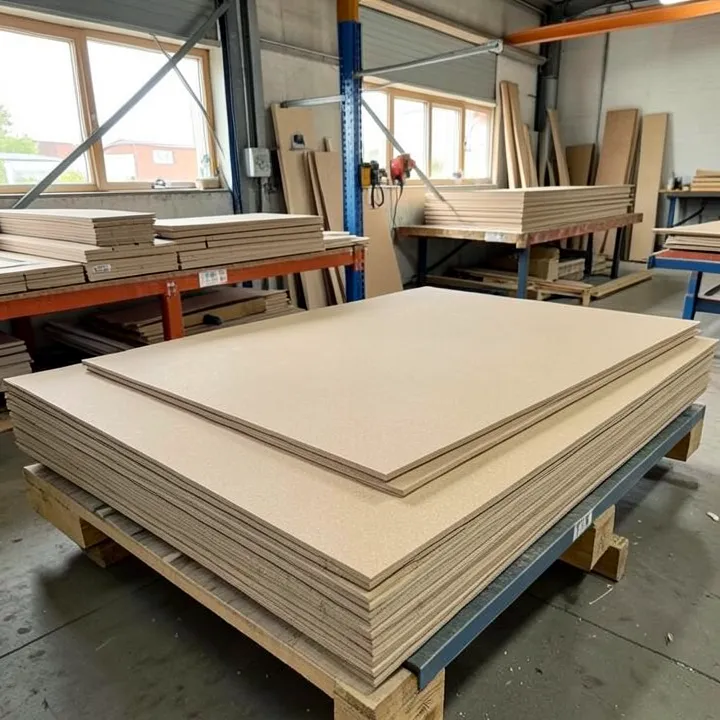
MDF Thickness Chart: Size, Weight & Cost at a Glance
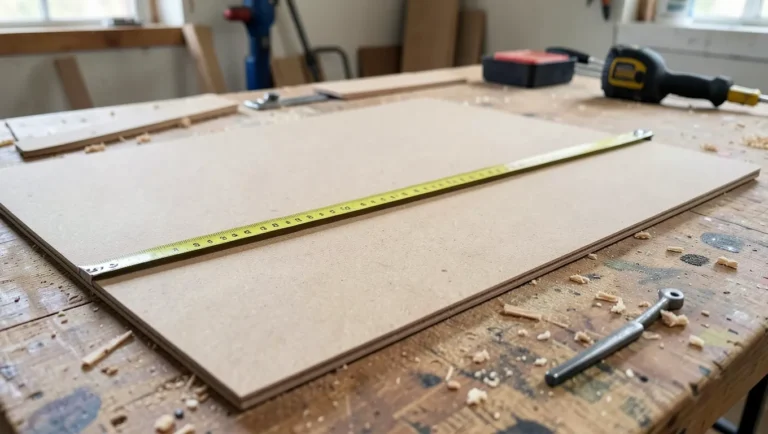
Nominal thickness and actual thickness are not the same thing — a sheet labeled 3/4 inch is typically milled to about 23/32 inch (0.71875″), a detail that catches people off guard when a “3/4-inch” panel does not sit flush against 3/4-inch plywood. The table below combines thickness, approximate full-sheet weight, and typical price into one reference — something no single manufacturer spec sheet gives you together.
| Nominal Thickness | Approx. Weight (4×8 sheet) | Typical Price | Best For |
|---|---|---|---|
| 1/4″ (6mm) | ~35 lbs | $15–$25 | Cabinet backs, drawer bottoms |
| 1/2″ (12mm) | ~65 lbs | $25–$40 | Cabinet sides, storage boxes, small shelving |
| 3/4″ (18mm) | ~95 lbs | $45–$60 | Cabinet doors, load-bearing shelves, tabletops |
| 1″ (25mm) | ~125 lbs | $65–$90 | Countertops, workbenches, heavy furniture bases |
Weights estimated from MDF’s typical 600–800 kg/m³ density; actual weight varies by manufacturer and moisture content. Prices reflect standard-grade indoor MDF; moisture-resistant and pre-primed sheets run higher.
For unsupported spans over about 24 inches — a shelf with no center support, for example — go up to 3/4 inch minimum. MDF has almost no flex memory: once it sags under a load, it does not spring back the way solid wood or plywood sometimes will.
MDF Grades and Types Explained
MDF grade is a manufacturing quality rating that describes how uniform the board’s surface and core are, separate from the thickness or type of resin used. As one of the main types of engineered wood, MDF is graded into three tiers: Grade I is defect-free and used for visible, finish-grade work; Grade II carries minor surface chips or scratches suitable for painted or hidden panels; Grade III has visible defects and is reserved for rough backing or structural fill where appearance does not matter.
MDF Types by Resin and Additive
- Standard MDF — the default; good for dry indoor furniture, shelving, and trim, but swells and delaminates if it stays wet
- Moisture-Resistant MDF (MR-MDF) — often green-tinted, treated with moisture-resistant resin for kitchens, bathrooms, and mudrooms; still not a substitute for exterior siding
- Exterior-Grade MDF — formulated for occasional outdoor exposure or high-humidity commercial spaces; check the manufacturer spec before using it as true exterior siding
- Fire-Retardant (FR) MDF — usually pink or red-tinted, contains fire-retardant additives, required by code in certain commercial and multi-family buildings
- Ultralight MDF — a lower-density version, roughly 30–50% lighter than standard, used for trade show builds, film sets, and anywhere weight matters more than load capacity
For most furniture and cabinetry, standard Grade I or II MDF is the right call. Reach for MR-MDF specifically for kitchen cabinet boxes or bathroom vanities — areas with regular humidity exposure but not direct water contact.
MDF vs. Plywood vs. Particle Board
All three are engineered wood panels, but they are not interchangeable. Engineered wood covers all three; the differences come down to how the wood fiber is processed and bonded.
| Material | Density/Strength | Weight (4×8, 3/4″) | Best For |
|---|---|---|---|
| MDF | Dense, uniform, no grain | ~95 lbs | Painted furniture, cabinet doors, smooth panels |
| Plywood | Strongest, layered grain | ~65–75 lbs | Structural work, furniture that gets moved often |
| Particle Board | Least dense, weakest screw-hold | ~90–100 lbs | Budget flat-pack furniture, low-load shelving |
MDF wins on surface finish — no grain to fill, no voids to patch, and it takes paint better than either alternative. Plywood wins on strength-to-weight and screw-holding power. Particle board is the budget option and the weakest of the three for anything load-bearing.
Cutting MDF Sheets to Size
A full 4×8 sheet is unwieldy alone, and MDF’s dense fiber core dulls blades faster than plywood does. A carbide-tipped blade with a high tooth count (60T or more) gives the cleanest edge and the least tear-out on the face veneer side. Cutting MDF also throws a fine, resin-laden dust — wear a proper dust mask, and see what to do if you breathe in MDF dust if you skip that step.

- Support the full sheet: lay it flat on sawhorses or foam board so it does not flex and bind the blade mid-cut.
- Score the cut line first: a shallow scoring pass with a utility knife on the finish face reduces splintering before the full-depth cut.
- Clamp a straight-edge guide: for cuts longer than 24 inches, a guide rail keeps a circular saw tracking true across the full length of the sheet.
- Cut finish-face up on a table saw, finish-face down on a circular saw: this keeps the blade’s exit tear-out on the side that will not show.
- Sand the cut edge: MDF edges are more porous than the face — a light pass with 150–220 grit before finishing keeps the edge from soaking up extra paint or sealer.
If you would rather skip the equipment entirely, see our guide on cutting MDF without power tools for hand-tool methods.
Best Uses for MDF Sheets
MDF’s biggest advantage is its paint-ready surface — no wood grain to fill, no knots to work around. That makes it the go-to choice for painted cabinets and furniture, decorative wall panels, and shelving that will be painted rather than stained. It is a poor choice for anything that needs to look like natural wood grain, since staining MDF produces a blotchy, uneven result.
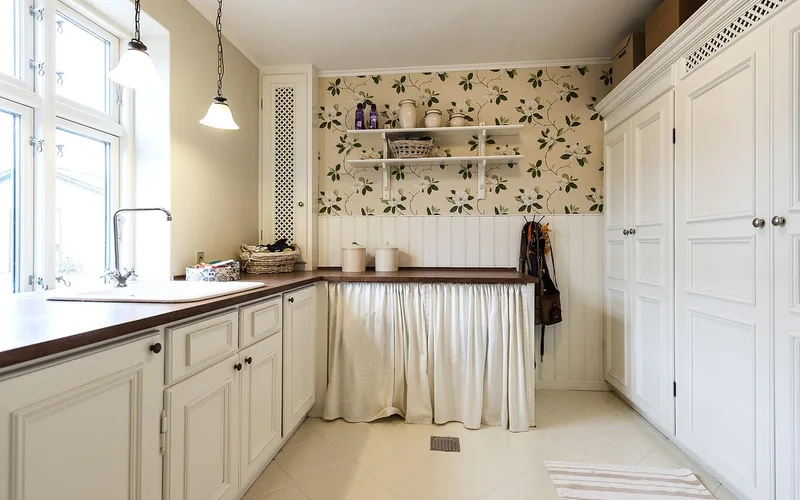
- Kitchen and bathroom cabinet doors — use MR-MDF for the added moisture resistance
- Wall paneling and wainscoting — MDF cuts cleanly into decorative profiles and routed patterns
- Shelving — fine for light to moderate loads at 3/4″ or thicker, with support every 24–32 inches
- Speaker boxes and acoustic panels — MDF’s density dampens vibration better than plywood
- Trim, baseboard, and crown molding — pre-primed MDF trim is now standard in most new-construction homes
Before you paint, always sand the raw edges and seal them — unsealed edges are the number one point of failure on MDF furniture, since exposed fiber wicks up moisture fastest at a cut edge.
Common Mistakes to Avoid With MDF Sheets
- Leaving cut edges unsealed: raw MDF edges absorb moisture fast and swell — always prime or seal every cut edge, not just the faces.
- Using standard wood screws near an edge: MDF has poor screw-holding strength close to the perimeter; use MDF-specific screws or pre-drill with glue reinforcement, and keep fasteners at least 1 inch from the edge.
- Skipping the sanding sealer before paint: MDF’s raw surface is more porous than it looks — skip the sealer and you will burn through twice the paint with a blotchy result.
- Choosing standard MDF for a wet location: kitchens and bathrooms need MR-MDF at minimum; standard MDF will delaminate under repeated moisture exposure.
- Under-sizing thickness for the span: a 1/2″ shelf over 24″ unsupported will sag permanently — MDF does not have the spring-back that solid wood has.
Frequently Asked Questions
What size does MDF come in?
Standard MDF sheets measure 4 feet by 8 feet (1220 x 2440mm), sold in thicknesses from 1/8 inch up to 1 inch. Pre-cut 2×4-foot half sheets are also widely available for smaller projects or easier transport.
How much does a sheet of MDF weigh?
A full 4×8 sheet of 3/4-inch MDF weighs approximately 95 pounds, based on MDF’s typical 600–800 kg/m³ density. A 1/4-inch sheet weighs closer to 35 pounds, while a full 1-inch sheet can run 125 pounds or more.
What’s the difference between MDF and particleboard?
MDF is made from fine wood fibers bonded with resin under heat and pressure, giving it a dense, uniform core with no visible particles. Particleboard uses larger, coarser wood chips and is less dense, which makes it lighter but weaker for screw-holding and edge strength than MDF.
Is MDF waterproof?
No, standard MDF is not waterproof and will swell, soften, or delaminate with sustained water exposure. Moisture-resistant MDF (MR-MDF) holds up better in humid rooms like kitchens and bathrooms, but even MR-MDF is not rated for direct, standing water contact.
When should you not use MDF?
Avoid MDF for exterior siding, anywhere it will see standing water or high humidity without a moisture-resistant rating, and for any structural application requiring high screw-pullout strength. Plywood is the better choice in those situations.
Conclusion
A standard 4×8 sheet covers nearly every project, so the real decision is thickness: 1/2 inch for cabinet sides and light shelving, 3/4 inch for anything load-bearing or a cabinet door, and moisture-resistant grade wherever humidity is a factor. Get the thickness and grade right up front and MDF outperforms both plywood and particleboard on cost and finish quality for painted furniture and cabinetry.
Sponsored / affiliate links. As an Amazon Associate I earn from qualifying purchases. I may earn additional commission from eligible campaigns.