Best Wood for a Desk: 8 Compared by Price & Warp Risk (2026)
The best all-around wood for a desk is black walnut — dense enough to resist keyboard and mouse wear, and the most evenly stable of the solid hardwoods here (a 1.4 tangential-to-radial shrinkage ratio, the lowest among the premium woods we compared). It runs about $28.78 per square foot as a prefinished slab. If budget is the deciding factor, birch actually edges it out on raw dimensional stability (1.3 T/R ratio) at roughly half the price per square foot — the surprising find in the dataset below.
Most "best wood for a desk" roundups compare species on adjectives — "durable," "stylish," "affordable" — without ever putting a real number next to any of them. That’s a problem for a desktop specifically, because a desk surface has a job the rest of a piece of furniture doesn’t: it sits directly under a monitor that runs warm for eight-plus hours a day, often clamped down at one point by a monitor arm, in a room whose humidity swings with the seasons and the HVAC. Hardness alone doesn’t predict how that surface behaves over years of that cycle — dimensional stability does, and almost no competing article puts a real stability number on the page. This one does. For a broader look at how these species compare outside a desktop context, see our full wood species guide.
Desk Wood Comparison Table: Hardness, Warp Risk & Price per Sq Ft
Every price below is the live buy-box price (Amazon Creators API, pulled this session) for a prefinished or unfinished desktop-ready slab in the same size class — roughly 48–60 inches long, 24–30 inches wide, 1–1.5 inches thick — so the per-square-foot figures are comparing like with like, not a small craft board against a full slab. Janka hardness and the tangential/radial (T/R) shrinkage ratio are sourced from The Wood Database. A lower T/R ratio means the board shrinks and swells more evenly across its width as humidity and a monitor’s heat cycle through the room, which is the real driver of cupping — not hardness alone.
| Material | Janka Hardness | T/R Shrinkage Ratio | Price / Sq Ft | Workability | Verdict |
|---|---|---|---|---|---|
| Black Walnut | 1,010 lbf | 1.4 (best) | $28.78 | Excellent | #1 Best Overall |
| Yellow Birch | 1,260 lbf | 1.3 (best) | $14.98 | Good | Best Value |
| White Ash | 1,320 lbf | 1.6 | $32.40 | Good | Best Shock Resistance |
| Hard Maple | 1,450 lbf | 1.9 | $32.40 | Difficult (hard on tools) | Best for Heavy Daily Use |
| Red Oak | 1,220 lbf | 2.2 | $30.72 | Good (some tearout) | Best Traditional Look |
| Acacia (Mangium) | 1,430 lbf | 2.8 (worst) | $19.98 | Moderate (interlocked grain) | Best Rustic Grain for the Money |
| Bamboo (laminated) | 1,180–3,000+ lbf* | N/A (engineered) | $16.62 | Moderate–Difficult (dulls blades) | Best Eco-Friendly Choice |
| Particleboard | Not Janka-rated | N/A (engineered) | $9.47 | Easy to cut, poor to finish | Best Budget / Temporary Desk |
*Bamboo hardness varies widely by construction — traditional laminated (horizontal/vertical grain) bamboo runs 1,180–1,380 lbf, while strand-woven bamboo is compressed under heat and resin and can exceed 3,000 lbf. The listing for the pick below doesn’t specify which construction it uses, so treat the hardness figure as a range, not a confirmed single number — disclosed here rather than guessed.
Best Wood for a Desk, Ranked
1. Black Walnut — #1 Best Overall
Price: $287.19 for a 60" x 25" x 1.5" prefinished slab ($27.56/sq ft) · Janka: 1,010 lbf · T/R ratio: 1.4
- 1,010 lbf Janka — softer than maple or ash, but still hard enough that a keyboard or a dropped stapler won’t dent it under normal desk use
- Best-in-class dimensional stability among the solid hardwoods tested (1.4 T/R ratio) — meaning it moves evenly as the room’s humidity and a monitor’s radiant heat cycle through the year
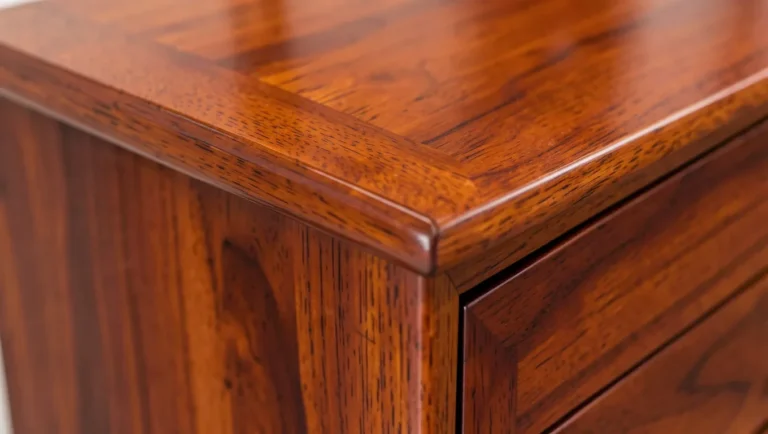
- Dark, straight grain that doesn’t require staining to look finished — an oil topcoat like Watco Danish Oil in Dark Walnut is enough
Walnut is the wood every competitor roundup calls "premium," and the dataset backs that up on stability — but it isn’t the hardest wood here. At 1,010 lbf it’s actually the softest of the eight materials in this table, softer than red oak. What it wins on is movement: a 1.4 T/R ratio means it shrinks and swells almost evenly in both directions, so a one-piece walnut desktop is less likely to cup or crown at the edges as your HVAC and a warm monitor cycle the humidity around it over a year.
Main drawback: at $27.56/sq ft it’s the second-most expensive hardwood on this list, and its relative softness means a dragged ceramic mug or a dropped multitool will leave a mark that maple or ash would shrug off. If dent resistance under heavy daily abuse matters more than movement, go to the maple pick below instead.
Who it’s for: a home office or executive desk where the desktop is going to sit under a monitor arm for years and look the part while doing it — the combination of low movement and a finished, no-stain-needed look is what earns it the overall pick despite not topping any single spec column.
2. Yellow Birch — Best Value
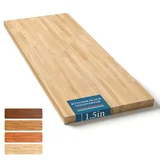
Price: $155.99 for a 60" x 25" x 1.5" unfinished slab ($14.98/sq ft) · Janka: 1,260 lbf · T/R ratio: 1.3
- The lowest T/R ratio in the whole comparison (1.3) — on paper, birch is actually the most dimensionally stable wood in this table, edging out walnut
- 1,260 lbf Janka is harder than both walnut and red oak, for roughly half walnut’s price per square foot
- Fine, even, closed grain machines cleanly and takes finish evenly once sealed
This is the dataset’s real surprise. Every competitor article treats walnut as the automatic "most stable" pick because it’s the premium wood, but the T/R shrinkage numbers say otherwise — birch’s 1.3 ratio is fractionally better than walnut’s 1.4, and it’s harder (1,260 lbf vs. 1,010 lbf) at just over half the price per square foot ($14.98 vs. $28.78). For a desk that needs to survive a monitor arm’s clamp pressure and years of daily use without a premium-wood budget, birch is the pick the traffic-driven competitor roundups miss entirely.
Main drawback: birch is notorious for blotching under oil-based stain the same way maple does — its tight, closed grain absorbs pigment unevenly. Use a pre-stain wood conditioner or go with a wipe-on poly that doesn’t rely on stain penetration.
Who it’s for: anyone building a desk on a real budget who still wants solid hardwood rather than an engineered panel — birch gets there without the walnut markup, and the dataset says it isn’t actually giving up stability to do it.
3. White Ash — Best Shock Resistance
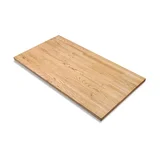
Price: $270.00 for a 48" x 25" x 1.5" prefinished slab ($32.40/sq ft) · Janka: 1,320 lbf · T/R ratio: 1.6
- 1,320 lbf Janka, harder than oak and walnut, with a mid-pack 1.6 T/R ratio
- The same species used for tool handles and baseball bats — ash absorbs sudden impact without cracking better than its Janka number alone suggests
- Open, straight grain that stains more evenly than oak’s
Janka hardness measures resistance to a slow, static indentation — it doesn’t capture how a wood handles a sudden impact, like a dropped tool or a chair arm banged into the edge. Ash’s long track record in tool handles and sporting goods is a real, if less quantifiable, advantage for a desk edge that’s going to take the occasional knock.
Main drawback: ash is currently priced identically to hard maple per square foot in this dataset ($32.40 vs. $32.40) but is softer, so unless the shock-resistance trait specifically matters to you, maple is the harder wood for the same money.
4. Hard Maple — Best for Heavy Daily Use
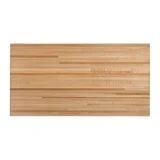
Price: $269.99 for a 48" x 25" x 1.5" prefinished slab ($32.40/sq ft) · Janka: 1,450 lbf · T/R ratio: 1.9
- 1,450 lbf Janka — the hardest solid wood in this comparison, meaning the best resistance to dents from a keyboard, a stapler, or a dragged desk lamp base
- Light, subtle grain suits a clean or modern desk build without staining
- Widely used for butcher blocks and workbenches for the same reason — it takes abuse
Maple is the wood to pick if the desk is going to see real daily wear — a shared family computer, a kid’s homework desk, a workbench-style standing desk. Its 1,450 lbf Janka rating beats every other wood in this table, including the premium walnut pick.
Main drawback: that same hardness makes maple genuinely difficult to work — it dulls blades and router bits faster than the other woods here, and it’s prone to scorching at the table saw or router table if the feed rate is too slow. It also blotches badly under oil-based stain; most maple desks are left natural or finished with a wipe-on poly rather than stained.
Who it’s for: a shared or high-traffic desk — a family computer station, a kid’s homework desk, a garage workbench doubling as a desk — where surface dents from daily wear are the real risk, not seasonal movement.
5. Red Oak — Best Traditional Office Look
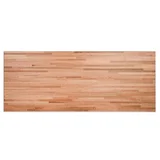
Price: $319.99 for a 60" x 25" x 1.5" prefinished slab ($30.72/sq ft) · Janka: 1,220 lbf · T/R ratio: 2.2
- 1,220 lbf Janka — mid-pack hardness, softer than maple, ash, and acacia
- The classic straight, open grain most people picture when they hear "wood desk"
- Takes stain and dye more evenly than most hardwoods, which is why it dominates traditional office furniture
Oak is the most expensive pick in this table per square foot at $30.72, priced above walnut despite being softer and less dimensionally stable (a 2.2 T/R ratio, the second-worst of the solid woods). It earns its spot on looks and finishing predictability, not on the numbers. If you’re sourcing rough oak lumber instead of a pre-sized slab, our current white oak board-foot pricing breakdown is a useful sanity check against a dealer’s quote.
Main drawback: oak’s 2.2 T/R ratio means it moves unevenly across the board width as humidity changes — a bigger warp risk than walnut, birch, or ash. On a large one-piece desktop (48"+ wide), that shows up as edge cupping over a few humid summers if the desk isn’t sealed on all six faces, including the underside.
6. Acacia (Mangium) — Best Rustic Grain for the Money
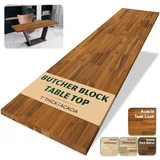
Price: $249.80 for a 60" x 30" x 1" teak-stained slab ($19.98/sq ft) · Janka: 1,430 lbf (Mangium species) · T/R ratio: 2.8
- 1,430 lbf Janka — nearly as hard as maple, for well under the price per square foot
- Dramatic, high-contrast grain and color variation that most solid woods don’t offer without exotic pricing
- Plantation-grown (mostly Acacia mangium from Vietnam) rather than old-growth, which keeps the cost down
Most furniture and desk listings just say "acacia" without naming the species — "acacia" sold at this price point in the US is almost always Acacia mangium, a plantation hardwood, not the wild Australian blackwood sometimes cited for acacia hardness figures. Mangium’s own Wood Database entry puts it at 1,430 lbf, just 20 lbf under hard maple, at roughly 60% of maple’s price per square foot.
Main drawback: a 2.8 T/R ratio — the worst dimensional-stability number of any solid wood in this comparison, nearly double oak’s. Acacia’s interlocked, irregular grain (the same trait that gives it the dramatic look) also means it moves unevenly and can tear out during planing. Seal every face before it goes anywhere near a monitor arm’s clamp.
7. Bamboo — Best Eco-Friendly Choice
Price: $132.99 for a 48" x 24" solid slab ($16.62/sq ft) · Janka: 1,180–3,000+ lbf depending on construction · T/R ratio: not applicable (engineered/laminated, not solid lumber)
- Bamboo is a grass, not a tree — a stand reaches harvest maturity in 3–5 years versus 20–60+ years for the hardwoods in this table, the closest thing to a genuinely sustainable pick here
- Traditional laminated (edge- or face-glued strip) construction runs a modest 1,180–1,380 lbf; strand-woven construction, compressed under heat and resin, can exceed 3,000 lbf
- Because it’s manufactured from glued strips rather than a single board, it resists seasonal cupping better than any solid wood in this table — cross-orientation in the lay-up does the same job plywood’s cross-grain plies do
The listing for this pick doesn’t state which construction it uses, so its actual hardness could sit anywhere in that 1,180–3,000+ lbf range — that’s a real gap in what the manufacturer discloses, not a number we’re willing to guess at. What’s not in question is the sustainability angle and the resistance to warping from the laminated construction.
Main drawback: bamboo’s silica content is genuinely hard on tools — it dulls standard carbide blades and bits faster than any hardwood in this table, so factor blade wear into the cost if you’re cutting it down yourself rather than buying it pre-sized.
8. Particleboard — Best Budget / Temporary Desk
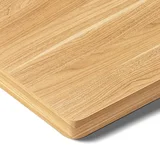
Price: $63.16 for a 40" x 24" x 1" laminated slab ($9.47/sq ft) · Janka: not Janka-rated (engineered board) · T/R ratio: not applicable
- By far the cheapest option in this table — less than a third the price per square foot of birch, the next-cheapest pick
- Won’t cup or warp from normal humidity swings the way solid lumber does, because it has no grain direction to move along
- Pre-laminated finish means no sanding or topcoat needed out of the box
Particleboard trades warp resistance for a completely different failure mode: it doesn’t shrink and swell reversibly like solid wood does — if the laminate edge is chipped or a drink spills into a seam, the exposed core swells permanently and doesn’t recover when it dries. It’s a legitimate choice for a starter desk, a kid’s homework desk, or anywhere the budget is the deciding factor and the desk isn’t expected to last a decade.
Main drawback: it doesn’t hold screws as well as solid wood or real plywood — a monitor-arm clamp or a repeatedly-removed drawer slide can strip the particleboard core over time in a way it wouldn’t in any of the seven other materials on this list. Pilot holes and screws sized for particleboard specifically (coarser thread, wider shank) help, but it’s not a fix for repeated disassembly.
How We Picked These
We have not physically tested these eight desktop slabs — no lab, no scale, no moisture meter on our own bench. What follows is a compared-and-sourced roundup (Tier C), built the honest way: every hardness and shrinkage figure comes from The Wood Database, a widely-cited reference maintained from milled and tested wood samples; every price is a live buy-box figure pulled from the Amazon Creators API on the date this article was published, for a desktop-ready slab in a consistent 40–60 inch size class so the per-square-foot numbers are genuinely comparable; and every workability note reflects well-established shop consensus for that species (blade wear, blotching tendency, tearout risk) rather than a single reviewer’s one-time experience.
Where a spec wasn’t verifiable this session — the exact bamboo construction (traditional laminated vs. strand-woven) — we said so directly instead of guessing at a number that would look more complete on the page.
What to Consider When Choosing Wood for a Desk
Will It Warp Under a Monitor’s Weight and Heat?
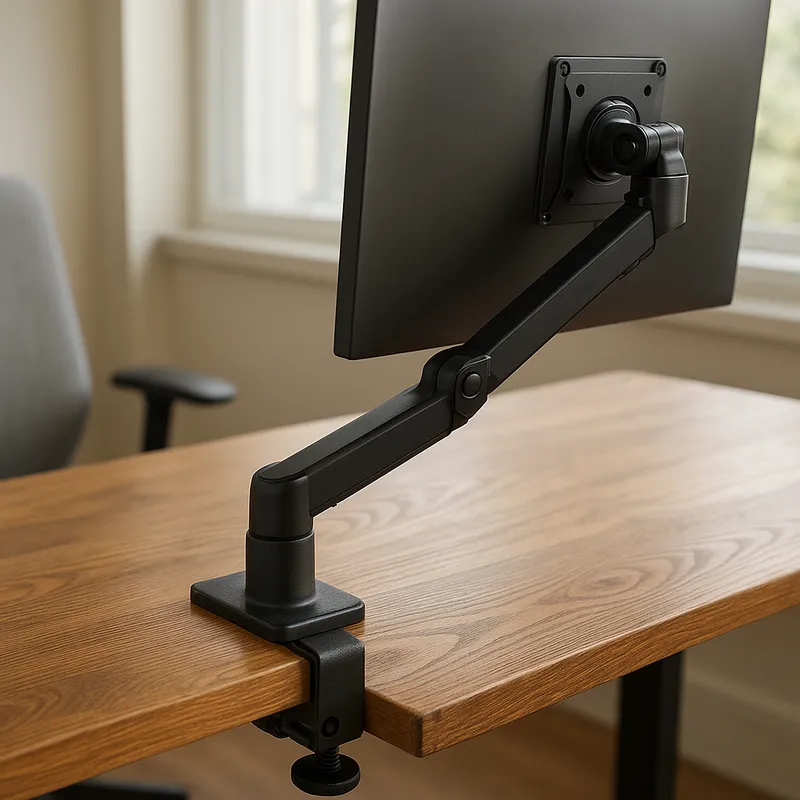
A monitor arm doesn’t just add static weight at one clamp point — it adds a sustained heat source a few inches above the desktop, and most monitors run warm enough to create a small, constant temperature gradient across the surface beneath them. That gradient, combined with normal seasonal humidity swings, is what actually drives long-term cupping, not the one-time clamp pressure. The T/R shrinkage ratio in the table above is the best available proxy for this: a lower ratio (birch at 1.3, walnut at 1.4) means the board moves more evenly in both directions as conditions change, while a higher ratio (acacia at 2.8, oak at 2.2) means one direction shrinks and swells faster than the other — which is exactly the mechanism behind edge cupping.
Engineered materials (bamboo’s laminated construction, particleboard) sidestep this by design — there’s no long grain direction to move unevenly along. The tradeoff is the swelling failure mode covered below.
Solid Wood vs. Engineered Panel
Solid lumber moves seasonally but recovers — it shrinks and swells with humidity and returns close to its original dimension when conditions normalize. Engineered panels (particleboard, MDF, laminated bamboo) resist that seasonal movement far better, but if water actually gets into the core through a chipped edge or an unsealed screw hole, the swelling is often permanent. Pick solid wood if the desk needs to look and feel premium and you’re willing to seal all six faces; pick engineered if budget and warp-proofing under normal humidity matter more than long-term repairability.
Workability — What It’s Like to Actually Cut and Finish
If you’re building the desk yourself rather than buying a pre-sized slab, workability matters as much as the finished spec sheet. Maple and bamboo are the two hardest materials to machine in this table — maple for its raw hardness and tendency to scorch at the router, bamboo for the silica content that dulls carbide blades. Walnut, ash, and birch are the easiest of the solid woods to work with standard shop tools.
Price per Square Foot for a Full Desktop
A typical single-person desktop runs about 12.5 square feet (a 60" x 30" surface, the size class most of the slabs above are sold in). At the per-square-foot prices in the table, that’s roughly $360 in walnut, $187 in birch, $250 in oak, or $118 in particleboard for the raw material alone, before finish, edge banding, or a base/legs. Buying a pre-sized slab (as priced above) usually costs more per square foot than sourcing rough lumber from a hardwood dealer and surfacing it yourself, but it skips the planer, jointer, and glue-up work entirely.
Finish Compatibility
Dark, open-grained woods (walnut, acacia) look best with an oil finish that lets the natural grain show — Watco Danish Oil is the standard choice and comes in a Dark Walnut tint that deepens the color further. Blotch-prone light woods (maple, birch) do better with a wipe-on polyurethane applied directly rather than a stain — Minwax Water-Based Wipe-On Poly avoids the uneven pigment absorption that oil-based stain causes on closed-grain wood. Dense or oily woods, and bamboo specifically, are a better match for a two-part hardwax oil like Rubio Monocoat, formulated to bond to surfaces that resist standard oil penetration. Particleboard needs a full-coverage poly or laminate on every face — oil doesn’t seal engineered board’s exposed core edges the way it penetrates solid lumber. For a deeper side-by-side on the two most common options, see our Danish oil vs. polyurethane comparison.
Thickness
1 inch is the practical minimum for a desktop that spans more than about 30 inches unsupported between legs without noticeable flex under a monitor arm’s clamp pressure; 1.5 inches (the thickness of most of the hardwood slabs above) adds stiffness and is standard for butcher-block-style desktops. Thinner engineered panels under 1 inch need a full apron or additional leg supports to avoid sag in the center — the same physics we cover in more depth in our piece on whether butcher block countertops sag over time.
Sustainability
Bamboo’s 3–5 year harvest cycle is the standout here against hardwoods that take decades to mature. Acacia (mangium) is a fast-growing plantation species too, typically harvested at 10–15 years, which is part of why it’s priced well below true old-growth hardwoods like walnut despite comparable hardness.
Grain and Color
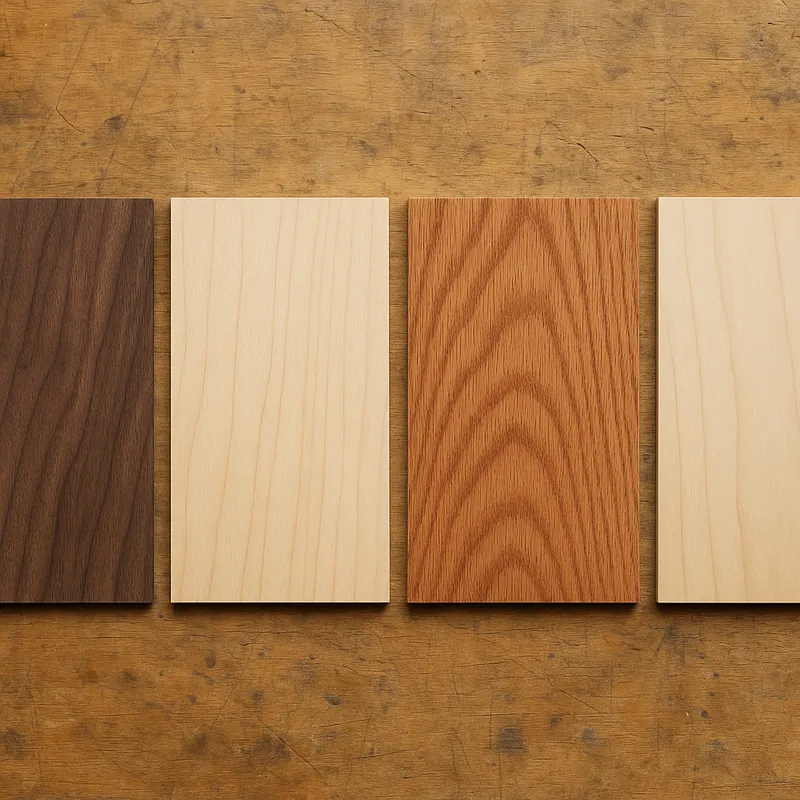
Walnut and acacia are the two woods here with the most visual character — walnut for its deep, consistent chocolate-brown tone, acacia for the dramatic, high-contrast streaking that comes from its interlocked grain (the same trait that hurts its T/R ratio). Maple and birch sit at the other end — light, subtle, and closer to uniform, which suits a minimal or modern desk build better than a statement piece. Oak and ash fall in between: visible, straight grain without walnut’s drama or acacia’s contrast.
Sourcing: Pre-Sized Slab vs. Rough Lumber
Every price in the comparison table above is for a pre-sized, surfaced slab bought directly on Amazon — the fastest route from purchase to finished desktop, and the one most home builders actually use. Buying rough lumber from a hardwood dealer and surfacing it yourself (jointer, planer, edge-gluing multiple boards to reach full width) is usually cheaper per board foot, sometimes significantly so, but it adds real shop time and requires equipment most casual builders don’t own. The per-square-foot prices above should be read as the convenience-priced ceiling for each material, not the floor. If a pre-sized slab still isn’t what you’re after, our guide to where to buy butcher block countertops locally covers the in-person sourcing route too.
Real Cost to Build a Desk: Budget vs. No-Compromise
Using a 60" x 30" desktop (12.5 sq ft) as the standard size, here’s what a full desk actually costs at each end of the range — desktop material, legs/frame, and finish, all live-priced this session. The desktop cost is the per-square-foot rate from the table above × 12.5 sq ft (a derived figure, not a separately priced 60"x30" SKU for every material).
Budget Route
| Item | Price |
|---|---|
| Desktop (particleboard, 12.5 sq ft @ $9.47/sq ft) | $118.38 |
| Legs — Lendpea fixed-height metal legs | $45.99 |
| Finish | Pre-laminated, none needed |
| Budget total | $164.37 |
No-Compromise Route
| Item | Price |
|---|---|
| Desktop (black walnut, 12.5 sq ft @ $27.56/sq ft) | $359.75 |
| Frame — HUANUO dual-motor electric standing frame | $159.99 |
| Finish — Watco Danish Oil, Dark Walnut | $14.56 |
| No-compromise total | $534.30 |
The gap between the two routes is about $370 — almost entirely the desktop material itself. The frame and finish costs barely move between routes; walnut vs. particleboard is where the budget decision actually lives.
How to Prep and Finish a Wood Desktop
This covers acclimating, sanding, and finishing a slab you’ve already bought or milled. If you’re building the whole desktop from raw sheet goods instead, our step-by-step guides to building a DIY wood desktop and building a desk from plywood cover the cutting and assembly steps this section doesn’t.
- Acclimate the slab. Let it sit in the room it’ll live in for at least a week before final sanding or finishing, so it can adjust to the room’s actual humidity first.
- Sand through the grits. Start at 120 grit if the slab isn’t pre-sanded, and work up to at least 220 before finishing — skipping grits shows up as scratches once oil or poly is applied.
- Seal every face, not just the top. The top gets the visible finish, but the underside, edges, and any cutouts for cable grommets need at least one coat too — sealing only the visible face is the single most common cause of one-sided cupping.
- Cut cable and mount openings before the final coat. Any grommet hole or monitor-arm mounting hole exposes fresh, unsealed wood — finish those cuts before the last topcoat, not after.
- Let each coat cure fully before use. Oil finishes need 24–72 hours between coats depending on humidity; loading a monitor arm onto a desktop before the finish has cured can leave a permanent clamp mark in the softer film.
Frequently Asked Questions
What is the best wood for a desk that won’t warp?
Birch and walnut have the lowest tangential-to-radial shrinkage ratios of the solid woods in this comparison (1.3 and 1.4), which makes them the most likely to move evenly rather than cup as humidity and a monitor’s heat cycle through the year. For a desk that needs to resist warping with zero seasonal movement, an engineered option like particleboard or laminated bamboo sidesteps the issue entirely, at the cost of a different failure mode if it gets wet.
Is oak or walnut better for a desk?
Walnut is more dimensionally stable (a 1.4 T/R ratio vs. oak’s 2.2) and, in this dataset, actually cheaper per square foot ($28.78 vs. $30.72). Oak is softer than walnut too (1,220 lbf vs. walnut’s 1,010 lbf is close, but oak’s real advantage is the classic look and more even stain uptake, not raw performance).
Is MDF or plywood better for a desk?
Neither was tested at a directly comparable price point in this roundup — pre-sized MDF and plywood desktop panels weren’t available in the same 40–60 inch slab class as the other picks, so we didn’t force a mismatched comparison into the table. As a general rule, cabinet-grade plywood with a real hardwood veneer holds screws and resists moisture better than MDF, while MDF machines more smoothly and takes paint better than plywood’s visible veneer seams.
Does bamboo make a good desk?
Yes, with one caveat: bamboo’s actual hardness depends heavily on whether it’s traditional laminated construction (1,180–1,380 lbf) or strand-woven (over 3,000 lbf), and most retail listings don’t specify which. It’s genuinely the most sustainable material in this comparison and resists warping well due to its cross-laminated construction, but confirm the construction type before assuming a hardness figure.
How thick should a wood desktop be?
1 inch is the practical minimum for a desktop wider than about 30 inches between leg supports; 1.5 inches is standard for butcher-block-style hardwood desktops and adds meaningfully more resistance to flex under a monitor arm’s clamp.
What’s the cheapest wood that still holds up for a desk?
Birch, at $14.98 per square foot in this comparison — it’s harder than both walnut and oak (1,260 lbf) and has the best dimensional stability of any solid wood tested, at roughly half the price per square foot of the premium picks.
Does a monitor arm actually cause a desk to warp?
Not on its own from clamp pressure alone — a standard monitor-arm clamp exerts far less force than the wood can handle structurally. The real risk is the sustained low-level heat the monitor radiates onto the same section of desktop for hours a day, combined with normal seasonal humidity change. That combination is what the T/R shrinkage ratio in the table above is meant to flag — materials with a high ratio (acacia, oak) are more likely to move unevenly under that kind of long-term, uneven exposure than materials with a low ratio (birch, walnut).
Final Thoughts
For most home-office builds, black walnut remains the safest single pick — it’s the most evenly stable of the solid hardwoods and looks the part without staining. But the dataset’s real finding is that birch, at roughly half walnut’s price per square foot, edges it out on the T/R shrinkage ratio that actually predicts warping. If the budget doesn’t stretch to walnut, birch isn’t a compromise pick — on the numbers, it’s arguably the better one.
Sponsored / affiliate links. As an Amazon Associate I earn from qualifying purchases. I may earn additional commission from eligible campaigns.