Delta Model 10 Radial Arm Saw: Model Numbers, Specs and Safety
The Delta “Model 10” name covers several different 10-inch radial arm saws made over decades, so the model number on the data plate matters more than the nameplate. The documented 33-830 is a 1.5 hp, 120/240V saw with a 16-inch crosscut and a 5/8-inch arbor, and it must keep its guard and anti-kickback fingers. This guide covers the model lineage, 33-830 specs, alignment, and used-buying checks.
Choosing a Blade for a Delta 10-Inch Radial Arm Saw
 |
Best Radial Arm Saw Blade Pick 10-Inch 80-Tooth Negative-Hook Sliding Miter / Radial Arm Saw Blade, 5/8-Inch Arbor, $30 The listing states a 10-inch diameter, a 5/8-inch arbor, a 6,000 RPM maximum (the Delta manual asks for 5,000 or higher), and a negative 5 degree hook, which is the blade geometry we explain below.
|
As an Amazon Associate we earn from qualifying purchases.
Delta’s own 33-830 manual says to use only 10-inch blades with 5/8-inch arbor holes that are rated for 5,000 RPM or higher. The motor on the 33-830 is listed by dealers at 3,450 RPM, so a blade with a 6,000 RPM rating leaves a margin.
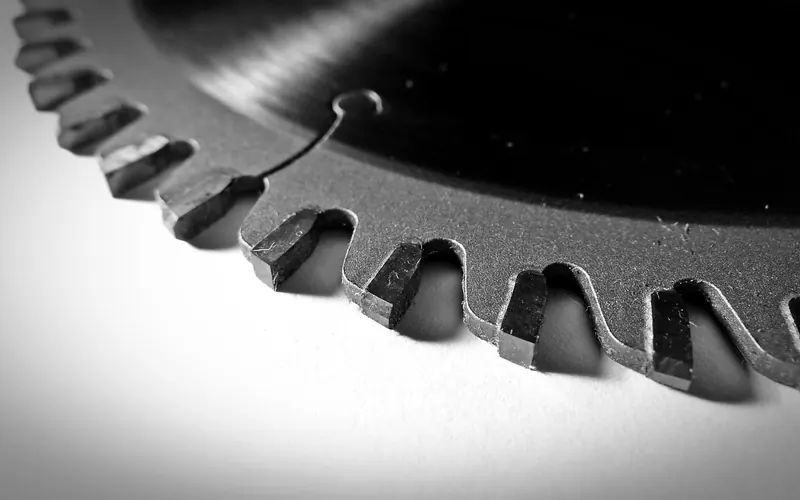
Hook angle is the part most buyers miss. On a radial arm saw the blade rotates so that, when you pull it through the work, the teeth tend to draw the carriage forward into the cut. Woodworkers describe this as climbing. A contributor on Woodweb’s radial arm saw thread recommends a negative hook blade in the range of minus 2 to minus 7 degrees, and Freud’s Amazon listing for its negative-hook 10-inch blade says the angle minimizes climbing. A standard positive-hook table saw blade makes the carriage pull harder, so match the blade to the saw.
Fine Woodworking’s 2002 review of the 33-830 reported marked tearout on plywood face veneer in crosscuts, which is the situation a fine-tooth negative-hook blade is meant to improve. The same review found blade changes cumbersome because the guard gets in the way, and the arbor nut has a left-hand thread.
Which Delta “Model 10” Do You Have?
Delta and Rockwell-Delta sold 10-inch radial saws from the 1950s onward under different names. The VintageMachinery.org publication index lists dated manuals and parts sheets for many of them. The table below uses those titles as listed. The year is the date of the publication, not a production date, so treat it as a rough marker only.
| Year of publication | Title as listed | What it tells you |
|---|---|---|
| 1953 | Operator’s Guide for 10″ Delta Radial Saw | Early Delta 10-inch design |
| 1962 | Delta “Super 990” and “Super 990-10” Radial Saw | Older Super 990 naming, not the same as the later 33-990 |
| 1965 | Rockwell-Delta “Plus 105″ 9” and “Deluxe 105″ 10” | Rockwell-era naming |
| 1973 | Rockwell Delta 10″ Radial Saw, beginning with serial no. 100-B | Serial number ranges changed parts |
| 1977 | 33-215 and 33-216 “Model 10” radial arm saw | Titled “Model 10” in the index |
| 1980 and 1996 | 33-975C and 33-990 10″ saw; “Model 10 Deluxe” 33-990 manual | The 33-990 appears in both years |
| 1998 and 2001 | 33-830 10″ Professional Radial Arm Saw manual | The saw most people mean today |
Here is a correction worth making: the 33-830 is not a 1950s or 1960s saw. Its manual carries a 2001 copyright, the index lists a 1998 edition, and Fine Woodworking reviewed it in 2002. The 33-990 shows up in manuals from 1980 and 1996, and I could not find a primary source that gives its horsepower, so do not assume it matches the 33-830. Read the model and serial number off the data plate, then match them to a manual before you trust any spec you see in a listing.
For replacement parts and where to look for them, see our guide to Delta radial arm saw parts. For restoration work on much older machines, our old radial arm saw restoration guide covers cleaning, wiring and testing.
Delta 33-830 Specs From the Manual
These figures come from the Delta 33-830 instruction manual (part no. 424-12-651-0031), except where a dealer listing is named.
| Item | Delta 33-830 | Source |
|---|---|---|
| Blade | 10 inch (254 mm), 5/8-inch arbor, rated 5,000 RPM or higher | Manual |
| Motor | 1-1/2 hp, 120/240V, shipped wired for 120V | Manual |
| Motor speed | 3,450 RPM | Dealer listing |
| Maximum crosscut | 16 inches (406 mm) | Manual |
| Depth of cut | 2-3/4 inch at 90 degrees, 2-1/2 inch at a 45 degree bevel | Manual |
| Positive stops | Bevel at 0, 45 and 90 degrees; miter at 0 and 45 degrees, left and right | Manual |
| Arm | Cast-iron track arm, steel stand, automatic blade brake | Manual |
| Circuit | Separate circuit, no smaller than #12 wire, 20 amp time-lag fuse | Manual |
A dealer listing for a “Model 10 Deluxe” saw gives a 16-inch crosscut at 1 inch depth, a 26-1/2 inch maximum rip, a 5/8-inch arbor, and 240V single phase. That is one dealer’s description, not a manual, so confirm it against your own saw.
Voltage, overload and the brake
The motor is dual voltage. To run it on 240V, the manual has you disconnect power, remove the nameplate cover, slide the switch in the motor junction box to 240, and replace the 120V plug with a UL or CSA listed plug rated for 240V and the saw’s current. It tells you to have a qualified electrician or service center do the plug. If the motor stops from overload, turn the switch off, wait three to five minutes, then push the reset button.
The built-in brake is meant to stop the blade within seconds after switch-off or power loss. Fine Woodworking measured roughly eight seconds for a full stop on its test saw, so wait for the blade to stop completely before reaching toward the cut-off piece, as the manual instructs.
Safety First: Guards, Kickback and Climbing
Safety warning
Do not buy or run a used radial arm saw that is missing its blade guard, its anti-kickback fingers, or a working carriage return. Delta’s manual says to replace missing or damaged parts before the saw is used again. If you cannot identify the model or get the parts, leave the saw.
“NEVER USE TOOL WITHOUT GUARDS in place.”
The 33-830 manual’s radial saw rules are blunt. They include: use anti-kickback fingers when ripping, never rip a workpiece from the wrong end, never feed work into the anti-kickback end, never cut freehand, never perform a crossed-arm operation, and never start the saw with the blade engaged in the workpiece. The manual also tells you to remove cut-off pieces from the table before cutting, because vibration can move them into the blade path.
OSHA requires a permanent label reading “Danger: Do Not Rip or Plough From This End” on radial saws, and says ripping must go against the direction the blade turns. Source: OSHA 29 CFR 1910.213(h)
Crosscutting without letting the blade run away
For a crosscut, Delta says to set the arm at zero, clamp it, keep the blade to the left and behind the fence, and pull the blade across the work just far enough to cut through. Return the carriage fully to the rear after every cut and turn the saw off. Because the blade tends to climb toward you as it enters the wood, keep a firm hand on the cutting-head handle and never let the carriage run forward on its own.
A secondary check comes from the OSHA rule for radial saws: the saw should sit so the cutting head returns gently to the starting position when released. Inferring from that, a good test on a used saw, with the plug pulled and the blade guarded, is to roll the head forward and let go. If it creeps forward or will not drift back, the saw needs adjustment or has worn track bearings.
Ripping on a radial saw
Ripping needs more setup. The yoke is rotated to the in-rip or out-rip position, the guard is lowered at the infeed side until it nearly touches the work, and the splitter must ride in the kerf with the anti-kickback fingers resting on the board. Delta says ripping stock under 4 inches wide needs a push stick. Out-ripping is fed from the left of the saw and in-ripping from the right. If your saw lacks a splitter or fingers, do not rip on it. For a comparison with another saw, see radial arm saw vs table saw.
Aligning a Delta 33-830 Step by Step
Unplug the saw for every step. This condenses the order in Delta’s manual; use the manual for fastener details.
- Level the table boards: set the four table adjustment screws so an arbor wrench fits the same gap between the motor shaft and the board at each corner.
- Cut into the table boards: with the guard on and the board clamped, lower the spinning blade about 1/16 inch into the table and pull the head forward to cut the kerf. Repeat for each angle you plan to cut.
- Square the travel to the fence: set a framing square against the fence and blade, slide the head the full length of the arm, and rotate the arm until the blade tracks parallel.
- Remove heeling: with a square on the table, release the yoke clamp and swivel the yoke until the blade is parallel to the square.
- Square the blade to the table: with the bevel index engaged, check with a square between two teeth and adjust the motor tilt if needed.
- Set the rip scale and splitter: zero the in/out rip pointer with the blade flush to the fence, then seat the splitter in the kerf.
Two details are easy to get wrong. The track arm clamp handle has left-hand threads, as does the arbor nut. And if the carriage bearings develop play, the manual says to adjust the two adjustable bearings by a small fraction of a turn, never loosening the adjustment screws more than half a turn, or the cutting head may fall off the arm. To protect the table from repeated cuts, Delta suggests an auxiliary facing of 1/4-inch plywood or particle board fastened with brads.
If the saw tends to tip, slide or walk, the manual says to secure it to the floor through the holes in the bottom of each leg. A table extension over 24 inches long needs an outrigger support or a floor-fastened stand. I could not find a published dimension chart for a Delta stand or mobile base, so measure your own saw before buying a base.
Buying a Used Delta Radial Arm Saw: What to Check
Prices vary widely with model and condition, so compare completed sales. Before you pay, run these checks. Our broader used radial arm saw inspection checklist covers general condition and negotiating.
- Data plate: photograph the model and serial number and match them to a manual. If it is missing or unreadable, treat the saw as unidentified.
- Guards: the upper hood, lower guard, splitter and anti-kickback fingers must all be present and move freely.
- Warning labels: the “do not rip from this end” label and the rotation arrow should still be on the hood.
- Carriage travel: the head should slide smoothly with no play, and drift back when released.
- Indexing: the miter, bevel and yoke stops should click firmly and hold.
- Motor and switch: check the cord, plug and switch for damage, and look for a working brake or overload reset if the model has them.
- Table: a heavily cut-up table is fixable, but a bent arm or column is a reason to pass.
If you decide a radial saw is not worth the risk, a sliding miter saw handles most crosscut work. Our Kobalt miter saw parts list shows what to expect when you own one, and our miter saw explainer covers how it cuts. For what the radial design is good at, read what radial arm saws are used for.
Frequently Asked Questions
What is the Delta Model 10 radial arm saw?
“Model 10” is a name Delta used for different 10-inch radial arm saws over many years, so there is no single set of specs. The best-documented current-era saw is the 33-830, a 1.5 hp, 120/240V saw with a 16-inch crosscut. Read the model and serial number on the data plate and match them to a manual.
What blade does a Delta 33-830 radial arm saw take?
The manual says to use only 10-inch blades with 5/8-inch arbor holes rated for 5,000 RPM or higher. A negative-hook blade is the usual choice for radial saws because it reduces the tendency of the blade to climb toward the operator. The arbor nut has a left-hand thread.
What is the crosscut capacity of the Delta 33-830?
The manual lists a maximum crosscut of 16 inches, with a depth of cut of 2-3/4 inches at 90 degrees and 2-1/2 inches at a 45 degree bevel. Material thicker than 1 inch needs the fence positioned directly behind the fixed front table board.
Can a Delta 33-830 run on 240 volts?
Yes, the motor is dual voltage and ships wired for 120V. The manual has you slide a switch in the motor junction box to 240 and replace the plug with a listed 240V plug. Disconnect power first and have a qualified electrician or service center do the plug.
Where can I find a manual for a Delta radial arm saw?
Start with the model number on the data plate, then search for that number with the word manual. The VintageMachinery.org publication index lists many Delta and Rockwell-Delta radial saw manuals and parts sheets, including one for the 33-830.
Is a used Delta radial arm saw safe to buy?
It can be, but only if the guards, splitter, anti-kickback fingers and warning labels are present and the carriage travels and returns smoothly. Delta’s manual tells owners to replace missing or damaged parts before using the saw. If key safety parts are missing and cannot be sourced, do not buy it.
Conclusion
A Delta radial arm saw can still do accurate crosscuts, but the name “Model 10” tells you very little until the data plate is matched to a manual. Buy only a saw with every guard in place and a manual you can read.
Sponsored / affiliate links. As an Amazon Associate I earn from qualifying purchases. I may earn additional commission from eligible campaigns.