12-Inch Radial Arm Saw: Are They Still Made? (Real Prices)
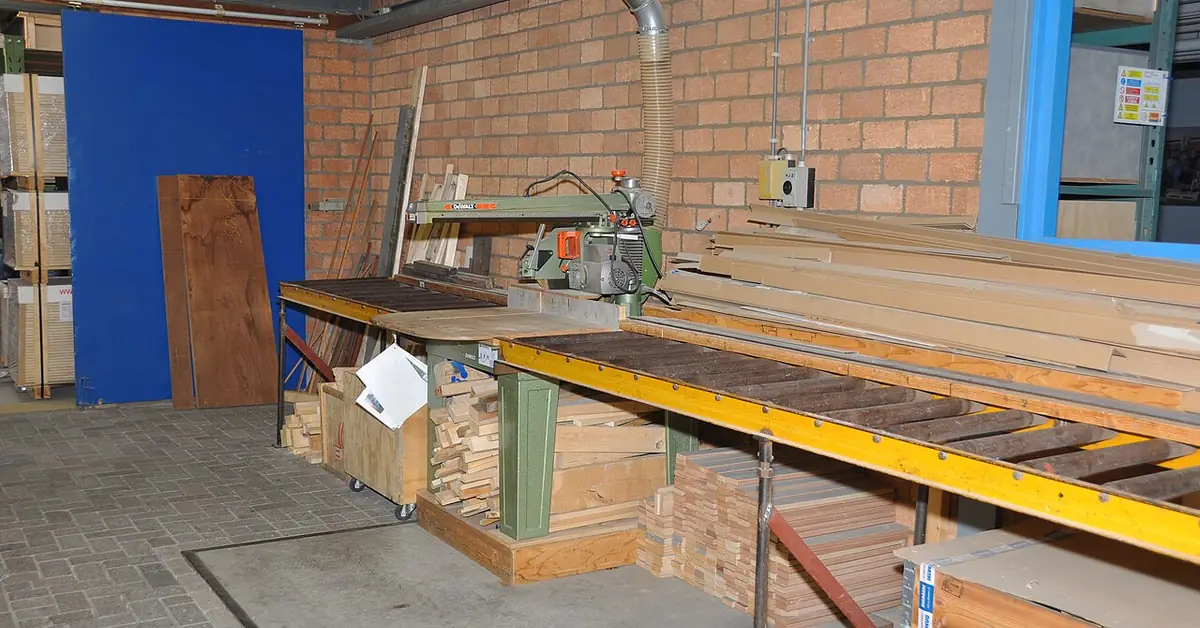
A 12-inch radial arm saw pulls its blade toward you on an overhead arm for crosscuts, dados, and long rips — but DeWalt stopped U.S. production in 1985, so most buyers today are shopping used. A worn arm track will throw every angle off no matter how good the laser guide is. This guide covers what the specs mean, why prices range from $200 to $6,235, and which accessories are worth buying new.
[Affiliate Disclosure reusable block goes here]
What Is a 12-Inch Radial Arm Saw Used For?
Best Radial Arm Saw Blade Pick
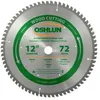
Oshlun SBW-120072N 12″ 72T Blade for Radial Arm Saws – $61.90
A negative-hook, thin-kerf blade built specifically for sliding miter and radial arm saws — the negative hook angle keeps the blade from self-feeding into the stock, which matters more on a saw where you’re pulling the blade toward yourself.
- Best for: Replacing a dull factory blade for cleaner crosscuts
- Why we picked it: Negative hook angle is the safer geometry for a pull-style saw
- Main drawback: Thin kerf flexes more in very hard or wet lumber
Compare more radial arm saw accessories
 Option 1 Oshlun LG-R01 Laser Guide – $35.85
|
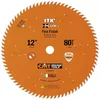 Option 2 CMT P12072 12″ 80T Finish Blade – $46.97
|
 Option 3 ANSI Z87.1 Safety Glasses + Ear Plugs – $15.99
|
As an Amazon Associate we earn from qualifying purchases.
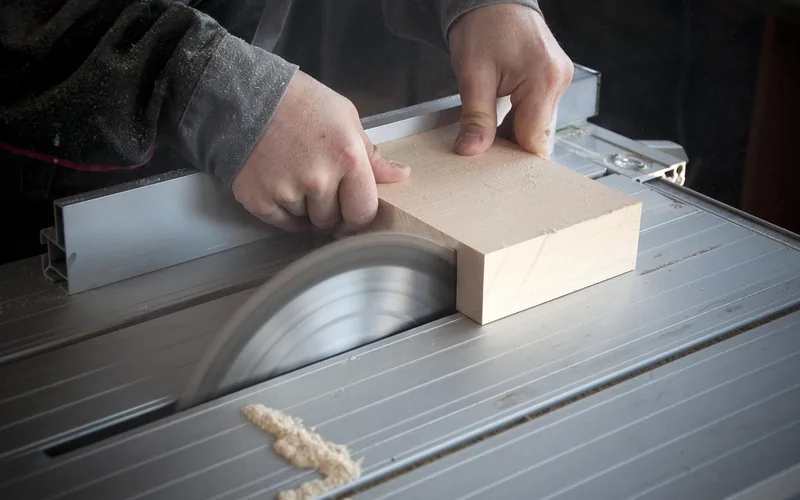
A radial arm saw is a stationary woodworking machine with a circular blade and motor suspended from an arm above a fixed table, used mainly for crosscutting, mitering, and ripping lumber. The “12-inch” refers to the blade diameter, which sets the maximum crosscut depth — typically around 3 to 3½ inches on a contractor-duty model.
Unlike a table saw, the blade travels toward the operator instead of the stock feeding into a fixed blade, which is what makes long crosscuts and dado work on wide panels easier with one machine. Tilt the motor head and you get bevel cuts; pivot the arm and you get miters; turn the head parallel to the table and you can rip boards, though most shops now reserve ripping for a dedicated table saw.
For a deeper look at specific operations — dados, compound cuts, and panel work — see our full breakdown of what radial arm saws are used for.
Are 12-Inch Radial Arm Saws Still Made?
Yes, but barely. Raymond DeWalt patented the original radial arm saw — marketed as the “Wonder-Worker” — in the early 1920s, and it became the standard crosscutting tool in home and pro shops through the 1970s. DeWalt discontinued U.S. production in 1985 once compound miter saws took over crosscutting duty, and most other household-name brands (Craftsman, Delta, Rockwell) followed within a decade or two.
Today, Original Saw Company is the only major U.S. manufacturer still building a new 12-inch contractor-duty radial arm saw — a 3 HP, 440-pound machine with a 21¾-inch crosscut and 3¼-inch depth of cut. Almost everyone else buying a radial arm saw in 2026 is buying used.
📊 DeWalt ended U.S. radial arm saw production in 1985 — Original Saw Company’s current 12″ Contractor Duty model is the only new one still built, priced $6,145–$6,235.
Best Radial Arm Saw Blades and Accessories
A used radial arm saw is only as accurate as the blade and guide you put on it. Since new saws aren’t practical for most buyers, upgrading the blade and adding a laser guide is the highest-value fix for a machine that already came with worn factory parts.
Radial Arm Saw vs. Miter Saw: Which Should You Buy?
A radial arm saw and a compound miter saw both crosscut, but they solve different shop problems. A radial arm saw can also rip boards and cut dados in one setup; a miter saw is faster and more accurate for angled trim cuts but cannot rip.
| Feature | Radial Arm Saw | Miter Saw | Best For |
|---|---|---|---|
| Rip cuts | Yes, turn the head 90° | No | One-machine shops |
| Angle accuracy | Drifts as the arm wears; needs tuning | Holds preset stops tightly | Trim and miter work |
| Footprint | Needs table space on both sides | Compact, portable | Small shops and job sites |
| New availability | 1 U.S. manufacturer, $6,145+ | Widely sold, $150–$700 | Budget-conscious buyers |
How Much Does a 12-Inch Radial Arm Saw Cost?
Expect to pay $200 to $800 for a used hobbyist-grade radial arm saw in working condition, $1,000 to $2,500 for a well-maintained mid-size shop model, and $3,000 or more for restored industrial units. A new Original Saw Company 12-inch contractor-duty model runs $6,145 to $6,235 depending on motor voltage.
Condition matters more than brand at the used-market end — a $300 saw with a tight arm track and a sharp blade will cut more accurately than a $700 saw that’s been sitting in a damp garage. Before paying anything, check the arm for side-to-side play and the table for flatness; both are cheaper to walk away from than to fix.
How to Operate a 12-Inch Radial Arm Saw Safely
A radial arm saw is more dangerous than a table saw for one specific reason: on a crosscut, you pull the spinning blade toward your body instead of feeding stock away from you. The anti-kickback pawls and blade guard shown below exist to stop the blade from climbing up and out of the cut, and skipping them is the single most common cause of radial arm saw injuries.
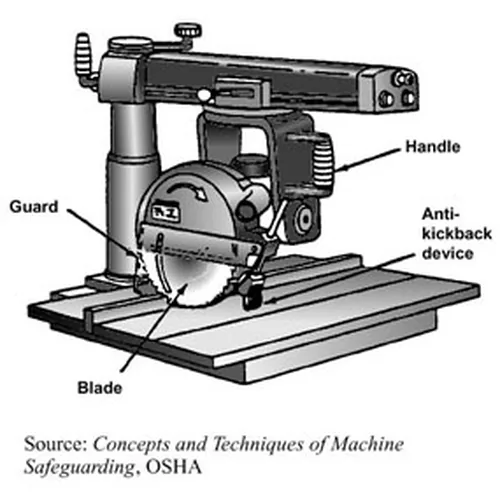
- Check the guard and anti-kickback pawls: Confirm the lower blade guard covers the blade and the anti-kickback pawls move freely before plugging in the saw.
- Set the crosscut stop and depth: Adjust the safety guard to about 1/8 inch above the board and lock the crosscut travel stop for the cut you’re making.
- Pull the saw through for crosscuts: Hold the workpiece firmly against the fence and pull the saw head toward you in one smooth motion, letting the blade do the cutting.
- Turn the head 90° and push for rip cuts: For ripping, rotate the motor head parallel to the table and feed the board into the blade against the direction of rotation, with the anti-kickback pawls engaged.
- Let the blade reach full RPM first: Start the motor and wait for the blade to reach full speed before it touches the workpiece to avoid bogging down or grabbing.
- Return the head and shut off before adjusting: Slide the saw head fully back to its resting position and switch off the motor before changing the blade, angle, or depth setting.
Buying Guide: What to Check on a Used Radial Arm Saw
- Arm and column play: Pull the saw head all the way out and back — any side-to-side wobble means worn bearings or a stretched track, and it will never cut square until that’s fixed.
- Table flatness: Sight down the table with a straightedge; a warped or gouged table telegraphs into every cut.
- Motor condition: Listen for bearing whine or excessive vibration when the motor spins up — a tired motor bogs down on anything thicker than 1-inch stock.
- Anti-kickback pawls and guard present: Many used saws are missing these safety parts entirely; factor $30–$60 into your offer if you need to replace them.
- Blade capacity and arbor size: Most 12-inch radial arm saws use a 1-inch arbor; confirm before buying replacement blades.
“In our shop, the most common problem with an older radial arm saw isn’t a weak motor — it’s a loose arm track that lets the blade wander out of square mid-cut. Before buying used, pull the saw head all the way out and back and check for side-to-side play; if you can wiggle it by hand, budget for new bearings or walk away.”
If you want a project-ready reference table instead of buying a factory stand, our radial arm saw table plans cover dimensions and safety setup for building your own. For parts once you own one, see our DeWalt radial arm saw parts guide and our roundup of radial arm saw attachments worth adding.
Frequently Asked Questions
Can you rip boards on a radial arm saw?
Yes. Rotate the motor head 90° so the blade runs parallel to the table, then feed the board into the blade against the direction of blade rotation with the anti-kickback pawls engaged. Most shops still prefer a dedicated table saw for ripping because it’s faster to set up.
Is a radial arm saw more dangerous than a table saw?
Both are dangerous without proper guards, but a radial arm saw carries a distinct risk: on a crosscut, the blade pulls toward the operator instead of stock feeding away from a fixed blade. Working anti-kickback pawls and a lower blade guard are essential, not optional.
What replaced the radial arm saw in most shops?
Compound miter saws took over crosscutting duty starting in the late 1970s because they’re more compact and hold angle settings more precisely. Table saws handle most ripping. Many woodworkers still keep a radial arm saw for dado work and long crosscuts on wide panels.
How do you keep a radial arm saw cutting square?
Check the arm and column for side-to-side play every few months by pulling the saw head fully forward and back. Re-tighten the track gibs per the owner’s manual if you feel any wobble, and recheck the 90° crosscut stop against a known-square reference board.
What maintenance does a radial arm saw need?
Keep the blade sharp and clean of resin, lubricate the arm track per the manufacturer’s schedule, and check the anti-kickback pawls for free movement. Vacuum sawdust out of the motor housing regularly — buildup there is a common cause of motor overheating on older saws.
Conclusion
A 12-inch radial arm saw still earns its floor space for crosscuts, dados, and long rips — but since DeWalt stopped building them in 1985, buying one today almost always means buying used. Judge the saw on arm play and table flatness before price, budget for a fresh blade and working anti-kickback pawls, and it will out-cut a newer machine that’s never been tuned.
Sponsored / affiliate links. As an Amazon Associate I earn from qualifying purchases. I may earn additional commission from eligible campaigns.