Driver Vs 3 Wood Distance: The Essential Proven Facts
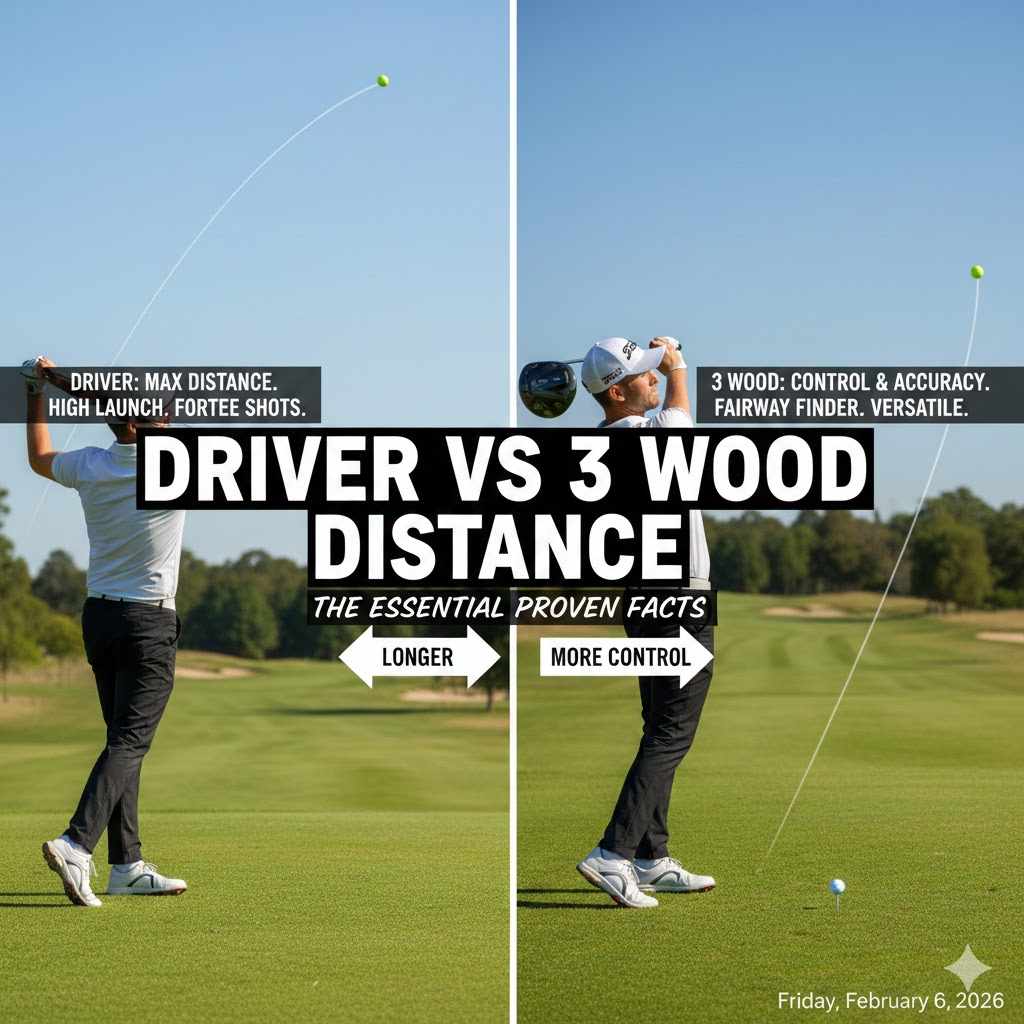
A driver typically hits the ball 20-40 yards farther than a 3-wood due to its longer shaft, lower loft, and larger clubhead designed for maximum distance. While the driver is the go-to club for power off the tee, the 3-wood provides greater control and versatility from both the tee and the fairway.
If you’re new to golf, you’ve probably stood on the tee box wondering which club to pull from your bag. The big-headed driver? Or the slightly smaller 3-wood? It’s a common question that can make a huge difference in your score. Many beginners grab the driver every time, thinking longer is always better, only to end up in the trees. Don’t worry, we’ve all been there!
Understanding the real difference between these two clubs is one of the first big steps toward smarter, more confident golf. This guide will break down everything you need to know in simple terms, so you can choose the right club for the right shot and start hitting more fairways.
What is a Driver and Why Do We Use It?
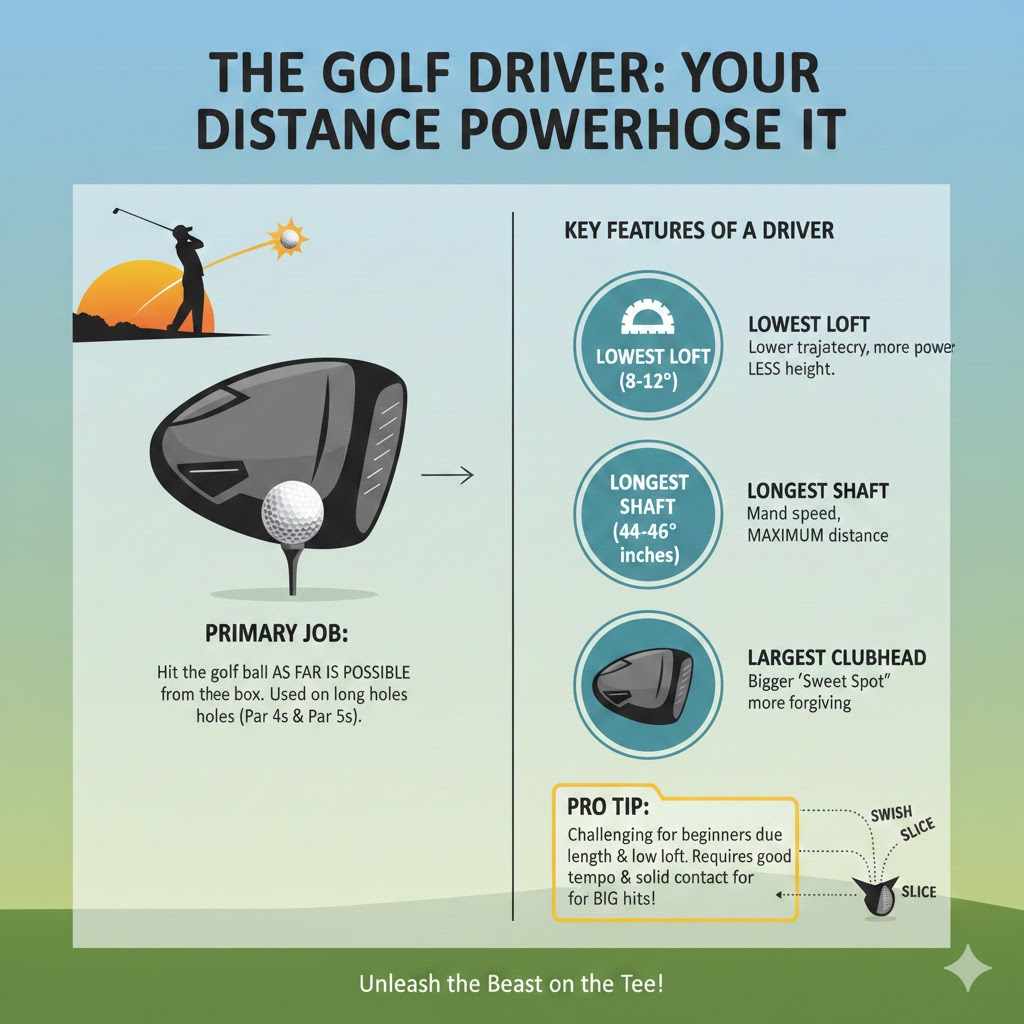
Think of the driver as the powerhouse of your golf bag. It has one primary job: to hit the golf ball as far as possible from the tee box. It’s the club you use to start most long holes, like par 4s and par 5s. Let’s look at what makes it so special.
Key Features of a Driver
- Lowest Loft: A driver has the lowest loft of any club in your bag, typically ranging from 8 to 12 degrees. Loft is the angle of the clubface, and less loft means the ball will travel on a lower, more powerful trajectory designed for distance, not height.
- Longest Shaft: It features the longest shaft of all your clubs, usually between 44 and 46 inches. This longer shaft helps you generate more clubhead speed during your swing, which is a key ingredient for hitting the ball a long way.
- Largest Clubhead: Drivers have the biggest clubhead, legally maxing out at 460 cubic centimeters (cc). This large size creates a bigger “sweet spot,” making it a bit more forgiving on off-center hits than a smaller club would be.
While the driver is built for maximum distance, its length and low loft also make it the most challenging club for many beginners to hit consistently. It requires a good swing tempo and solid contact to get the desired results. When you connect with it properly, the ball flies. When you don’t, it can lead to some wild shots.
What is a 3-Wood and What Makes It Different?
The 3-wood is your go-to club for versatility. It’s often called a “fairway wood” because you can hit it directly off the fairway grass, but it’s also an excellent and often safer alternative to the driver on the tee box. It’s designed to give you good distance combined with better control.
Key Features of a 3-Wood
- More Loft: A 3-wood has more loft than a driver, usually between 13 and 16 degrees. This extra loft helps get the ball in the air more easily, which is especially helpful when hitting from the fairway without a tee. It also produces a slightly higher, softer-landing shot.
- Shorter Shaft: The shaft of a 3-wood is shorter than a driver’s, typically around 42 to 43 inches. This shorter length makes the club easier to control throughout your swing, leading to more consistent and accurate shots.
- Smaller Clubhead: The clubhead is smaller and more compact than a driver’s. This design makes it easier to sweep the ball cleanly off the fairway grass. It’s built for solid contact from a variety of lies.
The 3-wood is a true multi-purpose tool. For beginners, it’s often the best choice off the tee when a fairway is narrow or has hazards. It gives you a great chance to put the ball in play, setting you up for a good next shot. It’s also the club you’ll reach for on a long par 5 when you need to cover a lot of ground with your second shot.
Driver vs. 3-Wood: A Head-to-Head Comparison
Seeing the key differences side-by-side makes it easier to understand why these clubs perform so differently. Each design feature is intentionally chosen to help you accomplish a specific goal on the golf course.
| Feature | Driver (1-Wood) | 3-Wood |
|---|---|---|
| Typical Loft | 8° – 12° | 13° – 16° |
| Standard Shaft Length | ~45 inches | ~43 inches |
| Clubhead Size | Up to 460cc (Largest) | ~175cc (Smaller, more compact) |
| Primary Use | Maximum distance from the tee box. | Distance from the tee OR fairway. |
| Difficulty to Hit | Higher (especially for beginners). | Lower (easier to control). |
As the table shows, every aspect of the driver is engineered for speed and distance. In contrast, the 3-wood balances distance with control and playability from different lies, making it a more adaptable club.
The Real Distance Gap: How Far Should You Hit Each Club?
This is the million-dollar question. While there’s a general rule of thumb, your personal distance will depend heavily on your swing speed. A faster swing will produce more distance and a larger gap between the two clubs.
Let’s look at some average carrying distances (how far the ball flies in the air) for different swing speeds. These are just averages, so don’t worry if your numbers are a little different. The important thing to notice is the gap between the two clubs.
Average Carry Distance by Swing Speed
| Player Swing Speed | Average Driver Carry | Average 3-Wood Carry | Typical Distance Gap |
|---|---|---|---|
| Slow (75 mph) | 180 yards | 160 yards | 20 yards |
| Average (90 mph) | 220 yards | 195 yards | 25 yards |
| Fast (105 mph) | 250 yards | 220 yards | 30 yards |
| Pro-Level (115+ mph) | 280+ yards | 245+ yards | 35+ yards |
As you can see, the gap consistently falls in the 20 to 40-yard range. Why does this happen? It’s a combination of the factors we discussed: the driver’s longer shaft creates more speed, and its lower loft turns that speed into forward distance with less backspin and a more penetrating flight.
When to Choose Your Driver Over Your 3-Wood
Pulling out the driver can feel powerful and exciting, and in the right situation, it’s absolutely the correct play. You’re giving yourself the best chance to get as close to the green as possible. Choose your driver when:
- The fairway is wide and open. If there’s plenty of room for error, go for maximum distance! A wide landing area minimizes the penalty for a slight mishit.
- You’re on a long par 4 or par 5. On these holes, distance off the tee is a huge advantage. Hitting a great drive can turn a long iron approach into a short iron, making it much easier to hit the green.
- You need to carry a hazard. If there’s a bunker, water, or rough that you need to fly over, the driver gives you the best chance to clear it with ease.
- Your confidence is high. If you’re swinging well and feeling good about your driver, trust it. A confident swing is often a good swing.
When Your 3-Wood is the Smarter Play
Good golf is about managing the course and your game, not just hitting the ball as far as you can. Many times, the 3-wood is the strategic choice that will lead to a lower score. Choose your 3-wood when:
- The fairway is narrow. When trouble (like trees, water, or out-of-bounds stakes) lines the fairway, accuracy becomes more important than distance. The 3-wood is your friend here.
- You’re playing a short par 4. If a good drive might run through the fairway or into a bunker near the green, a 3-wood can leave you in a perfect position for a short wedge shot. This is smart course management.
- You need a long, accurate shot from the fairway. This is the 3-wood’s specialty. On a long par 5, it’s the perfect club to advance the ball down the fairway for your second shot.
- It’s a windy day. A driver’s high, long-flying shot can get tossed around by the wind. The 3-wood often produces a slightly lower, more controlled flight that can “pierce” through the wind more effectively.
- You are struggling with your driver. If your driver is just not cooperating on a given day, don’t be stubborn! Put it away and use your 3-wood. Hitting the fairway consistently will build your confidence and save you strokes.
Simple Tips for Hitting Your Driver
To get the most out of your driver, you need to set up for success. Because you’re hitting off a tee, the swing is a bit different from your iron shots.
- Tee It High: A good rule of thumb is to have half of the golf ball above the top edge of your driver’s clubface when you set up. This helps you hit the ball on the upswing.
- Widen Your Stance: Take a slightly wider stance than you would for an iron. This provides a stable base for the powerful, sweeping swing the driver requires.
- Position the Ball Forward: Place the ball off the inside of your lead foot’s heel (your left heel for a right-handed player). This forward position is crucial for making contact as the club begins its ascent.
- Swing Up on the Ball: Unlike an iron where you hit down on the ball, the goal with a driver is to hit it on the upswing. This is known as a positive angle of attack, which launches the ball high with low spin—the perfect recipe for distance.
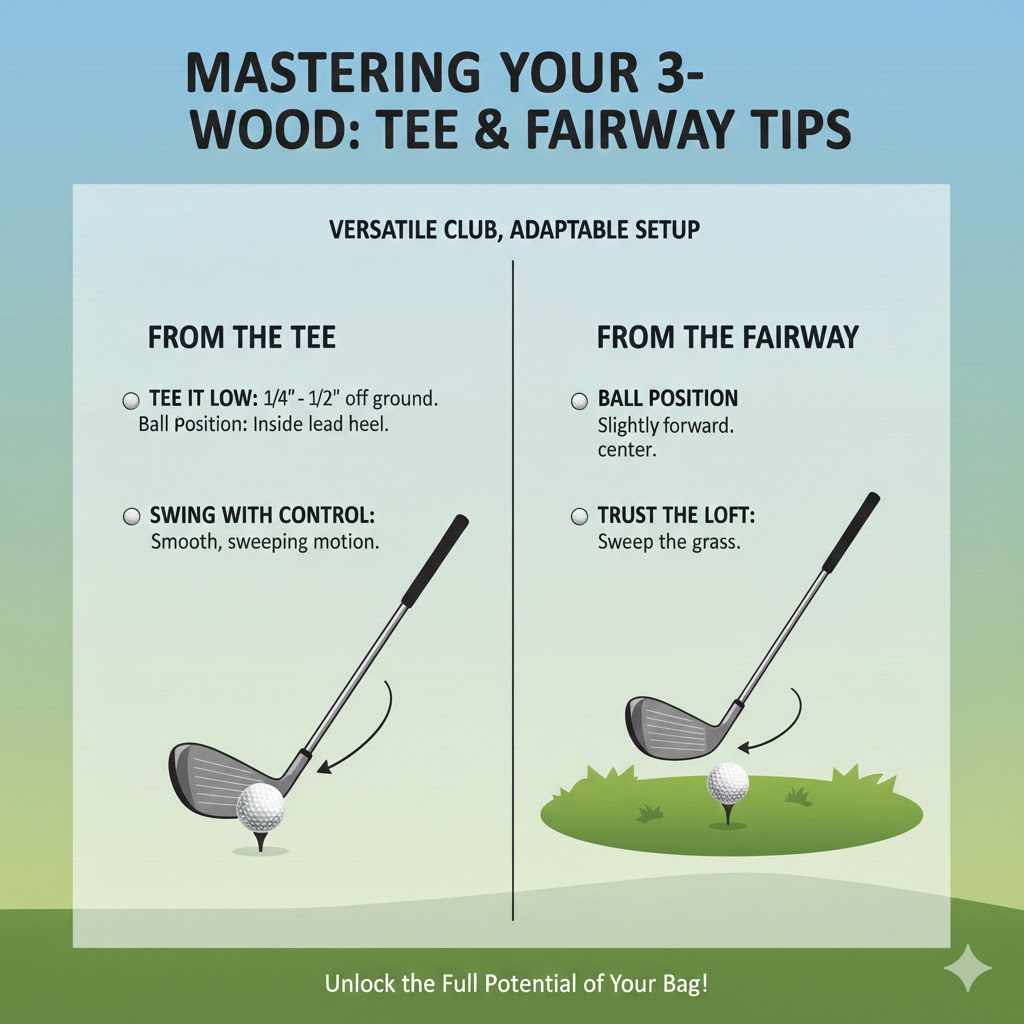
Simple Tips for Hitting Your 3-Wood
The 3-wood is versatile, so your setup changes slightly depending on whether you’re on the tee or in the fairway.
From the Tee
When using a 3-wood off the tee, you still want to give it a little height.
- Tee It Low: Use a much lower tee than you would for a driver. You only want the ball about a quarter-inch to a half-inch off the ground.
- Ball Position: Play the ball a bit further back than a driver, perhaps a couple of inches inside your lead heel.
- Swing with Control: Focus on a smooth, sweeping motion. Don’t try to overpower it. Think of it as a long, easy iron swing.
From the Fairway
This is where the 3-wood really shines, but it can be an intimidating shot for beginners.
- Ball Position: Place the ball slightly forward of the center of your stance, but not as far forward as a driver.
- Don’t Try to Lift It: Trust the club’s loft to do the work. Your job is to make a sweeping motion, brushing the grass at the bottom of your swing. Imagine you are sweeping the ball off the turf rather than hitting down on it.
- Focus on Solid Contact: A smooth tempo is key. A controlled swing that makes clean contact will go much farther and straighter than a fast, wild swing that misses the sweet spot.
Frequently Asked Questions (FAQ)
Can I use a 3-wood off the tee?
Absolutely! Using a 3-wood off the tee is a fantastic strategy for accuracy. On tight holes or short par 4s, it is often the smarter choice to ensure you hit the fairway and set up your next shot.
Why is my 3-wood sometimes longer than my driver?
This is a very common issue for beginners. It almost always comes down to consistency. The 3-wood’s shorter shaft makes it easier to control and find the center of the clubface. A solid shot with a 3-wood will always go farther than a poorly struck shot with a driver.
Should a beginner even carry a driver?
Yes, it’s a good idea to have a driver in your bag to learn with. However, you shouldn’t feel pressured to use it on every hole. Start by using your 3-wood off the tee to build confidence. As you improve, you can begin using the driver on more open holes.
What is the typical loft of a driver vs a 3-wood?
A driver’s loft is typically between 8 and 12 degrees, designed for a low, penetrating ball flight for maximum distance. A 3-wood has more loft, usually between 13 and 16 degrees, which helps get the ball in the air more easily.
How much shorter is a 3-wood shaft than a driver’s?
A 3-wood shaft is generally about 2-3 inches shorter than a driver’s shaft. This shorter length provides significantly more control and makes it easier to hit the ball squarely.
Can I adjust the loft on my driver or 3-wood?
Many modern drivers and fairway woods come with an adjustable hosel that allows you to change the loft and face angle. This can be a great feature for fine-tuning your ball flight, but it’s best to get help from a golf professional to find the right setting for your swing.
Does my swing speed change the distance gap?
Yes, it does. Players with faster swing speeds will see a larger yardage gap between their driver and 3-wood. This is because their high speed maximizes the distance-producing features of the driver more effectively.
Conclusion: The Smart Choice for Your Game
The debate over driver versus 3-wood isn’t about which club is “better”—it’s about which club is right for the shot in front of you. Your driver is your specialist for raw power and maximum distance when you have room to unleash it. Your 3-wood is your reliable, versatile tool for control, accuracy, and strong performance from both the tee and the fairway.
Understanding this fundamental difference is a huge step in your golf journey. Instead of automatically reaching for the driver, take a moment to look at the hole. Is the fairway wide or narrow? Is there trouble to avoid? Choosing the right club is the first part of a successful shot. Practice with both, learn your distances, and start making the smart decisions that lead to better scores and more fun on the course.