How Much Does an Oak Tree Weigh? Expert Weight Formula
Figuring out How Much Does an Oak Tree Weigh? Expert Weight Formula can seem tricky at first. People often wonder if there’s a simple way to get a good guess.
It’s like trying to weigh a giant without a scale! This post makes it easy. We will walk through it step by step, so you can get a clear answer without any confusion.
Let’s find out how heavy an oak tree really is.
Understanding Oak Tree Weight Factors
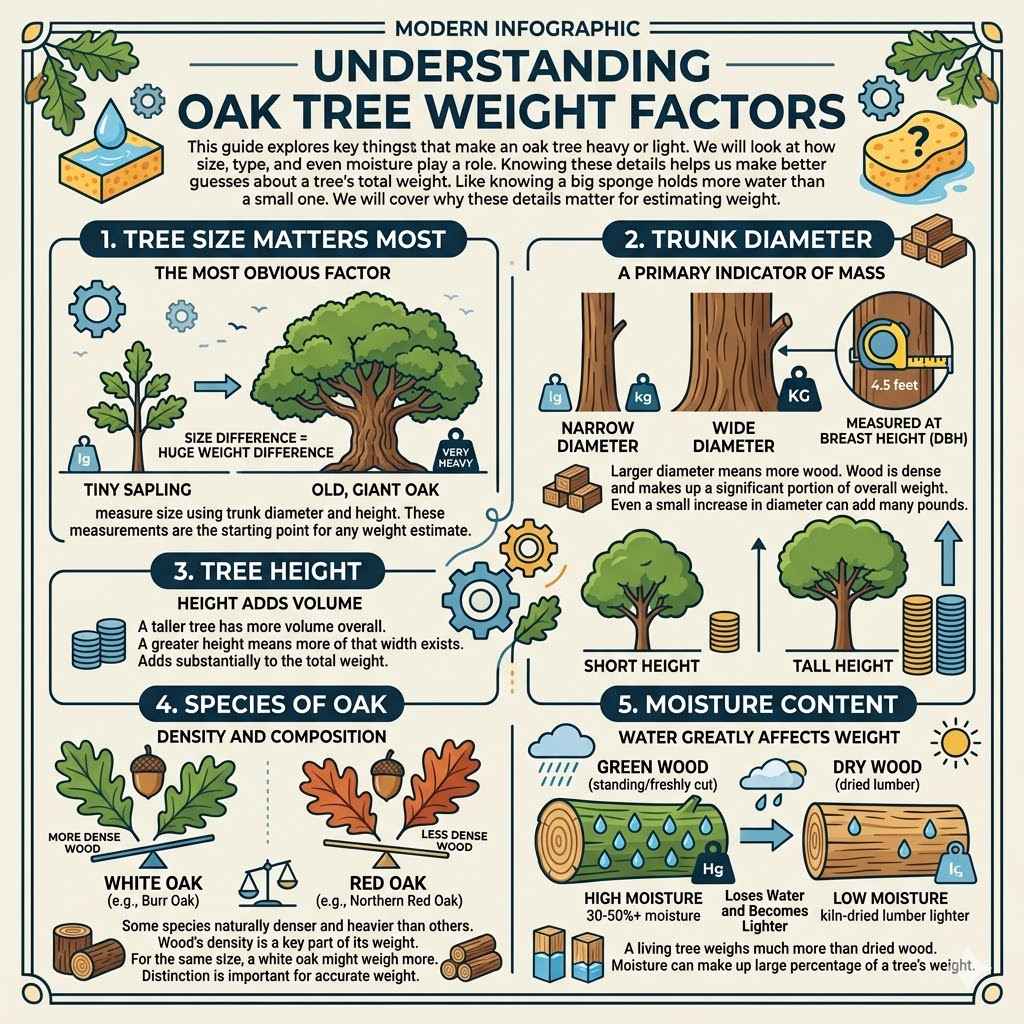
This section explores the key things that make an oak tree heavy or light. We will look at how size, type, and even moisture play a role. Knowing these details helps us make better guesses about a tree’s total weight.
It’s like knowing that a big sponge holds more water than a small one. We will cover why these details matter for estimating weight.
Tree Size Matters Most
The most obvious factor is how big the tree is. A taller, wider tree will naturally weigh much more. Think about comparing a tiny sapling to an old, giant oak.
The difference in their size means a huge difference in weight. We measure size using trunk diameter and height. These measurements are the starting point for any weight estimate.
Trunk Diameter
The diameter of the trunk is a primary indicator of a tree’s mass. A larger diameter means more wood. Wood is dense and makes up a significant portion of the tree’s overall weight.
Even a small increase in diameter can add many pounds. We often measure diameter at breast height (DBH), which is about 4.5 feet from the ground. This gives a standard way to compare trees.
Tree Height
Height is the other major dimension. A taller tree has more volume overall. Even if the trunk is a certain width, a greater height means more of that width exists.
This adds substantially to the total weight. Imagine stacking many discs of the same size versus just a few. The stack of many will be much heavier.
Species of Oak
There are many different kinds of oak trees. Some are naturally more dense and heavier than others. For example, white oaks are often denser than red oaks.
This means that for the same size, a white oak might weigh more. The specific species can influence the wood’s density, which is a key part of its weight.
White Oak vs. Red Oak
White oaks, like the Burr Oak or White Oak species, tend to have denser wood. This density contributes to a higher weight per cubic foot. Red oaks, such as the Northern Red Oak, can be a bit less dense.
This distinction is important when aiming for an accurate weight. Even though they look similar, their wood composition differs.
Moisture Content
Wood is not dry like a brick. It contains a lot of water. The amount of water in the wood, known as moisture content, greatly affects its weight.
A tree that has just been through a lot of rain will weigh more than the same tree on a dry day. Moisture can make up a large percentage of a tree’s weight.
Green Wood vs. Dry Wood
When a tree is standing or freshly cut, its wood is called “green wood.” This means it has a high moisture content, often 30-50% or even more. As wood dries out, it loses water and becomes lighter. “Kiln-dried” lumber is much lighter because most of its water has been removed.
This is why a living tree weighs much more than the same amount of wood after it has dried.
The Expert Oak Tree Weight Formula Explained
Now let’s look at how experts estimate the weight of an oak tree. This method takes into account the factors we just discussed. It uses a formula that is reliable and gives a good approximation.
We will break down the formula into simple parts so it is easy to follow. This formula is the core of How Much Does an Oak Tree Weigh? Expert Weight Formula.
Calculating Tree Volume
Before we can weigh a tree, we need to know how much “stuff” it is made of. This is its volume. We can think of a tree trunk as a cylinder for simplicity.
There are ways to calculate this volume using the tree’s measurements.
Cylinder Volume Formula
The volume of a cylinder is calculated using the formula: Volume = pi (radius^2) height. Here, pi is about 3.14. The radius is half of the trunk’s diameter.
So, if a trunk has a diameter of 2 feet, its radius is 1 foot. If the tree is 50 feet tall, we can plug these numbers into the formula. This gives us a basic idea of the tree’s volume in cubic feet.
However, tree trunks are not perfect cylinders. They often taper, meaning they get thinner towards the top. For more accurate volume calculations, forestry professionals use different formulas or tables that account for this taper.
These are often called form factor adjustments. But for a good estimate, the cylinder method is a great starting point.
Wood Density Values
Different types of wood have different densities. Density is how much something weighs for a certain amount of space it takes up. It’s usually measured in pounds per cubic foot (lbs/ft³).
Oak wood is quite dense. Specific oak species have slightly different densities, but we can use an average if the species isn’t known precisely.
Average Density of Oak Wood
The average density of green oak wood (meaning with its natural moisture content) is around 60 to 70 pounds per cubic foot. This can vary based on the specific oak species and how much water is in the wood. For a general estimate, using a value like 65 lbs/ft³ is common.
This number is a crucial part of our weight calculation.
It is important to note that this is for green wood. Dry oak wood can be much lighter, often around 40-50 lbs/ft³. Since we are talking about a living tree, we must use the density of green wood.
Putting It All Together The Formula
The basic formula to estimate a tree’s weight is:
Tree Weight = Tree Volume * Wood Density
So, if we know the volume of the tree and the density of its wood, we can multiply them to get the total weight. This is the core of How Much Does an Oak Tree Weigh? Expert Weight Formula.
Example Calculation
Let’s take a sample oak tree. Suppose its trunk has a diameter of 2 feet and it is 50 feet tall. First, find the radius: Radius = Diameter / 2 = 2 ft / 2 = 1 ft.
Next, calculate the volume using the cylinder formula: Volume = pi (radius^2) height = 3.14 (1 ft)^2 50 ft = 3.14 1 sq ft 50 ft = 157 cubic feet. Now, let’s use an average green oak density of 65 lbs/ft³. Tree Weight = Volume Density = 157 cubic feet 65 lbs/ft³ = 10,105 pounds.
This means our sample oak tree would weigh roughly 10,105 pounds. That’s over 5 tons!
Refining the Estimate More Advanced Methods
While the basic formula gives a good idea, there are ways to make the weight estimate even more accurate. These methods account for the tree’s shape and other factors more precisely. For scientists and foresters, these details are very important.
Form Factors for Taper
As mentioned, tree trunks aren’t perfect cylinders. They get thinner as they go up. A “form factor” is a number that adjusts the simple cylinder volume to better match the actual shape of the trunk.
This factor is usually less than 1. A common form factor for a mature tree might be around 0.7 or 0.8.
Applying Form Factors
To use a form factor, you multiply the simple cylinder volume by it. So, if our sample tree had a form factor of 0.7, its adjusted volume would be 157 cubic feet 0.7 = 109.9 cubic feet. Then, the weight would be: Tree Weight = Adjusted Volume Density = 109.9 cubic feet * 65 lbs/ft³ = 7,143.5 pounds.
You can see how this makes a big difference! The form factor helps us get closer to the real weight by recognizing the tree’s natural shape. Different tree species and ages have different typical form factors.
Estimating Branch and Leaf Weight
The formula so far only accounts for the trunk. A large oak tree also has many branches and, in season, a lot of leaves. These add significant weight.
Estimating the weight of branches and leaves is more complex and often done using ratios or allometric equations developed by foresters.
Branch and Leaf Ratios
Studies have found that branches can make up a substantial portion of a tree’s total weight. This can range from 20% to 50% or even more, depending on the tree’s age and structure. Leaves, when present, can add another considerable amount, especially in the summer.
However, for simplicity and focusing on the wood’s weight, many estimates focus on the trunk and major branches.
Allometric equations are mathematical relationships derived from data that relate a tree’s total weight or biomass to its size (like trunk diameter or height). These equations are developed through destructive sampling, where trees are cut down and weighed in sections.
Using Forestry Tools and Tables
Professional foresters use specialized tools and published tables to estimate tree weights. These resources are based on extensive research and field data. They often have tables that provide weight estimates based on species, diameter, and height, taking into account average densities and form factors.
Biomass Equations
Biomass equations are statistical models used in forestry to predict the total weight of a tree or forest. These equations often look like: Biomass = a * (DBH)^b, where DBH is the diameter at breast height, and ‘a’ and ‘b’ are coefficients determined from research data. These are very sophisticated ways to estimate weight.
For example, a common biomass equation for oak trees might look something like: Total Dry Biomass (kg) = 0.078 * (DBH in cm)^2.46. To convert this to green weight, you would then multiply by a factor that accounts for moisture content.
Real-World Examples and Scenarios
Let’s look at some practical situations where knowing how much an oak tree weighs might be useful. These examples show why this information matters.
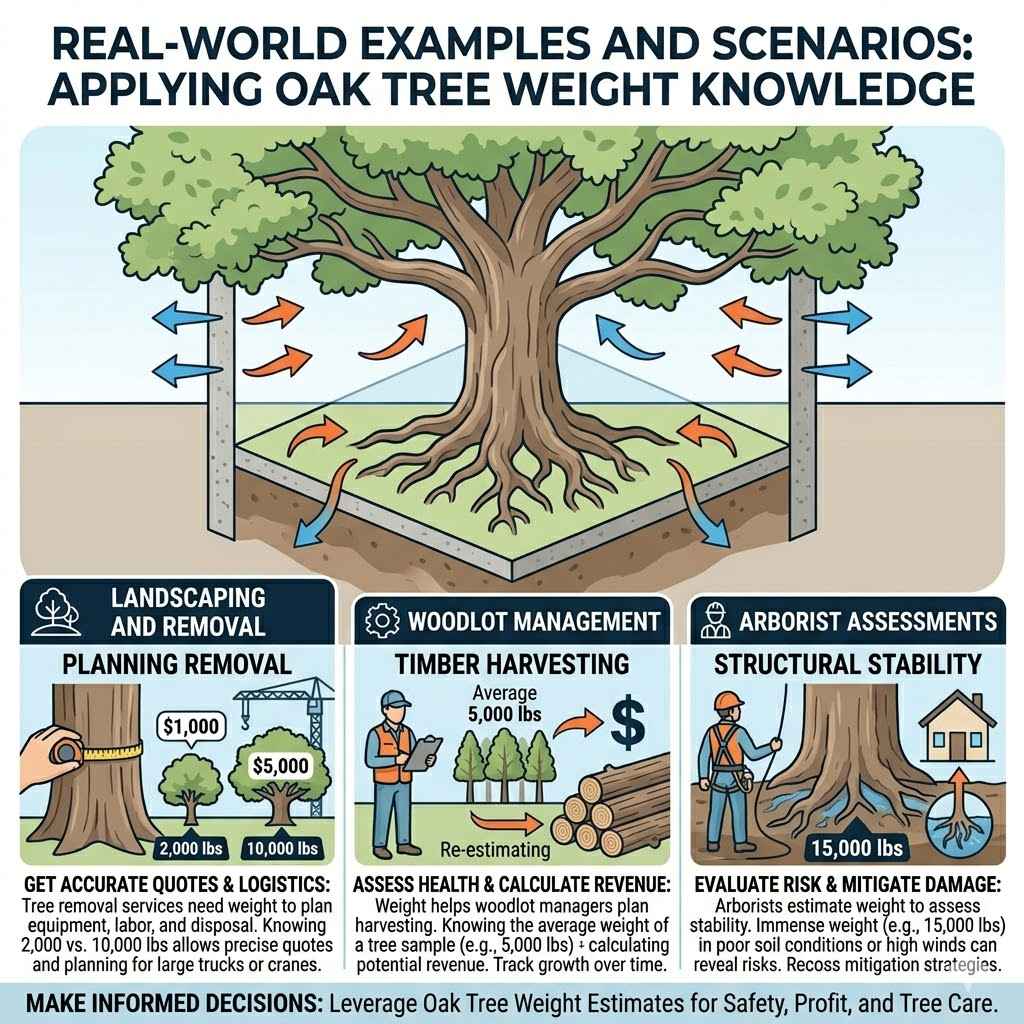
Scenario 1: Landscaping and Removal
Imagine you need to remove a large, old oak tree from your property. Knowing its estimated weight is crucial for several reasons. First, it helps you get accurate quotes from tree removal services.
A company needs to know the approximate weight to plan for equipment, labor, and disposal. A tree weighing 10,000 pounds will require very different handling than one weighing 2,000 pounds.
For example, a company might quote $1000 to remove a small oak but $5000 for a giant one. Understanding the weight helps you gauge if the quote is reasonable. It also helps in planning the logistics of removal, such as needing large trucks or cranes.
Scenario 2: Woodlot Management
For someone managing a woodland with oak trees, estimating weight can help in planning timber harvesting or assessing the health of the forest. If you plan to sell oak timber, knowing the volume and estimated weight allows you to calculate potential revenue. You can also track the growth of your trees over time by re-estimating their weight periodically.
A forester might use the How Much Does an Oak Tree Weigh? Expert Weight Formula on a sample of trees in a woodlot. They might find that a section of their land has 50 oak trees, each averaging 5,000 pounds.
This could translate to a significant amount of timber that can be sold. This informs decisions about sustainable harvesting or conservation efforts.
Scenario 3: Arborist Assessments
Arborists sometimes need to estimate the weight of a tree for structural assessments, especially if there’s concern about the tree’s stability or the ground supporting it. Understanding the tree’s weight can help them evaluate the risk of the tree falling or causing damage, particularly in areas with poor soil conditions or during high winds.
A homeowner might have a large oak near their house. The arborist could use the formula to estimate its weight, which might be 15,000 pounds. If the soil is very wet and soft, this immense weight could be a concern.
The arborist would then recommend mitigation strategies based on this understanding.
| Tree Component | Estimated Weight Percentage (Approximate) |
|---|---|
| Trunk | 50-70% |
| Branches | 20-40% |
| Leaves (Seasonal) | 5-15% |
| Roots | 10-20% (Often not included in simple estimates) |
This table shows how different parts contribute to the total weight. The trunk is usually the heaviest part, but branches and roots are also significant. For most practical weight estimations using formulas, the trunk is the primary focus because it’s the easiest to measure and the most substantial part.
Frequently Asked Questions
Question: Can I weigh an oak tree accurately without cutting it down?
Answer: Yes, you can estimate the weight quite accurately using formulas and measurements like diameter and height. Cutting down the tree is the only way to get an exact weight, but estimations are very useful.
Question: What is the average weight of a mature oak tree?
Answer: A mature oak tree can weigh anywhere from 5,000 pounds to over 20,000 pounds, depending heavily on its size and species. The formula helps you find a specific estimate.
Question: Does the season affect how much an oak tree weighs?
Answer: Yes, the season affects the weight, especially if you include the weight of leaves. In summer, a tree with a full canopy of leaves will weigh more than it does in winter when the leaves have fallen.
Question: Is it important to know the exact species of oak?
Answer: Knowing the exact species helps get a more precise weight because different oaks have different wood densities. However, using a general oak density will still give you a good estimate.
Question: What if I don’t know the height of the tree?
Answer: You can estimate the height using tools like a clinometer or even by comparing it to objects of known height nearby. Accurate measurements lead to better weight estimates.
Conclusion
Estimating How Much Does an Oak Tree Weigh? Expert Weight Formula involves simple measurements and a basic calculation. By understanding tree size, wood density, and using a formula like volume multiplied by density, you can get a reliable weight guess.
This knowledge is practical for many tasks. You can now confidently estimate the weight of an oak tree.