MDF Advantages and Disadvantages (With Real Spec Numbers)
MDF (medium-density fiberboard) has a grain-free, paint-ready surface, machines cleanly and holds screws better than most people expect, but it sags over long spans, swells at unsealed edges and throws fine dust. The pros and cons below are checked against manufacturer spec sheets, a Composite Panel Association shelf table and federal rules, so every claim comes with a number. For a project-by-project view, see our MDF pros and cons by project type.
MDF Advantages and Disadvantages at a Glance
Best MDF Edge Sealer Pick
|
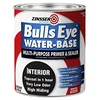
Zinsser Bulls Eye Water-Base Primer and Sealer, White, 1 Quart
|
| Common claim | Verdict | The number behind it |
|---|---|---|
| Smooth surface for paint | True, except raw edges | No grain or knots on the face; edges still soak up paint unless sealed |
| Holds screws well | True on faces, weaker at edges | Face 222 to 270 lb, edge 205 to 250 lb (GP minimum panel averages) |
| Strong enough for shelves | Only on short spans | 3/4 in MDF at 25 lb per sq ft: 22.7 to 29.7 in between supports |
| Resists water | Only if rated MR10 or MR50 | Rated boards swell 5.5% or less in 24 hours; unrated boards have no limit |
| Contains formaldehyde | Regulated, and avoidable | EPA limit 0.11 ppm for MDF; some lines use no added formaldehyde |
| Dust is harmless | False | NIOSH recommends 1 mg/m3 of wood dust; OSHA nuisance dust limit is 15 mg/m3 total |
What Is MDF?
MDF is a panel made by breaking wood down into fibers, mixing them with wax and resin, and pressing the mix into flat sheets. Because the fibers are uniform all the way through, a sheet has no grain direction, no knots and no layers. Our guide to how MDF is made covers the process, and MDF properties by grade has the full spec table. This page is about the trade-offs.
Advantages Of MDF
A Flat, Grain-Free Surface That Paints Evenly
Solid wood and plywood telegraph their grain through paint. MDF does not, which is why it is the default substrate for painted cabinet doors, trim and shelving. The one catch is the cut edge, where the fibers are exposed and absorb primer far faster than the face. Seal edges first and the finish looks uniform; the full routine is in does MDF paint well.

Clean Machining Without Tear-Out
With no grain to chip against, MDF routes sharp profiles and cuts square edges, which is why it is common in moulding and millwork. The cost is blunt tools: the resin dulls steel quickly, so carbide blades and bits last longer. Tips for chip-free cuts are in how to cut MDF without chipping.
Screw Holding Is Better Than Its Reputation
MDF is often said to hold screws poorly. The Georgia-Pacific UltraStock MDF specification sheet lists minimum panel averages of 222 to 270 lb for face screw holding and 205 to 250 lb for edge screw holding (edge values apply to panels 5/8 in and thicker). Those are manufacturer minimums for specific grades, but they show the problem is not weak holding on the face. The real limit is internal bond, listed at 85 to 130 psi: drive a screw too close to an edge or without a pilot hole and the core splits in layers. Pilot-hole sizes are in MDF screws and pilot holes.
Low Price and Consistent Quality
MDF is generally the least expensive paint-grade sheet material, and every sheet of a given grade is close to identical, so there are no knots or voids to cut around. That consistency is the main reason it beats solid wood for painted work, as covered in why people use MDF instead of wood.
Disadvantages Of MDF
It Sags Under Load: What the Shelf Tables Say
Sag is the disadvantage most articles mention without a number. The Composite Panel Association shelving bulletin publishes maximum spans for raw MDF shelves with a uniformly distributed load and a deflection limit of span divided by 240. Here are single-span values for a 3/4 in shelf, in inches between supports:
| Load (lb per sq ft) | Grade 115 | Grade 130 | Grade 155 |
|---|---|---|---|
| 10 | 30.8 | 37.0 | 40.3 |
| 25 | 22.7 | 27.3 | 29.7 |
| 50 | 18.0 | 21.6 | 23.6 |
The bulletin notes that bookshelf loads can easily reach 50 lb per square foot. At that load a 3/4 in MDF shelf can span only 18 to 23.6 in before it exceeds the sag limit, so a 36 in shelf of 3/4 in Grade 130 board only passes at about 10 lb per square foot. Three fixes come straight from the bulletin: shorten the span, add a center support, or support a shelf 12 in deep or less along its whole back edge, which lets you double the span. A strip of lumber under the front edge also stiffens it. Grade 115 is the weakest tier (MOR 1,800 psi against 3,130 for 130 and 4,050 for 155), so check what you are buying.
It Swells When Water Reaches the Edges
Unrated MDF has no guaranteed swell limit. Boards rated MR10 under ANSI A208.2 must swell 5.5% or less in a 24-hour soak, and MR50 boards must also keep half of their original bending strength after accelerated aging. On a 3/4 in panel, 5.5% is about 0.04 in of added thickness (a calculation from the limit, not a measured value), enough to lift a paint line or open a joint. That is a ceiling for a rated board in a lab soak; an unrated board in a damp room can do worse. Bathrooms and laundry rooms call for a rated grade and sealed edges, and when you should not use MDF lists the situations to skip it.
Cut Edges and Screw Holes Are Weak Points
Edge screw holding is a bit lower than face holding, and the exposed edge is also where water and paint go in. Treat every cut edge, hinge bore and screw hole as an entry point: seal before assembly, not after. Our guide to sealing MDF against water ranks the methods.
It Is Heavy
A 3/4 in 4 x 8 sheet is commonly listed at roughly 85 to 97 lb depending on the maker, which is a two-person carry and a real load for a shelf bracket or cabinet hinge. Plan fasteners and supports for that weight.

Dust and Formaldehyde: What the Rules Actually Say
Two health topics get mixed together. Formaldehyde is a regulated emission from the resin: under 40 CFR 770.10 (EPA TSCA Title VI), MDF is limited to 0.11 ppm and thin MDF to 0.13 ppm, compared with 0.05 ppm for hardwood plywood and 0.09 ppm for particleboard, and compliant products have had to be certified since June 1, 2018. Some makers go further; the Georgia-Pacific sheet above says its UltraStock panels are made with no added formaldehyde resin. Dust is the other issue. OSHA lists dermatitis, allergic respiratory effects and cancer among the health effects associated with wood dust, sets its nuisance dust limit at 15 mg/m3 total dust, and notes that NIOSH recommends 1 mg/m3. MDF cuts and sands into very fine particles, so use dust collection and a fitted NIOSH-approved respirator, and cut outdoors or with ventilation. More detail is in is MDF toxic and can MDF cause COPD.
Three MDF Claims That Do Not Hold Up
- “MDF is moisture resistant.” Only boards rated MR10 or MR50 are, and even they are not waterproof. Check the label or spec sheet rather than assuming.
- “MDF can not hold screws.” Face and edge holding are in the 200 to 270 lb range on one major maker’s grades. Splitting from missing pilot holes is the usual cause of failure.
- “All MDF is the same.” The spec sheet shows bending strength from 2,800 to 4,050 psi across one maker’s grades, and the CPA bulletin lists a Grade 115 at 1,800 psi. The cheapest board can be less than half as strong.
When MDF Is the Right Choice, and When It Is Not
| Project | Use MDF? | Why |
|---|---|---|
| Painted cabinet doors and panels | Yes | Flat paint surface, clean routed profiles |
| Router templates, jigs and shop fixtures | Yes | Stable, flat and cheap to replace |
| Long loaded shelves | Only with short spans | Sags; use a center support or thicker board |
| Bathroom, laundry or outdoor parts | Rated grade only, sealed | Unrated board swells when wet |
| Structural parts that carry weight | No | Low internal bond; use plywood or solid wood |
| Screws near an edge | With care | Pilot holes and distance from the edge prevent splitting |
If the choice is really MDF against a layered panel, see MDF board vs plywood and our plywood types and grades guide. For typical applications, what MDF is used for has a use-by-use list, and the disadvantages of MDF board goes deeper on the downsides alone.
Frequently Asked Questions
What Are 5 Advantages Of MDF?
MDF has a smooth grain-free surface, cuts and routes cleanly, paints evenly, holds screws on its face (222 to 270 lb on one maker’s grades), and is consistent from sheet to sheet. It is also generally cheaper than solid wood for painted work.
What Are The Disadvantages Of MDF?
MDF sags over long spans (about 18 to 24 in at a 50 lb per square foot load for 3/4 in board), swells when unsealed edges get wet, weighs roughly 85 to 97 lb per 3/4 in 4 x 8 sheet, and makes fine dust that needs a respirator and dust collection.
When Should You Not Use MDF?
Skip MDF for structural parts, long heavily loaded shelves, outdoor use, and any wet area unless you use a rated MR10 or MR50 board with every edge sealed.
Is MDF Waterproof?
No. Boards rated MR10 swell 5.5% or less in a 24-hour soak and MR50 boards also keep half their bending strength after aging, but both are only moisture resistant. Unrated MDF has no such limit.
Does MDF Contain Formaldehyde?
Often, in regulated amounts. EPA rules limit MDF to 0.11 ppm and thin MDF to 0.13 ppm, and some makers advertise no added formaldehyde. Check the label if emissions matter to you.
How Long Will MDF Board Last?
Indoors and kept dry, MDF lasts as long as its finish and edge seal do, since moisture at unsealed edges is the usual failure. For a grade-by-grade estimate see our guide on how long MDF lasts.
Conclusion
MDF is a good paint-grade panel and a poor structural one. Pick it for painted doors, trim, jigs and short shelves, choose a rated grade for anywhere damp, seal every edge, and control the dust. The spec numbers above let you decide on data instead of reputation.
Sponsored / affiliate links. As an Amazon Associate I earn from qualifying purchases. I may earn additional commission from eligible campaigns.