Best Scroll Saw Blades (2026): TPI Chart & Top Picks
The best scroll saw blade for most people is a plain-end, reverse-tooth variety pack in sizes #2/0 to #7, like the Flying Dutchman Ultra Reverse set, but older pin-end saws such as Craftsman and Delta models need pin-end blades instead. Match the blade number to your wood thickness: finer for thin stock, larger for thick. This guide covers maker specs from Olson and Flying Dutchman, pin-end vs plain-end fit, and our picks.
How to Choose the Right Scroll Saw Blade: TPI, Tooth Style & End Type
Best Plain-End Blade Pack | |
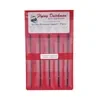 |
Flying Dutchman Ultra Reverse 60-Piece Variety Pack, $30.79 One dozen each of sizes #2/0, #1, #3, #5 and #7, so the pack covers the thin-stock to 3/4-inch range this guide’s size tables point to.
|
As an Amazon Associate we earn from qualifying purchases. Price checked 2026-10-05. | |
Three choices decide whether a blade works for you: the end type your saw clamps, the blade number (width and thickness), and the tooth style. Olson’s own chart gives the rule in one line: use lower numbers for thinner stock and higher numbers for thicker stock, and use the highest number that still handles your tightest turn, because larger blades are more durable. For the full #3/0 to #12 sizing breakdown, see our scroll saw blade sizes guide.
Blade Numbers Are Not Just TPI: Real Olson Specs
Blade numbers describe width and thickness, and TPI changes with them. These are Olson’s plain-end skip-tooth blades from its 2020 selection chart:
| Olson skip-tooth blade | Width | Thickness | TPI | Pilot hole |
|---|---|---|---|---|
| #2/0 (FR44000) | .022 in | .010 in | 28 | 1/32 in |
| #2 (FR44300) | .029 in | .012 in | 20 | 3/64 in |
| #4 (FR44500) | .035 in | .015 in | 15 | 1/16 in |
| #5 (FR44600) | .038 in | .016 in | 12.5 | 1/16 in |
| #7 (FR44800) | .045 in | .017 in | 11.5 | 1/16 in |
| #9 (FR45000) | .053 in | .018 in | 11.5 | 1/16 in |
| #12 (FR45300) | .062 in | .024 in | 9.5 | 5/64 in |
Why this matters: a #12 is more than twice as thick as a #2/0 (.024 in against .010 in) and needs a hole more than twice as big to thread it for inside cuts. That is why fine fretwork and heavy hardwood almost never share one blade.
Source: Olson Scroll Saw Blade Selection Chart, 2020.
Same Number, Different Blade: Comparing a #5 Across Makers
Blade numbers are not standardized between brands, so a #5 from one maker is not a #5 from another. Published specs for three #5 blades show it:
| #5 blade | Width | Thickness | TPI |
|---|---|---|---|
| Olson FR44600 skip tooth | .038 in | .016 in | 12.5 |
| Olson PG45502 precision ground (5RG) | .044 in | .018 in | 12 / 9 |
| Flying Dutchman Ultra Reverse #5 | .037 in | .015 in | 15 |
Flying Dutchman’s #5 packs 15 teeth per inch where Olson’s standard #5 has 12.5, so it cuts finer. Olson’s precision-ground #5 is the widest and stiffest of the three. When you switch brands, compare width, thickness and TPI rather than trusting the number alone.
Pin-End vs Plain-End: Which Fits Your Saw?
Flying Dutchman blades are 5 inches long and pinless, which means plain end. Olson sells 5-inch pin-end blades for machines that require them, and lists Sears Craftsman, Penn State, Delta, Ryobi and imported 15-inch and 16-inch saws as the typical users. If you own an older Craftsman 16-inch scroll saw, check the arm clamp first: a pin-end clamp holds a blade by its cross pin and will not grip a plain blade. Most current mid-range and premium saws, including the models in our best scroll saw for woodworking comparison, clamp plain-end blades directly. Your saw’s manual is the final word, since some models ship with convertible clamps.
One practical consequence: plain-end blades come in far finer sizes. Olson lists plain-end blades down to .022 in wide, which is why intricate fretwork is usually a plain-end job.
Scroll Saw Blade Tooth Styles Compared
Skip-tooth blades omit every other tooth, so chips clear fast and cuts stay smooth, but the underside can fuzz. Reverse-tooth blades add a few upward-facing teeth to cut the underside clean. Olson’s chart also lists double-tooth blades, which it calls especially good for hardwoods, crown-tooth blades that cut on both strokes (and can be flipped when the first teeth wear), and spiral blades that cut in any direction without turning the workpiece.
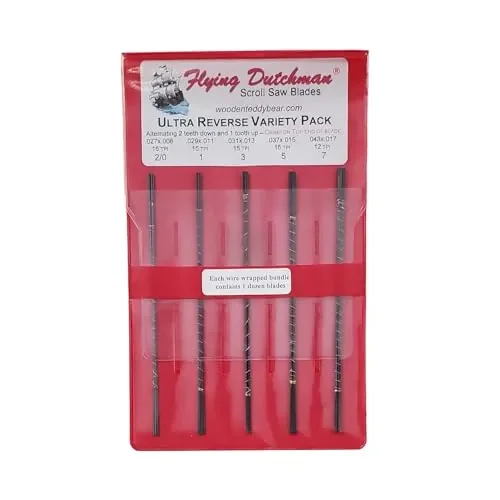
Flying Dutchman’s two reverse-style families show the tradeoff. Both use a two-teeth-down, one-tooth-up pattern. The Ultra Reverse is the fast cutter, while Flying Dutchman describes the Two-Way Cut as slower, giving an extra sense of control. Pick the Ultra Reverse for hardwood and thicker stock; pick the Two-Way Cut when you want to creep around tight corners.
“With reasonable force the center of the blade should not move more than 1/8 inch front to back. Too little tension weakens performance.”
Best Scroll Saw Blades by Job
The box above carries the only Amazon link on this page. The rest of these picks are plain text, so search your saw model and compare prices yourself. Specs come from the maker’s chart or listing.
Best All-Around Plain-End Pack: Flying Dutchman Ultra Reverse Variety Pack
Sixty blades, one dozen each of #2/0, #1, #3, #5 and #7. They are milled and made in Germany from hardened steel, and the size span (.027 to .043 in wide on the label) handles everything from veining and puzzle work to 1/2-inch hardwood. It was in stock at $30.79 on 2026-10-05 per the Amazon Creators API.
Best Starter Assortment: Olson FR49400 Skip Tooth
A 36-blade plain-end pack. The packaging shows 12 each of #2 (20 TPI), #5 (12.5 TPI) and #7 (11.5 TPI), and the label says the #2 and #5 can cut thin metal. That is three sizes, not the wide assortment older versions of this page claimed, so buy it as a budget starter rather than a one-box solution.
Best for Hardwood and Clean Edges: Olson Precision Ground (PGT)
Olson describes its PGT blades as having razor-sharp reverse teeth with wide-spaced gullets for straighter, faster, smoother and more accurate cuts. The #7 precision-ground reverse blade (PG45702) is .046 in wide and .018 in thick at 10/7 TPI, and the double-tooth PG49702 is the hardwood-oriented sibling.
Best Pin-End Option: Olson FR49501 or Pegas Pinned
If your saw needs pins, Olson’s FR49501 is the straightforward pin-end pick (listed in stock at $11.29 on 2026-10-05). Pegas also sells 5-inch pinned blades in packs of 12: the Hook pattern is aimed at softwoods and medium woods, and the Skip pattern at hardwoods, per the Amazon listings.
Best for Intricate Fretwork: Spiral Blades
Olson’s spiral blades cut in every direction, so you can follow a pattern without turning the work. Its chart lists #0 at 46 TPI, #2 at 41 TPI and #4 at 36 TPI. They cut slower and leave a rougher edge than skip-tooth blades, which suits detailed fretwork you will sand anyway.
Which Blade for Which Wood Thickness?
Makers do not publish one universal thickness chart, so treat this as a starting point built on Olson’s rule (finer for thin, larger for thick) and the specs above. Test on scrap before the real cut.
| Stock | Starting blade | Why |
|---|---|---|
| 1/8 in or thinner, tight curves | #2/0 to #2 (20 to 28 TPI) | Narrow kerf, small pilot hole |
| 1/4 in plywood or softwood | #2 to #5 (12.5 to 20 TPI) | Fine finish with enough stiffness |
| 1/2 in hardwood | #5 to #7 (11.5 to 15 TPI) | Stiffer blade resists drifting |
| 3/4 in hardwood | #7 to #9 (11.5 TPI) | Wider gullets clear chips |
| 1 in and thicker | #9 to #12 (9.5 to 11.5 TPI) | Heaviest blades, slow feed |
Printable patterns are a good way to practice blade choice; our scroll saw printable patterns guide lists real sources.
How to Stop Scroll Saw Blades Burning Wood
Olson’s advice is to slow the feed rate, let the blade do the cutting, and use a lube stick on the blade or clear shipping tape on the workpiece to inhibit scorching. Flying Dutchman similarly recommends 2-inch clear packaging tape over the pattern for burn-free cutting.
Frequently Asked Questions About Scroll Saw Blades
What TPI is best for a scroll saw blade?
There is no single best TPI. Fine blades run 20 to 28 TPI (Olson #2/0 is 28), general-purpose blades run 11.5 to 15 TPI, and heavy blades run near 9.5 TPI. Higher TPI cuts finer and slower, while lower TPI cuts faster and rougher. Match it to thickness and tightest curve.
Are scroll saw blades universal?
No. Blades differ by end type (pin or plain), length, width and thickness. Most blades are 5 inches long, but a pin-end saw will not clamp a plain-end blade. Blade numbers also differ between brands, so compare width, thickness and TPI.
Can I use pin-end blades in a saw that only takes plain-end blades?
Usually not. A pin-end blade has a cross pin that seats in a pin-end clamp, while a plain-end clamp grips the flat blade body. Check your saw manual for convertible clamps before buying.
How do I stop a scroll saw from burning wood?
Slow the feed rate and let the blade cut. Olson also suggests a lube stick on the blade or clear shipping tape on the workpiece, and Flying Dutchman suggests 2-inch clear packaging tape over the pattern. A dull blade burns too, so swap it as soon as the cut slows.
Can scroll saw blades be used in a jigsaw?
No. Scroll saw blades are thin 5-inch blades clamped at both ends in a tensioned arm, while jigsaw blades hang from one end and use a different shank. They are not interchangeable.
Bottom Line
For a plain-end saw, start with the Flying Dutchman Ultra Reverse variety pack, then add Olson PGT blades for thick hardwood. For a pin-end saw, buy pin-end packs and use the Olson numbers above to pick sizes. Match thickness to blade number and relax your feed.
Sponsored / affiliate links. As an Amazon Associate I earn from qualifying purchases. I may earn additional commission from eligible campaigns.