Beginner Gouache Painting Ideas: Genius Essentials
Beginner gouache painting ideas focus on simple subjects, color mixing basics, and layering. Explore landscapes, botanicals, and abstract shapes using essential tools and techniques for vibrant, opaque results.
Painting with gouache can seem a bit daunting at first, but it’s actually a wonderfully forgiving and versatile medium. Many beginners wonder where to start, especially when looking at all the amazing art out there. You might feel stuck, not knowing what to paint or how to get those rich, opaque colors you see from experienced artists. Don’t worry! Getting started with gouache is all about understanding a few key things and picking easy subjects. We’re going to walk through some fantastic beginner-friendly painting ideas and the essentials you’ll need to make them shine. Get ready to discover how simple and rewarding gouache can be!
Why Gouache is Perfect for Beginners
Gouache is often called “opaque watercolor,” but it’s so much more! This water-based paint dries to a velvety, matte finish and can be reactivated with water once dry, though less so than watercolor. Its opacity means you can paint lighter colors over darker ones, which is a huge advantage for beginners who might make mistakes or want to adjust their work. Unlike oils or acrylics, gouache is water-soluble, making cleanup a breeze. This combination of vibrant color, easy correction, and simple cleanup makes it an ideal choice for anyone just starting their painting journey.
Essential Tools Every Beginner Needs
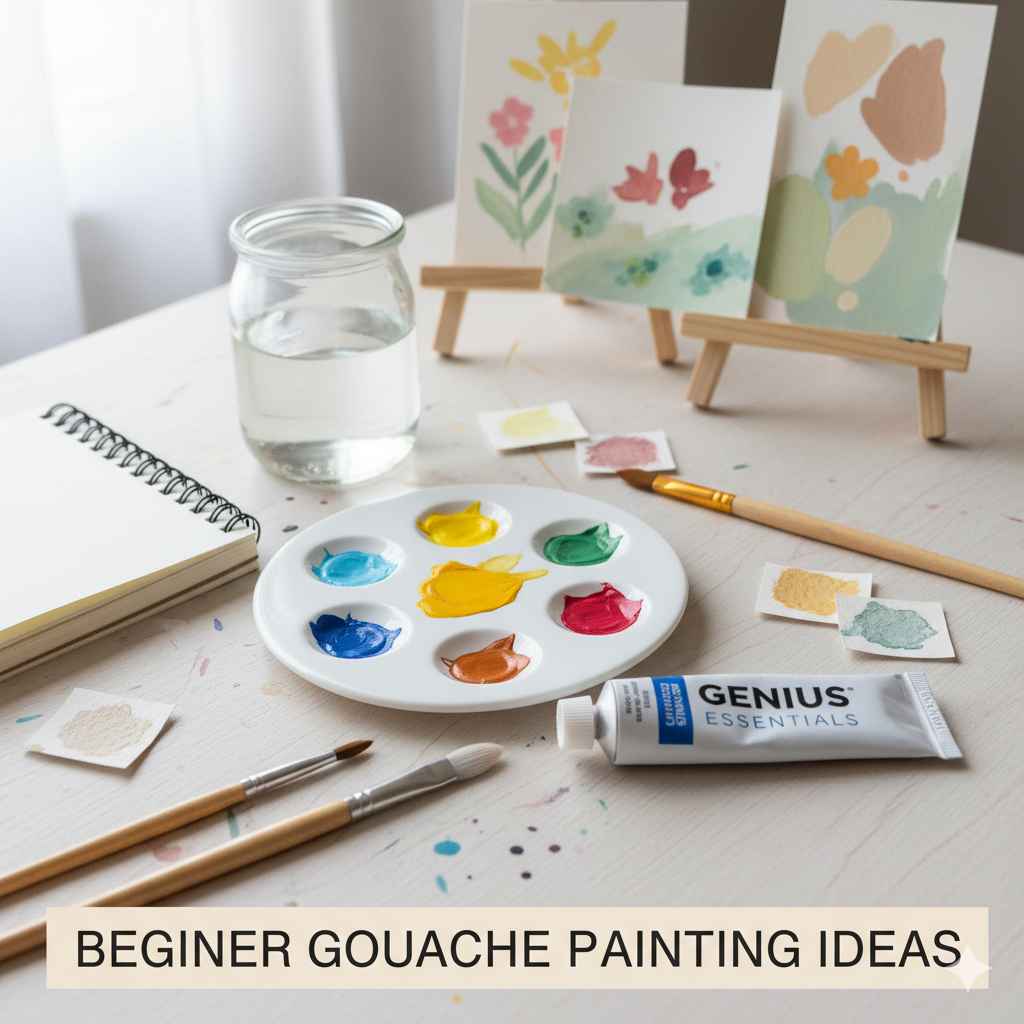
Before diving into painting ideas, let’s make sure you have the right gear. You don’t need a huge, expensive setup to start. Here’s a list of a few key items to get you going:
Gouache Paint Set: Look for student-grade sets. Brands like Arteza, Turner, or Winsor & Newton offer good quality at affordable prices. A set with 12-24 basic colors is plenty to start mixing.
Brushes: A few synthetic brushes in different sizes are perfect. A round brush (size 4-8) for details and lines, and a flat brush (1/2 inch or bigger) for washes and larger areas will cover most needs.
Paper: Gouache works best on sturdy paper. Try cold-press watercolor paper (at least 140lb/300gsm) or bristol board. These papers can handle the water without buckling too much.
Palette: A ceramic plate, a plastic palette with wells, or even a repurposed tile works great for mixing your colors.
Water Cups: Two cups are ideal – one for rinsing your brush and one for clean water to mix with your paints.
Paper Towels or Cloth: For dabbing excess water from your brush and cleaning up.
Understanding Gouache Basics: Mixing and Layering
Before you jump into specific ideas, a quick understanding of gouache’s unique qualities will make your painting experience much smoother.
Color Mixing
Gouache paints are highly pigmented, meaning a little goes a long way. Mixing is straightforward, just like with watercolors, but with gouache, you can achieve solid, opaque colors.
Creating Pastels: To make a pastel version of any color, add white. The more white you add, the lighter and more pastel-like the color will become.
Deepening Colors: To make a color darker or more muted, add a tiny bit of its complementary color (the color directly opposite it on the color wheel) or a touch of dark brown or black.
Achieving Gradients: You can create smooth transitions between colors by mixing them on your palette and then blending them on the paper while they are still wet.
Layering
One of the most powerful aspects of gouache is its opacity. This allows you to layer colors effectively:
Light Over Dark: Unlike watercolors, you can paint opaque lighter colors directly over dry, darker colors. This is fantastic for adding highlights or correcting areas.
Building Depth: Layering allows you to build up colors and create depth in your paintings. You might start with a light wash and then add darker details or shadows on top once the previous layer is dry.
Wet-on-Wet: Similar to watercolor, applying wet paint onto a wet surface creates soft edges and blended effects.
Wet-on-Dry: Applying wet paint to a dry surface gives you crisp, defined edges.
Visit the Royal Academy’s guide to color mixing for more in-depth information that can be applied to gouache.
Beginner Gouache Painting Ideas to Spark Your Creativity
Now for the fun part! Here are some simple, yet effective, gouache painting ideas perfect for beginners. We’ll focus on subjects that are forgiving and allow you to practice basic techniques.
1. Simple Landscapes
Landscapes are a classic for a reason. They offer endless possibilities and can be simplified to focus on shapes and colors.
Monochromatic Mountains: Pick one color (like a deep blue or grey) and create a landscape using only different shades of that color. This forces you to focus on value (lightness or darkness) and form.
Start with a lighter wash for the sky.
Paint darker, blocky shapes for mountains.
Add even darker tones for shadows or distant peaks.
Sunset Sky: This is all about blending. Use warm colors like yellow, orange, and pink.
Paint a light yellow or orange base.
While wet, add streaks of pink and red, blending them gently.
You can add a silhouette of a horizon line (a simple hill or tree) once the sky is dry.
Abstract Nature: Focus on shapes found in nature – rolling hills, cloud formations, or simple trees. Don’t aim for photorealism; instead, play with color and texture.
2. Easy Botanicals and Florals
Flowers and plants are beautiful subjects that can be broken down into simple shapes.
Single Flower Study: Choose a simple flower like a daisy or a tulip.
Lightly sketch the outline.
Fill in the petals with a base color.
Add darker shades for shadows and lighter touches for highlights.
Paint the stem and leaves.
Leaf Studies: Focus on individual leaves. They have wonderful natural shapes and veins.
Paint the basic shape of a leaf in a mid-tone color.
Add darker greens for shadows or lighter yellow-greens for new growth.
Use a fine brush to paint in the veins.
Minimalist Bouquet: Arrange a few simple elements like leaves and one or two types of flowers. Focus on creating a pleasing composition rather than intricate detail.
3. Still Life with Simple Objects
Setting up a small still life is a great way to practice observing shapes, light, and shadow.
Fruit Bowl: Apples, oranges, or lemons are excellent subjects.
Arrange 2-3 pieces of fruit.
Observe how light hits them and creates shadows.
Paint the basic shapes, then add shadows with darker tones of the fruit’s color.
Add highlights with a lighter, more opaque mix.
Ceramic Mugs or Vases: These have smooth surfaces that reflect light.
Choose a simple, solid-colored mug or small vase.
Pay attention to the curves and how they affect the light and shadow.
Gouache’s opacity is perfect for capturing those bright highlights.
Stacked Books: Even simple geometric shapes like books can be a rewarding study.
Focus on the edges and how they create form.
Play with the spine colors and how light falls across the covers.
4. Abstract Shapes and Color Blocks
Abstract art is fantastic for beginners because it removes the pressure of representation. It’s all about color, form, and composition.
Geometric Grids: Paint a grid of squares or rectangles.
Fill each section with a different color.
Experiment with varying the saturation or lightness of your colors.
Try creating a simple pattern or a gradient across the grid.
Organic Blobs: Paint freeform, organic shapes.
Focus on interesting color combinations.
Overlap shapes, letting some dry before painting over others.
Consider texture by varying the amount of water you use.
Color Play: Simply experiment with mixing colors and seeing how they interact on the paper. Don’t aim for a specific subject; just enjoy the process of applying paint.
5. Illustrative Elements
Simple illustrations can be very effective and are often less intimidating than full scenes.
Cute Animals (Simplified): Think cartoon-style animals. A simple bird, a cat with basic shapes, or a playful dog.
Focus on rounded forms.
Use bold, flat colors.
Add simple eyes and outlines.
Food Illustrations: A well-rendered slice of cake, a steaming cup of coffee, or a tasty cookie.
Break down the object into basic shapes.
Gouache’s opaque nature is great for capturing the textures of frosting or steam.
Constellations and Stars: A dark blue or black background with white or yellow dots and lines for stars and constellations.
Paint a dark base layer.
Once dry, use a small brush or a toothbrush to flick white paint for stars.
Connect dots with fine lines for constellation patterns.
Tips for Success with Gouache
As you try out these ideas, keep these tips in mind:
Work from Light to Dark (Mostly): While gouache allows you to paint light over dark, starting with lighter values and building up darker tones often leads to more control and a fresher look. However, don’t be afraid to experiment!
Don’t Overwork the Paint: Gouache can become muddy if you constantly lift and rearrange the paint. Try to lay down your colors and let them dry when possible.
Control Your Water: Finding the right amount of water is key. Too much water makes your paint transparent like watercolor; too little makes it thick and hard to spread.
Embrace Imperfection: For your first few paintings, focus on learning and having fun. Don’t aim for perfection. Every artist started somewhere!
* Clean Your Brushes Thoroughly: Gouache can dry hard on brushes. Always rinse your brushes well with water and soap if necessary after each painting session. This is crucial for maintaining your supplies.
Comparing Gouache to Other Media
It’s helpful to understand how gouache stacks up against other popular mediums, especially for a beginner.
| Feature | Gouache | Watercolor | Acrylic | Oil |
|---|---|---|---|---|
| Opacity | Opaque/Matte | Transparent | Opaque/Satin or Glossy | Opaque/Glossy |
| Layering | Light over dark possible | Dark over light only | Light over dark possible | Light over dark possible |
| Reactivation | Can be reactivated (some extent) | Highly reactivated | Permanent when dry | Permanent when dry, requires solvent for cleanup |
| Drying Time | Fast | Fast | Fast | Slow |
| Finish | Matte, velvety | Transparent, luminous | Varies (can be matte or glossy depending on type) | Glossy |
| Corrections | Easy (can paint over) | Difficult (can lift, but hard to cover) | Easy (can paint over) | Difficult (requires scraping or solvent) |
| Cleanup | Water-soluble | Water-soluble | Water-soluble (while wet) | Requires solvents (turpentine, mineral spirits) |
| Beginner Friendliness | Excellent (forgiving, easy cleanup, layering) | Good (requires careful planning, transparency) | Good (permanent, but forgiving) | Challenging (slow drying, solvent handling) |
To learn more about different paint types, check out The National Gallery of Art’s resources on artist’s materials.
Frequently Asked Questions About Beginner Gouache Painting
Here are some common questions beginners have about gouache painting.
Q1: Do I need special paper for gouache?
While you can paint on regular paper, it will likely warp and buckle due to the water. Using paper designed for watercolor or gouache (at least 140lb/300gsm) is highly recommended. This heavier paper can handle the moisture much better.
Q2: Can I mix gouache with watercolor?
Yes, you can! Because both are water-based and dry to a soluble film, they can be mixed. However, adding gouache to transparent watercolor will make it opaque. Using gouache on top of dry watercolor is a fantastic way to add opaque highlights and details.
Q3: How do I get my gouache to be opaque?
Gouache is naturally opaque! The key is to use less water. If your paint is too watery, it will behave more like watercolor. Use your paint more directly from the tube or with very little water added for maximum opacity.
Q4: What if I make a mistake?
That’s the beauty of gouache! Once a layer is dry, you can simply paint over your mistake with a lighter or darker color. You can also gently re-wet an area and lift the paint off with a brush or paper towel, though this is best done with thinner applications.
Q5: How many colors do I really need to start?
You can achieve a vast range of colors with just a basic set of 12 primary, secondary, and some earth tones. Don’t feel the need to buy a huge set. Learning to mix your own colors is a vital skill!
Q6: My gouache looks chalky when dry. What did I do wrong?
This can happen when you use too much binder (the whitish substance that makes the paint opaque) or if the paint is of lower quality. Using student-grade paints is fine, but sometimes they can have a slightly chalkier appearance than professional grades. Ensure you are using the paint at a suitable consistency and not diluting it too much with water, as this can also contribute to a chalky look. Good quality paper also helps achieve a better finish.
Conclusion
Diving into gouache painting is an exciting journey, and with these beginner-friendly ideas and essential tips, you’re well on your way to creating beautiful artwork. Remember, the most important thing is to start practicing. Whether you’re painting a simple landscape, a vibrant botanical, or exploring abstract forms, each stroke is a step in your creative development. Gouache is forgiving, versatile, and incredibly rewarding, allowing you to build confidence with every layer and color mix. So, gather your supplies, pick an idea that speaks to you, and enjoy the wonderful process of bringing your vision to life with this amazing medium. Happy painting!