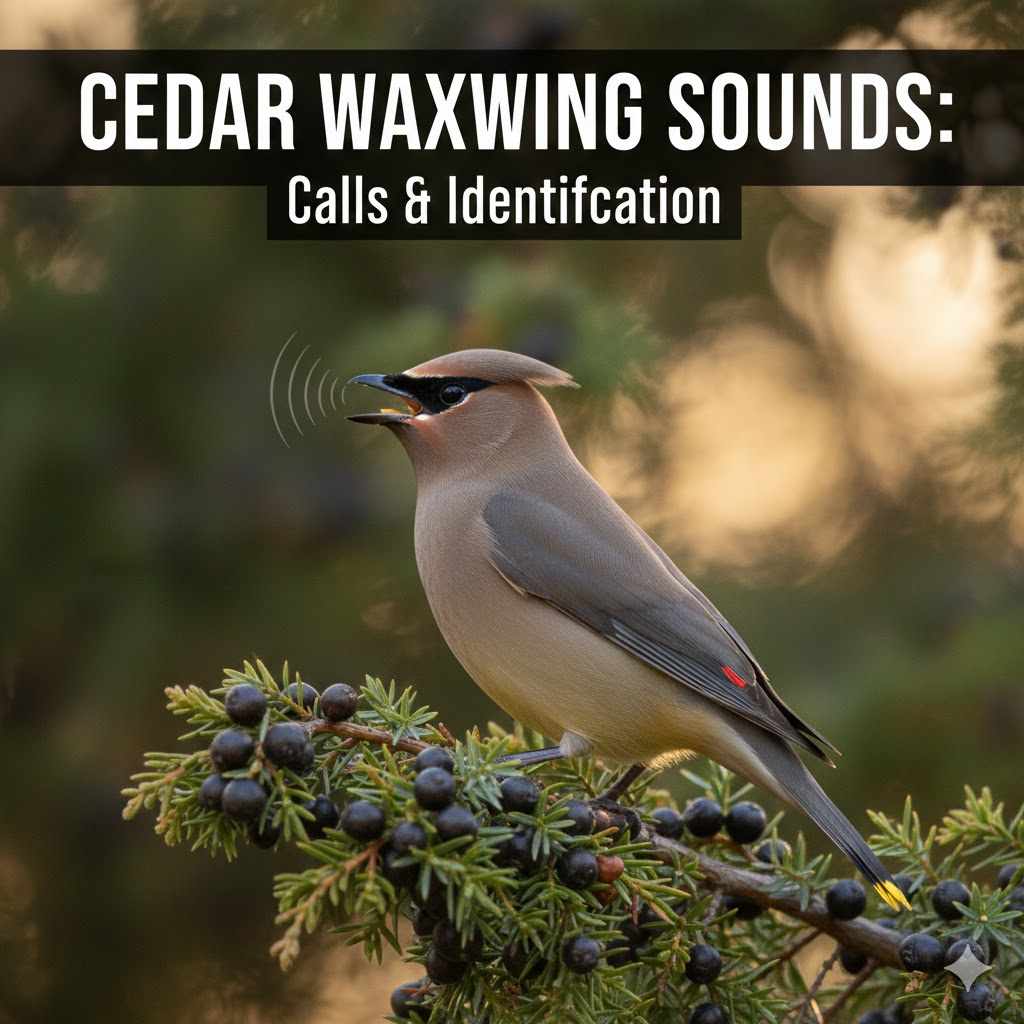
Cedar Waxwing Sounds: Calls & Identification
Have you ever heard a soft, high-pitched trill and wondered what bird was nearby? For many bird watchers, identifying the Cedar Waxwing Sounds: Calls & Identification can feel a little tricky at first. Their calls aren’t as loud as some other birds, and they can be shy.
But don’t worry! This guide will make learning their sounds super simple. We’ll break it down step-by-step so you can easily recognize these beautiful birds by their unique voices.
Get ready to know exactly who’s singing when you hear them.
Understanding Cedar Waxwing Sounds
This section focuses on the fundamental aspects of how Cedar Waxwings communicate. We will explore the typical vocalizations that these birds use for various purposes, such as staying in touch with their flock or warning others of danger. By understanding the basic sound profiles, beginners can start to build a foundation for recognizing them in their natural habitat.
We’ll cover the common types of calls and what they generally signify, making the initial steps of identification straightforward and accessible for everyone.
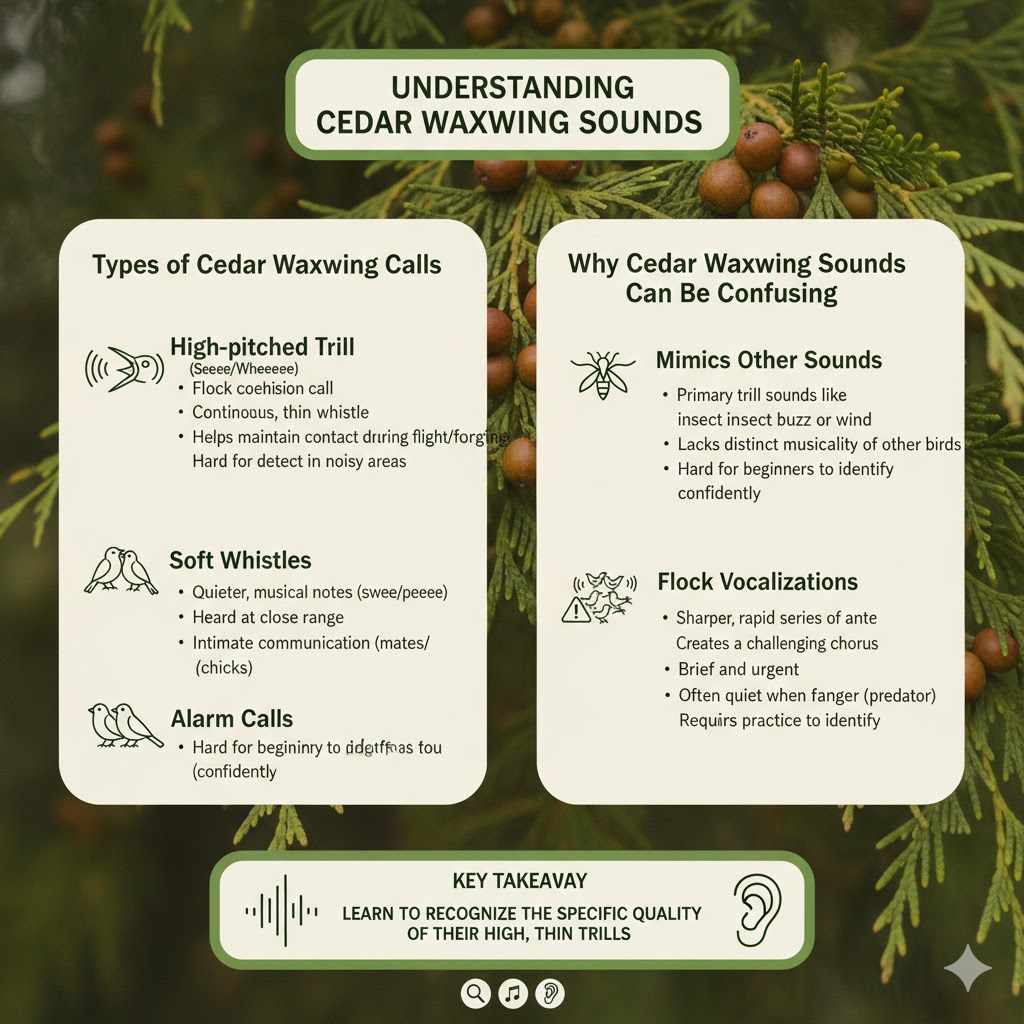
Types of Cedar Waxwing Calls
Cedar Waxwings have a limited but distinctive vocal repertoire. Their primary call is a high-pitched, almost insect-like trill. This sound is often described as “seeee” or “wheeeeee.” It’s usually emitted by individuals within a flock, helping members maintain contact as they forage or fly.
These calls are not very loud, which can make them hard to detect in noisy environments or at a distance.
Another common sound is a softer, more subdued whistle, often used when birds are very close to each other, perhaps during courtship or when feeding young. These whistles are more subtle and might be missed by the casual observer. The specific pitch and duration can vary slightly, but the overall impression is one of gentle communication.
- High-pitched Trill (Seeee/Wheeeeee)
This is the most frequently heard call. It’s a continuous, thin whistle that can last for several seconds. It serves as a flock cohesion call, ensuring that individuals stay together, especially when flying through dense foliage or over open areas. The sound carries well and helps waxwings keep track of each other’s location without needing visual contact. It’s a vital tool for their nomadic foraging habits, allowing them to communicate group movements effectively. - Soft Whistles
These are quieter, more musical notes, often sounding like “swee” or “peeee.” They are typically heard at close range and are used for more intimate communication, such as between mates or parents and chicks. These calls are less about long-distance signaling and more about maintaining social bonds within a small group or family unit. Their softness makes them harder to identify, but they are a key indicator of proximity and social interaction. - Alarm Calls
While less common and harder to distinguish from their regular calls, Cedar Waxwings may use variations in their trill or a sharper, more rapid series of notes to signal danger. These calls are usually brief and more urgent than their contact calls. They are designed to alert other waxwings to the presence of a predator, prompting them to take cover or become more vigilant. Identifying these specific alarm calls requires significant practice and familiarity with their typical vocalizations.
Why Cedar Waxwing Sounds Can Be Confusing
Many people find Cedar Waxwing sounds a bit tricky to pin down at first. Their primary trill can sound a lot like the buzzing of an insect or even the wind whistling through something. It doesn’t have the distinct musicality of a robin’s song or the sharp “chick-a-dee-dee-dee” of a chickadee.
This can make it hard for beginners to confidently say, “That’s a bird, and it’s a Cedar Waxwing!”
Also, Cedar Waxwings often move in flocks. This means you might hear multiple birds calling at once, creating a chorus of similar sounds. Separating individual calls within a flock can be challenging.
They also tend to be quiet when feeding, making their presence known more by their movement than their song. This is why learning to recognize the specific quality of their high, thin trills is so important for identification.
Identifying Cedar Waxwings by Sound
Once you understand the basic calls, you can begin to use sound as a primary tool for identifying Cedar Waxwings. This section will guide you on how to distinguish their specific vocalizations from other birds and environmental noises. We’ll focus on the characteristics of their calls that make them unique and provide tips for actively listening and recognizing them in different settings, enhancing your birdwatching skills.
Distinguishing Their Calls from Other Birds
The Cedar Waxwing’s characteristic high-pitched trill is its most distinguishing vocalization. While other birds might have high-pitched calls, the sustained, almost pure tone of the waxwing’s “seeee” or “wheeeeee” is unique. For instance, some warblers have high notes, but they are often more complex or shorter bursts.
Finches might have chirps, but rarely a continuous, wavering trill like the waxwing.
When listening, pay attention to the quality of the sound. Is it a sharp, clear whistle with a slight waver? Does it seem to come from a small group of birds?
If you hear this sound repeatedly, especially in areas with berry-producing trees or near water, it’s a strong indicator of Cedar Waxwings.
Think of it this way: If you hear a simple, high-pitched squeak that goes on for a bit, it’s likely your Cedar Waxwing friend. It’s not a complex song; it’s more of a soft, persistent signal. Compare this to the sharp “chip” of a sparrow or the varied calls of a robin.
The Cedar Waxwing’s sound is simpler and more sustained.
- The “Seeee” Sound
This is the signature call. It’s a pure, high-pitched whistle that can last for several seconds. It’s not a musical warble but more of a steady, almost piercing tone. Imagine a very thin, high violin string being gently bowed. This sustained nature is key to distinguishing it from other bird calls that might be shorter or more varied. It’s often the first sound that alerts birders to the presence of Cedar Waxwings. - Lack of Complex Melodies
Unlike songbirds that sing elaborate tunes, Cedar Waxwings have very simple vocalizations. This simplicity is actually a helpful identification point. If a bird is making a sound that is just one basic, high note held for a while, and it’s not a mechanical sound, it’s a good candidate for a Cedar Waxwing. Avoid confusing it with insect noises; waxwing calls are distinctly avian. - Flock Communication
Cedar Waxwings are highly social and often travel in groups. You’ll frequently hear their calls in a chorus, especially during migration or when feeding at a rich food source. This collective trilling can create a distinctive ambiance. While identifying individual calls is useful, recognizing the sound of a flock communicating is also a strong clue. The sheer number of similar calls emanating from one area points towards a flock of Cedar Waxwings.
Context and Habitat Clues
The environment where you hear a particular sound is just as important as the sound itself. Cedar Waxwings are often found near fruit-bearing trees and shrubs, especially during the fall and winter when berries are abundant. They also frequent open woodlands, forest edges, orchards, and even suburban gardens.
If you’re in an area with many berry bushes or fruit trees and hear that high, thin trill, your chances of it being a Cedar Waxwing are very high. They also love to perch on wires or bare branches, where they can survey their surroundings for food. Their presence is often announced by their feeding behavior, but their calls help confirm it.
Consider the time of year. While Cedar Waxwings can be found year-round in some areas, they are more widely distributed during migration and winter. Hearing their calls during these periods in suitable habitats increases the likelihood of a correct identification.
They are not songbirds that sing a lot in breeding territories; their calls are more functional for group cohesion.
A common scenario is finding a flock of Cedar Waxwings feasting on a mulberry or hawthorn bush. You might not see them at first, but you’ll hear their soft, continuous trilling as they move from branch to branch, eating berries. This combination of sound and habitat is a classic Cedar Waxwing encounter.
Cedar Waxwing Identification Beyond Sound
While sounds are a key part of identification, visual cues are also essential. This section explores the physical characteristics that help confirm if the bird you’re hearing is indeed a Cedar Waxwing. We’ll cover their unique appearance, including their sleek plumage, distinctive mask, and waxy red tips on their wings, providing a complete picture for identification.
Physical Characteristics
Cedar Waxwings are medium-sized songbirds, easily recognizable by their smooth, elegant appearance. They are about the size of a European Starling but much more slender. Their overall color is a soft, grayish-brown, with a darker gray or blackish head and a distinctive black mask that looks like a bandit’s mask across their eyes.
One of their most striking features, and the source of their name, is the bright red, waxy-looking tips on their secondary wing feathers. These can vary in number from zero to nine, but are usually present and quite noticeable. They also often have yellow or orange tips on their tail feathers, which can be bright yellow in some individuals or more orangey in others, depending on their diet, particularly the carotenoids in berries.
They have a crest on their head that they can raise or lower, giving them different expressions. Their bill is short and broad, adapted for catching insects in flight or plucking fruit. Their legs and feet are dark.
When seen in a flock, their streamlined shape and coordinated movements are very characteristic.
- Sleek Plumage
Their feathers are very smooth and blend together seamlessly, giving them a polished look. The body is mostly a warm, creamy brown to buff color, fading to a lighter shade on the belly. This smooth, soft appearance is different from the more ruffled or patterned plumage of many other birds. It’s a uniform, elegant coloring that makes them stand out in their own way. - Black Mask
The most iconic feature is the black mask across their eyes, bordered by a fine white line. This mask gives them a sophisticated, almost masked appearance, contributing to their unique visual identity. It’s a stark contrast to their otherwise soft colors and is very helpful for identification, even from a moderate distance. - Waxy Red Wing Tips
These bright red, waxy tips on the secondary flight feathers are a defining characteristic. They are not present in all birds of the species all the time, but they are a strong indicator when seen. The number and intensity of these red tips can vary. They are thought to be related to sexual maturity and are a beautiful, unique feature. - Yellow or Orange Tail Band
The tail is moderately long and square-tipped. It usually has a bright yellow band at the tip in males and younger birds, and often a more orange band in females and older birds. This color contrast with the darker tail feathers is often visible in flight or when the bird is perched. The intensity of this band is directly linked to diet. - Prominent Crest
Cedar Waxwings often sport a crest on their head, which they can raise or lower depending on their mood or alertness. This crest can make their head appear larger and more prominent. When relaxed, the crest lies flat, but when excited or alarmed, it can be held upright, giving the bird a distinct profile that aids in recognition.
Behavioral Traits for Identification
Observing a bird’s behavior can provide strong clues, especially when sound is also a factor. Cedar Waxwings are known for several characteristic behaviors that aid in their identification. Their social nature and feeding habits are particularly telling.
One of their most notable behaviors is their tendency to gather in large, noisy flocks. These flocks can number from a dozen to hundreds of birds. They often move together in waves, feeding on fruit or flying to new locations.
If you hear those soft trills and then see a large group of sleek, brown birds moving in unison, you’ve likely found Cedar Waxwings.
They are also known for their patient feeding. They will often perch on branches near abundant fruit sources, systematically picking off berries. Sometimes, they can be seen passing berries from one bird to another in a line, a fascinating behavior to witness.
This cooperative feeding within a flock is quite distinct.
Cedar Waxwings are also very fond of water and can often be seen bathing or drinking in shallow streams, bird baths, or even puddles. They are not shy about approaching human-made water sources. Another interesting habit is their ability to catch flying insects in mid-air, much like swallows.
You might see them sallying out from a perch to snatch an insect and then return to the same spot.
- Flocking Behavior
Cedar Waxwings are rarely seen alone; they are highly social creatures. They move in flocks, and these groups can be quite large, especially during migration or when food is plentiful. Witnessing a cohesive group of birds flying together, all making similar calls, is a very strong indicator of Cedar Waxwings. The way they fly in formation, like a synchronized unit, is also notable. - Berry Feeding Frenzy
Their diet consists heavily of fruit, and they are particularly attracted to berries. You’ll often find them in orchards, parks, or natural areas with fruiting trees and shrubs like hawthorn, serviceberry, and cedar. Observing a flock methodically consuming berries from a bush is a classic Cedar Waxwing scene. They can eat large quantities of fruit, sometimes even to the point of intoxication if the fruit is fermented. - Passerine Feeding
A unique feeding behavior is the passing of berries along a line of birds. One bird plucks a berry, then passes it to the bird next to it, and so on. This can happen within a flock when they are crowded together. It’s a charming display of cooperation and coordination that is quite memorable and specific to this species. - Aerial Insect Catching
Like swallows, Cedar Waxwings are adept at catching insects in flight. They will often perch and then sally out to catch insects, returning to their perch. This agile aerial hunting is a dynamic behavior to observe and is another clue that, combined with their calls and appearance, helps confirm their identity.
Putting It All Together: Birding Scenarios
Now that you know the sounds and visual cues, let’s look at some real-world situations. This section offers practical examples of how to identify Cedar Waxwings using both sound and sight. By walking through these scenarios, you’ll gain confidence in applying what you’ve learned in the field, making your birding experiences more rewarding and accurate.
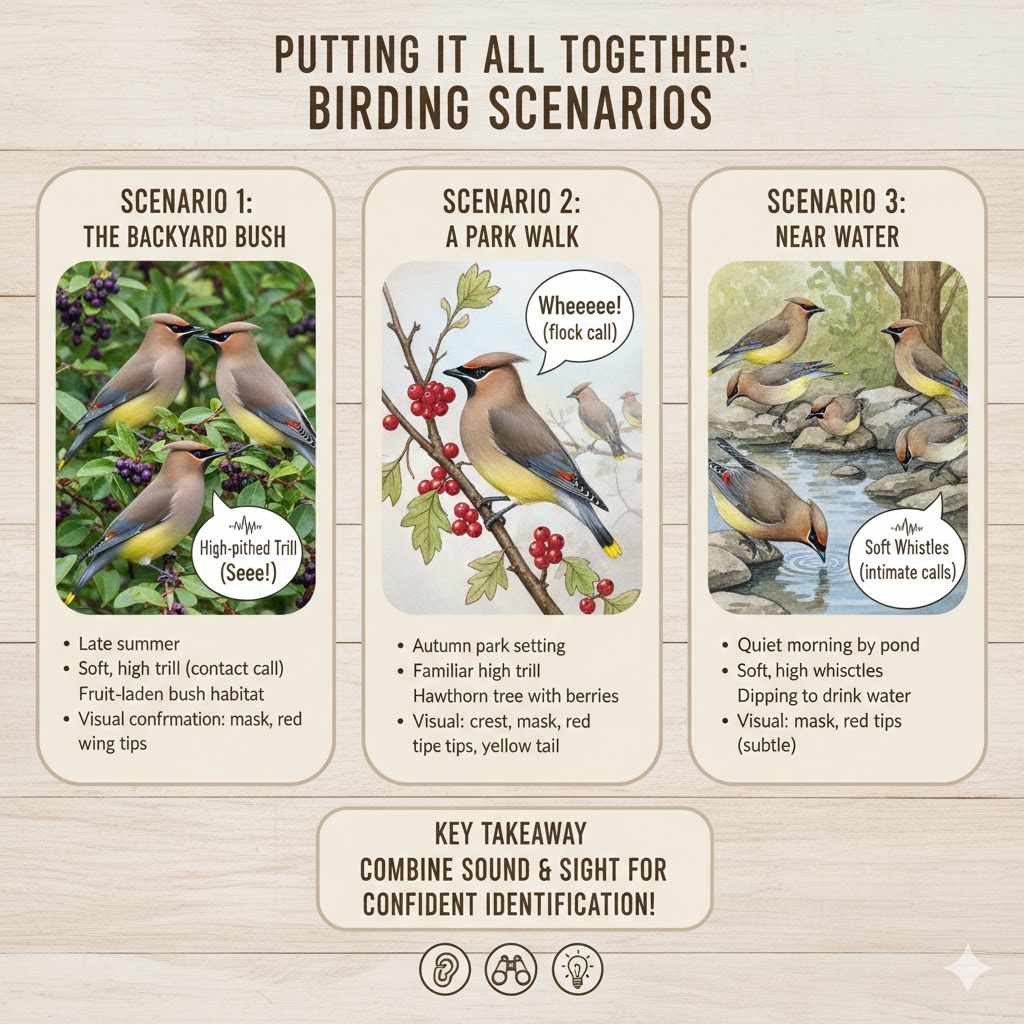
Scenario 1: The Backyard Bush
Imagine you’re in your backyard on a late summer afternoon. You hear a soft, high-pitched trill coming from the large serviceberry bush near your fence. It’s not a loud, complex song, but a continuous, thin “seeee.” You walk closer, and through the leaves, you spot several sleek, brown birds.
You notice a distinct black mask across their eyes and as one bird turns, you see the characteristic red tips on its wings. They are busily plucking berries from the bush. This combination of the distinctive sound, the fruit-laden bush habitat, and the visual confirmation of their masked faces and red wing tips leaves no doubt that you are observing a flock of Cedar Waxwings.
The soft trills are their contact calls, keeping the flock together as they feed.
Scenario 2: A Park Walk
While walking through a local park in autumn, you hear that familiar high “wheeeeee” sound. It seems to be coming from the upper branches of a hawthorn tree, which is covered in bright red berries. You look up, and there, perched on a bare branch, is a bird with a prominent crest and a smooth, grayish-brown body.
As you watch, a few more birds join it, all making the same soft trilling sounds. You can clearly see the black mask and the waxy red tips on their wings. The yellow band on the tail of one bird is also visible as it moves.
This visual evidence, coupled with the sound and the context of the berry-laden tree, confirms it’s a flock of Cedar Waxwings. Their calls are active as they communicate about the food source and the presence of each other.
Scenario 3: Near Water
You’re enjoying a quiet morning by a small pond. Suddenly, you hear a series of soft, high whistles, almost like a child’s toy. You scan the area and notice a small group of birds near the water’s edge, dipping down to drink from the shallow water.
They are medium-sized with smooth, elegant plumage.
As they fly up to a nearby tree, you can see the dark mask and the subtle red tips on their wings. While the whistles are softer than the typical trill, their behavior near water, combined with their appearance and the general pitch of their calls, strongly suggests Cedar Waxwings. This scenario highlights how their calls can vary slightly depending on the situation and proximity.
Frequently Asked Questions
Question: Are Cedar Waxwing sounds hard to hear?
Answer: Cedar Waxwing sounds are generally high-pitched and not very loud, which can make them challenging to hear, especially in noisy environments or from a distance. They are often described as soft trills or whistles.
Question: What is the most common Cedar Waxwing call?
Answer: The most common call is a high-pitched, thin trill, often described as “seeee” or “wheeeeee.” This call is used to keep flock members in contact.
Question: Can Cedar Waxwing calls sound like insects?
Answer: Yes, their high-pitched, sustained trills can sometimes be mistaken for insect sounds or the whistling of wind due to their thin, pure tone.
Question: Do Cedar Waxwings sing complex songs?
Answer: No, Cedar Waxwings do not sing complex songs. Their vocalizations are simple and consist mainly of high-pitched trills and soft whistles, used primarily for communication within the flock.
Question: How do their calls help with identification?
Answer: Their distinctively high, thin, and sustained trill, combined with their flocking behavior and habitat (often near fruit sources), makes their calls a valuable tool for identification, especially when visual cues are limited.
Summary
Learning Cedar Waxwing Sounds Calls & Identification is achievable by focusing on their characteristic high, thin trills and soft whistles. Combining these sounds with their sleek appearance, black mask, red wing tips, and flocking behavior in berry-rich areas provides clear identification. Listen for those simple, sustained notes.
You’ll soon be recognizing these beautiful birds by their unique voices.